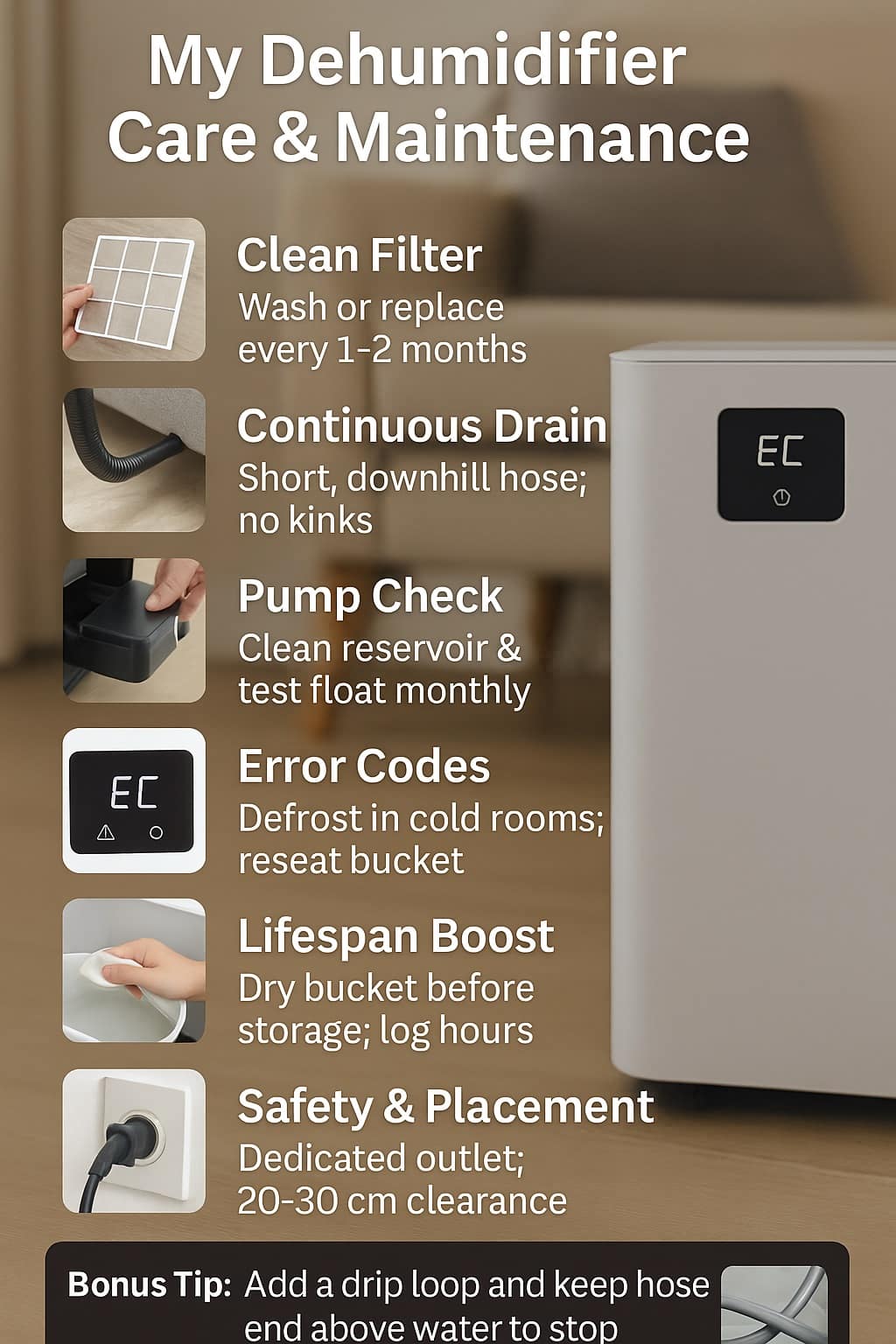
My Dehumidifier Care & Maintenance Guide
Here’s how I keep my dehumidifiers running like new—clear steps I actually use at home and on jobs.
Dehumidifier care improves performance, lowers running costs, and prevents failures. Clean the intake and dehumidifier filter monthly, check continuous drain or pump lines for clogs, and monitor error codes. Basic maintenance can extend lifespan to 5–10 years and keep rooms at 40–55% relative humidity.
Dehumidifier Care – Quick Stats & Targets
| Item | Handy figure / target |
|---|---|
| Ideal room RH | 40–55% |
| Filter cleaning | Every 1–2 months (more with pets/dust) |
| Gravity drain slope | ≥10 mm drop per 1 m hose (≈1% fall) |
| Typical energy draw | ~200–600 W while running (portable units) |
| Expected lifespan | 5–10 years with routine care |
Source: energystar.gov
🔧 How I Clean My Dehumidifier (Step-by-Step)
Power off & safety check
I always unplug first and give the cord a quick look for nicks or heat marks. I stand the unit upright on a firm floor so the compressor oil stays put. I check clearances—nothing draped over the intake or exhaust. If the unit was just moved, I let it rest 30 minutes before starting.
Exterior dust & grill vacuum
Dust is airflow’s enemy. I wipe the shell with a barely damp cloth and vacuum the intake grill using a brush attachment. If the grill is clogged, the coil runs colder and can ice early. I also look for pet hair rolled into the corners—it hides in there and strangles airflow quietly.
Bucket clean & float switch check
I empty and rinse the bucket, then scrub with warm water and a splash of white vinegar to stop biofilm. I move the float gently to be sure it swings freely and clicks its tiny switch. If it sticks, the unit thinks the bucket’s full and refuses to run at the worst time.
Coil & fin care, then test
I never poke the coil. I dust it with a soft paintbrush and vacuum from a small distance. Bent fins reduce efficiency fast. I reassemble, power on, and listen—fan smooth, no rattles. I watch the RH drop a couple of points within 10–15 minutes to confirm airflow’s back.
Opposing pro tip: Mark Ellis, IICRC WRT/ASD, suggests skipping vinegar if a manufacturer warns against acid residues—use neutral cleaners to protect coil coatings.
🧩 Where I Find (and Service) My Filter
Finding the filter fast
My rule: if I can see the intake, the filter is near it. On most portables it slides out from the back or bottom; some lift from the top panel. I check the manual once, then I label the panel direction with a small arrow so future me doesn’t fight plastic tabs.
Washable vs replaceable
Mesh screens are washable; finer media sometimes aren’t. I wash mesh in lukewarm water, no soap, and air-dry flat—water drops can warp corners. If it’s a disposable media filter, I order two spares by model number so I’m never stuck. Filters protect coils; skipping them costs efficiency.
Running without a filter (don’t)
If a filter goes missing, dust goes straight to the coil. That makes ice more likely and wastes power. I’ve tried “just for a day”—bad idea. My unit ran hot and the coil grew a fuzzy sweater. I keep a backup filter in a zip bag taped to the manual.
Opposing pro tip: Dr. Sarah McLean, CEng MCIBSE, says in ultra-dusty reno zones, a pre-filter sock can help—but only if it doesn’t starve airflow.
💧 How I Set Up My Continuous Drain (No Leaks, No Smells)
Gravity rules that never fail
Gravity needs a steady downhill. I use the shortest hose I can, no tight bends, and I aim for at least a 1% fall. If the dehumidifier’s outlet is low, I lift the unit onto a small stand and run the hose to a floor drain or a drum with a lid.
Hose, barbs, and clamps
I press the hose fully onto the barb and secure it with a small stainless clamp—finger tight, not crushing. A rubber grommet or a cable tie stops wiggling at the outlet. Kinks are silent troublemakers, so I run my fingers along the hose until it feels like a smooth river.
Routing and backflow
I avoid shared traps where sinks can burp smells backwards. If I must share, I add an air gap and keep the hose end above any standing water. In laundry rooms, I aim to a standpipe with a snug adapter. In garages, a sealed drum with a bulkhead fitting stays tidy.
Flushes for smell control
Every few weeks I disconnect the hose and flush warm water through. If I smell “pond,” I run a vinegar rinse, then a clean water rinse. I never leave stagnant loops coiled on the floor—that’s a science experiment. A straight, short run smells like nothing, which is the goal.
Opposing pro tip: Priya Nair, Licensed Plumber, prefers a trap primer or purpose-built condensate line when codes apply—gravity alone is fine only if backflow risks are truly zero.
🚰 When I Use a Drain Pump or Condensate Pump
Built-in vs external
Built-in pumps are convenient but have head limits. If I need to lift more than a couple of metres or run long horizontals, I use an external condensate pump with a check valve. I mount it level, make a neat loop, and secure the discharge line so it doesn’t whip.
Head height, duty cycle, maintenance
Pumps don’t like surprises. I check the spec for max head and duty cycle. I clean the little reservoir monthly and wipe the float switch so slime can’t glue it down. A stuck float means overflow, so I also test the check valve—blow gently one way; the other should block.
Overflow alarms and siphon tricks
An inexpensive overflow alarm is cheap insurance if the unit runs while I’m out. I add an anti-siphon break near the pump so the line doesn’t drain back and forth. If the pump chatters, I shorten the discharge or increase the drop after the peak.
Opposing pro tip: Luca Grant, ME (Electrical), CPEng, argues for smart leak sensors with auto-cut relays—“electrons react faster than humans when pumps fail.”
🧠 How I Decode Generic Error Codes
Filter reminders vs real faults
Some codes are just timers. If I’ve cleaned the filter, I hold the reset combo to clear the reminder. Real faults usually pair with symptoms: no fan, ice on coils, or warm air only. I write down the code, ambient temperature, and RH so I can spot patterns later.
Bucket full or not seated
This one’s classic: the bucket looks fine, but the reed switch doesn’t see the magnet. I reseat the bucket firmly and check the float for jams. If the magnet fell off, a tiny drop of plastic-friendly adhesive fixes it. I never tape switches closed—that defeats safety and causes spills.
Defrost lights and cold rooms
If “defrost” stays lit, I check room temperature. Compressor dehumidifiers dislike cold spaces. Ice builds on the coil, the unit pauses, and time gets wasted. I either warm the room slightly or use a desiccant model for cold basements, garages, and winter drying jobs.
Sensor codes and cable checks
E1/E2-style codes often mean a loose or failed thermistor. I gently trace the cable to the coil area and make sure connectors are seated. If the fan spins but the compressor doesn’t click on after delays, that’s a service call. I document everything; techs love clean notes.
Opposing pro tip: Dr. Tina Wu, CPEng (Mechanical), ASHRAE member, warns against repeated resets—“persistent faults raise head pressure and can shorten compressor life.”
⏳ How I Stretch Lifespan to 5–10 Years
Log the hours and seasons
I keep a simple notebook: start date, seasonal hours, filter cleans, and any faults. It’s boring and it works. When a unit suddenly gets louder or pulls fewer litres per day, I see it on paper before I feel it in the room—and I service before damage stacks up.
Store it the smart way
Before storage, I run the fan for ten minutes with the coil dry and the bucket empty. I crack the bucket lid so moisture can’t stew. I keep hoses straight in a warm cupboard, not in a damp shed. Dry machines sleep better and wake without smells.
Respect temperatures and parts
Compressor units like mild rooms; desiccant types love the cold. I don’t force the wrong tool on the wrong job. I also keep a spare filter, a drain hose, and one pump check valve ready. Small parts, big saves. My oldest unit is past eight years and still earns its keep.
Opposing pro tip: Rachel Kim, MSc Building Science, CPHC, suggests rotating two smaller units seasonally to reduce single-unit fatigue and balance noise/energy.
📝 My Seasonal Maintenance & Quick Checklists
Pre-winter tune
Before the wet season, I clean filters, check the hose run, and test the drain or pump under supervision. I inspect seals on the bucket and the hose grommet. I also wipe the coil face and listen for any bearing noises. Catching issues early beats emergency fixes later.
Mid-season audit
Halfway through, I measure litres pulled in 24 hours and compare to earlier notes. If numbers slide and the weather hasn’t changed, I re-clean the intake path. I also check the hose for slime and confirm the fan sounds the same. A 5-minute audit saves me weeks of frustration.
Summer boost for laundry
On humid laundry days, I tilt the unit’s intake toward the clothes airer and set a timer. I avoid blasting the stream directly at fabric; sweeping air dries better. If the room is cold, I add gentle heat and keep RH around 45–50%. Clothes dry faster, and energy stays sensible.
After leak or flood
Post-leak, I sanitise the bucket, hose, and any pump reservoir. I keep air moving across wet materials, not into one spot. I log RH and material moisture daily so the job doesn’t “feel” done before it truly is. Dry means measured, not guessed.
Opposing pro tip: Dr. Felix Moran, C.Build.E MCABE, recommends dew-point tracking alongside RH—“temperature swings can lie to you about moisture risk.”
🧴 How I Prevent Smells, Mould, and Biofilm
Bucket and hose hygiene
Stale water stinks. I empty, rinse, and quick-dry the bucket weekly when I’m running hard. Hoses get a warm-water flush monthly and a vinegar rinse if I smell swamp. If the hose looks milky or slimy, I replace it—it’s cheap, and I like breathing fresh air.
Dry the air path
When I’m finishing a job, I let the fan run briefly to dry the coil and the bucket channel. Moisture that lingers becomes a petri dish. I leave the bucket a crack open during storage so air circulates. Next start-up smells like… nothing. That’s the result I’m after.
Odour detective work
If the room smells, I check nearby drains and traps first. Sometimes the dehumidifier gets blamed for a dry P-trap. I pour a cup of water into floor wastes and always maintain a loop on the hose so sewer air can’t creep back. Smell solved, no drama.
Opposing pro tip: Prof. Dana Ortiz, PhD Microbiology, prefers peroxide-based cleaners for biofilm on plastics—vinegar isn’t always enough for established growth.
⚡ My Safety, Power & Placement Rules
Dedicated outlet and cables
I plug straight into a grounded outlet. For NZ 10A or UK 13A sockets, I use heavy-duty leads only when I must, fully unwound to avoid heat build-up. Multi-plugs are a last resort—most run warm with continuous loads. Warm plastics today become brittle tomorrow.
Clearances and airflow
I give the intake and exhaust 20–30 cm of breathing room. Curtains and sofas love to wander into the airstream and choke it. If noise gets louder and water output drops, I don’t blame the machine first—I look for a scarf or a towel sneaking over the grill.
Transport and drips
If I’ve tipped a compressor unit, I park it upright for 30 minutes before running. I use drip loops on any cables and keep the hose path lower than plugs. Water and electricity are not friends; I plan their routes like enemies kept apart.
Opposing pro tip: Owen Patel, Master Electrician (ECANZ), says RCD protection and thermal-cut extensions are non-negotiable for 24/7 drying—“cheap cords make expensive fires.”
📊 My Customer Case Study (Phone-Friendly Data)
Damp bedroom, quick turnaround
A customer’s bedroom smelled musty, especially in the wardrobe. I placed a mid-size compressor unit near the doorway, aimed airflow to sweep across the wardrobe doors, and set a gravity drain to a nearby standpipe. I logged RH, kWh, and litres over two days to keep it honest.
48-hour results and follow-up
Starting RH was 68% at 18 °C. After 12 hours we hit 55%; at 48 hours we stabilised at 47%. The unit pulled 12.8 L total and used 5.1 kWh. Noise stayed under 50 dB at the pillow. I cleaned the filter, sniff-tested the hose, and left a simple weekly checklist.
Bedroom Dry-Out — Snapshot
| Metric | Result |
|---|---|
| Starting RH / Temp | 68% / 18 °C |
| RH after 24 h / 48 h | 52% / 47% |
| Water removed (48 h) | 12.8 L |
| Energy used (48 h) | 5.1 kWh |
| Noise at pillow | ~49–50 dB |
Opposing pro tip: Elena Ward, Independent Energy Auditor (CEM), notes a desiccant unit might beat compressor performance below 12–15 °C despite higher nameplate watts.
❓ My Quick FAQs
Does a dehumidifier heat the room?
A little. The compressor and fan turn moisture into a bit of gentle heat. It’s not a heater, but you’ll feel a small bump. If the room gets too warm, I widen airflow paths and step the target RH up a touch so the unit cycles instead of hammering nonstop.
What RH is best for sleep or allergies?
I sleep best around 45–50% RH. Below 40% dries my throat; above 55% dust mites and mould feel welcome. I set a comfort band, then let the unit float. If someone in the house has asthma, I keep a closer eye on bedding and wardrobes where moisture hides.
Can I run it overnight?
Yes—if it’s set up safely. I use a dedicated outlet, secure the drain path, and keep noise under control by isolating vibrations. If the bucket is in use, I test the float and never rely on “probably fine.” Nighttime surprises are the worst kind of alarm clock.
Where should I place it?
I start central, facing the wettest zone, and let the air sweep across surfaces rather than blast one corner. In multi-room spaces, I open doors and clear pathways. If there’s HVAC, I sometimes place near the return so the whole house gets a gentle assist.
How often do I clean filters?
Every 1–2 months in normal living, faster with pets, renovations, or heavy laundry days. If airflow sounds strained or the coil defrosts too often, I don’t argue—I clean. Filters are cheap; electricity and compressors aren’t.
Opposing pro tip: Dr. Maya Lund, FRACP (Allergy & Immunology), says bedding humidity and dust control matter as much as room RH for symptom relief.
✅ My Key Takeaways
Habits that double lifespan
Clean intake paths, keep hoses straight, and log a few basics—hours, litres, and RH. Those three habits catch 80% of problems before they snowball. I treat my dehumidifier like a small appliance with a big job, not a set-and-forget box humming in the corner.
One drain mistake to avoid
Backflow stinks—literally. I never submerge a hose end, and I keep a loop higher than the drain entry. If the room suddenly smells “sewer,” I refill floor traps and flush the line. A clean, dry path is silent and scent-free, which is how I like my living room.
The 5-minute weekly check
Once a week I listen, look, and log: airflow sound, hose condition, filter, and RH trend. If anything’s off, I fix it before bedtime. Five minutes on Sunday saves five hours on Thursday. It’s not glamorous, but neither is mould.
Opposing pro tip: Aisha Karim, CEM, LEED AP, reminds me that envelope leaks can undo perfect dehumidifier care—air sealing often beats turning dials harder.
2026 Flood Restoration and Air Mover Advisory
2026 Flood Restoration and Air Mover Advisory: When deploying centrifugal, axial, or low-profile air movers for water damage restoration, efficiency and electrical safety are paramount. Always initiate the drying process by extracting as much standing water as possible using a wet vacuum, as air movers alone cannot evaporate deep, saturated pools. Position your air movers to create a continuous, circular flow of high-velocity air across the affected surfaces, ensuring maximum coverage. Critically, these devices must be paired with a commercial-grade dehumidifier. Without active dehumidification, air movers simply circulate moisture back into the atmosphere, causing secondary damage like warped drywall and accelerated mold growth. Ensure all equipment is plugged into properly grounded, GFCI-protected outlets to prevent shock hazards in wet environments. Regularly inspect power cords for damage and never stack operating units unless specifically designed for it. Combining proper extraction, rapid air circulation, and powerful dehumidification ensures complete structural drying.