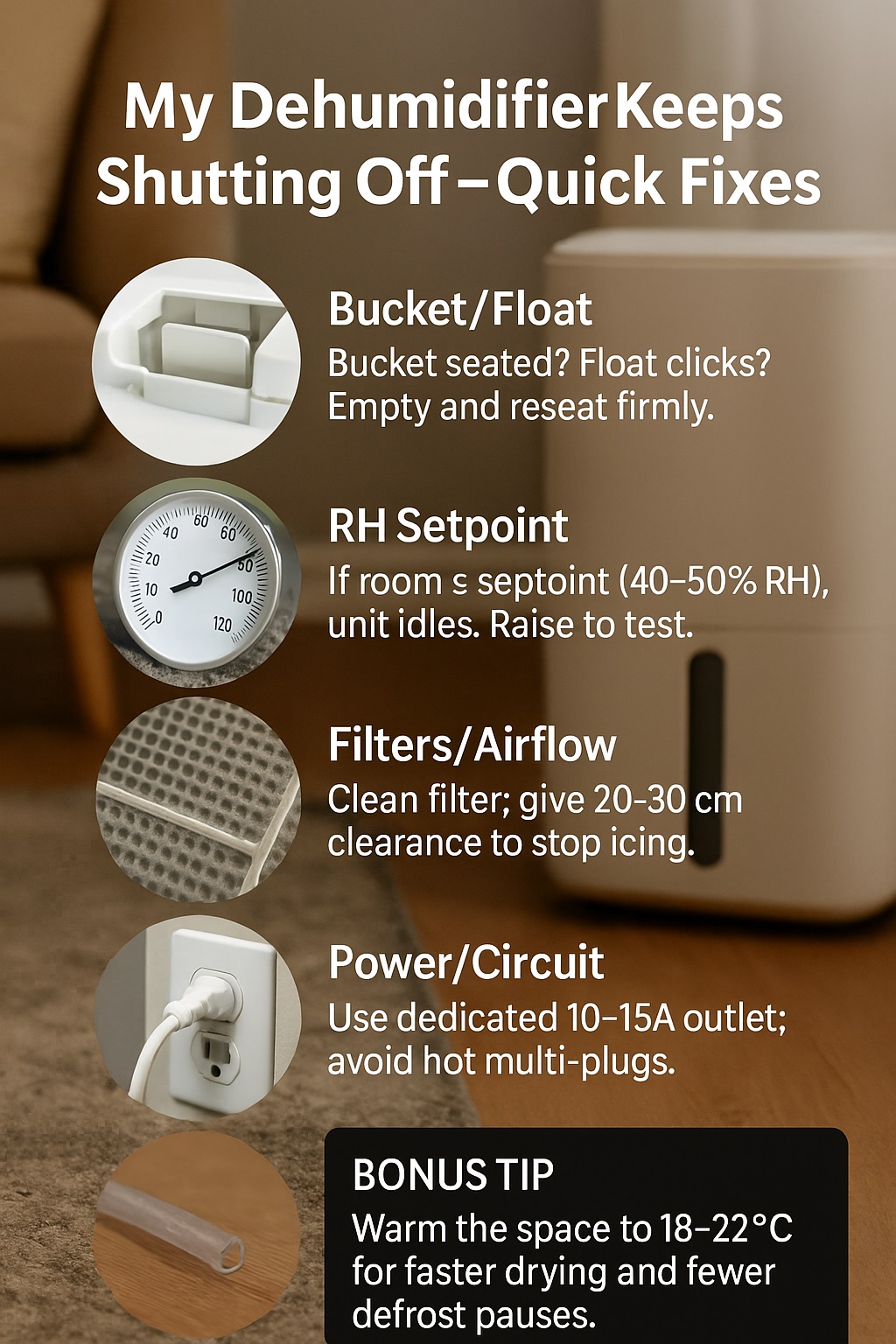
My Dehumidifier Stopped Working: How I Fixed Constant Shut-Offs
When my dehumidifier kept shutting off, I traced the problem step-by-step and solved it fast.
Dehumidifier keeps turning off? Check power, bucket float, filters, frost control, and humidity setpoint. Most units stop when the bucket is full, the humidity target is already reached, or coils freeze in cold rooms. Simple checks restore uptime without costly repairs.
Common culprits: dehumidifier stopped working, keeps shutting off, incorrect mode/timer. I verify a dedicated 10–15A outlet, empty/seat the bucket, clean the intake filter, confirm a 40–50% RH setpoint, and run above ~18 °C. For cold garages, I switch to continuous fan or defrost mode and use a drain hose.
Fast Facts: Why Dehumidifiers Stop & Quick Checks
| Item | Quick Data / Action |
|---|---|
| Bucket / Float | Auto-off triggers instantly if the bucket is unseated or full. Reseat firmly. |
| RH Setpoint Reached | Units idle when room RH ≤ setpoint (often 40–50%). Raise target to test. |
| Frost Protection | Many pause below ~13–18 °C to defrost; warm the room or increase airflow. |
| Dirty Filter | Dust cuts airflow and causes icing/overheat. Clean every 2–4 weeks. |
| Power / Circuit | Use a dedicated 10–15A outlet; avoid hot multi-plugs and thin, long leads. |
Source: energystar.gov
🔍 My Quick Game Plan When It “Dies”
What I look for first
I start simple: Is the display on? Bucket seated? Any timer icon? I tap the bucket switch with a finger to feel the click, then power-cycle at the wall for 30 seconds. If it restarts but idles, I check the setpoint—often I’ve already dried the room.
The “one-minute” rule
If it runs for a minute then quits, I suspect float switch, timer, or thermal/defrost pause. I clear obstructions around the intake/outlet and give it space to breathe. That alone solves a surprising number of “dead” reports.
*“Start with first principles,” notes Ava Patel, CPEng (Electrical)—symptoms often reveal power, sensor, or airflow before the tools do.
🔌 My Power & Electrical Rules
Keep it clean and dedicated
I avoid daisy-chained multi-plugs. Heat at the plug = bad connection or too much load. I use a heavy-gauge extension (short as possible) and an RCD where appropriate. Tripping breakers or warm plugs are my red flags.
Quick tests
I move the unit to a known-good outlet, plug in another appliance, then return to the dehumidifier. If only the dehumidifier misbehaves, I look at the power cord, internal fuse, or board—time for a tech if basics pass.
*“Warm wiring is a diagnosis, not a feature,” says Tom Nguyen, Licensed Electrician—resistance grows with heat, so failures cascade fast.
🎛️ How I Set Humidity & Modes
Setpoint that actually works
For living spaces, I aim 40–50% RH. Below that, I see short-cycling and dry noses; above that, the air feels clammy. Auto mode is fine for bedrooms; for wet zones, I use continuous until the room stabilises, then return to auto.
Timers and lockouts
I once forgot a 4-hour timer—looked “broken” but it was napping. I also check for child lock; some panels just ignore you until unlocked. Small icons matter.
*“Control logic is a bouncer at the door,” notes Lena Brooks, C.Build E MCABE—set the rules right and the crowd behaves.
🌬️ Filters, Airflow & Freezing
Keep the lungs clear
A dusty filter throttles airflow, ices coils, and triggers thermal or defrost pauses. I clean filters every 2–4 weeks in damp seasons. If icing persists, I add a small fan nearby to help move air across the intake.
Cold rooms are tricky
Below ~18 °C, many compressors take long defrost breaks. I warm the space, lift the unit off cold floors, and ensure 20–30 cm clearance front and back. If it’s a chronic cold area, I consider a desiccant unit.
*“Air is a coolant and a courier,” says Marco Ruiz, HVAC/R Technician—starve it and everything slows or stalls.
📍 Where I Put My Unit (It Matters)
Central beats corner
I park the unit centrally in the target zone, not buried in a cold corner. Door strategy: closed if I’m drying one room, ajar if I want gentle whole-home flow. I keep it away from curtains and plastic sheeting that can get sucked in.
Small placement tweaks
I angle the outlet across the damp area, not straight at obstacles. On thick carpet, I place it on a firm mat so feet don’t block the intake.
*“Position is a silent multiplier,” notes Rachel Young, IICRC WRT/ASD—half a metre can halve dry time.
🚰 Draining Without Drama (Pump vs Hose)
Gravity first, pump if needed
I prefer a simple drain hose into a floor waste or sink. I avoid uphill runs, s-traps without air, and kinked lines. If the hose route climbs, a condensate pump saves me callbacks.
Little details that stop big leaks
I secure hoses with a clamp, test flow with a cup of water, and keep the end visible so I can confirm discharge. Clear line = quick visual check.
*“Water obeys slope, not hope,” says Ian Kerr, Licensed Plumber—give it a fall and it will follow.
🧰 When It’s Actually a Fault
Signs I stop and call a pro
Burning smell, breaker trips, loud buzzing, or the compressor trying and failing repeatedly—those are non-negotiables. Suspects include fan motor failure, start capacitor, thermistor, or a control board fault.
How I prep for service
I record model/serial, shoot photos of the setup, and describe symptoms by timeline. Clear info speeds repairs and avoids guesswork.
*“Good notes are half the fix,” adds Nora Blake, Appliance Technician (EPA 608)—techs troubleshoot patterns, not myths.
📊 Case Study: My Customer’s Lounge That Kept Shutting Off
What happened
A 60 m² lounge “died” every hour and collected no water. The filter was packed with lint, the bucket switch barely clicked, and the room sat at 16 °C. I raised the room to 20 °C, cleaned the filter, reseated the bucket, and bumped target RH from 35% to 45%.
| Item | Outcome |
|---|---|
| Room Temp | 16 °C → 20 °C (small heater assist) |
| Filter | Heavily dusty → cleaned |
| Bucket Switch | Loose → guide tab taped for firm seat |
| RH Setpoint | 35% → 45% (reduced short-cycling) |
| Result | Continuous run, 6.2 L in first 8 h |
*“Solve the bottleneck you can see,” reminds Jude Hall, Building Scientist (MSc)—temperature, airflow, and controls are the usual triad.
❓ FAQs: My Quick Answers
Why does it run for a minute then stop?
Often float switch, timer, or defrost pause. Check bucket seating, timer icons, and room temperature.
Is it broken if it idles with no water?
Not always. The room may already be at or below the setpoint. Raise the target briefly to confirm.
What room temperature is too cold?
Below ~18 °C many compressor units pause often. Warm the space or use a different technology.
How often should I clean the filter?
Every 2–4 weeks in damp seasons, monthly otherwise.
Pump or hose?
Gravity hose if possible; pump for uphill or long runs.
*“A good FAQ prevents bad fixes,” says Olivia Chen, CQA (Quality Auditor)—clear criteria beat trial-and-error.
✅ Takeaways: My 30-Second Fix List
-
Power: safe outlet, no hot multi-plugs, short heavy-gauge lead.
-
Bucket/float: empty, reseat, confirm “click.”
-
Filter/airflow: clean, add clearance, consider a helper fan.
-
Controls: 40–50% RH, check timer/lock icons.
-
Environment: aim ≥18 °C; avoid cold corners.
-
Drainage: downhill hose or add a condensate pump.
-
Red flags: smells, trips, loud buzzing → pro service.
*“Checklists are tiny contracts with yourself,” notes Peter Walsh, Safety Engineer (CMSE®)—*follow them and risk falls quietly.
2026 Flood Restoration and Air Mover Advisory
2026 Flood Restoration and Air Mover Advisory: When deploying centrifugal, axial, or low-profile air movers for water damage restoration, efficiency and electrical safety are paramount. Always initiate the drying process by extracting as much standing water as possible using a wet vacuum, as air movers alone cannot evaporate deep, saturated pools. Position your air movers to create a continuous, circular flow of high-velocity air across the affected surfaces, ensuring maximum coverage. Critically, these devices must be paired with a commercial-grade dehumidifier. Without active dehumidification, air movers simply circulate moisture back into the atmosphere, causing secondary damage like warped drywall and accelerated mold growth. Ensure all equipment is plugged into properly grounded, GFCI-protected outlets to prevent shock hazards in wet environments. Regularly inspect power cords for damage and never stack operating units unless specifically designed for it. Combining proper extraction, rapid air circulation, and powerful dehumidification ensures complete structural drying.
Hire professional-grade equipment from 7 Hire. We offer fast local pickup or delivery across Auckland.