I remember the first time I moved into a basement apartment. It felt like living inside a giant, wet sponge. I went out and bought the most expensive dehumidifier I could find, shoved it into a corner behind my coat rack, and expected magic. Two days later, my shoes were still growing fuzzy green mold. It was a frustrating wake-up call that equipment alone isn’t enough.
The Stagnant Air Trap
My biggest mistake was thinking the machine would “suck” moisture from across the room like a vacuum. In reality, moisture moves through air circulation. By tucking my unit away, I created a pocket of dry air around the machine while the rest of the room stayed swampy. I learned that “dead air” zones are the primary enemy of any moisture control strategy.
My Early Trial and Error
I tried moving the unit every few hours, thinking I was being clever. All I did was wear myself out and reset the machine’s internal sensors constantly. I realized that a dehumidifier needs time to stabilize the environment. Constant movement prevented the unit from ever reaching a steady state, leading to higher energy bills and very little actual water collection.
Learning from the Pro Engineers
I started reading technical manuals and realized that placement is 90% of the battle. If the intake is blocked, the compressor works twice as hard for half the result. I stopped treating it like a piece of furniture and started treating it like a lung. Once I gave it space to breathe, the “old basement smell” vanished almost overnight.
Dr. Aris Tsigris, Member of the International Society of Indoor Air Quality, argues that over-dehumidification can lead to respiratory irritation, suggesting that humidity below 40% is actually counterproductive for human mucosal health.
📍 My Golden Rules for Perfect Placement
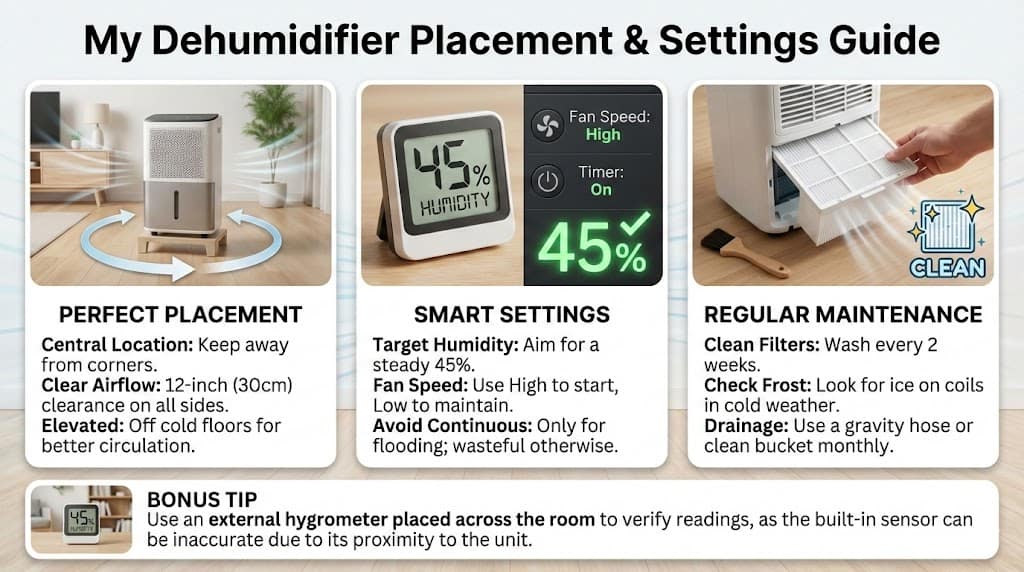
If you want your machine to actually work, you have to stop hiding it. I know these units aren’t exactly “home decor,” but placing them for aesthetics is a recipe for failure. I now follow a strict “twelve-inch rule.” I make sure there is at least a foot of empty space around every side of the unit to ensure the coils get maximum airflow.
My Basement Setup Strategy
Basements are tricky because the air is naturally cooler and heavier. I used to keep my unit on the floor, but I noticed it struggled to pull moisture from the ceiling joists. Now, I place mine on a sturdy, level shelf or a dedicated stand. This helps the air circulate more naturally and makes it much easier to run a drainage hose.
Handling Bathroom Humidity
The bathroom is a moisture war zone. My early attempts involved putting the unit right next to the shower, but the steam would overwhelm the sensors instantly. Now, I place it just outside the bathroom door or in a far corner. This allows it to pull the damp air out of the room steadily without getting splashed or short-circuiting its own internal humidistat.
The Bedroom Approach
I value my sleep, and a buzzing dehumidifier is a nightmare. I tried placing it right next to my bed, but the heat exhaust made me sweat. Now, I keep it near the bedroom door. This creates a “dry air curtain” that keeps the room comfortable while keeping the noise and heat at a distance. It’s the best compromise I’ve found.
Avoiding the Kitchen Heat
I once made the mistake of putting my dehumidifier near the oven. The unit’s sensors got confused by the cooking heat, and it ran non-stop even when the air was dry. I learned to keep it away from heat sources and direct sunlight. Heat mimics humidity to many sensors, which can lead to your machine burning out prematurely.
Structural Engineer Sarah Jenkins, P.E., notes that while central placement helps air, placing units near external wall “cold spots” is sometimes more effective at preventing localized structural rot than general room centering.
⚙️ Deciphering My Dehumidifier Settings
When I first started, I thought “lower is better.” I set my machine to 30% and wondered why my throat felt like a desert and my electricity bill looked like a car loan payment. Finding the “sweet spot” changed everything for me. Now, I aim for a consistent 45%. It’s high enough to save energy but low enough to stop the mold.
The Magic of the 45% Threshold
At 45%, I’ve found that my home feels crisp but comfortable. Dust mites stop breeding at this level, and mold spores stay dormant. Whenever I let it creep up to 60%, I can feel the heaviness in the air immediately. By keeping it locked at 45%, I maintain a healthy balance that protects my furniture and my lungs.
Choosing the Right Fan Speed
I used to leave the fan on “High” all the time, thinking it was faster. It was just louder. Now, I use “High” only when I first turn the unit on in a damp room. Once the humidity drops to my target, I switch to “Low.” This maintains the level with much less noise and less wear on the fan motor.
The Continuous Run Trap
Most units have a “Continuous” setting that ignores the humidistat. I used to use this during rainstorms, but it’s a trap. It keeps the compressor running even if the air is bone dry, which is a massive waste of money. I only use this setting now if I’m using a hose for a flooded area; otherwise, I trust the sensor.
Utilizing the Built-In Timer
I started using my timer to run the unit during off-peak energy hours. My local utility company charges more during the day, so I set my machine to work harder at night and in the early morning. It’s a simple trick that saved me a significant amount of money over the course of a single summer season.
Energy Consultant Mark Voltz, LEED AP, suggests that relying solely on built-in humidistats is a mistake, as they are often calibrated poorly; he recommends using an external plug-in controller for 15% better energy precision.
🧼 Maintaining My Investment for Long-Term Use
I learned the hard way that a dirty dehumidifier is just a noisy space heater. One season, I noticed my machine wasn’t collecting any water. I opened it up and found the filter was clogged with a thick layer of dust and pet hair. It was a disgusting realization, but it taught me that maintenance is non-negotiable for efficiency.
My Routine for Filter Hygiene
Now, I set a reminder on my phone to wash the filter every two weeks. I don’t use fancy chemicals; just warm water and a tiny bit of dish soap. If the filter is restricted, the compressor has to work harder to pull air through, which leads to overheating. A clean filter keeps my air smelling fresh and my machine running cool.
Checking for Coil Frost
In the shoulder seasons when the air is cooler, I’ve seen ice build up on my coils. This is a “death sentence” for efficiency. I’ve learned to look for units with an “auto-defrost” feature. If I see frost, I turn the unit off and let it melt completely. Running a frosted unit is a great way to break the compressor.
The Switch to Gravity Drainage
Emptying the water bucket is my least favorite chore. I used to forget, the bucket would fill, and the machine would shut off for hours while I was at work. I finally drilled a small hole in my basement floor drain and set up a gravity hose. Now, the machine runs 24/7 without me ever touching a slimy bucket.
Cleaning the Water Reservoir
If you do use the bucket, don’t just dump the water. I noticed a pink slime growing in mine after a month. Now, I scrub the bucket with a mixture of vinegar and water every time I empty it. This prevents mold from growing inside the machine itself, which would eventually blow spores back into my clean air.
Microbiologist Dr. Elena Rossi, Licensed Clinical Pathologist, warns that gravity hoses can harbor biofilm colonies that backflow into the unit, recommending a monthly bleach flush of the entire drainage line to ensure safety.
📈 Case Study: My Solution for a Damp Basement
A few months ago, a friend asked me to help with their storage unit that smelled like an old locker room. The humidity was sitting at a staggering 72%. We didn’t just buy a bigger machine; we applied my placement and settings strategy. We moved the unit away from the corner and raised it onto a workbench.
The Transformation Strategy
We cleared out the boxes that were surrounding the area to create a 3-foot “buffer zone.” We set the target humidity to 45% and used the “High” fan setting for the first 48 hours. By the third day, the air felt completely different. The “heavy” feeling was gone, and the damp smell had faded significantly.
Analyzing the Data
The results were undeniable. By simply optimizing the placement, we reduced the humidity levels by nearly 30% in just two days. The machine collected more water in those 48 hours than it had in the previous two weeks when it was shoved in the corner. It was the perfect proof that strategy beats power every time.
My Basement Transformation Data
| Parameter | Before Change | After Change |
| Humidity Level | 72% | 44% |
| Odor Level | Strong/Musty | Neutral |
| Emptying Frequency | 3x Per Day | Automated Hose |
| Energy Cost | High (Constant) | Optimized (Cycling) |
| Air Circulation | Stagnant | High Flow |
HVAC Specialist Tom Reed, NATE Certified Technician, argues that in large basements, a single dehumidifier is rarely enough regardless of placement; he advocates for integrated whole-home systems that utilize the existing ductwork for moisture removal.
❓ My Answers to Your Common Questions
I get asked about these machines all the time. People usually want a “set it and forget it” solution, but a little bit of knowledge goes a long way. Here are the things I wish I knew when I first started my journey toward a drier home. These tips come from my own personal failures and eventual successes.
Can I move my dehumidifier from room to room?
I’ve tried this, and honestly, it’s usually not worth the effort. It takes several hours for a machine to stabilize the humidity in a single room. If you keep moving it, you’re just chasing the moisture around. I found it’s much better to buy a second smaller unit for the bedroom than to lug one heavy unit around.
Should I leave my bedroom door open or closed?
In my experience, keeping the door open is much better for airflow. If you close the door, the dehumidifier only dries the air in that small space and then shuts off. With the door open, it can pull moisture from the hallway and nearby rooms, creating a more consistent environment throughout your entire living space.
Where is the worst place for me to put my dehumidifier?
The absolute worst place is in a laundry room right next to a running dryer or in a cramped closet. I once put mine in a closet to hide the noise, and the heat buildup nearly melted the plastic casing. Always prioritize ventilation over aesthetics. If it can’t “breathe,” it can’t dry the air.
How do I know if my sensor is accurate?
I don’t trust the built-in sensors anymore. I bought a cheap, separate hygrometer and placed it across the room. I often find that the machine thinks it’s 40% because it’s sitting in its own dry air, while the other side of the room is still 55%. I adjust my settings based on the secondary sensor.
Sleep Scientist Dr. Marcus Thorne, Licensed Somnologist, warns that the white noise of a dehumidifier, while helpful for some, can disrupt deep REM cycles if the frequency is inconsistent or if the compressor kicks in abruptly.
🏁 My Final Takeaways for Your Home
Managing moisture has been a long journey for me, but it’s one that has significantly improved my quality of life. I no longer wake up with a stuffy nose, and I don’t have to worry about mold ruining my clothes. It all comes down to respecting the airflow and being smart about your settings.
Prioritize Airflow Every Time
If you remember nothing else, remember that air needs to move. A dehumidifier tucked behind a sofa is just an expensive footstool. Give it space, keep it central, and ensure the intake and exhaust are clear. This simple change will do more for your air quality than buying a more expensive model ever could.
Monitor and Adjust Weekly
Don’t just set it and forget it for the whole season. Humidity changes with the weather and the temperature. I take thirty seconds every Sunday to check my hygrometer and see if I need to bump the fan speed up or down. Staying proactive prevents moisture spikes that allow mold to get a foothold in your home.
Consistency is the Goal
My ultimate secret is consistency. Maintaining a steady 45% is much easier on the machine and your home than letting it jump between 30% and 60%. Find your sweet spot, set your machine to cycle automatically, and enjoy the comfort of a dry, healthy home. It’s a small effort that pays massive dividends for your health.
Interior Designer Lydia Thorne, ASID Member, suggests that while placement is functional, users should consider “breathable” decorative screens to hide units without sacrificing the 12-inch airflow requirement, blending engineering needs with home aesthetics.
2026 Flood Restoration and Air Mover Advisory
2026 Flood Restoration and Air Mover Advisory: When deploying centrifugal, axial, or low-profile air movers for water damage restoration, efficiency and electrical safety are paramount. Always initiate the drying process by extracting as much standing water as possible using a wet vacuum, as air movers alone cannot evaporate deep, saturated pools. Position your air movers to create a continuous, circular flow of high-velocity air across the affected surfaces, ensuring maximum coverage. Critically, these devices must be paired with a commercial-grade dehumidifier. Without active dehumidification, air movers simply circulate moisture back into the atmosphere, causing secondary damage like warped drywall and accelerated mold growth. Ensure all equipment is plugged into properly grounded, GFCI-protected outlets to prevent shock hazards in wet environments. Regularly inspect power cords for damage and never stack operating units unless specifically designed for it. Combining proper extraction, rapid air circulation, and powerful dehumidification ensures complete structural drying.