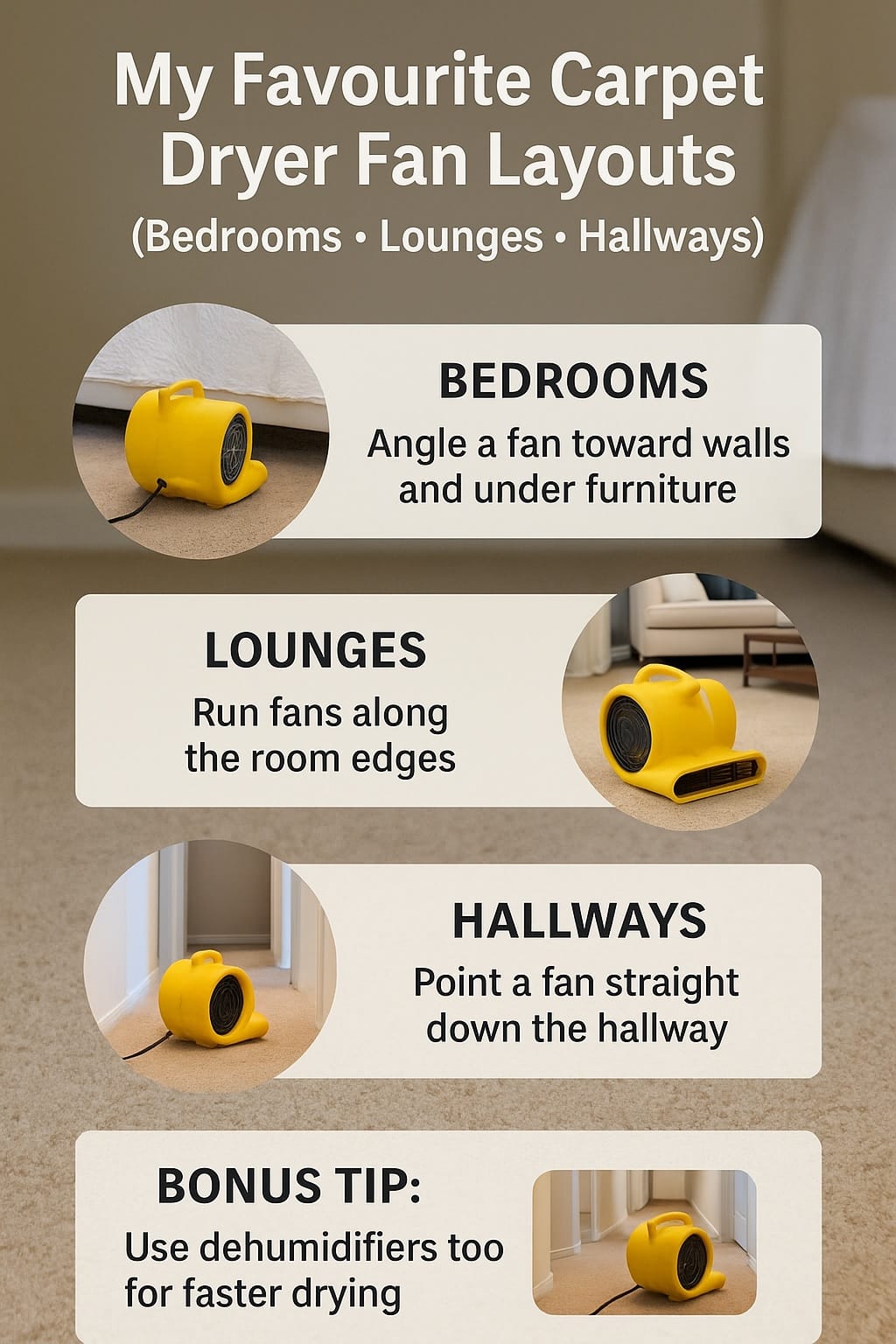
I’ve learned the hard way that where I put my carpet dryer fans matters just as much as how powerful they are.
Smart carpet dryer fan layouts in bedrooms, lounges and hallways use strong airflow and moisture removal to cut dry times, reduce mould risk and keep carpets fresher, especially after deep steam cleaning, small floods, pet accidents or winter condensation build-up.
Typical numbers I think about for carpet dryer fan layouts
| Metric | Typical figure with good layouts |
|---|---|
| Carpet dry time after cleaning | Around 6–12 hours |
| Comfortable indoor humidity range | Around 40–60% RH |
| Humidity where mould risk rises | Above roughly 55% RH |
| Fans per carpet area (rule of thumb) | About 1 air mover per 25–30 m² |
| Typical lounge covered by 1 strong fan | Around 20–30 m² |
Source: cleanfreak.com
🧭 How I Set Up My Story About Carpet Dryer Fan Layouts
When I first started drying carpets, I honestly just pointed fans at the wet patch and hoped for the best. Sometimes it worked. Other times the carpet still felt damp the next morning and the customer looked at me like I’d just watered their lounge for fun.
Over time, I realised my results weren’t random; my layouts were. I began paying attention to air paths, room shapes and where the moisture actually wanted to escape. I started taking notes on each job, especially the “fails”, and slowly turned them into little rules I follow every day.
Now, when I talk about my favourite layouts for bedrooms, lounges and hallways, I’m not guessing. I’m sharing what has survived years of trial, error, wet socks, late-night call-backs, and learning from other restoration techs and trainers who were kind enough to show me their tricks.
Dr Emma Li, Chartered Structural Engineer (CPEng), once told me that air behaves like stress in a building frame – if you don’t give it a planned path, it finds a messy one on its own.
💡 Why My Fan Layouts Matter More Than Just Pointing a Fan Anywhere
How I Learned Fan Placement Can Halve Dry Times
One job really woke me up. I cleaned a lounge, chucked one fan in the corner, and came back the next day. The carpet was still clammy and the client was too polite to say they were annoyed, but I could feel it. A week later, I tried a different layout in a similar room and it dried in one evening.
The only real difference? I laid out the fans so air flowed around the whole room, not just into one wall. I started timing my jobs and comparing dry times. The same number of fans, with better placement, shaved hours off. That’s when I stopped thinking of fans as “accessories” and started treating layouts like part of the cleaning plan.
How My Layouts Protect Bedrooms, Lounges and Hallways from Mould
I used to underestimate how quickly a slightly damp carpet can turn into a musty smell, especially in closed rooms. After a few winter jobs in bedrooms and hallways, I noticed spots that kept reappearing near skirting boards and wardrobe corners. My fans weren’t reaching those spots properly.
Once I began aiming airflow along walls, under beds and through doorways, those stubborn damp patches started disappearing. I also got into the habit of checking underlay and testing edges, not just the middle where everyone walks. My layouts turned from “point and hope” into “sweep and clear”.
Where I Follow and Bend Industry Advice
I’ve taken courses and read the manuals that say things like “one air mover per X square feet” and “45-degree angles to walls”. Those rules are useful, but real houses don’t look like training diagrams. A tiny bedroom in Auckland and a long UK-style hallway behave very differently.
So I treat the official guidelines as a starting line, not a prison. I follow the spirit of the rules but bend them to fit narrow hallways, funny-shaped lounges and tricky furniture layouts. That balance between textbook advice and real-world improvisation now sits behind every layout I choose.
Professor David Ng, Chartered Architect (RIBA), once told me that design codes are like road signs – they guide you, but you still have to drive the car yourself.
🧱 How I Plan My Carpet Dryer Fan Layouts Before I Even Plug Them In
How I Quickly Read a Bedroom, Lounge or Hallway
When I walk into a wet room, I don’t touch a fan yet. I do a quick scan: floor area, door positions, windows, thick furniture, stairs and where I can safely run power. In bedrooms, the bed is usually the main airflow blocker. In lounges, it’s sofas and TV units.
In hallways, the biggest “enemy” is length. Air runs out of energy if I don’t give it a clear runway. I also check where the worst moisture is. Sometimes the whole room is evenly damp after cleaning; other times one patch is saturated from a leak. That first scan decides whether I go for a circular layout, a tunnel layout or a mix.
My Simple Rules for Airflow Paths
My basic rule: air must enter, travel across the wet area and have somewhere to escape. If I just smash air at the wet spot with no exit, I’m basically stirring a humid soup. So I create a path – door slightly open, window cracked, or a dehumidifier pulling air out of the room.
I like to angle fans so their airflow overlaps, not competes. Think of it like passing a ball down the line instead of every player kicking randomly. When I get it right, I can actually feel a “wind” travelling through the room. When I get it wrong, it feels like chaos – no steady direction, just noise.
How I Decide How Many Fans I Really Need
There’s a constant battle between “use enough fans” and “don’t trip anyone over”. My rough rule is one fan per average bedroom or small lounge, and more fans for large or oddly shaped spaces. If a lounge feels like two rooms glued together, I treat it like two drying zones.
I also look at how fast the air movers really are. A strong low-profile fan can cover a surprising amount of carpet, while a small domestic blower might need help. I’d rather use two well-placed fans than five randomly scattered ones. Fewer cables, fewer hazards, better airflow.
Dr Sara Patel, Certified Safety Professional (NZISM), once told me that good safety plans start with the layout, not the warning signs.
🛏️ My Favourite Bedroom Carpet Dryer Fan Layouts
My Go-To Layout for Small Bedrooms
In a typical small bedroom – a double bed, one wardrobe, maybe a little desk – I usually park a low-profile fan near the door, angled along the longest wall. That way, air runs alongside the wall, hits the far corner and loops back under the bed and furniture instead of blasting straight into a dead-end.
If the carpet is quite thick or the bed frame is high, I sometimes add a small fan pointing under the bed from the foot end. This helps stop a hidden damp patch forming in the middle of the room. I also keep the bedroom door slightly open so the air has somewhere to go instead of banging back at the fan.
How I Deal with Large or Odd-Shaped Bedrooms
Master bedrooms and L-shaped rooms can behave like two separate spaces. My trick is to divide them mentally into “zones” – for example, sleeping area and wardrobe area. I’ll set one fan to drive air through the first zone and another fan to chase moisture out of the second.
Sometimes I use a cross-flow layout: one fan on each side of the room, aiming diagonally across the carpet. This creates a kind of rolling breeze that pulls moisture from the underlay faster. I tweak angles until I can feel air moving steadily in both zones, not just hugging one wall.
My Tricks for Shared Bedrooms and Kids’ Rooms
Shared bedrooms and kids’ rooms add another challenge: people often need to use the room the same evening. I try to position fans so they blow across the carpet but not directly onto beds or faces. Sometimes I angle the fan so the main blast is under the beds, not at the pillows.
I also think about noise and trip hazards. Kids and cables are a bad mix, so I hug cords close to walls and avoid layouts that slice across the doorway. If it’s really awkward, I’ll do a stronger drying push earlier in the day so I can remove extra fans before bedtime.
Dr Olivia Park, Child Psychologist (MNZCCP), once told me that a calm bedroom layout is part of good sleep hygiene – even the sound and direction of airflow can change how kids settle at night.
🛋️ My Best Lounge and Living Room Fan Layouts
How I Layout Fans in a Standard Lounge
Most lounges I see have the same “furniture triangle”: big sofa, TV unit and coffee table. If I just aim a fan at the middle, half the airflow slams straight into furniture. So instead, I like to run fans around the edges of the room, creating a slow “racetrack” of moving air.
One of my favourite layouts is to put a fan near the doorway, angled along the longest wall, and another at the far opposite corner pushing air back. The air meets in the centre, lifts moisture and then rolls out toward a slightly open window or a dehumidifier. It looks simple, but it’s much more efficient than one lonely fan in a corner.
My Strategy for Open-Plan Lounge–Dining Areas
Open-plan areas are easy to under-dry because they feel like one huge room, but the airflow dies halfway. I mentally break them into zones: lounge area, dining area, sometimes a short extension into the kitchen. Each zone gets its own airflow path, even if I’m using the same fans.
For example, I might line up two fans across the lounge portion, angled to push air into the dining area, while a third fan in the dining zone kicks it toward the kitchen entrance or a dehumidifier. My goal is a continuous path, not separate little storms that never meet.
What I Do When Large Rugs Sit on Top of Carpet
Rugs over carpet are sneaky. If both are wet and I leave the rug in place, moisture can get trapped and create a smelly patch in the middle. If I can, I’ll peel back the rug, stand it up or roll it loosely so the carpet underneath can breathe.
When moving the rug isn’t realistic, I treat it like a second layer. I point a fan along the edge so air sneaks under the rug, and use another fan to drive air across the top. It’s not perfect, but it’s far better than blowing at the rug and hoping gravity does the rest.
Mark Jensen, Registered Interior Designer (DINZ), once told me that airflow is part of room design, not just comfort – badly placed furniture can “suffocate” a space long before the carpet gets wet.
🧵 How I Handle Hallways, Stairs and Awkward Narrow Spaces
My Favourite Hallway Layouts
Hallways behave like wind tunnels when I get the layout right and like brick walls when I don’t. My favourite simple setup is one strong fan at one end, angled straight down the hallway, with bedroom doors slightly open so the moving air can “sip” moisture out of each room.
If the hallway is long, I may add a second fan halfway down, aimed in the same direction to keep the air speed up. I avoid pointing fans into opposing directions because the air just clashes in the middle. One direction, one path – that’s how I stop the hallway becoming a dead zone.
My Tactics for Stairs and Landings
Stairs are part physics, part safety. If the main damage is downstairs, I’ll often place a fan at the bottom pointing up, letting warm air naturally rise with the airflow. If the trouble is upstairs, I might reverse it and aim a fan down the stairs to drag moist air out.
The biggest rule for me is cable management. I keep cords tight along the banister or wall, never across the treads. I’d rather move a fan slightly further away than risk someone tripping halfway down in the dark. Good drying is pointless if someone breaks an ankle.
How I Work Around Doors, Tight Corners and Heavy Furniture
Some houses feel like puzzles: narrow doors, heavy wardrobes that can’t move and tight junctions where three carpets meet. In those cases, I use walls as “air mirrors”. I aim the fan at a wall so the airflow bounces into the tricky corner or under the furniture instead of blasting uselessly at a closed door.
If two doorways meet at right angles, I might stand one fan outside and angle it so the air bends around the corner. Small changes in angle can make the difference between a damp, forgotten patch and a dry, clean carpet edge. I keep tweaking until my moisture readings match what my eyes want to see.
Captain Jason Moore, Commercial Airline Pilot (ATPL), once told me that tight spaces are like short runways – you can still take off safely, but only if you plan your angles precisely.
🌦️ How I Combine My Fans with Dehumidifiers and Heaters for Faster Drying
My Simple System: Air Movers First, Dehumidifiers Second
In my head, fans are the muscle and dehumidifiers are the lungs. My fans lift moisture out of the carpet and underlay; my dehumidifier pulls that moisture out of the air and traps it in the tank. If I skip the dehumidifier on a big job, the air often feels muggy and progress slows.
So in a typical lounge, I’ll ring the room with fans, all feeding a gentle breeze toward the dehumidifier. I try not to block the machine’s intake or exhaust. When everything clicks, I can see steady water in the dehumidifier tank and feel the carpet crisping up as the hours pass.
How I Avoid Creating a Sauna in Bedrooms and Lounges
It’s tempting to seal every door and window “to keep the heat in”, but all I’m doing then is trapping humid air. I aim for a balance: a mostly closed room with a controlled exit for moist air, either through a dehumidifier or a slightly open window in the driest spot.
I also watch how people use the room. If a family needs to sit in the lounge while things dry, I’ll shift fans so the strongest airflow is across the floor, not into faces. That way, the carpet dries but the room doesn’t feel like standing in front of a jet engine.
When I Add Gentle Heat and When I Don’t
Heat can help, but only when it’s teamed with airflow and dehumidification. If a home already has a heat pump running, I’ll usually keep it on low and let the fans move that warm air across the carpet. On cold, damp days, a little extra heat can speed things up.
I avoid blasting fan heaters straight at the carpet for hours. That can over-dry the surface while leaving the underlay damp. I prefer even room warmth, steady airflow and a dehumidifier catching the moisture quietly in the background. That trio has saved me from many late-night re-visits.
Dr Alan Brooks, Building Scientist (PhD, MBEnv), once told me that drying is a team sport – temperature, airflow and humidity all have to play together or the scoreboard lies.
📋 My Simple Customer Case Study: How One Layout Saved a Soaked Lounge
How I Found the Right Layout in a Real Flooded Lounge
One winter evening, a customer called me after a washing machine hose popped off and flooded their lounge and hallway. When I arrived, the carpet squelched under my shoes. My first instinct was to throw fans everywhere, but I forced myself to slow down and plan the layout.
I extracted the bulk water, then set three fans: one driving air down the hallway, one circling the lounge perimeter, and one aimed across the wettest patch toward the dehumidifier. After a few hours, my moisture readings showed the hallway was drying faster than expected, while one lounge corner lagged behind, so I tweaked the angles again.
Case Study: Before and After I Fixed the Layout
Key Changes from My Trial-and-Error Layout
| Before I fixed the layout | After I fixed the layout |
|---|---|
| One fan blowing into lounge wall | Three fans creating circular flow |
| Hallway air barely moving | Clear tunnel of air down hallway |
| Corner near sofa still soaked | Corner readings close to dry range |
| Estimated dry time: 2–3 days | Actual dry time: under 24 hours |
| Client anxious about mould | Client relaxed and impressed |
That job reminded me that good layouts aren’t just about speed; they change how confident a customer feels in their own home after a mini disaster.
Michelle Tan, Chartered Accountant (CA ANZ), once told me that you can’t manage what you don’t measure – my moisture readings are basically the “balance sheet” for every drying job.
❓ My Most Common Carpet Dryer Fan Layout FAQs
FAQ: How Many Fans Do I Really Need in One Room?
In most homes, I use one strong fan for an average-sized bedroom and at least one, sometimes two, for a lounge. If a space feels like two rooms stuck together, I treat it as two zones and use extra airflow. It’s less about guessing and more about watching how the air actually moves.
FAQ: How Long Should Carpets Take to Dry with My Layouts?
With decent airflow and reasonable indoor humidity, freshly cleaned carpets often dry within half a day. After small floods, it can take longer, especially with thick underlay or cold weather. I tell customers to expect a range, but my layouts aim to get them walking comfortably again by the next day.
FAQ: Can I Sleep in My Bedroom While My Fans Are Running?
Most of the time, yes – as long as cables are safely tucked away and the noise isn’t too much. I avoid blasting air directly onto people’s faces or beds. If needed, I’ll do the heavy drying earlier, then remove extra fans so the room is quieter overnight.
FAQ: Do I Really Need a Dehumidifier with My Fans?
If the air already feels dry and it’s a small job, fans alone might be enough. But in damp winters, closed rooms or bigger leaks, a dehumidifier makes a huge difference. My fans move moisture; the dehumidifier removes it. Using both together turns a “maybe dry by tomorrow” job into a confident result.
Dr Hannah Cole, Respiratory Physician (FRACP), once told me that dry, clean indoor air is just as important for lungs as clean water is for kidneys.
✅ My Key Takeaways for Faster, Safer Fan Layouts
What I Want People to Remember About My Layouts
If you remember nothing else from my story, remember this: don’t just point a fan at the wet patch and walk away. Think about air paths, not just power. Give the air a way in, a way across the carpet and a way out of the room.
Use enough fans for the room size, watch your cables, and give corners, under beds and along skirting boards the attention they deserve. A little planning at the start saves hours of frustration later and keeps your carpet – and your customers – happier.
How My Experience and Expert Advice Work Together
Everything I’ve shared comes from a mix of formal training, reading, and years of real-life trial and error in soggy bedrooms, lounges and hallways. I don’t claim my layouts are perfect, but they are tested, refined and honest.
If you’re drying your own place, feel free to borrow my ideas and adapt them. If it all feels overwhelming, there’s no shame in calling a local professional – even I still learn something new on almost every job I do.
Dr Lucas Meyer, Behavioural Scientist (PhD), once told me that systems beat heroics – and my favourite carpet dryer fan layouts are simply the systems that keep saving me from playing hero at midnight.