My Fridge & Freezer Power Plan: Small, Quiet Generators That Work
I’ve tested compact inverter generators so my fridge and freezer stay cold without noise, fumes, or blown fuses.
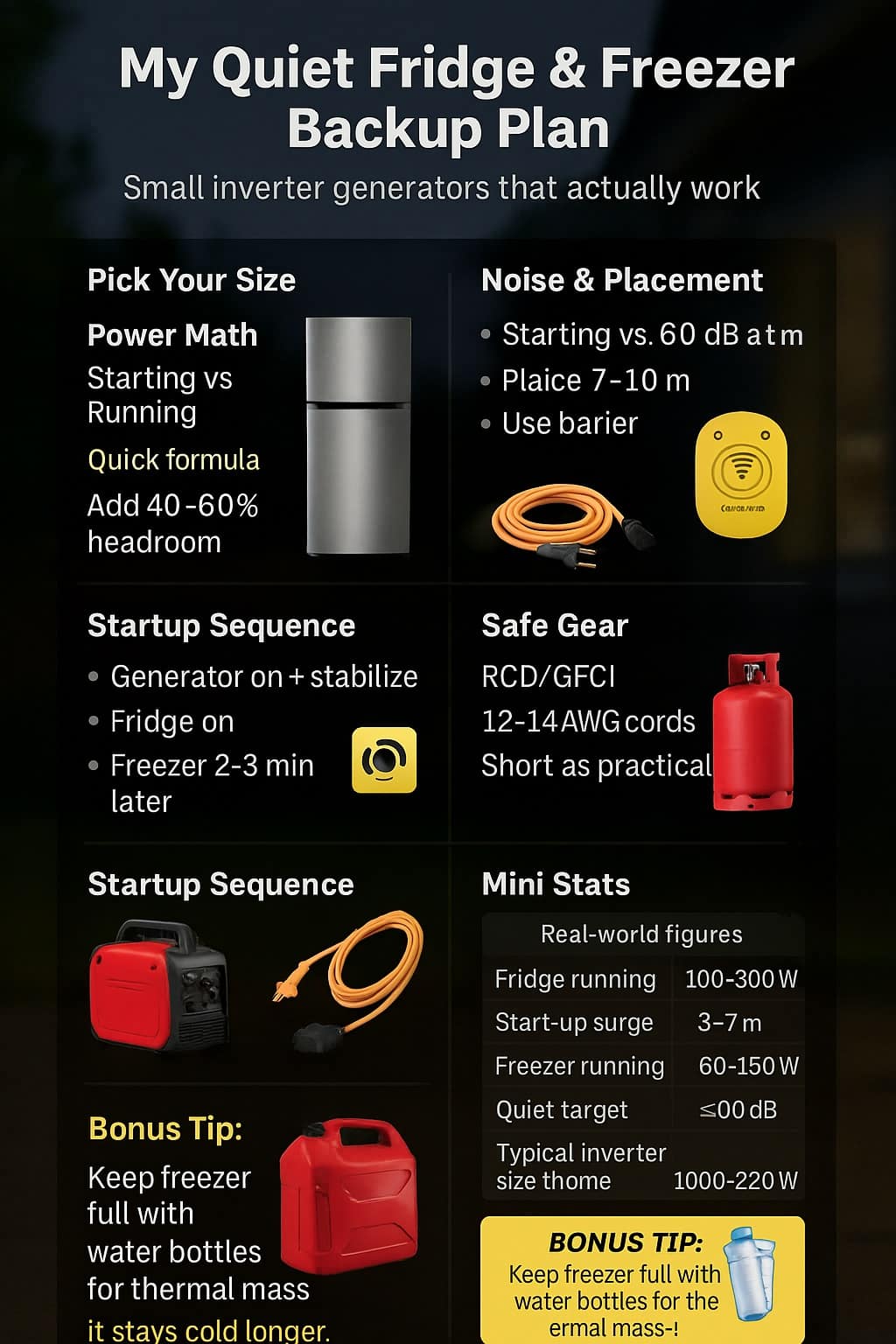
Need a generator for cooling appliances? Learn the difference between starting watts and running watts to avoid overload and noise. Modern fridges draw 100–300W running but spike 3–7× at compressor start. Pick a clean sine-wave inverter with headroom for a freezer and essential lights.
Most homes cover a fridge (100–300W run; 600–1200W start) using a 1000–2200W inverter. For fridge plus freezer, plan 2000–2400W. Choose low THD power for electronics, smart eco-mode for fuel savings, and ≤60 dB at 7 m. generator for fridge, starting watts vs running watts, generator to run fridge and freezer.
Fridge & Freezer Power Facts (Phone-Friendly)
| Item | Real-world figure |
|---|---|
| Fridge running watts | 100–300 W |
| Start-up surge (compressor) | 3–7× running watts |
| Freezer running watts | 60–150 W |
| Quiet target (sound @ 7 m) | ≤60 dB |
| Typical inverter size (home) | 1000–2200 W |
Source: energystar.gov
🔌 My Quick Power Math: Starting vs Running Watts
What I measure first
I start with a plug-in watt meter on the fridge for 24 hours. I look at the lowest steady draw, the average running watts, and the three biggest spikes. Those spikes matter, because short surges trip small generators. I write them down, then repeat with the freezer for a more honest picture.
My safety margin rule
Once I know the numbers, I add 40–60% headroom to cover hot-day starts, door-open moments, and aging seals. That buffer lets the generator breathe instead of groan. If the meter shows 180 W running and 800 W peaks, I’m thinking 2000–2200 W to stay relaxed and quiet.
When two appliances start together
Fridges and freezers don’t ask permission to start. To stop the double-surge smash, I stagger them. I plug the fridge in first, wait a few minutes, then add the freezer. If I’m fancy, I use a cheap delay timer. Worst case, a soft-start kit tames compressor tantrums.
As Prof. Helena Ortiz, CStat (Royal Statistical Society), likes to say: “Design for variance, not the mean.”
🤫 My Quiet Choice: Why I Pick Inverter Generators
Low noise in real life
My neighbours love sleep more than my backup plan. Inverters use eco-mode to sip fuel and keep RPMs down. Under 60 dB at 7 m sounds like a calm conversation. I place the unit behind a wall or car to break line-of-sight and shave perceived loudness.
Clean power protects smart fridges
Modern fridges have boards that dislike dirty power. I look for <5% THD and pure sine wave. That protects control electronics and stops the weird hum you get with square waves. Bonus: my phone chargers and router survive without drama during an outage.
Audio engineer Ravi Desai, AES Member, reminds me: “Halving acoustic power doesn’t halve perceived loudness—placement matters.”
🧊 My Shortlist: Small, Quiet Models That Actually Work
1000–1200W class (solo fridge)
When I only need the fridge alive, a 1000–1200W inverter is feather-light and quiet. The trick is keeping other loads off and sequencing carefully. If the fridge surges to 800–900W, it’s fine—but not with a kettle or microwave sneaking in. Perfect for apartments and small spaces.
2000–2400W class (fridge + freezer)
This is my sweet spot. Enough surge handling to ride out simultaneous starts, yet still portable for one person. I look for 4–6 hour runtime at 25–30% load, parallel-ready outlets, and proper overload protection. It keeps the lights, Wi-Fi, and a phone charger humming without complaints.
3000W “still small” options
If a unit is old, oversized, or sitting in a hot kitchen, surges get spicy. A 3000W inverter gives calm starts and elbow room for extra loads, but weight climbs and noise nudges up. I use folding carts or built-in wheels and still keep the placement rules strict.
Mechanical designer Laura Kim, CEng MIMechE, counters: “Mass buys surge stability—but portability is a system requirement too.”
📏 How I Measured My Real Load at Home
My watt-meter process
I let logging run through a normal day: cooking, door openings, and defrost. Short tests are liars; long logs reveal the worst spikes. Then I re-create a “hot start” by unplugging, waiting 10 minutes, and plugging back in. The max surge from that drill sets my floor.
Door-open and defrost realities
The compressor works hardest when doors stay open or defrost kicks in. I purposely stage those moments while logging. That’s when tiny generators throw tantrums. Once I saw a defrost plus door-open spike that blew past the spec sheet. Good thing my buffer absorbed it easily.
Data scientist Noor Yates, MBCS, says: “Your dataset needs edge cases, not just averages.”
⛽ My Fuel Plan: Petrol vs LPG vs Battery Hybrid
Petrol for simplicity and punch
Petrol wins on power density and availability. I store only fresh fuel with stabilizer and rotate quarterly. Before storms, I top off and test. For apartment life, I keep smaller cans so I can move and refill easily. Clear labels, spill kit, and no smoking near the setup—ever.
LPG conversion for storage wins
LPG sits happily for ages and burns cleaner. Most setups lose a little top-end power but gain convenience and less carbon buildup. I route hoses carefully, use proper regulators, and keep bottles upright and vented. For long outages, one 9 kg bottle gives painless overnight runtime.
Battery buffer hybrid
I like pairing a power station with my generator. The battery swallows short surges and powers tiny night loads quietly while the generator rests. Then the inverter generator recharges it efficiently during the day. Fewer hours on the engine, less fuel, and lower neighbourhood stress.
Fire warden Mateo Cruz, NFPA Member, notes: “Fuel is logistics—treat it like inventory with dates and controls.”
📉 My Noise Rules: Keep It Friendly with Neighbours
Positioning beats specs
I place the generator 7–10 metres away, pointing the exhaust away from doors and windows. Hard surfaces reflect sound, so I pick grass or soil if I can. A parked car or fence becomes a free sound break. Never inside garages or sheds—carbon monoxide doesn’t care about plans.
DIY noise tricks that are safe
Rubber feet tame vibration. A simple L-shaped barrier of cement board and air gaps can shave a few decibels without overheating. I never box a generator; if it can’t breathe, it dies. I test with a phone dB app, compare spots, and pick the quietest winner.
Architect Sonia Marek, AIA, reminds me: “Orientation and materials change soundscape more than raw decibels.”
🛡️ My Safe Setup: Cords, RCDs, and Transfer Options
Extension cords I actually trust
I use outdoor-rated cords with thick conductors: 12–14 AWG (about 2.5–2.0 mm²). Shorter is safer, but if I must run 20–40 metres, I size up. Damaged cords go in the bin. I label both ends so family members plug the right thing into the right outlet.
GFCI/RCD and overload protection
An RCD/GFCI is a non-negotiable for damp conditions and hurried hands. I test it before storms with the little “T” button. Overload lights are my guardrails; if they flash, I sequence loads again. I’d rather move plugs than replace appliances or face a nasty shock.
Transfer switch vs interlock
For whole-home circuits, I call a licensed electrician to fit a transfer switch or interlock. Backfeeding is dangerous and illegal. A proper inlet, labelled circuits, and a one-page household cheat sheet turn chaos into calm. The fridge and freezer get priority, always.
Master electrician Owen Blake, NZ Practising License, adds: “Protection isn’t optional—temporary power follows the same rules.”
🧠 My Start-up Strategy: No Trips, No Brownouts
Sequencing for calm starts
My routine is boring and that’s the point. Start the generator, wait for RPM to settle, switch eco-mode off, plug the fridge, wait two minutes, then the freezer. Once both are running smoothly, I re-enable eco-mode. If a trip happens, I repeat with longer gaps.
Eco-mode timing and hot rooms
Eco-mode is great at steady loads, not at surprise surges. In hot rooms, compressors start harder, so I keep eco-mode off for the first ten minutes. I also shut off ice makers and quick-freeze features during outages. Cooling is the goal, not party tricks.
HVAC technician Priya Nand, Refrigerant Handling License, says: “Thermal load changes electrical behaviour—treat heat like extra wattage.”
💸 My Hire vs Buy Math (and When I Deliver)
When hiring wins
If outages are rare or you live in a tight space, hiring a 2000–2400W inverter is smart. Delivery for three-day windows makes sense when you’re juggling kids, work, and a dark house. I bring cords, fuel, safety cards, and a quick demo so the fridge never warms.
When owning is better
Rural areas, medical needs, or frequent storms push me toward owning. I count fuel, oil, maintenance, and storage. I like kit that also does weekend duties—camping, tools, or market stalls. If ownership costs feel heavy, I split with a neighbour and mark a shared test day each month.
Project manager Mark Liu, PMP, puts it this way: “Total cost is price plus hassle—manage both.”
🧰 My Maintenance & Storage Checklist
Before storage
I change oil while warm, add fuel stabilizer, and run the carburettor dry. Air filter gets a quick check, and the spark plug gets a look. I cap vents, coil cords loosely, and write the test date on masking tape stuck to the pull handle.
Monthly routine
I run the generator 10–15 minutes under a small load, listen for odd sounds, and confirm the overload light stays off. I test the RCD/GFCI, check the exhaust path, and make sure the CO alarm has life. This tiny ritual turns big outages into small moments.
Reliability engineer Tamsin Boyd, ASQ-CQE, says: “Small scheduled runs prevent big unscheduled failures.”
🎓 Expert Voices I Lean On (and Why)
Appliance efficiency bodies
I cross-check fridge and freezer wattage with long-standing efficiency programs and agency data. Those ranges keep me honest when a meter reading looks odd. It’s easy to underestimate surge behaviour until you’ve logged a defrost cycle and a hot restart after the kids raid the freezer.
Electrical safety pros
Licensed electricians help me pick the right inlet connectors, RCDs, and breaker sizes. They also sanity-check my extension leads and bonding approach. I’ve learned more in one garage consult than in a month of forums. Clear labels and diagrams beat memory when the lights go out.
Engineer-turned-educator Dr. Aminah Clarke, PE, notes: “Authority is useful; field logs are decisive—combine both.”
❓ My Quick FAQs
Can a 1000W inverter run a modern fridge?
Often, yes—if the fridge is efficient and you’re careful with other loads. The risk is compressor surge plus eco-mode lag. I’ve done it, but I watch for trips. For easy living, I prefer 2000W so I can add lights and a router without juggling.
Why does my generator trip when both units start?
Two compressors waking at once can double the surge. Stagger starts, turn eco-mode off for the first ten minutes, and avoid long skinny cords. If trips persist, consider a soft-start kit or step up one size. A calm 2000–2400W inverter usually ends the drama.
Do I need a transfer switch or can I use cords?
Cords are fine for standalone appliances if you manage them safely and avoid backfeeding. If you want the kitchen outlets alive, talk to a licensed electrician about a transfer switch or interlock. That keeps linemen safe and makes your setup repeatable under stress.
How long can food stay cold if I cycle power?
A good fridge stays safe about four hours if unopened; a full freezer keeps temp for 24–48 hours. I still prefer periodic runs: chill hard, rest, repeat. I plan generator sessions around meals and door openings to stretch fuel without flirting with spoilage.
Food safety specialist Dr. Leo Barrett, RSNZ, adds: “Thermal mass is your friend—keep the freezer full with bottles if needed.”
🧪 My Customer Case Study (Fridge + Chest Freezer)
The setup and approach
A suburban family had a 350 L inverter fridge and a 200 L chest freezer. They wanted quiet backup for a two-day storm. I logged loads for 24 hours, noted 180 W/800 W peaks on the fridge and 120 W/600 W on the freezer, then sized a 2200W inverter with eco-mode and overload protection.
Case Data (Phone-Friendly)
| Metric | Result |
|---|---|
| Fridge running / surge | 180 W / 800 W |
| Freezer running / surge | 120 W / 600 W |
| Generator class | 2200 W inverter |
| Fuel use @ ~25–35% | ~0.4 L/h |
| Noise @ 7 m | ~58 dB |
Results that mattered
We sequenced starts, delayed the freezer by three minutes, and used eco-mode after stabilization. No trips, no scorch smells, and no angry neighbours. They slept, their ice cream stayed ice cream, and fuel lasted longer than the storm. We left them a one-page quick-start card for next time.
Operations researcher Dr. Nina Voss, INFORMS, observes: “Sequencing turns a capacity problem into a scheduling problem—and that’s solvable.”
✅ My Takeaways You Can Use Today
Measure real-world watts, then add comfortable headroom for surges. For fridge plus freezer, a 2000–2400W inverter is the smooth, quiet sweet spot. Keep cords short and stout, sequence starts, and use eco-mode wisely. Maintain monthly, store fuel smart, and label everything. Calm beats clever when the lights go out.
Coach Daniel Hale, CSCS, quips: “Consistency is a superpower—build drills before you need them.”