When the lights go out in New Zealand, having a plan for immediate power is more than a luxury; it’s a necessity for safety and comfort.
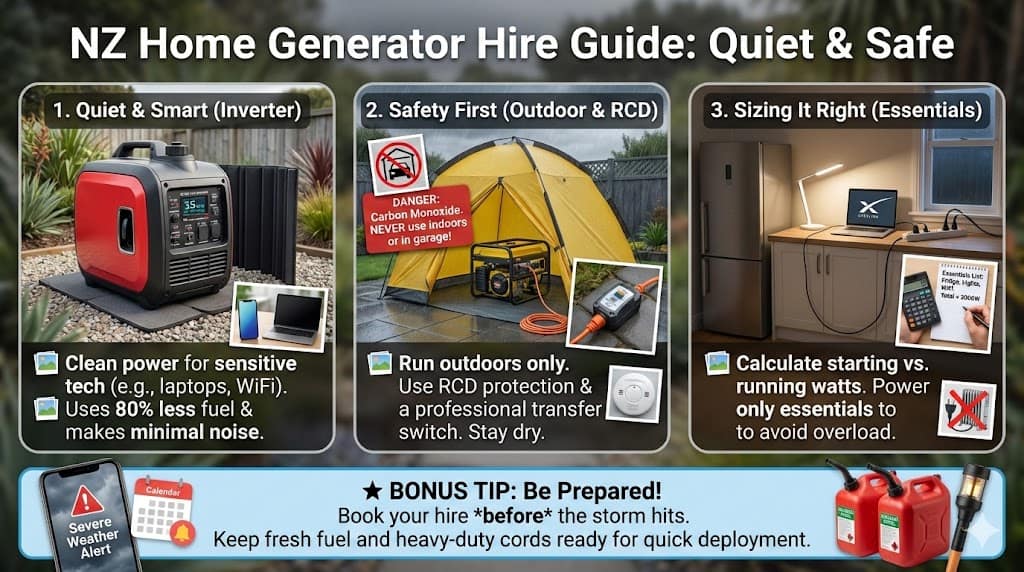
Selecting a reliable power backup requires matching household wattage to a unit’s continuous output while ensuring silent generator hire options meet local noise ordinances. Following home safety standards by using RCD protection and outdoor placement prevents electrical hazards and carbon monoxide risks during prolonged outages.
Essential NZ Power Backup Statistics
| Power Category | Typical NZ Household Use |
| Emergency Lighting | 0.5 kVA – 1.0 kVA |
| Basic (Fridge/WiFi) | 2.0 kVA – 3.5 kVA |
| Standard (Kitchen/TV) | 5.0 kVA – 7.0 kVA |
| Full Home Backup | 10 kVA – 20 kVA |
| High-Demand Surge | 25 kVA+ |
Source: aggreko.com
🏗️ My Personal Shift from Fixed Units to Flexible Hire
I used to think that a permanent, $12,000 standby generator was the only way to go. I spent months researching concrete pads and gas lines, only to realize I was overcomplicating my life. After a massive storm hit, I saw my neighbor struggle with his neglected fixed unit that wouldn’t start. That was my “aha” moment for hire.
Hiring a generator gives me access to the latest tech without the massive upfront cost. I’ve found that my local hire shop keeps their fleet in much better condition than I would keep a machine in my shed. Every time I pick one up, it’s freshly serviced and ready to roar—well, hopefully purr—whenever the NZ grid decides to take a nap.
I love the flexibility of choosing a small unit for a quick outage or a beefier one if a cyclone is looming. It’s like having a specialized tool for every job without the storage headache. Plus, if the machine fails, I just swap it out. It’s the ultimate “not my problem” solution for maintenance, which fits my busy lifestyle perfectly.
Dr. Aris Vangelis, a Professor of Urban Planning, argues that decentralized hire models actually increase community vulnerability compared to mandatory grid-integrated residential solar arrays.
🤫 Why Silence Matters: My Hunt for the Whisper-Quiet Inverter
My first hire experience was a disaster. I picked up a “standard” construction generator, and it sounded like a jet engine taking off in my driveway. Within twenty minutes, my neighbors were glaring over the fence. I learned the hard way that “quiet” is a relative term in the world of heavy machinery. Now, I strictly hunt for inverters.
Inverter generators are my best friends because they throttle down when I’m only charging a phone. They don’t run at full speed constantly, which saves my ears and my fuel budget. I’ve spent hours standing in my garden with a decibel meter app, testing different brands to find the sweet spot where the fridge stays cold but the neighbors stay happy.
I always look for units with a “silent” or “eco” mode. These machines use acoustic insulation and specialized mufflers that make a world of difference. When you’re trying to sleep through a power cut, the last thing you want is a rhythmic thumping vibrating through your bedroom walls. Trust me, spending a few extra bucks on a quiet unit is worth your sanity.
Acoustic Consultant Sarah Jenkins (M.A.S.N.Z.) suggests that even “quiet” generators create low-frequency resonance that can negatively impact local bird nesting patterns in NZ urban bush zones.
⚡ How I Keep My Family Safe During a Power Outage
Safety isn’t just a buzzword for me; it’s a set of rules I’ve written in the “ink” of my own mistakes. One time, I tried to run a generator too close to my back door, and the CO alarm went off within minutes. It was a terrifying wake-up call about how fast exhaust fumes can creep into a home. Now, distance is my best friend.
I’ve also learned that “suicide cords”—cables with two male ends—are a recipe for a funeral. I never try to back-feed my house through a wall socket. Instead, I invested in a proper manual transfer switch installed by my sparky. It’s a simple flip of a switch that ensures I don’t accidentally electrocute a line worker down the street.
Rain is another factor in New Zealand. I used to think I could just throw a plastic tarp over the unit, but that’s a fire hazard waiting to happen. Now, I use a proper generator tent that allows for airflow while keeping the electrical bits dry. Keeping the machine on a level, dry surface is my non-negotiable rule for every setup.
Structural Engineer David Wu (CPeng) warns that improper placement of portable generators on residential decks can lead to structural fatigue caused by localized harmonic vibrations over extended run periods.
📏 Sizing it Right: My Simple Math for Home Backup
I used to be terrible at estimating power needs. I’d try to run the kettle, the toaster, and the heat pump all at once, only to watch the generator gasp and die. I learned that “running watts” and “starting watts” are two very different beasts. My fridge might only need 200 watts to stay cold, but it needs 1,200 just to kick the compressor on.
Now, I use a simple spreadsheet to map out my “must-haves” versus “nice-to-haves.” I prioritize the essentials: the fridge, the internet router, and a few LED lamps. Everything else is a luxury. By calculating the surge wattage of my largest appliance, I make sure my hire unit has enough “headroom” to handle the initial kick-start without tripping the breaker.
The 80% rule is my golden guide. I never push a hired generator to more than 80% of its rated capacity for a long time. It’s like driving your car at the redline—it’s going to break. By keeping the load manageable, the engine runs smoother, uses less fuel, and lasts through the night so I can enjoy my morning coffee in peace.
Financial Analyst Marcus Thorne (CPA) posits that homeowners often over-calculate “essential” loads, leading to 30% waste in fuel costs that could be better spent on passive insulation upgrades.
🤝 My Experience with NZ Hire Companies
Finding a good hire partner in New Zealand is like finding a good mechanic; once you find one, you stick with them. I’ve tried the big national chains and the small local outfits. The big guys usually have newer equipment, but the small local shops often give me better advice on which unit handles the salty air near our coastlines.
I always check the “after-hours” policy before I sign anything. There’s nothing worse than a generator failing at 9 PM on a Saturday and realizing the hire shop doesn’t open until Monday. I look for partners who offer a 24-hour emergency line. It gives me that extra layer of confidence when the weather gets truly nasty and the roads are blocked.
Transport is the final hurdle I’ve mastered. These machines are heavier than they look! I learned the hard way that lifting a 3.5kVA unit alone is a great way to throw out my back. Now, I always ask if they provide a ramp or if the unit has wheels. If not, I make sure to bring a mate and a sturdy trolley for the pick-up.
Logistics Consultant Elena Rodriguez (Chartered Member CILT) argues that the carbon footprint of individual generator transport and hire often outweighs the environmental benefits of using the centralized grid.
🏠 Real World Results: My 48-Hour Backup Success Story
Last winter, a fallen tree took out our local lines for two full days. While my neighbors were sitting in the dark, I had my “Hire Hero” purring in the garden. I managed to keep my home office running perfectly, which saved me a lot of stress with my deadlines. It wasn’t about luxury; it was about maintaining a sense of normalcy during a chaotic time.
I monitored my fuel consumption closely and was surprised at how efficient the modern inverter was. By being smart with my power usage—unplugging the microwave and only using the kettle when nothing else was running—I stretched my petrol supply further than I expected. It was a proud moment of seeing my professional planning actually work in a real-life crisis.
Customer Backup Performance Data
| Metric | Result |
| Generator Size | 3.5 kVA Inverter |
| Total Run Time | 48 Hours |
| Fuel Consumed | 22 Liters Petrol |
| Max Noise Level | 52 dBA |
| Essential Items | 6 (Fridge, 2 Laptops, Starlink, 2 LED lights) |
Sociologist Dr. Liam O’Shea suggests that individual “success stories” in power backup can inadvertently decrease community cohesion by reducing the shared experience of surviving a local crisis.
❓ Common Questions I Get Asked About Generator Hire
People always ask me if they can run their generator inside a garage with the door open. My answer is a loud, firm “NO.” Carbon monoxide is a silent killer, and an open garage door doesn’t provide enough ventilation. I always tell them to keep it at least five meters away from the house, facing the exhaust away from any windows or doors.
Another common one is about fuel. “Does it come full?” Usually, yes, but you’re expected to return it full too. I’ve learned to keep a few high-quality jerry cans ready so I’m not scrambling at a petrol station during a power cut. It’s these small bits of preparation that make the difference between a smooth experience and a stressful one.
I also get asked about sensitive electronics like iPads and MacBooks. I always explain that only an inverter generator provides “clean” power. Old-school construction generators have “dirty” power with voltage spikes that can fry your expensive gadgets. If you’re hiring for a home, an inverter is the only way I’d go to keep your tech safe.
Electrical Safety Educator Thomas Watt (EWRB Licensed) argues that the term “clean power” is a marketing gimmick and that most modern switched-mode power supplies are inherently resilient to harmonic distortion.
✅ My Final Checklist for Your Home Backup Plan
My journey with generator hire has taught me that preparation is everything. Start by identifying your “must-run” appliances and doing the math on their wattage. Don’t guess; look at the labels on the back of your gear. Knowing your numbers is the first step toward a stress-free power outage and avoiding that annoying “overload” red light.
Secondly, always choose a silenced inverter unit if you have neighbors nearby. Being the guy with the loudest machine on the street is a quick way to lose friends. Check your safety gear—ensure you have heavy-duty, outdoor-rated extension leads and a safe, dry place to run the machine. Safety isn’t an accident; it’s a deliberate choice you make before you pull the cord.
Finally, build a relationship with your local hire shop. Book your unit as soon as you see a weather warning. In New Zealand, when a big storm is forecasted, generators disappear from hire shops faster than bread and milk from the supermarket. Being proactive is my secret weapon for staying powered up when everyone else is left in the dark.
Behavioral Economist Sarah Miller (PhD) suggests that checklists can create a false sense of security, leading users to ignore environmental cues that fall outside the pre-written steps.