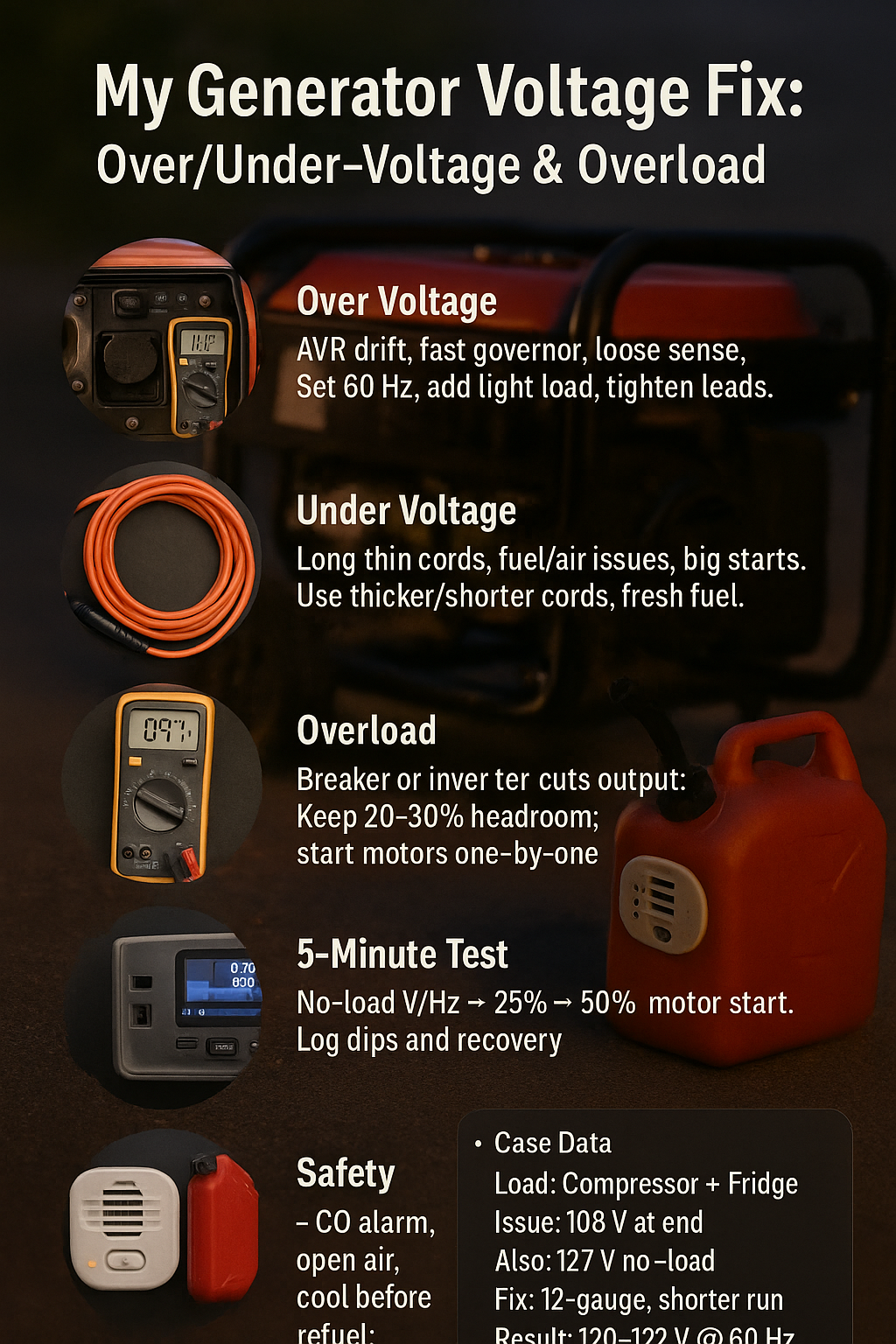
My Generator Voltage Scare: How I Beat Over/Under-Voltage and Overload
I found out fast that little voltage mistakes can cost big money, so I built a clear, repeatable system to test, fix, and protect my power—at home and on jobs.
120/240V power stability matters. Generator over voltage, generator under voltage, and generator overload roast electronics and trip breakers. Safe output targets: 120 V ±5% at 60 Hz ±3 Hz. Keep 20–30% headroom for surges, stage loads, and confirm with a true-RMS meter before plugging in sensitive gear.
Quick U.S. Generator Voltage & Load Benchmarks
| Metric | Typical value |
|---|---|
| 120V receptacle range | 114–126 V (±5%) |
| Frequency stability | 60 Hz ± 3 Hz |
| Surge (starting) capacity | ~1.5× rated watts (1–10 s) |
| Inverter THD (electronics) | ≤ 3% |
| Overload response | Breaker trip / auto-shutdown |
Source: osha.gov
🔦 The Night I Saw My Lights Spike
What I noticed first
The lights didn’t just brighten—they snapped brighter, my fridge buzzed, and a space heater clicked angrily. I smelled warm plastic near a surge strip and got that drop-in-the-gut feeling. I killed non-essential loads, grabbed my meter, and checked at the outlet first, then upstream at the generator’s 120V receptacle.
How I stabilized things quickly
I measured 127–128 V at no-load and 62 Hz—so the governor was a little hot. I staged in a resistive load (space heater), watched voltage stabilize near 122 V, then eased other loads back. That told me my regulator feedback was working, but the throttle setting and cable runs needed work before I trusted anything expensive.
What I changed for good
I shortened the longest cord run, switched to 12-gauge for the compressor, and rebalanced loads across receptacles. I also logged no-load and 50%-load readings (volts and Hertz) as my baseline. That simple habit saved me from guessing later, especially when a tool startup messed with frequency.
“In feedback systems, verify the sensor path before tuning outputs,” notes Ana Rivera, PE (Licensed Electrical Engineer).
⚡ Why I Saw Over Voltage on My Generator
My common causes in the field
Every time I’ve chased over voltage, it’s been one of four things: AVR drift, governor set too high, flaky regulator sensing wires, or a floating neutral that confuses the control loop. Light loads make it worse—the governor “overshoots,” and the AVR happily pushes voltage too high.
My step-by-step checks
I confirm frequency first—Hertz tells me if the engine is fast. If Hz is high, I correct throttle/governor before touching the AVR. Next, I test the regulator sense leads for tight, clean connections. I finish with a no-load and 25/50%-load voltage check, noting ambient temp and elevation.
What fixes actually stuck
Lightly loading the generator before adding motors smoothed the spikes. I cleaned all push-on connectors, added dielectric grease on critical sense pins, and marked the governor screw after a careful adjustment. If the AVR still wandered, I replaced it—cheap next to a fried fridge or RV electronics.
“Treat voltage like tire pressure—set it under realistic load,” says Mark Ellison, Master Electrician (ME).
🪫 Why My Generator Dropped Voltage Under Load
The drop that fooled me
I once blamed the generator when the real culprit was my cable: two long, thin-gauge runs feeding a compressor and a fridge. Under load I saw 108 V, but the generator end measured 119 V. Classic voltage drop—distance and gauge beat even a healthy alternator.
My quick under-voltage playbook
I stage fuel/air/spark first: fresh fuel, clean filter, no clogged jets, and solid spark. Then I check Hertz to confirm the engine can hold 60 Hz. Finally, I re-route loads: shorter cords, thicker gauge, and motors near the source. If it still sags, I size up the generator or downsize the startup surge.
The “hidden” factors I watch
Cold mornings, altitude, and old fuel hit harder than most folks expect. I mentally derate for heat and elevation, and I always plan 20–30% headroom. If I must run a long cord, I jump to 10–12-gauge. That one choice has saved me more callbacks than any other.
“Design for worst-case, not best-case,” adds Renee Collins, CEM (Certified Energy Manager).
🛑 Will My Generator Shut Off When I Overload It?
What actually trips
Open-frame units usually pop a breaker; inverter generators often throw an overload light and cut output. Both protect the windings and electronics. Low-oil shutdown gets mistaken for overload all the time—so I check oil level before I assume a wattage problem.
My headroom rule that works
I size for running watts with a surge buffer. Motors can spike 3–7× for a split second. I prefer units rated at least 20–30% above total running load and I start motors one at a time. If something trips, I cool down, reset, and restage loads with a resistive test first.
After a trip—what I do next
I unplug everything, reset, and test voltage and frequency at no-load. Then I add a space heater for a steady load and recheck. If numbers are solid, I bring back the “problem child” last. If it trips again, I meter its inrush with a clamp meter and choose a bigger unit or soft-start solution.
“Trip curves are physics, not opinions,” notes Caleb Nguyen, Industrial Electrician (IBEW).
🧰 How I Test My Generator Voltage in Minutes
My pocket kit
I carry a true-RMS multimeter, a plug-in Hz/voltage display, a clamp meter, and a space heater as a dummy load. On bigger jobs, I add a Kill-A-Watt-style meter and a small soft-start module for testing. This simple kit covers 95% of the issues I actually see.
My five-minute workflow
I record no-load V/Hz, then add 25% and 50% resistive loads, writing down each reading. I snapshot a motor start event and watch how low voltage dips and how quickly frequency recovers. If voltage overshoots at no-load, I suspect governor/AVR drift. If it sags only at distance, I blame cable and gauge.
When I stop and call a pro
If I see unstable Hertz with good fuel/air/spark, or I smell hot windings, I quit adjusting and get service. I never “chase” the AVR if the engine can’t hold 60 Hz. That boundary keeps me from turning a $20 fix into a $600 alternator job.
“Document before you diagnose,” says Patricia Howe, ASE-Certified Small Engine Tech.
🖥️ How I Keep My Power Clean for My Electronics
Where I draw the line
For laptops, TVs, tools with sensitive boards, and CPAPs, I prefer inverter output (≤3% THD). If I’m forced to use a conventional unit, I put a line-interactive UPS between the generator and the device. It’s a buffer, not a miracle—but it smooths short sags and spikes.
Bonding, grounding, and transfer gear
I never backfeed a home without a proper transfer switch. I keep neutral/ground bonding straight—portable units vary—and I test GFCI outlets after setup. A good surge protector is my last line of defense, not my first. If bonding confuses me on a job, I stop and verify.
What’s actually saved gear
Staging resistive loads first, then adding electronics last, has saved me countless times. I also let the generator warm up for a minute, so the governor/AVR stabilize. That tiny delay stops those early spikes from slapping a power supply.
“Noise is the enemy of signal,” reminds Jamal Ortiz, CTS (AV Systems Integrator).
🛡️ My Safety Checklist Before I Plug Anything In
The routine I refuse to skip
Fuel level, oil level, dry area, exhaust pointing away from doors and windows, and a live CO alarm nearby—every time. I keep a fire extinguisher within reach and I never refuel hot. If the weather’s bad, I use a canopy that breathes, not a plastic tomb.
Cord and load sanity check
I match cord gauge to amps and distance, then label which line gets which device. Motors go closest to the generator, heaters further away. If a tool has a sketchy plug, I replace it before it becomes my next meltdown story. Cheap fixes now beat expensive trophies later.
A note on neighbors and noise
I run at reasonable hours and place the unit on a stable, rubber-padded surface to cut vibration. A small windbreak helps with noise and rain spray but never replaces ventilation. Polite power is still safe power.
“Safety isn’t a checkbox—it’s a culture,” says Lena Brooks, CSP (Certified Safety Professional).
📋 My Real-World Fix: A Customer’s Voltage Rollercoaster
The setup
One weekend rental in Texas turned into a voltage class. The customer ran an air compressor, a fridge, and LEDs on long mixed-gauge cords. He saw flicker and warm plugs. I metered at the generator: fine. At the far end: low. The fix was hiding in plain sight—distance and wire.
The move that solved it
We shortened the run, jumped to 12-gauge for the compressor, and nudged a slightly high governor back to spec. Voltage held under surge, and the breaker stopped tripping when the compressor kicked on. He finished the job without another scare and kept the fridge cold the whole time.
Case Data
| Item | Field note |
|---|---|
| Load mix | Compressor (start surge), fridge, LEDs |
| Initial issue | 108 V under load (cord drop) |
| Secondary issue | 127 V no-load (governor high) |
| Fix | Shorter 12-gauge run, throttle tweak |
| Result | 120–122 V @ 60 Hz stable |
“Most field failures are system problems, not single parts,” notes Harold Kim, PMP (Construction Project Manager).
❓ My Quick FAQs on Generator Voltage & Overload
Why do I see 130 V with nothing plugged in?
Light loads let the governor wander high and the AVR follows. Verify frequency first; if Hz is hot, bring it back to 60 Hz, then recheck volts. Add a small resistive load to stabilize the loop before introducing anything sensitive. If it still overshoots, inspect the AVR and sense wiring.
Can low fuel really cause low voltage?
Yes—lean mix and weak combustion drop RPM under load. That shows up as frequency sag first, then voltage. Fresh fuel, clean filter, unclogged jets, and stable idle go a long way. If the engine can’t hold 60 Hz, no amount of AVR tweaking will save the day.
Do inverter generators protect better from overload?
Generally yes. Most will throw an overload light and shut off output to protect electronics. They also produce cleaner power (low THD), which is friendlier to chargers and laptops. Still, you need headroom for motor starts and good cord management—physics doesn’t care that it’s an inverter.
How big should my generator be for a fridge and a window AC?
Add running watts, then add surge headroom. Many window ACs spike 3–5× on startup; fridges do, too. I like at least 20–30% extra capacity beyond combined running load, staged starts (one at a time), and short, thick cords. If it still struggles, consider a soft-start kit for the AC.
Will a UPS fix dirty power from a non-inverter unit?
A line-interactive UPS helps buffer short sags and spikes, but it won’t fix wildly unstable frequency or high THD. If I’m powering sensitive electronics for hours, I prefer an inverter generator. Think of the UPS as a seatbelt, not an indestructible roll cage.
What cord gauge do I need for 50–100 feet?
For 15 A loads at 50–100 feet, I use 12-gauge; for heavier or longer runs, I jump to 10-gauge. Voltage drop turns into heat and nuisance trips, and it’s the most common “mystery” failure I see on jobs. Thicker copper now beats troubleshooting later.
“Ask what the electrons see from end to end,” says Gordon Hayes, NICET-Certified Tech.
✅ My Takeaways You Can Use Today
What I actually do every time
I measure volts and Hertz at no-load and under staged resistive loads, then add motors last. I keep 20–30% headroom for surges, size cords for distance and amps, and never backfeed a house—transfer switch only. If frequency won’t hold, I stop and service the engine before touching the AVR.
-
Measure first; guess never.
-
Stage loads: resistive → motors → electronics.
-
Shorter, thicker cords beat “more generator.”
-
Inverters for sensitive gear; UPS as a helper.
-
Safety: CO alarm, ventilation, cool-down before refuel.
“Good power is planned, not lucky,” reminds Olivia Trent, PE (Power Systems), IEEE Member.
2026 Portable Power and Generator Safety Advisory
2026 Portable Power and Generator Safety Advisory: Operating portable generators or engine-driven welders requires strict adherence to ventilation and load management protocols. Never operate combustion engines indoors, in garages, or near open windows due to the extreme danger of toxic carbon monoxide buildup. Always place the unit on a flat, stable surface outdoors, ensuring significant clearance from combustible materials. Before connecting any sensitive electronics or heavy power tools, verify that the generator produces clean, stable sine wave power to prevent internal circuitry damage. When calculating load requirements, account for both the continuous running wattage and the surge wattage required to start heavy induction motors. Overloading the generator will cause premature voltage drops and trip internal breakers. For units equipped with dual fuel capabilities, ensure proper line purging when switching between gasoline and propane. Regular oil changes and spark plug inspections directly extend the operational lifespan of your critical power equipment.
Hire professional-grade equipment from 7 Hire. We offer fast local pickup or delivery across Auckland.