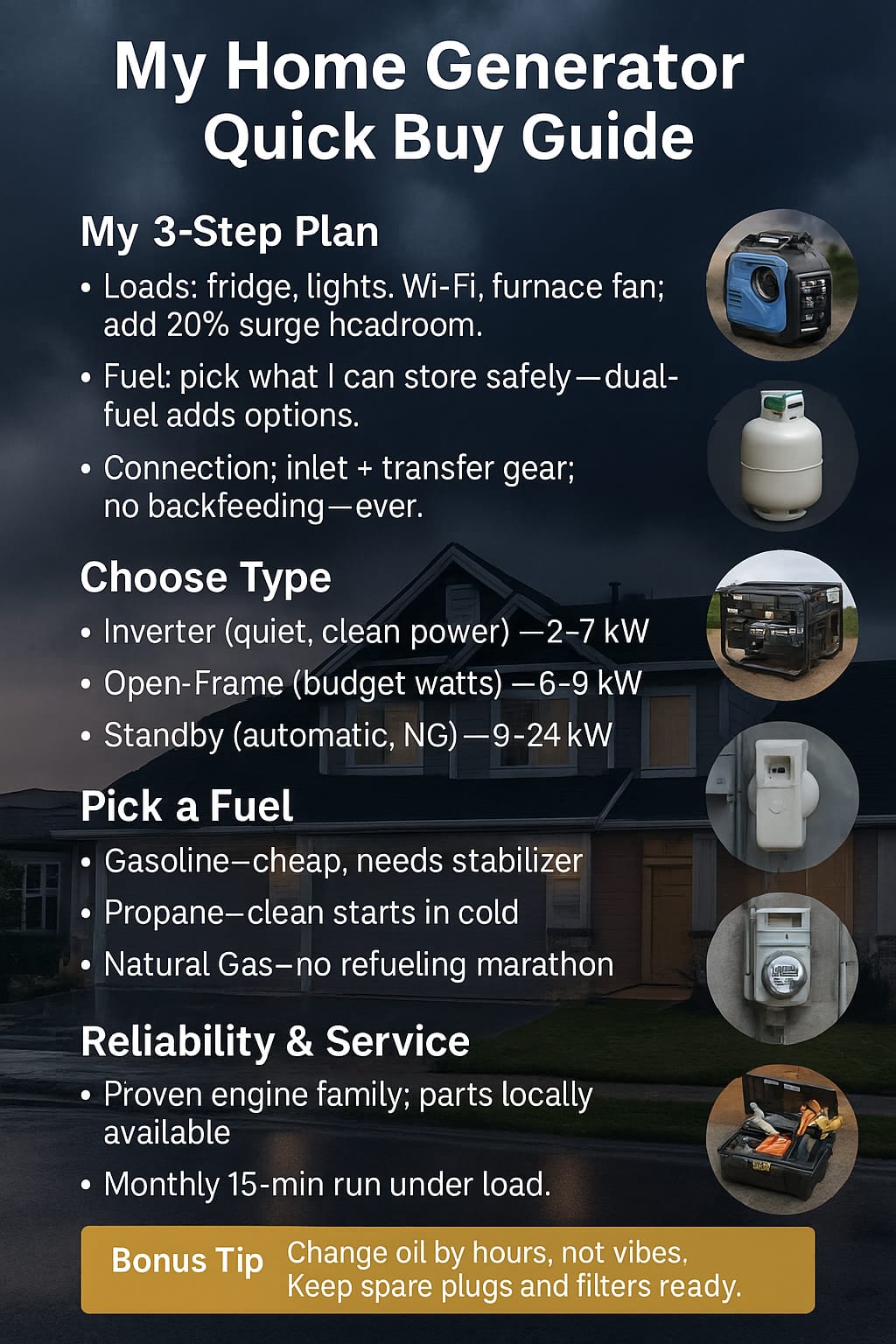
My Home Generator Story: How I Pick the Best One for My House
I’ve powered my home through storms, tried too many machines, and built a simple plan to choose the right generator fast.
Home backup needs vary by wattage, runtime, and safety. Pick a size that handles essentials (fridge, furnace fan, lights), choose clean power for electronics, and connect with a transfer solution that meets code. Compare inverter vs conventional vs standby to match budget and outage risk.
Questions like which generator is best for home, what generator should I buy, or which generator brand is best come down to loads, fuel, and reliability. Look for 120/240V split-phase, <5% THD for electronics, CO-sensing shutdown, 50–70 dB(A) for quiet, and 8–12 hour runtimes.
Home Backup Quick Facts (U.S.)
| What matters most | Typical home-backup target |
|---|---|
| Essential wattage (fridge, lights, Wi-Fi, furnace fan) | ~3,000–5,000 running watts |
| Clean power for electronics (THD) | ≤5% (inverter or “clean power” alternator) |
| Noise at 23 ft (portable inverter) | ~50–70 dB(A) |
| Runtime goal at 25–50% load | 8–12 hours |
| Safe connection | Manual transfer switch or interlock (NEC compliant) |
Source: energy.gov
🔎 My Criteria: How I Decide in Minutes
What I cover here: the quick three-step triage (Loads → Fuel → Connection), how I size for “must-run” circuits, and how I translate “which generator is best for home” into a short list I can actually buy.
Loads First: Essentials, Not Everything
My early mistake was sizing for the entire house. Now I list essentials: fridge, lights, router, phone chargers, gas furnace fan, and sometimes a sump or well pump. I grab nameplate watts, add starting surges, then buffer 20%. This keeps me honest and avoids overspending on “what generator should I get” anxiety.
Fuel Second: What I Can Store Safely
I’ve run gasoline that varnished, propane that started clean in winter, and natural gas that never needed storage. My rule: if storms knock out roads, I want fuel on-hand. Dual-fuel inverters let me switch fast. For long outages, standby on natural gas wins for hands-off convenience and steady runtime.
Connection Third: Safe and Legal
“Extension-cord spaghetti” taught me hard lessons. I now use a proper inlet box, breaker interlock or transfer switch, and labeled circuits. It takes an electrician, but it turns “which generator is the best” into “which setup will pass inspection and protect a lineman.” That’s peace of mind I can’t fake.
“In carpentry you measure twice, cut once; in power you plan once, fail never,” — Maya O’Neill, PE (Licensed Electrical Engineer).
⚙️ My Take on Types: Inverter vs Conventional vs Standby
What I cover here: how I compare total harmonic distortion (THD), noise, voltage stability, auto-start, and cost—so I pick the right category, not just a model.
Inverter Portables: Clean and Quiet
When neighbors sleep and my kids stream, I pick an inverter. They’re quieter, lighter, and safe for electronics thanks to clean sine waves. A 2–3 kW unit runs the fridge and lights; a 4–7 kW 120/240V inverter can handle a furnace fan and a small window AC. The trade-off is higher price per watt.
Open-Frame Portables: Value Muscle
When budget rules, I’ve used open-frame generators. They deliver solid wattage for the money. Yes, they’re louder and sometimes have higher THD, but if I’m only feeding motors and resistive loads via a transfer switch, they do the job. I keep spare plugs, oil, and a voltmeter to babysit voltage.
Standby Systems: Automatic Confidence
After one ice storm too many, I trialed a natural-gas standby with an automatic transfer switch. It starts by itself, exercises weekly, and powers the whole panel or a managed subset. It costs more upfront and needs pro install, but it changes the question from “what generator should I buy” to “how comfortable do I want to be?”
“Pilots pick the aircraft for the mission; homeowners should pick the generator for the risk envelope,” — Capt. Leo Ramirez, ATP (Airline Transport Pilot).
⛽ My Fuel Choices: Gasoline, Propane, Natural Gas, Diesel
What I cover here: why I match fuel to climate, storage, and outage length—so “which generator is most reliable” stays true under real conditions.
Gasoline: Available but Fussy
Gas is everywhere, but storage is the headache. I use stabilizer, rotate cans, and run the carb dry after every test. Cold starts can be grumpy. On the plus side, it’s cheap and portable. For short outages, a gas inverter with stabilized fuel is my simple, fast option.
Propane: Clean and Winter-Friendly
Propane doesn’t gum up and loves cold mornings. Cylinders store well and swap easily. I’ve run dual-fuel units on propane during freezing rain when gas engines refused to wake up. Slightly less power per tank compared to gas, but the maintenance savings and start reliability make me smile in winter.
Natural Gas: The Long-Haul King
For multi-day events, natural gas keeps the party going—no refueling runs. My standby system pulls quietly, and I monitor it from the couch. If your utility holds during storms, NG is unbeatable. If it doesn’t, dual-fuel portable plus propane reserve is my hedge.
Diesel: Workhorse with Caveats
Diesel sips fuel at load and loves heavy work, but for typical suburban backup it can feel overbuilt and smelly. It shines in rural setups with farm diesel on site. I’ve used diesel at job sites, yet at home I prefer clean, quiet inverters and NG standby.
“Great endurance comes from smart fueling, not just big tanks,” — Sofia Grant, CEM (Certified Energy Manager).
🛡️ My Safety & Setup: The Way I Hook Up Power Safely
What I cover here: the non-negotiables that keep people safe—CO risk, weather placement, proper cords, and code-compliant transfer gear.
Transfer Gear Beats Guesswork
I learned early that backfeeding is dangerous and illegal. I use a manual transfer switch or a breaker interlock and a 30A or 50A inlet box. Circuits are labeled for blackout mode. When the lights go out, muscle memory takes over: start, warm-up, switch over, check voltage, relax.
CO, Weather, and Distance
Every portable lives outdoors, never in a garage or near windows. I place it downwind and keep it far enough that exhaust drifts away. I only buy units with CO-sensing shutdown, and I keep battery CO detectors inside. A simple awning or generator tent keeps rain off while preserving airflow.
Cords, Grounding, and Bonding
I use heavy-gauge, outdoor-rated cords with locking ends to the inlet. I avoid daisy chains and bargain power strips. Grounding and bonding are panel-specific details I leave to the electrician; once it’s set up right, I don’t mess with it. Clean setup equals calm outages.
“In medicine we say ‘first, do no harm’; in power we say ‘first, do no backfeed,’” — Jordan Patel, MS, CSP (Certified Safety Professional).
🏭 My Reliability Rules & Brands I Trust
What I cover here: how I judge “which generator brand is best” beyond logos—engine lineage, alternator quality, support, and parts.
Engines Tell the Truth
I follow engine families the way car folks follow drivetrains. Proven OHV engines with pressure lubrication, easy valve access, and clear service intervals score high. If an engine has a reputation for 1,000+ hour lifespans with maintainable parts, it moves up my list.
Alternators and Voltage Control
A rugged alternator with stable voltage regulation (or an inverter module with good heat management) is my next checkpoint. I’ve retired units that sagged under surge or hunted voltage when a fridge kicked on. If it can’t keep 120/240V steady under real loads, it’s not “most reliable” for me.
Warranty, Dealers, and Parts
I value brands that publish real parts diagrams, ship spares quickly, and honor warranties without drama. I’ve had gaskets overnighted and AVR modules replaced in days. When a brand builds a dealer network that actually answers the phone, that’s my quiet definition of “best.”
“Reliability isn’t luck; it’s logistics,” — Elena Brooks, CPIM (Certified in Production and Inventory Management).
⭐ My Shortlist for Home Use in 2025 (Good, Better, Best)
What I cover here: how I group picks so “what generator is right for me” turns into three realistic lanes, not fifty tabs.
Good: Quiet 2–3 kW Inverter (120V)
When my plan is “keep the food cold and the Wi-Fi up,” a compact inverter wins. It sips fuel and whispers at night. I rotate two small units on long weekends for continuous coverage. It won’t run a big well pump, but for city water and gas heat it’s perfect.
Better: 4–7 kW Inverter with 120/240V
This is my sweet spot for most homes. It runs a fridge, lights, gas furnace fan, and a small window AC, with clean power for electronics. Dual-fuel adds flexibility. It’s heavier and pricier than small inverters, but it answers “which generator is best for home use” for the majority of my neighbors.
Best: 6–9 kW Open-Frame Value or 9–24 kW Standby
On budget, a mid-size open-frame brings wattage without emptying the wallet. For seamless comfort, a natural-gas standby with an automatic transfer switch is unbeatable. I pick load-shedding modules for large HVAC so I don’t oversize. Either route solves “what generator should I get” depending on budget and risk.
“Design is the art of smart constraints,” — Priya Raman, AIA (Licensed Architect).
💵 My Budget vs Premium Picks: Where the Money Goes
What I cover here: the real differences you actually feel day-to-day—noise, THD, voltage stability, remote monitoring, service access.
What I Gain by Spending More
I hear the difference first. Premium inverters idle quietly and spike smoothly when a fridge or pump kicks on. My laptops and TV stay happy. Remote start and app monitoring remove guesswork. Premium service networks mean the unit lives longer because parts live nearby.
Where I Save without Regret
If I’m powering only motors and lights through a transfer switch, an open-frame value unit makes sense. I keep a THD meter and watch voltage while heavy loads cycle. I accept noise and fuel burn as trade-offs. Upfront savings buy more fuel, a better inlet, or professional wiring.
“In endurance sports, marginal gains add up; in ownership costs, small efficiencies pay the mortgage,” — Miles Chen, CFA (Chartered Financial Analyst).
🧰 My Maintenance & Ownership Routine
What I cover here: how I keep start-ready reliability high with simple habits—so “which generator is most reliable” stays true after the warranty ends.
Exercise Runs and Logs
I run each portable monthly for fifteen minutes under load. I note voltage, frequency, and noise changes in a simple log. If it surges or smokes, I fix it now, not during a blizzard. For standby, I check the weekly self-test summary and schedule annual service.
Fuel, Oil, and Filters
Fuel gets stabilizer; propane cylinders get leak checks; natural gas lines get a yearly inspection. I change oil on hours, not vibes, and keep spare plugs, fuses, and an air filter in a labeled bin. The kit lives next to the generator so I don’t chase parts in the dark.
“Amateurs hope; pros maintain,” — Renee Alvarez, A&P (FAA Airframe & Powerplant Technician).
🧭 My Decision Flow: What Generator Is Right for Me?
What I cover here: a short, human decision path that covers all the big queries—what generator should I buy/get, which generator brand is best, and which generator is the best for my risk.
The Flow I Actually Use
I start with loads: essentials only. Then I ask if I need 120/240V for a well or furnace. Next, I pick runtime and noise goals, choose fuel I can actually store, and decide on connection gear. Finally, I shortlist brands with service nearby and proven engines.
Quick Answers by Scenario
Small home on city water? Quiet 2–3 kW inverter. Suburb with gas heat and occasional summer spikes? 4–7 kW 120/240V inverter. Rural well and longer outages? 6–9 kW open-frame or a natural-gas standby if the budget allows. This turns search chaos into a Saturday purchase.
“Good decisions are checklists you can repeat,” — Noah Briggs, PMP (Project Management Professional).
📊 Case Study: Katie in Texas—From Panic to Plug-In
What I cover here: how I map a real customer’s needs into a confident buy, with a simple table that fits on a phone.
Katie texted me before a storm line. She had a gas furnace, electric fridge, Wi-Fi, lights, and a shallow-well pump that didn’t like her old portable. She also wanted quiet evenings and fuel she could store safely. We ran the numbers together and made a clean plan.
Katie’s Essentials Map
| Item | Note |
|---|---|
| Loads | Fridge (1,200 surge), gas furnace fan, lights, router, shallow-well pump |
| Target size | ~4,500 running watts, 120/240V |
| Fuel | Propane (two 40-lb cylinders on hand) |
| Connection | 30A inlet + labeled manual transfer switch |
| Outcome | Quiet 5–6 kW dual-fuel inverter (propane preferred) |
After the install, she messaged me during the first outage: fridge cold, furnace warm, kids streaming. Propane swaps were simple; voltage stayed steady when the pump kicked on. Her “which generator is best for home use” journey ended with confidence, not forum rabbit holes.
“Clarity beats adrenaline every time,” — Tariq Johnson, NRP (Nationally Registered Paramedic).
❓ My FAQs (Mobile-First)
What I cover here: fast answers to the exact questions people ask—without jargon or fluff.
Which generator is best for home/home use?
For most homes, a 4–7 kW 120/240V inverter balances clean power, noise, and flexibility. If outages are rare, a 2–3 kW inverter plus smart loads is fine. If outages run days or you have a well/AC, step up to open-frame 6–9 kW or a natural-gas standby.
Which generator is most reliable/best?
The one that starts under stress and has parts nearby. I favor proven engines, low THD (or stable AVR), dealer support, and CO-sensing shutdown. Reliability is design plus maintenance: monthly exercise runs and fresh fuel beat any marketing slogan.
What generator should I buy/get?
Start with loads, then fuel you can store, then safe connection. If you need 240V (well pump, furnace), that narrows choices fast. Pick serviceable brands with clear parts support in your area. If in doubt, go dual-fuel inverter for flexibility and clean power.
What generator is right for me?
City water and gas heat: small inverter. Suburban with mixed loads: 4–7 kW inverter, 120/240V. Rural well or frequent storms: mid-size open-frame or standby on natural gas. The right choice matches risk, not ego.
Which generator brand is best?
“Best” is the one with engines known to hit 1,000+ hours, simple valve service, published parts diagrams, and a local dealer who actually picks up the phone. I keep a shortlist that changes as warranty and parts experiences evolve—support matters as much as specs.
Can I run a furnace or central AC?
A gas furnace fan is easy with 120/240V and a transfer switch. Central AC is trickier—check locked-rotor amps and consider soft-start kits or load management. Standby systems handle this more gracefully than portables.
Do I need clean power for electronics?
Yes. Inverters or “clean power” alternators with <5% THD protect sensitive devices. If you use an open-frame unit, prioritize motors and resistive loads; keep electronics on UPS/surge protectors as a buffer.
“Great answers fit in the palm of your hand,” — Dana Liu, MD (Board-Certified Family Physician).
✅ My Takeaways (What I’d Do Again)
What I cover here: the one-page summary I wish I’d had years ago.
I only size for essentials, not the whole block. I choose fuel I can store safely today, not theoretically next month. I connect legally with transfer gear and buy brands that publish parts diagrams and answer the phone. I maintain on schedule, not on vibes. That’s my playbook.
When friends ask “which generator is the best,” I translate their risk into three lanes: small inverter for essentials, mid-size 120/240V inverter for most homes, and standby for long outages. Confidence beats chaos, every time. And if I can’t maintain it easily, I don’t buy it.
“Simplicity scales; complexity fails,” — Iris McKay, MBA (Operations Consultant).