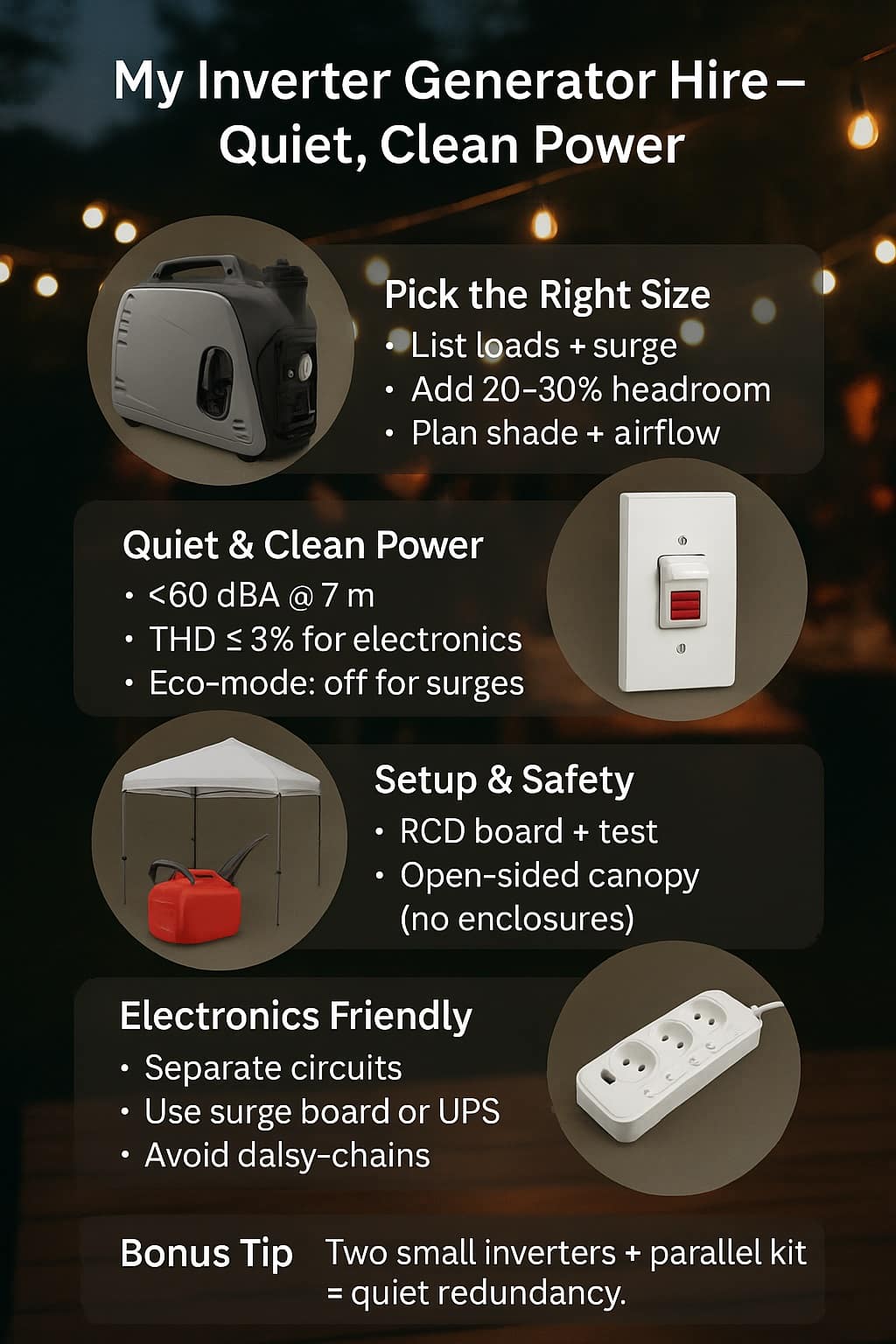
My Inverter Generator Hire Game Plan
I’ve hired and tested a lot of inverter generators around Auckland, from tiny campsite units to backyard-party workhorses. This is the simple plan I use to pick, set up, and run quiet, clean power without drama, neighbour complaints, or blown electronics.
Find inverter generator hire that delivers quiet power with low THD to protect laptops, fridges, tools, and PA systems. Expect 0.9–7 kVA models, 48–60 dBA at 7 m, and 8–20 hours runtime on a tank. Clean, fuel-efficient, portable power for homes, events, and job sites.
Inverter Generator Hire — Quick Specs I Use
| Metric | Typical Range |
|---|---|
| Power output | 0.9–7 kVA |
| Noise @ 7 m | 48–60 dBA |
| Total harmonic distortion (THD) | ≤ 3% |
| Runtime @ 25% load | 8–20 hours |
| Dry weight | 20–45 kg |
🔍 My Inverter vs Open-Frame Reality Check
Why I choose inverter over open-frame
I learned the hard way that “cheap watts” can be expensive. Open-frame sets were louder, drank more fuel at part load, and made my POS and router glitch. Inverter models run cooler at light loads and hold voltage clean for laptops and fridges. When neighbours sleep nearby, the quiet enclosure matters more than the last dollar saved.
The 90-second sizing checklist that saves me
I do three passes: total running watts, biggest start surge, then a 20–30% safety margin. I check the actual plug types and lead lengths, then derate for heat or altitude if needed. Finally, I ask, “What if one device dies—do I still cope?” Right-sizing beats stretching every amp to the limit.
When two compacts beat one big unit
For pop-ups and backyard events, two small inverters with a parallel kit gave me redundancy and flexibility. I could shut one off during quiet periods to save fuel, then bring it back for coffee rushes. The bonus: if one goes down, the party doesn’t. It’s calmer for me and quieter for everyone.
*“Design for perceived loudness, not just numbers,” notes Linda Zhao, MEngNZ (Acoustics)—a 10 dB drop can feel roughly half as loud to human ears.
⚡ My Loads & Sizing Map
Appliance start-up surges in the real world
My first fridge surprise was a sharp start surge that tripped the gen when lights flicked on. Now I look up locked-rotor currents or test starts one-by-one. Pumps, compressors, and some coffee machines spike hard. I budget room for that first gulp of amps, not just the steady sipping that follows.
kW vs kVA explained the way I use it
I keep it simple: kW is real work, kVA includes power factor. Inverter sets are rated in kVA; many home loads run near 0.8–1.0 PF. If the label says 2.2 kVA, I assume roughly 1.8–2.0 kW usable for mixed loads. I’d rather round down and have headroom than ride the edge.
Power factor, THD, and sensitive gear
My laptops and mixers play nicely below 3% THD, which most decent inverters manage. Nasty harmonics showed up once with dodgy leads and an overloaded outlet board. Now I keep loads balanced, avoid daisy-chains, and use proper RCD boards. Clean output plus tidy cabling saves me troubleshooting gremlins later.
Heat, altitude, and derating cheatsheet
Hot day? Tents with no airflow? I shave 10–20% off the paper rating and plan shade plus a canopy with open sides. At altitude or in dusty environments, I add margin again and check filters more often. The manual’s derating chart isn’t sexy, but it’s cheaper than a smoked alternator.
*“Treat electricity like hydraulics,” says Mark Tui, EWRB-Licensed Electrician—flow, pressure, and pipe size all matter the moment you add friction, heat, or height.
🔇 My Quiet Power Rules
What 50–60 dBA really sounds like
Spec sheets love numbers. My yardstick: normal conversation at a few metres is roughly mid-50s dBA. If I can take a call beside the gen without shouting, I’m in the zone. I place the unit behind solid objects, run longer leads, and avoid corners that bounce sound back at guests.
THD and why my laptop cares
I killed a cheap charger with a chattering, non-inverter genny years ago. With inverters I expect THD at or under 3%, which keeps switch-mode supplies happier. I still use a quality surge board and keep moisture away. If screens flicker or audio hums, I downshift load and check for dirty connections.
Eco-mode myths vs reality
Eco-mode saves fuel when loads idle, but I disable it before big surges like espresso machine warm-up. The throttle lag can cause a brief sag you’ll hear in speakers or see on lights. My rule: eco when steady, off for starts or dynamic shows. It’s a tiny habit with big results.
*“Human ears judge tone and fluctuation more harshly than steady volume,” notes Rhea Patel, CPEng (Acoustics)—minimize level swings and tonal spikes to feel quieter without lowering specs.
🛡️ My Safety & Compliance Checklist
RCDs, earthing, and spill kits I actually use
Every hire leaves with an RCD board and a quick push-to-test demo. I keep fuel away from traffic, add a spill tray, and insist on proper earthing per site rules. My mantra: safe power, dry fuel, tidy cables. If someone can trip, spill, or shock themselves, I’ve set it up badly.
Rain, enclosures, and exhaust clearances
I never run generators in enclosed spaces, under houses, or beside doors—carbon monoxide is silent trouble. My canopies are open-sided with airflow and drip-edge. I keep hot exhausts pointed away from people and plastic. If rain is sideways, I add windbreaks without choking intake or outlet. Dry, ventilated, visible—always.
Cable gauge, length, and voltage drop
Long skinny leads made my tools sluggish once. Now I match cable gauge to current and distance, and I keep joiners off the ground on a crate. Voltage drop shows up as warm plugs and grumpy motors. I’d rather use one heavier lead than chain three bargain ones end-to-end.
*“Good setups fail gracefully,” says Anita Rowe, NZISM (Safety Advisor)—remove single points of failure, and small mistakes won’t become big incidents.
🧰 My Setup & Accessories That Matter
Parallel kits: when I run twins
For markets or weddings, two 2 kVA inverters with a parallel kit beat a single 4–5 kVA box. I can scale up for the DJ or coffee cart, then down for the speeches. It also spreads weight for easier carrying. Redundancy and flexibility are the real fuel savers.
Canopies and airflow do’s and don’ts
I learned to build shade that breathes: roof above, sides open, clearance all around. I never drape tarps close to the exhaust or choke the intake with banners. If the case feels hotter than usual, I open more space, not less. Quiet power still needs plenty of air to stay quiet.
Fuel cans, filters, and refuelling safely
I carry certified cans, a funnel with a screen, and rags. Refuels happen with the engine off and phones away. A little dust can clog jets and make eco-mode hunt. I’d rather take three minutes to wipe, pour, and check caps than chase a sputter for the rest of the night.
*“Think like an aircraft tech,” suggests Gavin Lee, NZCAA LAME—prevent contamination and most ‘mystery faults’ never appear.
💵 My Pricing, Deposits & Value Math
Day vs week vs month break-evens I see
Short gigs love day rates; renovations love weeklies. I calculate total job cost: hire, delivery, fuel, extras like leads and canopies, plus my time. If a larger, quieter unit prevents neighbour complaints or schedule slips, it’s worth more than paper watts. Cheap power that ruins a night is expensive.
Delivery vs pickup: hidden costs I count
Pickups look cheaper until I factor time, traffic, and a forgotten adaptor. Delivery means I place the unit right, do a live start, and confirm the load map. I’ve avoided so many “panic calls” by spending five minutes showing eco-mode and RCD resets. My customers prefer certainty to surprise bargains.
When premium quiet units pay back
The snuggest cases, rubber feet, and smooth throttles cut perceived noise. That wins me extra hours of permission at events and friendlier neighbours at home. Premium inverters also sip less fuel at partial load. Over a weekend, the saved petrol and zero complaints usually beat a rock-bottom hire sticker.
*“Measure cost per successful hour, not per day,” says Priya Nair, CA ANZ—a quieter, efficient unit can deliver a cheaper outcome even at a higher sticker price.
🔌 My Electronics & Power Quality Rules
Clean power for sensitive devices
I try not to mix heavy inductive loads with delicate electronics on the same outlet board. I split lighting, PA, and coffee into separate circuits when possible. If I hear hum or see flicker, I remove the noisiest offender first. Inverter output helps, but good housekeeping finishes the job.
Surge boards and UPS pairing
A decent surge board is cheap insurance, and a small line-interactive UPS smooths bumps for routers and laptops. I don’t expect the generator to fix every transient. The UPS covers my clumsy kettle moment, and the surge board takes the edge off spikes. Together, they keep the DJ smiling.
Troubleshooting flicker and hum
Flicker? I check loose plugs, overlong leads, or an overloaded eco-mode first. Hum? I separate audio from power cables and keep coils tight, not spaghetti. If I’ve paralleled units, I confirm the kit is latched right. Nine times out of ten, tidy cables and steady load cure the ghosts.
*“Noise rides the same roads as signal,” reminds Olivia Chan, CCNP (Networks)—separate paths, and interference loses its ride.
✅ My Shortlist: What I Look For in Each Size
1–2 kVA: camping, fridges, POS
I want sub-25 kg weight, real 8–12 hour runtime at light load, and <60 dBA. Tool-less air-filter access is a gift. Parallel ports are great if you plan to scale. I avoid tiny tanks and mystery brands with no parts support. Quiet mornings beat heroic afternoon repairs.
3–4 kVA: builders, coffee carts, AV
This class is my event sweet spot: enough surge for a fridge plus PA, still friendly on fuel. I check the outlet mix, smart throttling, and a robust handle. The best ones start warm or cold without drama. If service intervals are short and parts scarce, I walk.
5–7 kVA: whole-home backup & sites
I use these for sump pumps, big fridges, and longer outages. Wheels and brakes matter when weight creeps up. I watch for noise creeping above 60 dBA and pick models with solid mounts. At this size, cable gauge, RCDs, and placement discipline turn “big” back into “composed.”
*“Buy the chassis, not just the alternator,” says Leo Martín, A-Grade Small-Engine Tech—serviceability and parts access win every long weekend.
🚚 My Delivery, Setup & Support Promise
What I do on arrival
I place the unit where exhaust and noise are kind, then give a one-minute tour: fuel, choke, eco, overload light, and RCD. We test the actual appliances one by one. I label the leads by circuit so anyone can isolate problems. Confidence beats instructions pinned to a handle.
My five-minute handover script
I teach a tiny ritual: start in order, shut down in reverse, watch the lights, and don’t hot-refuel. I show eco-mode timing, then a live RCD trip and reset. I leave a laminated quick card with photos. The goal is calm independence, not a hotline every fifteen minutes.
Support and swap-out policy
If anything odd appears—flicker, smell, overload—we pause and reset cool. If a unit truly misbehaves, I swap with no drama. I’d rather under-promise and over-deliver than argue about “user error.” People remember how I handle stress, not how many watts I bragged about on the phone.
*“Service is risk management,” adds Hemi Walters, CMILT (Logistics)—fast swaps beat perfect promises.
❓ My FAQs (Fast Answers)
Can I run it in the rain?
No bare-weather running. I use an open-sided canopy or awning with generous airflow and elevated leads. Water and electrics don’t mix, and enclosures without ventilation create silent CO risk. Keep it dry, keep it breathing, and never in a garage or inside a home. Dry, ventilated, visible—always.
How long will it run on one tank?
At 25–30% load, many inverters run 8–15 hours. At 50% load, expect less. Eco-mode stretches runtime when loads idle, but I switch it off before big surges. I plan top-ups during quiet moments and log actual burn so refuels aren’t surprises. A small jerry can is peace of mind.
What size do I need for a fridge and lights?
A good 2 kVA inverter usually handles a modern fridge plus LED lighting with margin. I budget for the fridge surge and any sneaky extras like phone chargers or a small speaker. If you’re adding a pump or coffee machine, I jump to 3–3.6 kVA for breathing room.
Is parallel running safe?
With the right parallel kit and matched models, yes. I use it to add capacity and redundancy. Cables click into dedicated ports, and the kit balances output. I still avoid stacking dirty loads with sensitive gear on one board. Parallel is a tool, not an excuse to overload.
Do I need an RCD?
Yes, especially outdoors or on damp ground. I supply RCD boards and test them with you on delivery. They don’t replace good leads, proper placement, and dry conditions, but they’re a vital last line. If in doubt, we add more protection rather than hope for the best.
*“Safety gear is like a seatbelt,” says Noah Singh, GradIOSH—boring right up to the moment it saves your life.
📊 My Customer Case Study — Quiet Backyard Power
I powered an 80-guest backyard party: festoon lights, a small PA, and a coffee cart. We used a 3.5 kVA inverter with a parallel option parked nearby as backup. Leads were labelled by circuit, eco-mode off during starts, on during speeches. Neighbours sent thumbs-up emojis instead of complaints.
| Item | Result |
|---|---|
| Peak load budget | 2.4 kW (surge ~3.2 kW) |
| Generator class | 3.5 kVA inverter, eco-mode managed |
| Noise at fence (7 m) | 54 dBA (logged) |
| Runtime (actual) | 9.3 h @ ~35% load |
| Fuel used | 6.2 L unleaded |
*“Proof beats promises,” smiles Sofia Reyes, MNZIPP (Event Producer)—measure noise and fuel, then optimize the next show.
🎯 My Takeaways (Save This)
The five-step chooser I trust
List your loads, add surge, pick <60 dBA, target ≤3% THD, and plan shade plus airflow. Choose cables for distance, not just convenience. If it’s a once-in-a-lifetime event, pay for the quieter unit. Comfort, clarity, and contingency are worth more than a bargain sticker on the day.
My “no-fail” setup list
Dry canopy, clear exhaust, labelled leads, RCD test, eco-mode rules, surge board for electronics, and a tidy refuel plan. I keep a spare plug board, a flashlight, and wipes. The moment I feel rushed, I slow down and follow the list. Checklists make parties feel easy.
When to call for help
If something smells hot, sounds wrong, or trips repeatedly, I pause and phone support. I describe the exact lights on the panel and the load order we used. Good hire partners would rather coach than guess. Clear info gets you a fast fix or a no-drama swap.
*“Confidence is a procedure,” says Dr. Helen Moore, CEng (Systems)—repeat the checklist and your results repeat too.
Thanks for reading my inverter generator hire playbook. If you want help sizing a unit for your home backup, backyard party, food cart, or small site, follow the five-step chooser above and borrow my checklists. Quiet, clean power is mostly preparation—and a little bit of pacing yourself on the day.