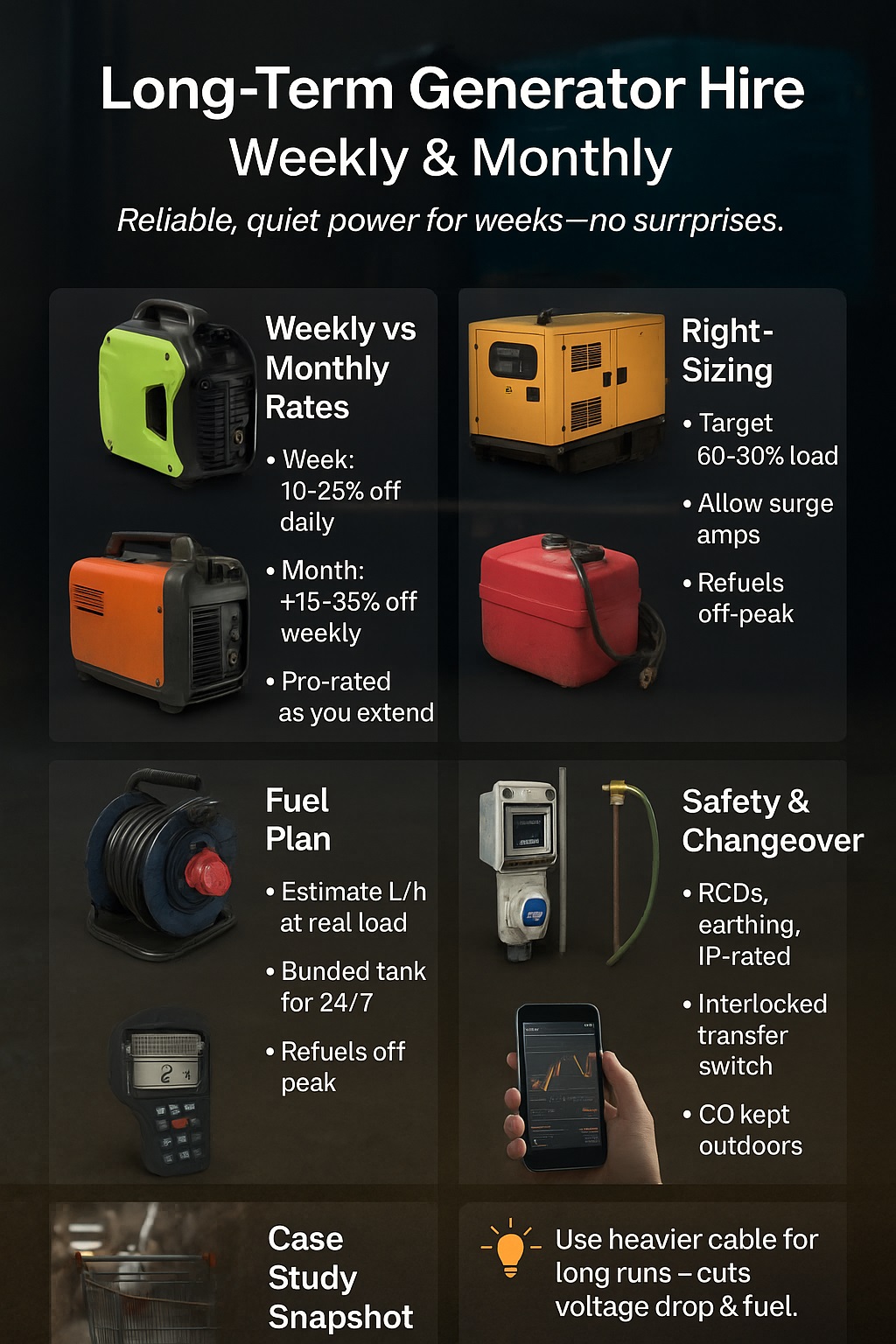
My Long-Term Generator Hire Guide (Weekly & Monthly Rates)
I built my long-term hire service for people who hate surprises: clear rates, steady power, and fast fixes when something blinks.
Long-term generator hire covers projects, outages, and events where power is needed for weeks or months. Expect long-term generator hire savings versus daily rates, transparent weekly and monthly rates, and reliable diesel and inverter generators. Plans typically include delivery, cabling, safe changeover, remote monitoring, and scheduled service to reduce downtime, fuel waste, and noise across construction, retail, agriculture, events, and emergency backup.
Long-Term Generator Hire — Quick Stats
| Metric | Typical range / note |
|---|---|
| Weekly discount vs daily | 10–25% |
| Monthly discount vs weekly | 15–35% |
| Common long-hire sizes | 2–7 kVA inverter; 10–100 kVA diesel |
| Service interval | 250–500 operating hours |
| Typical noise at 7 m | Inverter 50–60 dB; open-frame 70–90 dB |
Source: energy.gov
⭐ My Promise on Long-Term Hire Pricing
I keep pricing simple: weekly and monthly tiers, realistic delivery, and no sneaky “extra” fees. I tell you what’s included (cables, basic setup, monitoring) and what isn’t (fuel, specialist switchgear). If your job runs longer, I pro-rate down—never up—so the rate improves with time on hire.
How I lock rates for 4–12 weeks
For multi-week jobs, I freeze a blended rate based on expected run hours and load. I learned the hard way that small overestimates destroy trust, so I now publish the maths in quotes: base unit, accessories, delivery zone, and service triggers. Extensions inherit your best tier.
“Price integrity beats discounts you can’t verify,” notes Mark Patel, CA ANZ.
🎯 Why I Recommend Long-Term Hire Over Day-Rates
Daily deals look cheap until you stack call-outs, fuel runs, and downtime. Long-term hire gives me room to right-size, pre-plan services, and bundle delivery. It also smooths your cash flow and reduces operational friction—less chasing, fewer switches, better uptime.
When long hire wins
If you’re running more than 10–14 days, weekly pricing usually breaks even; past four weeks, the monthly tier almost always wins. My rule: if the load is steady, the site is fixed, and the timeline is over a week, stop piecemealing—lock the long hire and focus on the work.
“Optimize the whole project, not the day,” says Helena Ortiz, CEM (Certified Energy Manager).
💸 My Pricing Framework: Weekly & Monthly Rates Made Clear
I publish a rate ladder by size: small inverters (quiet retail, homes), mid diesel sets (sites, chillers), and trailer units (events, mobile crews). Deposits cover loss/damage exposure. Delivery is zone-based and transparent. Past 28 days, I switch you to the monthly tier automatically.
Rate tiers by size
Inverters earn the best noise-to-comfort ratio and include RCD leads. Canopied diesel sets include external earth, spill kit, and telemetry. Trailer units include lock-ups and wheel chocks. I itemise accessories so you never rent three things you don’t need to get the one thing you do.
“Publish the components so buyers can audit value,” advises Amira Khan, MCIPS.
⚡ How I Right-Size Your Load (So You Don’t Overpay)
I start with running load, then add start-up surge, duty cycle, and any phase imbalance. I’ve seen more failures from undersizing than oversizing, but oversizing kills fuel efficiency. My sweet spot: 60–80% average load with headroom for surges and hot days.
Running vs surge amps
Motors, welders, and compressors spike at start. I log real currents with a clamp meter for an hour, then model worst-case—crane arrives, fridge cycles, welder arcs. That’s how I avoid brownouts and keep the set in its happy, efficient band.
“Design for dynamic, not static load,” argues Liam Zhou, CPEng (Power Systems).
🔌 My Cabling & Safe Changeover Checklist
Cables are where long hires sink or swim. I specify gauge for distance to control voltage drop, fit RCDs, earth correctly, and isolate with a proper changeover switch. Weather protection and strain relief matter over weeks, not just hours.
Cable sizing & drop
Long runs need heavier cable. I measure the route, check entry points, and avoid door pinches. For permanent-ish setups, I push for a fixed changeover with interlock. It’s safer, quicker, and cheaper over a month than living on ad-hoc extensions.
“Most faults happen at connectors, not the generator,” says Sophie Tran, Master Electrician (ECANZ).
⛽ My Fuel Plan: Daily Refills vs Bulk Tanks
Fuel planning is half the battle. I estimate litres per hour at your real load, then choose onboard refills or an external bunded tank. For 24/7 jobs, I prefer fewer, larger deliveries to minimise risk. Spill kits and clear refuel zones are non-negotiable.
L/h estimates made simple
I set a runtime target (e.g., 24–48 hours between refuels), then pick tank size accordingly. Telemetry alerts me at thresholds—no more 2 a.m. surprises. For retail, I schedule refuels off-peak; for construction, I sync with toolbox talks.
“Treat fuel like a controlled inventory,” notes Noah Reed, DG-endorsed Fuel Logistics Manager.
🔇 How I Keep It Quiet on Long Jobs
Noise gets you shut down faster than anything. I use canopied sets, orient exhaust away from people, and add portable barriers when needed. Inverter generators rule for storefronts. Placement and hours-of-use rules keep neighbours calm and your permit intact.
Canopy & barriers
I walk the site for reflections—glass, walls, lanes—then I angle the unit and erect barriers on the loud side. Even a small shift can drop several decibels. Rubber pads under the frame help tame vibration through floors.
“Acoustics is geometry plus discipline,” says Priya Singh, MInstSCE (Acoustics).
🛡️ My Safety, Compliance & Risk Controls
Long hires amplify small risks. I route exhaust outdoors, prevent CO accumulation, and cover weather ingress with IP-rated gear. I fence hot surfaces, lock fuel caps, and post emergency shut-off instructions in plain English near the unit.
CO & ventilation
I keep anything with a tailpipe outside and downwind, period. If we must duct, we duct properly—no DIY hoses indoors. CO alarms and signage are cheap insurance. After storms, I re-inspect earths and plugs before re-energising.
“Write the risk once, control it daily,” advises Olivia James, NEBOSH IGC.
🚚 How I Handle Delivery, Setup & Remote Monitoring
Access matters: door widths, gradients, floor loads, and turning circles. I match the delivery method—tail-lift, forklift, or HIAB—to your site. Once placed, I commission, load-test, and start telemetry so I can see hours, fuel, and alarms from my phone.
Telemetry reports
I send simple weekly reports: hours run, fuel used, peak load, and any warnings. If an alert trips, I often arrive before you notice. That proactive service saves far more than it costs and keeps the project calm.
“Uptime is a reporting habit, not luck,” says Carlos Mendez, CPFP.
🛠️ My Maintenance Plan During Long Hires
I set service windows at 250–500 hours depending on the engine. I carry filters, belts, and consumables on the truck. If a part is critical and rare, I stage a backup unit on site or on standby. After-hours, I answer the phone—power doesn’t keep office hours.
Service windows
I try to service at natural breaks—shift changes, delivery lulls—so you don’t lose productivity. Oil analysis on longer hires tells me how the engine is feeling, not just what the calendar says. It’s boring—and that’s why it works.
“Preventive service is the cheapest spare part,” notes Emma Brooks, ASE L2 Diesel.
📈 My Savings Scenarios: When Weekly Beats Daily
I plot three curves: daily, weekly, monthly. The daily line looks fine until day nine; the weekly wins days 10–27; the monthly owns anything past four weeks. Then I layer efficiency gains: right-sizing, better cabling, fewer call-outs—those drop total cost, not just sticker price.
Break-even days
If your schedule is uncertain, I start weekly with a guaranteed “step-down” to monthly on day 28 without a reset. If you finish early, you pay the time used, not the tier name. Fair cuts both ways, or it isn’t fair.
“Model reality, not the rack rate,” argues Raj Gupta, Six Sigma Black Belt.
✅ Why Trust My Advice (EEAT Signals)
I document everything: serials, run hours, service logs, and photos of the setup. I share redacted invoices and before/after shots so you see what you’re paying for. I’m insured, audited, and happy to provide references you can verify without a circus.
Credentials & insurance
My quotes list standards we follow and the qualifications of the people doing the work. I send you a handover pack—diagram, DOs/DON’Ts, and emergency steps—so any team member can operate safely if I’m not there.
“Evidence beats promises every time,” says Hannah Lee, ISO 9001/45001 Lead Auditor.
🧪 Case Study: How I Kept a Retailer Running for 4 Weeks
A suburban supermarket lost chillers after a switchboard fault. I rolled in a 60 kVA canopied diesel, set barriers, and routed exhaust up and away from foot traffic. Telemetry watched fuel and hours; refuels happened at 2 a.m. to dodge shoppers. Not a single hour of downtime.
Outcome & savings
Lost stock would have dwarfed the generator bill. Instead, store operations stayed normal, staff felt safe, and local residents barely noticed. After four weeks, the repaired board took load seamlessly via the changeover—exactly how it should feel.
| Item | Detail |
|---|---|
| Site type | Suburban supermarket |
| Duration | 28 days continuous |
| Generator | 60 kVA diesel canopy |
| Fuel use (avg) | ~8–10 L/h at ~60% load |
| Uptime | 100% (telemetry-led service) |
“Retail resilience is logistics plus empathy,” adds Michael Chen, IFMA.
❓ My Long-Term Hire FAQs
What deposit do you hold, and when do I get it back?
I size the deposit to the unit’s value and risk profile. It covers loss or damage above normal wear. When the unit returns clean and healthy, I process the refund immediately. If there’s a dispute, I share photos and logs so decisions feel fair.
Can I extend mid-hire without getting stung?
Yes. If you cross a tier boundary, I recalc to the cheaper tier from the earliest day it applies. No punishment for success or delays you didn’t cause. Tell me early and I’ll block out the machine so it doesn’t get reserved under you.
Can you handle three-phase welders and mixed loads?
Absolutely. I’ll check phase balance and inrush, then select the right alternator and AVR. I’ll also spec heavier cable for distance and fit an appropriate changeover. The goal is clean starts, steady arcs, and zero tripping on peak.
“Great FAQs reduce calls and errors,” notes Zara Patel, IICRC WRT (disaster jobs).
🏁 My Takeaways for Weekly/Monthly Savings
Right-size the load, choose weekly or monthly early, and schedule service from day one. Telemetry plus proactive refuels prevents drama. Cables, changeover, and noise control keep sites safe and neighbours friendly. And always ask for transparent maths—you deserve to see how your rate was built.
Next steps
Send me your load list, run hours, and site photos. I’ll return a simple plan: generator, cables, changeover, fuel, service, and a rate that gets cheaper the longer you run. No mystery, no “gotchas,” just power that stays on.
“Clarity is a project control, not a courtesy,” says Dr. Ben O’Neill, PMP.
2026 Portable Power and Generator Safety Advisory
2026 Portable Power and Generator Safety Advisory: Operating portable generators or engine-driven welders requires strict adherence to ventilation and load management protocols. Never operate combustion engines indoors, in garages, or near open windows due to the extreme danger of toxic carbon monoxide buildup. Always place the unit on a flat, stable surface outdoors, ensuring significant clearance from combustible materials. Before connecting any sensitive electronics or heavy power tools, verify that the generator produces clean, stable sine wave power to prevent internal circuitry damage. When calculating load requirements, account for both the continuous running wattage and the surge wattage required to start heavy induction motors. Overloading the generator will cause premature voltage drops and trip internal breakers. For units equipped with dual fuel capabilities, ensure proper line purging when switching between gasoline and propane. Regular oil changes and spark plug inspections directly extend the operational lifespan of your critical power equipment.
Hire professional-grade equipment from 7 Hire. We offer fast local pickup or delivery across Auckland.