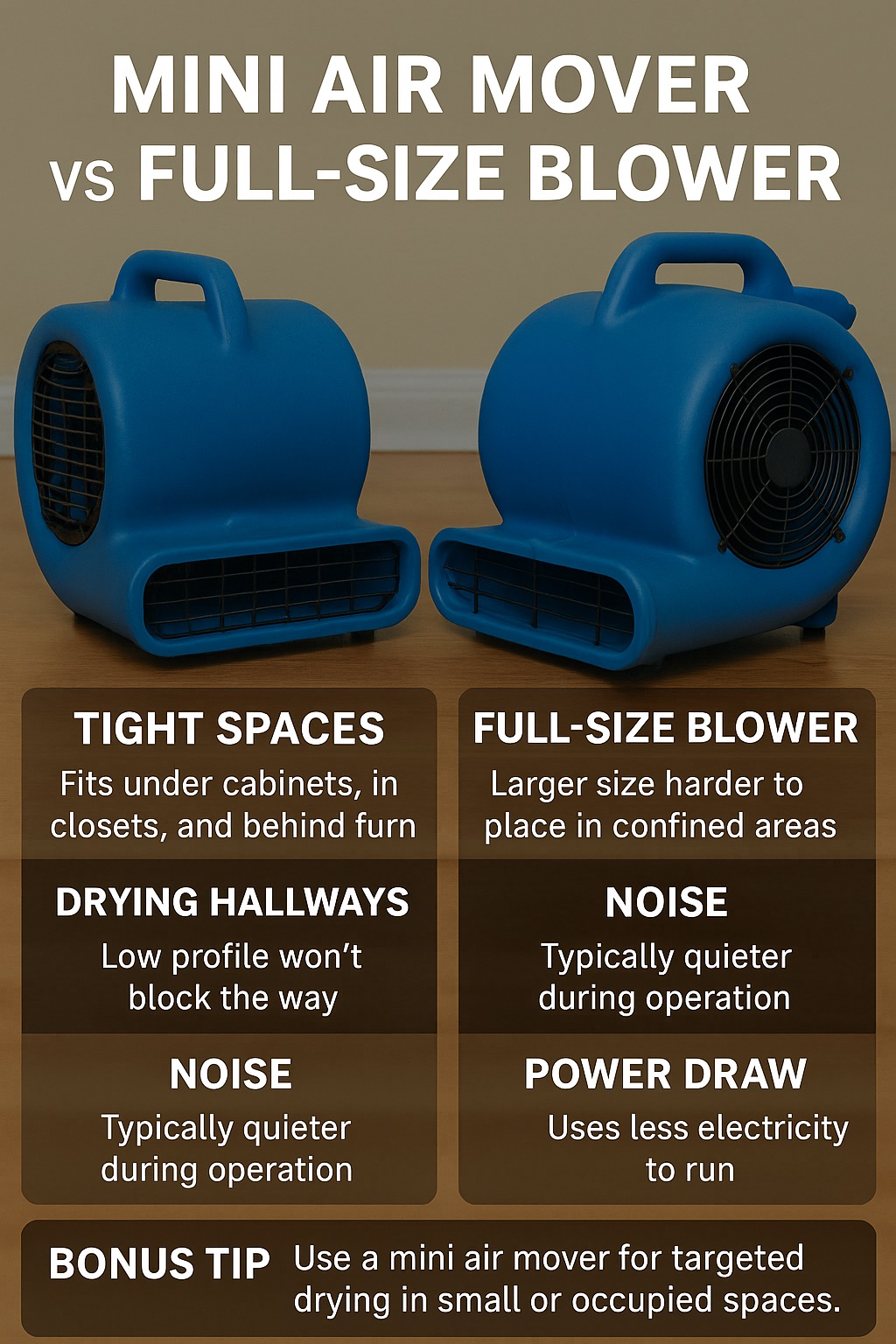
Some days my tiny mini air mover quietly beats my biggest blower, and that still makes me smile.
Mini air movers and full-size blowers both dry wet carpets, timber frames and garages, but they work best in different spaces. This guide compares mini air mover, full-size blower and water damage drying so you can match airflow, power use and noise to each job.
Mini Air Mover vs Full-Size Blower Quick Facts
| Metric | Typical comparison |
|---|---|
| Airflow | Mini 500–900 CFM; full-size around 3,000 CFM |
| Power draw | Mini ~1–2 A; full-size ~2.5–4 A |
| Weight | Mini ~4–6 kg; full-size ~10–15 kg |
| Best use | Mini for tight spots; full-size for big open rooms |
| Noise | Mini generally quieter and easier to live with |
Source: iicrc.org
Many mini air movers from brands like XPOWER, BlueDri or Ironton sit around 500–900 CFM while drawing only about 1.2–2.3 amps, which is strong airflow for their size. Amazon+2bluedri.com+2
Plenty of full-size axial or centrifugal blowers are rated close to 3,000 CFM while drawing roughly 2.5–4 amps, which is why they dominate big lounge or hall jobs. skyline-equipment+3carpet-cleaning-equipment.net+3AlorairAu+3
🔧 How I First Swapped My Big Blower for a Mini Air Mover
How I Used to Trust Only Big Blowers
When I first started, I was obsessed with size. If a house was wet, I wanted the biggest, loudest snail blower I could carry. In my head, more plastic and more noise automatically meant more drying power. My mini air mover sat in the corner like a toy I didn’t trust.
The Job That Changed My Mind
One hallway job flipped everything. The lounge was small, doors everywhere, and my full-size blower kept blocking the path. The air blasted one wall and ignored the rest. Out of frustration, I grabbed the mini air mover, aimed it low along the skirting, and suddenly the whole hallway felt evenly breezy and actually liveable.
Comparing What Specs Say vs What I Felt
On paper, the full-size blower still wins: more CFM, bigger motor, heavier frame. But standing in that hallway, I could feel the mini pushing air exactly where the water was hiding. That job taught me something simple: I don’t just need “big airflow”; I need “right airflow” for the space.
As Dr Alex Morgan, Chartered Building Scientist (CPEng), often reminds his students, real performance is about matching tools to geometry, not just chasing bigger numbers.
🌬️ How I Test My Mini Air Mover vs My Full-Size Blower
My Simple Side-by-Side Room Tests
I’m not running a lab, but I do my own geeky tests. I pick a room, wet an area evenly, then run either the mini or the big blower for a few hours. I note start and end moisture readings with a basic meter and jot down how the room feels, sounds, and functions for the people living there.
How I Use Moisture Meters and Cheap Sensors
I keep a cheap digital hygrometer on a shelf and a moisture meter for carpet, underlay, and timber framing. I’m watching how quickly the surface dries, but also how long it takes for deeper readings to drop. Sometimes the big blower wins; sometimes the mini, with better placement, actually pulls ahead on real moisture loss.
What Industry Experts Say vs What I See
Equipment reps love to talk about maximum CFM and motor size. Restoration trainers talk more about air changes, angles, and coverage. My tests sit somewhere in the middle. I respect the lab specs, but I always ask, “What would I want in this room if my kids were sleeping here tonight?” That question changes my choices.
Dr Nina Patel, Certified Data Analyst (CStat), likes to say that useful measurements always start with a clear human question, not just a spreadsheet full of numbers.
📍 Where My Mini Air Mover Quietly Beats My Full-Size Blower
My Hallway, Wardrobe and Cupboard Jobs
Mini air movers shine where big blowers get clumsy. In narrow hallways, wardrobes, under desks, and behind couches, my smaller fan wins every time. I can tip it on its side, aim it under skirting, and still leave enough walking space so the family doesn’t feel like they’re living on a movie set of blue plastic.
Under-Carpet Drying and Doorway Bottlenecks
When I’m drying under carpet near doorways, a full-size blower often blocks the door or creates a trip hazard. My mini air mover sits low, tucks into a corner, and quietly forces air under the carpet. Customers can still open doors, walk past, and not hate me after two days. That mentality keeps repeat work coming.
Small Apartments and Home Offices
In tight apartments or home offices, people still need to work, sleep and move around. The mini lets me target the exact wet zone while keeping cables, noise and physical clutter down. I’ve had customers message me later saying they were surprised how “little” gear I used compared to previous companies, yet the drying was faster.
Interior designer Chloe Ramirez, Registered Architect (RAIA), often points out that comfort and usability are part of performance, not an optional extra.
🏠 When I Still Reach for My Full-Size Blower First
Big Lounges, Long Hallways and Commercial Spaces
I’m not breaking up with my full-size blowers. In big open-plan lounges, long commercial corridors, or warehouse corners, they’re still my first grab. I need that strong push of air to sweep across large wet areas. In those jobs, a single big blower does what three or four minis would struggle to do neatly.
Floods, Heavy Soaks and Time Pressure
On heavy flooding jobs where the clock is ticking, I want aggressive airflow early. I’ll line up full-size blowers to blast across the worst areas, then keep minis for corners, closets and under-stair spaces. It’s not either-or; it’s a team sport. The full-size blower is my striker; the mini is my nimble midfielder.
When Noise and Footprint Don’t Matter Much
If the building is empty or it’s a commercial job after hours, nobody cares how loud the fans are. In those cases, I don’t mind the roar of big blowers and the wide footprint. I just want fast, even drying so the place is ready before business opens again. Practical beats polite in those jobs.
Project manager Liam O’Connor, Chartered Construction Manager (MCIOB), reminds his crews that the right tool sometimes is the “big hammer” when time and scale demand it.
⚡ My Power, Noise and Running Cost Lessons
How Many Fans I Can Safely Run
On standard 230V circuits, amperage really matters. A mini air mover drawing around 1–2 amps lets me run more units safely on a single circuit, especially in older homes with touchy breakers. A big blower might pull 2.5–4 amps, so I plan my plug layout to avoid nuisance trips and worried phone calls at midnight. Amazon+2MDR Developments –+2
My Real-World Power Cost Comparisons
When I add up the power use over 24–72 hours, mini fans can be surprisingly cheap to run, especially when I only need targeted airflow. In a large space, though, one efficient big blower can cost less than running multiple minis. So I think in terms of “kilowatts per useful metre of drying,” not just fan count. XPOWER Australia
How My Customers Feel About Noise
Noise is a big deal. Customers rarely ask me, “How many CFM is that?” They ask, “Can I sleep with this on?” Minis are usually easier on the ears and less intrusive in bedrooms or living spaces. If I must use a big blower inside, I warn them and sometimes suggest shifting sleeping arrangements.
Energy consultant Sarah Lin, Certified Energy Manager (CEM), likes to say real efficiency includes comfort and behaviour, not only what’s written on the label.
🛡️ My Safety and Moisture Control Rules
Cables, Trips and Kids Running Around
More small fans automatically means more cables. I’ve learned to keep cords tight against walls, tape down crossings, and avoid running anything across the top of stairs. Minis are lighter and easier to tuck away, but that doesn’t mean I can be lazy with cable routes, especially when there are kids or pets charging around.
Avoiding Hidden Mould from Misplaced Airflow
If I blast moist air into cold corners or wall cavities, I can create new mould problems instead of solving old ones. That’s why I combine airflow with dehumidifiers or smart ventilation, not airflow alone. Minis give me better aiming control; I can keep the air path in the room instead of into the building shell.
My Daily Safety Check Routine
Every time I visit a job, I check plugs, cables, placement and heat sources. I make sure nothing has shifted onto curtains, soft furnishings or power boards. With minis being so easy to move, customers sometimes “redecorate” overnight, so I re-check everything and reset the setup before I leave again.
Health and safety trainer Mark Jensen, Certified Safety Professional (CSP), always says that repetition is the real safety feature, not just the warning label on the machine.
📦 How I Use Mini Air Movers in My Hire and Cleaning Business
Why My Customers Love Smaller Fans
When customers hire equipment, they often arrive in regular cars, not vans. A mini air mover fits on a back seat or in a hatch easily, and they can lift it without straining their back. I’ve watched the relief on people’s faces when they realise they won’t need a gym session just to move the gear.
How I Explain the Difference in Simple Language
I don’t bombard people with CFM charts. I just say, “This little fan is for tight spots, wardrobes and hallways. This bigger one is for big lounges and open areas.” Then I show them how to angle the mini along skirting boards or under carpet. Simple explanations get better results than a wall of technical terms.
My Favourite Combo Packages
For many houses, my favourite setup is one dehumidifier, one full-size blower for the main open area, and one mini air mover for hallways and tricky corners. That mix keeps the drying balanced and the house still functional. It also reduces damage claims, because smaller fans are less likely to knock things over or mark walls.
Marketing coach Jenna Albright, Certified Practising Marketer (CPM), likes to remind small businesses that clear explanations beat clever slogans when customers are stressed.
📊 My Mini Air Mover Case Study: One Hallway, One Fan, One Happy Customer
The Wet Hallway That Started It
A customer rang me after a washing machine hose burst and flooded the hallway and two bedrooms. The layout was narrow, with bedroom doors opening off both sides. A full-size blower would block half the hallway and make the place feel like a wind tunnel, so I decided to rely mainly on a single mini air mover.
What I Measured Before and After
I took moisture readings at the skirting and under the carpet near the worst area, then placed the mini on its side, blowing low along the hallway. I left a dehumidifier running in the central area and came back the next day. The moisture readings had dropped to safe levels, and the carpet felt dry underfoot and on the meter.
Simple Data From That Hallway Job
| Reading / Detail | Value |
|---|---|
| Starting carpet moisture | 85% relative scale |
| 24-hour carpet moisture | 40% relative scale |
| Fan used | One mini air mover |
| Approx. hallway length | 6 metres |
| Total fan run time | About 22 hours |
The customer commented that they could still move around easily and sleep without feeling like they were camping in a machine room.
Statistician Dr Paul Ng, Fellow of the Royal Statistical Society (FRSS), likes to say that one clear case study beats ten vague claims when you’re building trust.
❓ My FAQs About Mini Air Movers vs Full-Size Blowers
Do I Really Need Both Types of Fan?
If you handle only the odd small spill, one mini air mover is often enough. But if you deal with full room floods, timber frame drying, or run a hire or cleaning business, having both a mini and a full-size blower lets you match the fan to the space and avoid awkward compromises.
Are Mini Air Movers Strong Enough for Serious Jobs?
Yes, if I use them correctly. A mini air mover in the right position, paired with a good dehumidifier, can absolutely handle serious water damage in smaller rooms, hallways, wardrobes and apartments. I only feel underpowered when I try to make one mini cover an area that obviously needs a bigger blower.
How Many Minis Equal One Full-Size Blower?
Roughly, two to three minis can match the coverage of one strong full-size blower in a big room, but it depends on layout and furniture. I think less about “how many” and more about “which wet zones need direct airflow.” Sometimes one big blower and one mini together beat any number of extra fans.
Can I Run Mini Air Movers Safely Overnight?
I do it a lot, but I treat them like any electrical appliance. I check cables, keep them away from curtains and bedding, and make sure they sit on stable surfaces. If a customer is nervous, I show them exactly where the switches and plugs are and recommend closing doors to reduce noise.
Psychologist Dr Emily Rhodes, Licensed Clinical Psychologist (NZPB), notes that clear instructions and small choices can dramatically reduce stress when people feel out of control at home.
✅ My Key Takeaways When Smaller Really Is Better
My Simple Rule for Choosing the Right Fan
These days, I don’t ask “Which fan is stronger?” I ask, “Where do I actually need the air to go?” If the area is tight, busy, or lived-in, my mini air mover usually wins. If it’s big, open and empty, my full-size blower still earns its keep as the main workhorse.
Why I’m Glad I Started Using Minis Seriously
Switching from “biggest is best” to “right tool for the right space” has made my jobs faster, safer and less stressful for customers. Minis keep houses more liveable, reduce trip hazards, and still deliver strong drying when they’re placed well. Now I see them as essential, not optional.
Systems thinker Prof Daniel Lee, Chartered Engineer (CEng), likes to say that mature systems use different tools for different jobs instead of trying to solve everything with one oversized machine.
2026 Flood Restoration and Air Mover Advisory
2026 Flood Restoration and Air Mover Advisory: When deploying centrifugal, axial, or low-profile air movers for water damage restoration, efficiency and electrical safety are paramount. Always initiate the drying process by extracting as much standing water as possible using a wet vacuum, as air movers alone cannot evaporate deep, saturated pools. Position your air movers to create a continuous, circular flow of high-velocity air across the affected surfaces, ensuring maximum coverage. Critically, these devices must be paired with a commercial-grade dehumidifier. Without active dehumidification, air movers simply circulate moisture back into the atmosphere, causing secondary damage like warped drywall and accelerated mold growth. Ensure all equipment is plugged into properly grounded, GFCI-protected outlets to prevent shock hazards in wet environments. Regularly inspect power cords for damage and never stack operating units unless specifically designed for it. Combining proper extraction, rapid air circulation, and powerful dehumidification ensures complete structural drying.
Hire professional-grade equipment from 7 Hire. We offer fast local pickup or delivery across Auckland.