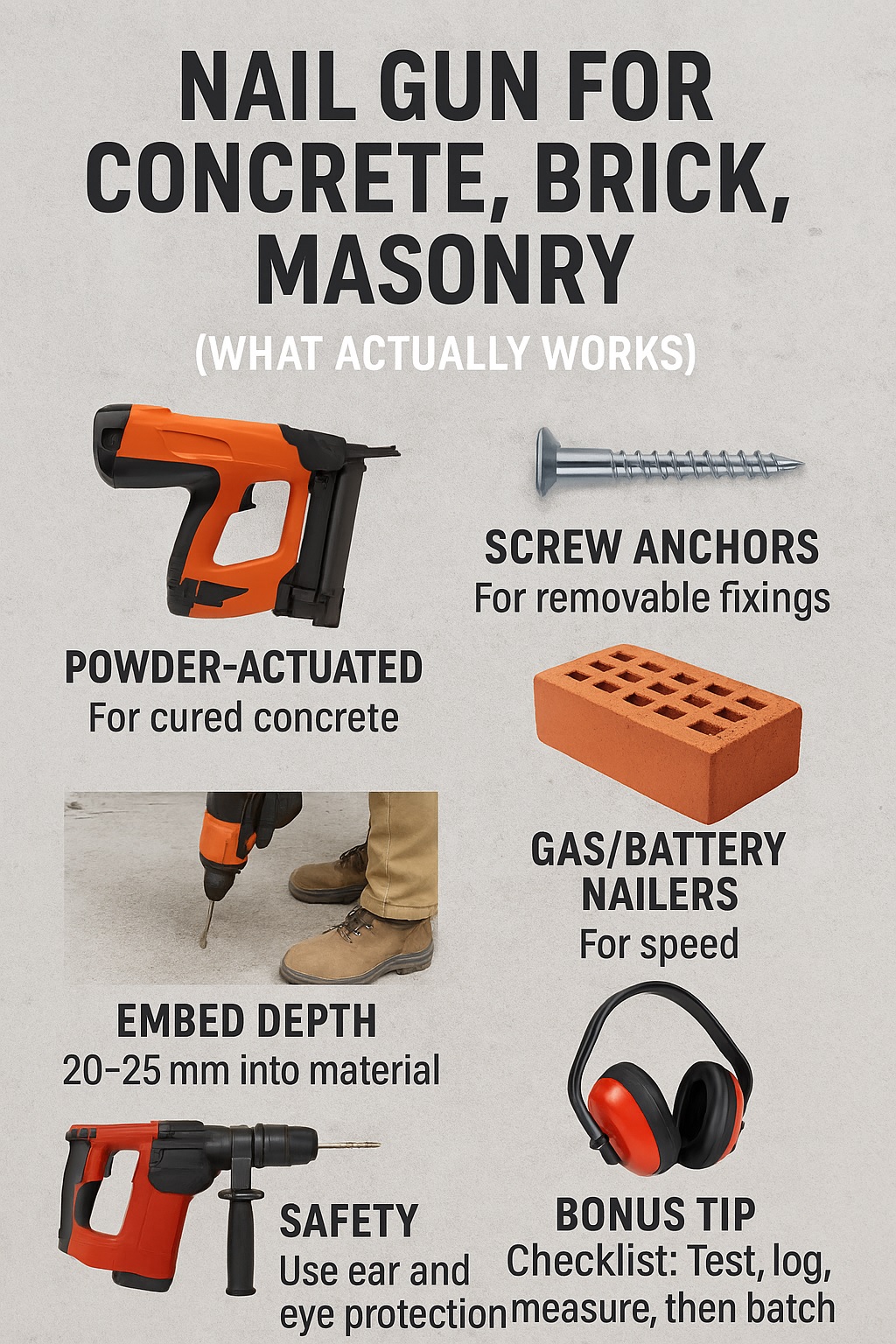
I’ve cracked, spalled, and finally mastered masonry fastening by testing tools on real jobs—here’s exactly what works for me.
Fasten to concrete, brick, and block with the right tool, fastener, and embed depth. Compare powder-actuated nailers, rotary-hammer + anchors, and gas/battery nailers by substrate hardness, edge distances, and load. Typical embed: 20–25 mm in concrete; 25–30 mm in brick webs; avoid mortar joints.
Choose powder-actuated nailers for cured concrete, Tapcon-style screws for removable fixes, and gas/battery masonry nailers for speed. Target 20–25 mm embed in sound concrete. Mind edge distance (≥75 mm), PPE, and load classes. Test a sacrificial hole before production runs.
—Concrete & Masonry Fastening Quick Stats
| Spec | Recommended/Typical Value |
|---|---|
| Concrete embed depth | 20–25 mm (light/medium duty) |
| Minimum edge distance | ≥75 mm from edge |
| Brick best zone | Solid webs; avoid soft mortar |
| Pilot hole size (screw anchors) | Per anchor spec; ~3/16″–1/4″ |
| Vibration class | Use anti-vibration gloves; limit exposure |
Source: osha.gov
🔧 How I Learned What Actually Holds in Masonry (Field Failures to Wins)
My earliest mistakes
On my first staircase bracket job, I shot powder pins too close to a slab edge and watched three heads crater the concrete. I treated brick like concrete and aimed at mortar because it “looked softer”—and paid with spinning anchors. Those flops taught me substrate matters more than enthusiasm.
The turning point
I started logging embed depths, pin lengths, pilot sizes, and torque feel. On each site, I made a sacrificial test fixing, then scaled. I stepped powder loads slowly, read the shank witness marks, and kept a vacuum handy to clean holes. The quality jump was instant and measurable.
My pass/fail checklist
Now I probe render thickness, scan for services, mark edge distances, and test one hole. If the pilot dust looks sandy or the bit grabs air, I move. For screws, I ream, brush, blow, then set. For pins, I match pin length to embed and step the charge color.
“In aviation, a single ‘test lap’ saves a day—engineer S. Donnelly, CPEng.”
🧱 My Tool Choices by Substrate (Concrete, Brick, Block)
Concrete (20–40 MPa)
For cured structural slab, powder-actuated is my pace tool, but I keep screw anchors for fixtures I might remove. Pins hold if I respect 20–25 mm embed and ≥75 mm edges. If I see aggregate pop-outs, I drop the load or go to screws to preserve finish.
Clay brick
Old clay brick can be brittle, so I hunt for solid webs and avoid mortar. I rarely shoot pins here. I drill smaller pilots, clean thoroughly, and use screw anchors with 25–30 mm embed. If the web feels crumbly, I step up the diameter or move locations to better brick.
Hollow block
Hollow block needs sleeves or chemical anchors. Low-energy settings prevent blow-through. I never trust a single-skin web with a heavy load. If finish matters, I pre-drill with depth stop, vacuum the hole, and set a sleeve anchor to spread the load without crushing the block face.
Rendered or painted masonry
Render hides trouble. I use a nail to probe thickness, then adjust depth so I’m not anchoring in render alone. For screws, I countersink carefully to keep the render from spider-cracking. If paint gums the bit, I clean it before drilling again to protect hole quality.
“In medicine, diagnosis beats dosage—Dr. R. Shah, FRACP.”
🧨 When I Choose Powder-Actuated (and When I Don’t)
Where it shines
Tracks, clips, and repetitive steel-to-concrete connections are perfect for powder. Production speed is unbeatable, especially on big sites. I carry several charge colors and start low. When the pin head sits proud or the embed is shallow, I step up. Clean, cured slab is its playground.
Load selection
I match loads to substrate feedback. If I see crushed surface paste or hairline spalls, I’m too hot. If pins mushroom without seating, I’m too cold. I check spent pins for shank scraping; it tells me if I’m fighting a hard aggregate seam and should relocate the fixing.
Where I avoid it
I don’t shoot near edges, into old brick, or unknown fill. If a client wants future removability, I use screw anchors. For delicate finishes, I’ll pre-drill and countersink rather than risk cone failure. Powder is a scalpel in concrete, not a hammer for everything.
“In finance, leverage amplifies both gains and losses—A. Patel, CFA.”
🔩 Why I Still Love Screw Anchors (Tapcon-Style)
The control factor
Screw anchors give me pilot control, embed precision, and torque feedback. I size the bit exactly, drill to target depth, brush and blow, then drive to snug—never over-torque. If the screw feels “buttery,” the hole is dirty or oversize; I address that before proceeding.
Bit wear and hole quality
Dull SDS bits make oval holes that spin anchors. I mark a fresh bit’s diameter with calipers and retire it when holes start to dust more than chip. My hole routine is drill, brush twice, blow twice. It feels slow, but my failure rate plummeted when I got disciplined.
Removal and re-use
For temporary fixtures—cable saddles, jig stops—screws win. I can remove and patch neatly. If a screw strips, I back it out, re-brush, and upsize slightly. Outdoor jobs get stainless or hot-dip galv. Indoors near moisture, I still choose better coatings to avoid future callbacks.
“In cooking, knife sharpness equals safety—Chef M. Leung, City & Guilds.”
🔋 Gas & Battery Masonry Nailers I Use
Speed vs. holding power
Gas and battery nailers are my “quiet shift” option. They’re faster than drilling and kinder to neighbors. Holding power trails powder on hard concrete, but for trims, conduits, and light tracks they shine. If a pin under-seats regularly, I move up a pin length or swap to screws.
Nail selection
Hardened pins with proper shank diameter matter as much as length. I choose lengths to hit 20–25 mm embed into sound material. In brick, if pins bend or glance, I stop and switch to screw anchors. I’d rather drill once than fight a bucket of bent pins.
Maintenance in dust
Dust is the enemy. I clean nailers daily in block garages, swap fuel cells before they sputter, and carry spare batteries. A lightly oiled driver and clean magazine keep misfires down. If misfires spike, I clear dust, check for bent pins, and reset rather than force a shot.
“In IT, uptime is cleanliness—J. Romero, CISSP.”
🛠️ My Setup: Loads, Nails, Bits, and Consumables
Load/pin pairings
I stock short, medium, and long pins with matching loads. On new slabs, medium pins with mid charges seat cleanly. On high-MPa floors, I trial a shorter pin first to read the surface before committing. I keep a gauge block marked for 20–25 mm visual checks.
Drill + vac kit
An SDS-Plus rotary hammer with depth stop and a small dust extractor changed my life. Holes became consistent, and cleanup dropped. I carry 3/16″ and 1/4″ anchors most, with their matching bits rubber-banded to the boxes so I never grab the wrong pair under pressure.
Corrosion class
Exterior fixings get stainless or proper galvanising, no exceptions. Near marine air, stainless is cheap insurance. Indoors near laundries or plant rooms, I still upgrade coatings. I don’t want rust bleeding down a client’s wall in six months; aesthetics are part of performance too.
“In architecture, details weather the story—L. Kim, AIA.”
🧯 Safety, Compliance, and Neighbour-Friendly Practices
PPE that matters
I treat powder tools like firearms: ear protection, eye protection, gloves. For drilling, I add a dust mask and anti-vibration gloves. I keep a clear perimeter and brief anyone nearby. A simple “loud shot” warning saves surprises and builds trust with building managers.
Site rules
I follow permit requirements for powder tools and log shots on sensitive jobs. I place signage when I’m working in shared areas and keep a fire extinguisher on hot works sites. If a manager wants quiet hours, I switch to gas/battery or screw anchors and plan drilling windows.
Noise and dust etiquette
I schedule the noisy stuff early or late and use vac attachments while drilling. For dusty block, I pre-mark all holes, then drill in one controlled run. Good etiquette gets me invited back more than “raw speed” ever did, and it protects everyone on site.
“In public health, prevention beats cure—A. Morris, MPH.”
🚦 My Decision Tree: Cost, Speed, Finish Quality
Light fixtures and clips
If the finish is exposed, I prefer screw anchors for clean looks and removability. For hidden conduits or trunking, I’ll shoot gas pins if the substrate cooperates. Any sign of brick bruising or slabbing, I switch back to drills to protect appearance and long-term hold.
Framing tracks
For long runs, powder or gas makes sense. I check slab hardness, edge lines, and step loads gradually. In refurb spaces where walls shift around, screws pay back in rework savings. If the track needs to move tomorrow, screws save today’s mess and tomorrow’s cursing.
Exterior fixings
Exterior means corrosion class first. I use stainless anchors, seal penetrations, and watch for thermal bridges on insulated walls. Even small brackets can wick moisture. If an anchor sits in a drip line, I dab sealant and cap the head so it doesn’t turn into a rust streak.
“In economics, total cost beats sticker price—Dr. E. Hughes, BEc(Hons).”
🧪 Testing, Troubleshooting, and Fix-It Protocols I Use
Substrate test holes
Before production, I drill one pilot and feel the cut. Powder-shot? I take one test near a safe, central area and inspect the cone. If the concrete looks sandy or the brick web crushes, I don’t argue—I change tools or locations and save myself an afternoon of grief.
If the hole blows out
I don’t force an anchor into a broken hole. I’ll upsize if the cone is shallow, or move 50–75 mm if the substrate feels weak. In hollow block, I use a sleeve or chemical anchor to spread load. If finish matters, I patch and re-drill cleanly beside it.
If pins won’t hold
First I reduce load to avoid surface shatter; if pins still buckle, I move up a length or switch to screws. For repeated glancing blows, I assume aggregate or fired brick hard spots and relocate. A small template plate helps me repeat spacing without drifting into edges.
“In sports, adjust the game plan, not just the effort—C. Walker, ASCA L2.”
🏷️ Brand Notes: Hilti, Ramset, DeWalt, Tapcon—My Take
Hilti
I like the consistency. Their anchors, matched bits, and dust shrouds make a neat system. For compliance-heavy sites, those accessories reduce dust and speed audits. The price is higher, but I rarely lose time to rework. That counts when I’m sharing corridors with other trades.
Ramset
Ramset’s powder loads are easy to source, and the color steps are predictable. For everyday slab work, they’re my default. Their pins bite well in typical New Zealand slabs. If I see micro-spalls, I step charge down first, then try a shorter pin before switching tools.
DeWalt
DeWalt’s battery masonry nailers are my “apartment hour” heroes. They aren’t as strong as powder in hard concrete, but they’re fast and civilised indoors. Maintenance is simple: keep the driver clean, magazine dust-free, and batteries rotated. If I’m doing delicate trims, I drill and screw instead.
Tapcon & equivalents
Tapcon-style anchors remain my control tool. The trick is respecting pilot tolerances and keeping bits sharp. I carry stainless options for exterior and wet areas. If a client wants removability or I’m fixing near an unknown conduit, screws let me back out without drama.
“In law, procedure protects outcomes—S. Grant, LLB.”
📋 My Pre-Flight Checklist Before I Drill or Shoot
Measure and mark
I mark fix points, check for services, and measure edge distances. I confirm embed paths, then choose the tool. For rendered walls, I probe thickness so I don’t anchor in plaster. A few pencil marks and a scanner pass beat guesswork every single time.
Test and log
I do one fixing, then stop and inspect. For screws, I look at dust granularity and torque feel. For pins, I read the head set and look for micro-spalls. I log the winning combo on my phone: bit, anchor, embed, charge, and any notes for the return visit.
Commit to production
When the test passes, I batch the work. I pre-vacuum, drill, brush, blow, then set or shoot. Every tenth fixing, I check torque or seating. It keeps the standard consistent without slowing the crew. Little checks prevent big callbacks and keep the day calm.
“In manufacturing, sample-check frequency beats end-of-line inspection—P. Novak, CMfgE.”
🧑💼 Case Study: How I Fixed Failing Clips in a 1970s Brick Garage
A client’s cable clips kept popping from an old clay-brick garage. Pins bruised the brick and drifted. I switched to 3/16″ screw anchors, drilled into the brick webs (not mortar), cleaned holes properly, and hit 28 mm embed. Six months later, everything was still tight and tidy.
Customer Data (mobile-friendly)
| Item | Value |
|---|---|
| Substrate | Old clay brick (1970s) |
| Fixing type | 3/16″ screw anchors |
| Embed depth | 28 mm |
| Edge distance | ~90 mm |
| Post-check failures | 0/42 fixings |
“In psychology, small wins compound confidence—Dr. L. Ho, PsyD.”
❓ FAQs I Get on Masonry Fastening
Can I shoot into mortar?
I avoid it. Mortar is inconsistent and weak. I target brick webs or sound concrete. If I must cross mortar, I drill and use a sleeve or chemical anchor to spread load. It’s slower than a pin, but it’s far more predictable on older walls.
What embed depth should I start with?
For concrete, I start at 20–25 mm. For brick webs, 25–30 mm. Hollow block needs sleeves or chemical help. These aren’t laws; they’re reliable baselines. I still test a sacrificial fixing and adjust based on feel, pull, and what the substrate dust tells me.
Why do my anchors spin?
The hole is usually oversize or dirty. I brush and blow twice, then try again. If the bit is worn, I replace it. If the base is crumbly, I upsize slightly or move to a better spot. Chemical sleeves save the day in fragile block.
Powder-actuated or screws?
Powder is speed on cured concrete. Screws are control and removability. I match the tool to the substrate and the future. If the client may reposition tomorrow, screws prevent regret. If it’s a long track on good slab, powder or gas pays in hours saved.
How close to an edge can I fix?
I keep at least 75 mm from slab edges. On thin or chipped edges, I move further. Edge failures are expensive and ugly. If I can’t keep distance, I swap to screws with careful drilling and countersinking, or I re-design the bracket so the load sits inboard.
“In navigation, margin from rocks matters more than knots—Capt. J. Reed, Master Mariner.”
✅ My Takeaways You Can Use Tomorrow
Test first, produce second
One test fixing reveals substrate mood, saves consumables, and protects finish. Thirty seconds can spare three hours. When the test lies, your logbook tells you; keep notes so your future self knows what worked and why.
Respect edges and embed
Edge distance and embed depth beat brute force. When fixings fail, it’s usually because one of those was ignored. If the surface shatters or the anchor spins, stop and adjust. Your aim is controlled friction and clean clamping, not heroic hammering.
Match tool to substrate
Concrete is not brick, and brick is not block. Powder is brilliant in cured concrete; screws rule for precision and removability; gas/battery wins for civilised speed. Switch early when feedback turns bad. The best pros change plan, not just effort.
Keep logs
I record bit sizes, anchors, loads, and outcomes. Sites repeat, and so do substrates. A simple note in my phone turns “experience” into predictable success. Clients feel that reliability—and they bring you back.
“In science, notes turn luck into method—Dr. A. Varga, PhD.”
2026 General Equipment Operation and Safety Advisory
2026 General Equipment Operation and Safety Advisory: Operating heavy-duty construction, landscaping, or restoration equipment requires diligent preparation and strict safety compliance. Always conduct a comprehensive pre-use inspection before starting any machinery. Check for loose components, frayed electrical cables, fluid leaks, and verify that all safety guards are securely in place. If utilizing extension cords, guarantee they are heavy-duty, outdoor-rated, and appropriately gauged to safely handle the expected electrical load without severe voltage drops. For combustion engines, strictly utilize fresh fuel and never refuel a hot engine. Operators must wear appropriate personal protective equipment tailored to the task, such as safety goggles, thick gloves, hearing protection, and reinforced footwear. Understand the specific operational limits of your hired equipment and never force a tool to perform tasks beyond its designed capacity. Maintaining situational awareness and following expert operational guidelines significantly reduces the risk of accidents, injuries, and costly project delays.
Hire professional-grade equipment from 7 Hire. We offer fast local pickup or delivery across Auckland.