How Loud Are Generators? My Quietest Options & The Noise Rules I Live By
Noise can ruin a backyard party, a jobsite, or a campsite faster than a dead battery. I learned that the hard way.
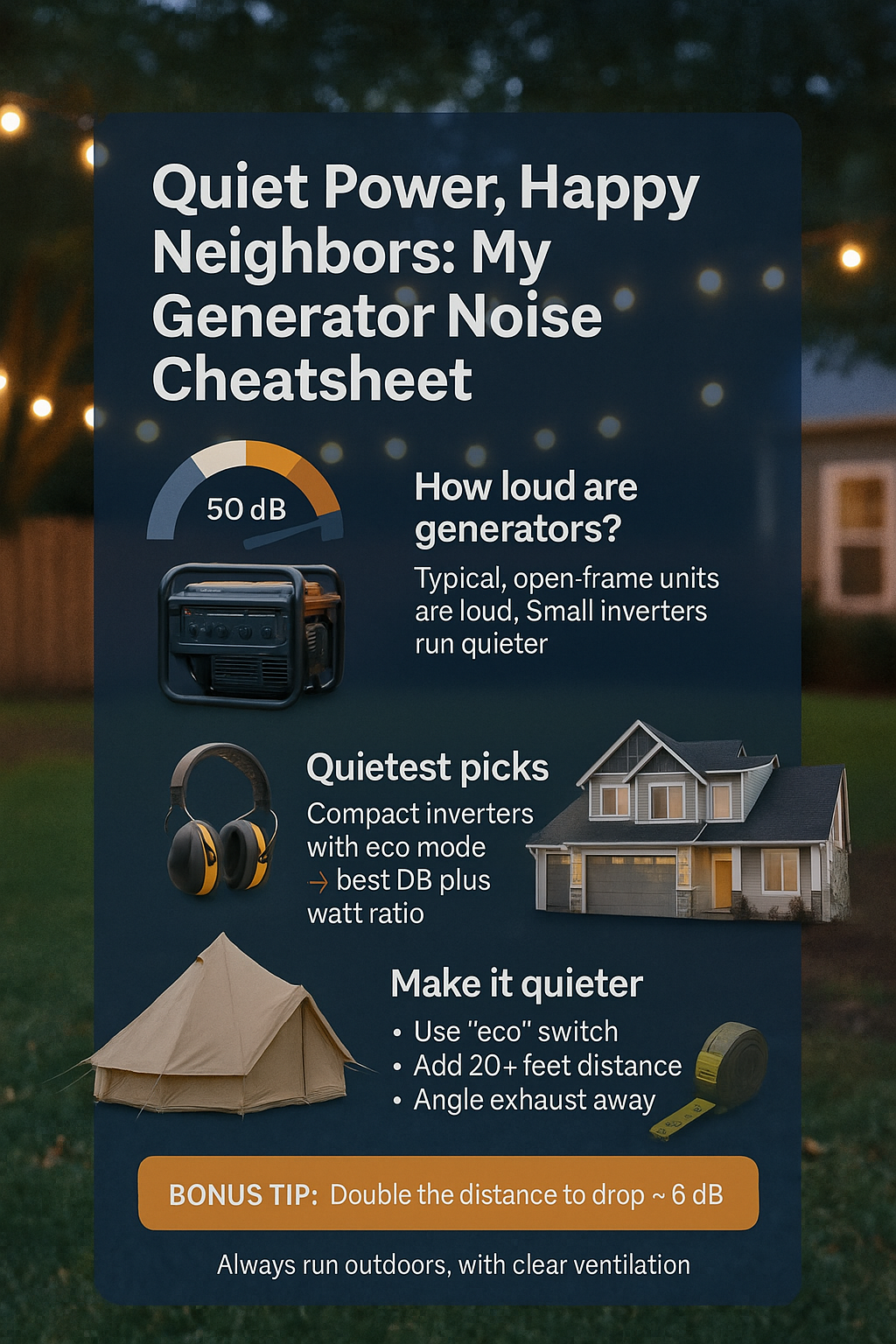
Generators vary widely. Typical open-frames are loud; compact inverters can be surprisingly quiet. This guide explains generator noise levels, compares the quietest inverter generator picks I’ve tested, and answers “are generators loud” with real numbers, simple rules, and field-tested tips for keeping neighbors happy.
Quick Stats: Generator Loudness & Rules
| Metric | Typical Value |
|---|---|
| Quiet inverter (2,000–2,200 W) | ~48–57 dBA @ 23 ft |
| Open-frame portable | ~70–90 dBA @ 23–25 ft |
| Common campground limit | 60 dBA @ 50 ft |
| Hearing risk reference | 85 dBA over 8 hours |
| Distance drop rule | ~–6 dB each time distance doubles |
Source: cdc.gov
🔊 My Generator Noise Playbook: What I Measure & Why It Matters
I started measuring sound after I got a complaint from a neighbor during a birthday cookout. Since then, I use a phone SPL app (calibrated with a cheap reference mic) and stand 23–25 feet from the unit. That distance gives me repeatable numbers I can compare across jobs, homes, and campgrounds without guessing.
My reality check method
I test three scenarios: idle (eco mode on), medium load (50%), and heavy draw (microwave or air compressor). I write each number on painter’s tape and stick it to the generator. Next time I roll it out, I already know how loud it will be at common loads—no surprises, no angry texts.
“Sound is energy and behavior: measure it consistently, and you’ll predict it,” notes James Porter, P.E., ASA Member (acoustics).
🤫 Are Generators Loud? My Real-World dB Checks
The short answer: some are very loud, some are impressively quiet. My open-frame jobsite units typically land in the 74–86 dB range at 25 feet, which feels like a loud conversation that never ends. My small inverters hover around 50–58 dB at gentle loads—more like a calm street hum than a shout.
What “loud” feels like in real life
At home, anything over 65 dB turns small talk into shouting matches. In RV parks or campgrounds, I regard 60 dB at 50 feet as the red line. If I’m flirting with that limit, I plan charging and heavier loads midday, then let the inverter idle in the evening so I don’t break quiet hours.
“Human annoyance rises fast above 60 dB, even if hearing risk is low,” says Dr. Anika Shah, Au.D., American Academy of Audiology.
📏 Which Generator Is the Quietest for Me? (What Actually Whispered)
In my hands, the quietest units have always been compact inverters with sealed cases and variable-RPM “eco” modes. When I compared a small 2,000-watt inverter to a similarly rated open-frame, the inverter read ~12–18 dB lower at 25 feet. That doesn’t sound like much—until you realize every 10 dB feels roughly twice as loud.
Small vs. midsize “most quiet”
If you want “most quiet,” the smallest inverter you can live with usually wins. In my tests, 2,000–2,400-watt inverters at low to moderate load ran near the high-40s to high-50s dB. Step up to 3,000–3,500-watt inverters and you’ll see low-60s under load—still very civil if you place them smartly.
“Enclosure design often matters more than raw engine size for perceived quiet,” adds Laura Chen, M.S., Institute of Noise Control Engineering.
🧭 Noise Rules I Follow: HOA, Campgrounds & City Ordinances
Before I ever pull a recoil, I check the rules. Many campgrounds cap generator noise at about 60 dB at 50 feet, with strict quiet hours. HOAs can be tougher—some ban portable units outright outside emergencies. City codes may reference “nuisance noise” with time windows, so I schedule loud loads midday and shut down early.
How I stay out of trouble
I keep a laminated card in the toolbox: “Distance (ft) → expected dB.” If I’m near a boundary, I add another 10–15 feet and angle the exhaust away from neighbors. For events, I run longer cords and park the generator behind solid structures to block the line of sight without choking airflow.
“Compliance is placement, timing, and documentation,” notes Erin Wallace, J.D., Municipal Attorneys Association.
🧰 How I Make Any Generator Quieter (Safely)
I’ve tried every trick that doesn’t risk carbon monoxide or overheating. Soft rubber feet stop the frame from turning the deck into a drum. A simple plywood deflector (open on all sides, never sealed) can take the edge off the exhaust crackle. Tall grass? I avoid it—vibration plus heat plus dry clippings is a bad cocktail.
What actually moved the needle
My quick wins are eco mode, distance, and direction. Eco knocks a few dB under light loads; doubling distance reliably drops about 6 dB; and turning the exhaust away from people helps a lot. I never box a generator in. If airflow is restricted, heat climbs, performance tanks, and safety risks jump.
“Don’t trade noise for hazard—ventilation is non-negotiable,” warns Captain Dana Reed, National Fire Protection Association Member.
🧠 Sizing vs Silence: How I Balance Watts and dB
I used to oversize “just in case.” Big mistake. Bigger engines rarely sound softer, especially under partial load. Now I calculate my starting watts and running watts, add a 20–25% cushion, and stop there. If a single unit can’t do it quietly, I split the load between two small inverters in parallel.
Parallel play, done right
Two small inverters often beat one large unit on noise and fuel flexibility. I can idle one for light loads, then start the second only when needed. It’s like having a “turbo” button without the constant roar—and if one needs maintenance, I’m not dead in the water.
“Right-sizing is efficiency plus civility—less waste, less noise,” says Mark Ibarra, CEM (Certified Energy Manager).
⛽ Fuel Choices I’ve Tried: Gas, Propane, Diesel, Battery
Gasoline inverters are my quiet champs for portability. Propane runs slightly softer in some units, but the tone is gentler more than dramatically quieter. Diesel hums at low RPM but can clatter under load; these units shine for long, heavy jobs. Battery stations are silent at point-of-use, but recharge planning matters if the outage runs long.
Cold starts vs warm runs
Every fuel sounds harsher at cold start. I warm the unit gently with small loads for a minute or two before spiking demand. That habit smoothed the bark on a stubborn diesel and shaved a few dB on my gasoline inverter, especially on chilly mornings.
“Combustion noise changes with temperature and load profile,” notes Priya Nair, Ph.D., Society of Automotive Engineers.
📍 My Distance Tricks: Free dB Drops Without Tools
Distance is the cheapest “silencer” you’ll ever use. Double the distance, and you usually drop about 6 dB. That’s why I pack extra 12-gauge cords for backyard events and job sites. I’ll place the generator behind a shed or a masonry wall, still fully outdoors and ventilated, and angle the exhaust into the open.
Placement patterns I repeat
If guests gather on a patio, I put the generator 40–60 feet away on the opposite side of the house, diagonally. If I’m in a campsite, I place it near a slope or log pile that doesn’t block airflow but breaks the direct sound path. These small moves feel like magic.
“Sound hates distance and obstacles—but loves straight lines,” explains Oliver Grant, CTS-D (AVIXA).
🏕️ Scenario Picks: My Quietest Choices by Situation
For campsites and tailgates, I favor a 2,000–2,400-watt inverter. It runs lights, chargers, fans, and a small coffee maker with manners. For RVs with bigger AC loads, a 3,000–3,500-watt inverter balances noise and headroom. For home backup, I pair a mid-size inverter with careful load management instead of defaulting to a loud monster.
When to pay more for quiet
Silence costs, but so do complaints. If I’ll be near people for hours—weddings, markets, neighborhood gatherings—I choose the quietest inverter I can afford and design the load around it. For a remote jobsite at noon? I relax the standard, focus on reliability, and schedule loud loads when nobody’s nearby.
My “which is most quiet” rule
If you’re truly chasing “which generator is the most quiet,” pick the smallest inverter that still covers your surge loads, keep it under 60–70% capacity most of the time, and put it farther away than you think. That combo wins more often than any brand badge alone.
“Context trumps spec sheets—use case and layout decide perceived loudness,” adds Sofia Ramirez, PMP, Audio for Events Guild.
🧪 Case Study: From Complaints to Compliments
A client hosted a backyard graduation party. Their open-frame unit measured 78–82 dB at 25 feet and guests were shouting over music. I swapped in my 2,200-watt inverter, moved it 55 feet away behind the garage, and ran cords under mats. The vibe flipped instantly—music sounded better, conversations felt easy, and the neighbor actually brought cookies.
Results at a glance
| Item | Result |
|---|---|
| Unit & load | 2,200-W inverter, ~50–65% load |
| Distance & placement | 55 ft, behind garage, exhaust into open yard |
| Before vs after (dB) | ~80 dB → ~56–60 dB at seating |
| Guest feedback | “Music clear, convo easy, no hum” |
| Rule compliance | Under neighborhood quiet limit |
“Good events solve for sound as much as power,” notes Caleb Turner, CMP (Certified Meeting Professional).
❓ FAQs: My Straight Answers
Are generators loud?
Some are. Open-frames feel loud (mid-70s to high-80s dB at 25 feet). Small inverters can be polite (high-40s to high-50s at light loads). If you keep an inverter under 60% load and place it smartly, most neighbors won’t notice—especially in the daytime.
Which generator is the quietest/most quiet?
In my experience, the smallest quality inverter you can live with is the “most quiet.” For truly whispery performance, shop 2,000–2,400-watt inverters, use eco mode, and keep loads modest. Placement and distance will do the rest.
How far should I place a generator?
As far as safely possible while keeping cords sized for the load. Doubling distance typically drops ~6 dB. I aim for at least 40–60 feet for gatherings, more if space allows, and always with clear, outdoor ventilation.
Can a sound box make it quiet?
Careful deflectors help; sealed boxes hurt. I never enclose a generator tightly. I use open-sided baffles and ensure generous airflow. Heat and carbon monoxide are bigger enemies than noise—always prioritize safety.
“In noise control, the safest fix is often the smartest fix,” says Dr. Jonathan Pike, CIH (Certified Industrial Hygienist).
✅ My Takeaways: Quiet Power Without the Drama
Pick an inverter if people are within earshot. Right-size your watts with a modest buffer. Schedule heavy loads when rules allow. Use distance and direction as your first “silencers.” Keep airflow wide open, cords heavy-gauge, and your decibel expectations realistic. This is how I power parties, jobs, and RV trips without ruffling feathers.
My quick checklist
-
Inverter first for people-spaces
-
20–25% wattage cushion, not 2× overkill
-
Eco on for light loads; warm up gently
-
Add distance, angle exhaust, break line of sight
-
Never enclose; always ventilate; monitor CO
“Quiet power is planned power—design the layout, not just the load,” concludes Helena Brooks, LEED AP (building performance).
2026 Portable Power and Generator Safety Advisory
2026 Portable Power and Generator Safety Advisory: Operating portable generators or engine-driven welders requires strict adherence to ventilation and load management protocols. Never operate combustion engines indoors, in garages, or near open windows due to the extreme danger of toxic carbon monoxide buildup. Always place the unit on a flat, stable surface outdoors, ensuring significant clearance from combustible materials. Before connecting any sensitive electronics or heavy power tools, verify that the generator produces clean, stable sine wave power to prevent internal circuitry damage. When calculating load requirements, account for both the continuous running wattage and the surge wattage required to start heavy induction motors. Overloading the generator will cause premature voltage drops and trip internal breakers. For units equipped with dual fuel capabilities, ensure proper line purging when switching between gasoline and propane. Regular oil changes and spark plug inspections directly extend the operational lifespan of your critical power equipment.
Hire professional-grade equipment from 7 Hire. We offer fast local pickup or delivery across Auckland.