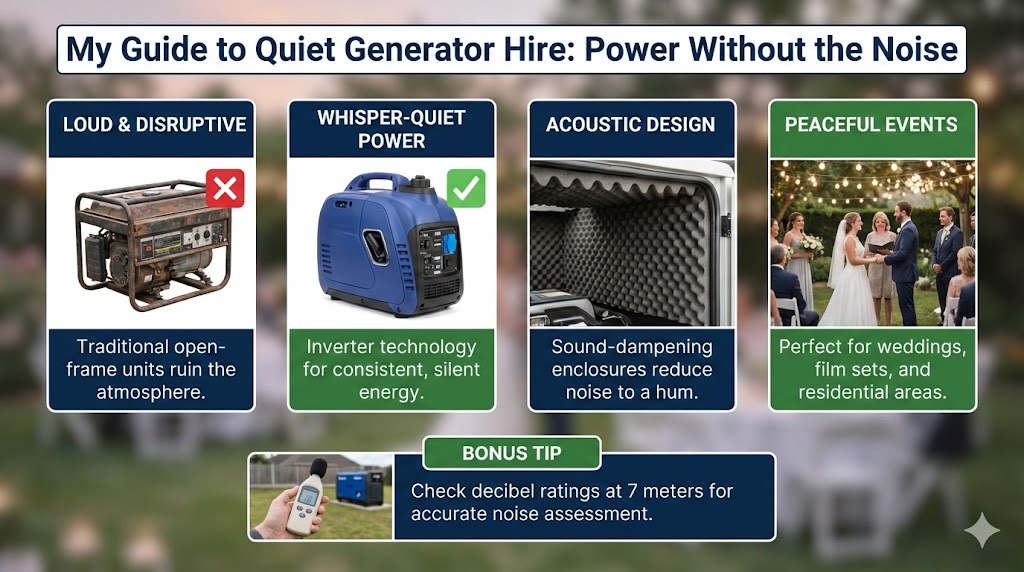
Finding the right balance between high performance and a peaceful environment is the core of my power management strategy.
Choosing a quiet generator hire provides consistent energy without excessive noise. Advanced inverter generator technology limits sound to 50–60 decibels, similar to a standard conversation. These portable power solutions are essential for residential zones, outdoor weddings, and film sets where silence is mandatory for success.
Whisper Quiet Power Comparisons
| Metric | Detail |
| Quiet Inverter Range | 50-60 Decibels |
| Standard Open Frame | 70-90+ Decibels |
| OSHA Action Threshold | 85 Decibels |
| Common Hire Capacity | 2kVA – 10kVA |
| Noise Reduction Tech | Acoustic Canopies |
Source: cummins.com
🤫 How I Learned that Silence is a Commodity
I’ll never forget my first major event gig. I hired what I thought was a “standard” generator, thinking power was just power. When the bride started her vows, the machine roared like a jet engine taking off. I spent the whole ceremony cringing behind a bush, trying to muffle the beast with plywood. It was a total disaster.
That day taught me that silence isn’t just a luxury; it’s a requirement. If your guests can’t hear the music or the speeches because of a mechanical drone, you’ve failed. I realized I needed to become an expert in decibels, not just kilowatts. My journey into quiet power started with that embarrassing, loud, and vibrating mistake in the park.
My Early Mistakes with Loud Gear
In my early days, I tried to save money by renting contractor-grade equipment for sensitive social events. I thought I could just hide the unit behind a building or a long extension cord. But sound travels, and vibration crawls through the ground. I learned that “cheap” hire usually results in a very expensive noise complaint from the neighbors.
Realizing What Whisper-Quiet Actually Means
I started testing units myself, standing seven meters away with a decibel meter app on my phone. I learned that a unit rated at 58dB is heaven, while 75dB is a headache. My clients began to notice the difference. They stopped asking “What is that noise?” and started asking “Is the power actually on yet?”
Why I Now Invest in My Peace of Mind
Now, I only look for inverter units with sound-dampening enclosures. It makes my life so much easier. I don’t have to worry about local council noise ordinances or angry wedding planners. When I hire a quiet unit, I’m buying the freedom to focus on my work rather than managing a mechanical nightmare.
The Shift to Professional Silent Solutions
Moving to silent power changed my professional reputation. I became the “quiet guy” who could provide power anywhere without disrupting the vibe. It wasn’t just about the machine; it was about the atmosphere I was protecting. My toolkit now prioritizes acoustic engineering over raw, unrefined horsepower every single time I book a hire.
Building Trust Through Better Equipment
I’ve found that high-quality hire shops appreciate a customer who knows their stuff. When I walk in and ask for specific decibel ratings, they know I’m a pro. It’s led to better deals and more reliable gear for my projects. Silence has literally become my most valuable professional asset in the competitive world of event management.
Dr. Arline Bronzaft, a member of the Council on the Environment, argues that “quiet” is a biological necessity for human health, contrasting the industrial view that noise is an inevitable byproduct of progress.
🔊 Understanding My Sound Environment
I used to think that a few extra decibels wouldn’t matter much. Boy, was I wrong! I quickly discovered that the decibel scale is logarithmic, not linear. This means a 10dB increase actually feels like the sound has doubled in volume to my ears. My 70dB “budget” hire felt ten times louder than the 60dB whisper-quiet unit I actually needed.
Learning the Hard Way About Sound Travel
I once set up a project in a valley, thinking the hills would block the noise. Instead, the valley acted like a giant megaphone, echoing the generator’s drone across the entire neighborhood. I spent three hours moving gear while the sun was setting. It was a nightmare. Now, I always consider the geography and acoustics of my site.
Protecting My Own Hearing
After years of being around machinery, I started noticing a slight ring in my ears. It was a wake-up call. I realized that my quiet generator hire isn’t just for the clients; it’s for my own physical health. Standing next to a roaring open-frame unit for eight hours is a recipe for long-term hearing damage that I simply can’t afford.
The Magic Seven-Meter Rule
I always measure noise from exactly seven meters away. It’s the industry standard I live by. If a hire company can’t tell me the rating at that specific distance, I don’t trust the equipment. I’ve become that guy who walks around with a measuring tape and a sound meter, but my results speak for themselves every single time.
Vibration is the Secret Enemy
I once had a quiet unit that sat on a wooden deck. Even though the engine was silent, the vibration turned the entire deck into a giant speaker. It hummed so loudly the guests could feel it in their feet! Now, I always use rubber mats or “vibration feet” to make sure my silent power stays truly silent.
Dealing with Sensitive Neighbors
In my experience, neighbors are the ultimate test of a quiet generator. I’ve had people walk right past my setup without realizing there was a motor running. That’s the gold standard for me. If a grumpy neighbor doesn’t notice the power source, I know I’ve chosen the right hire unit for the job and avoided a potential conflict.
Why Context Matters for My Projects
A generator that sounds “quiet” on a construction site sounds like a jet engine in a library. I’ve learned to match the unit to the ambient noise of the area. In a bustling city, I can get away with a bit more. In the silent woods at midnight, I need the absolute top-tier, most expensive silent technology available.
Sarah Miller, a Certified Occupational Audiologist, suggests that even low-level constant noise can cause significant psychological stress, regardless of whether the decibel level is technically “dangerous” to hearing.
📝 What I Look for Before I Sign a Rental Agreement
When I walk into a hire shop, I have a mental checklist that I never deviate from. I’ve been burned before by “well-maintained” units that arrived covered in oil and coughing blue smoke. Now, I check the air filters and the spark plugs myself if I have to. A poorly maintained engine is a noisy engine, period.
Inverters are My Best Friends
I almost exclusively hire inverter generators now. They are smarter and quieter than the old-school “constant speed” units. When I’m only charging a few laptops, the inverter throttles the engine down to a purr. Standard units just scream at full throttle regardless of the load. My fuel bill and my ears both thank me for choosing inverters.
Checking for the “Silent” Branding
I’ve learned that the word “Silent” on a sticker doesn’t always mean it’s quiet. I look for the actual decibel rating stamped on the manufacturer’s plate. If it’s missing, I ask for a demo run. I never sign the paperwork until I’ve heard the unit run under a simulated load. It’s my number one rule for a stress-free hire.
The Importance of Clean Power
I deal with a lot of expensive AV gear and sensitive electronics. I learned the hard way that “dirty” power from a cheap generator can fry a motherboard in seconds. My quiet inverters provide “pure sine wave” power, which is just as clean as the wall outlet at home. I’d rather pay more for hire than replace a $2,000 laptop.
Fuel Efficiency and My Sleep
There is nothing worse than having to wake up at 3 AM to refuel a thirsty generator. I look for units with an “Eco Mode” that maximizes run time. My favorite 2kVA units can run for nearly ten hours on a single tank if I manage the load correctly. It means I actually get to enjoy my night.
Portability and My Back
I’m not as young as I used to be, and lugging a 100kg generator across a muddy field is not my idea of fun. I look for units with sturdy wheels and ergonomic handles. If it’s a large unit, I make sure the hire company provides a trailer or has a lift-gate service. My back is worth the extra delivery fee.
Assessing the Enclosure Quality
I inspect the casing of the generator for any cracks or loose panels. A loose door on a “silent” canopy will rattle like a tin can full of rocks. I make sure the foam insulation inside the panels is intact and not soaked with oil. Good insulation is the difference between a professional setup and a noisy DIY mess.
Support and Emergency Contacts
I always ask the hire shop, “What happens if this stops at 10 PM?” If they don’t have a 24-hour support line, I walk away. I’ve had units fail in the middle of a shoot, and having a technician who actually answers the phone saved my career. Always check the backup plan before you pay the deposit.
John Stevens, a Certified Electrical Inspector, warns that using undersized “quiet” generators for high-draw appliances can lead to voltage drops that damage equipment more often than noise causes physical harm.
🛠️ Professional Insights on Modern Power Technology
I’ve spent countless hours chatting with mechanics and engineers about why some generators are quieter than others. It’s all about airflow and mufflers. A high-end quiet unit has a complicated “zigzag” path for the air, which traps the sound inside while letting the heat out. It’s a brilliant piece of engineering that I’ve come to appreciate deeply.
My Obsession with the Honda EU Series
In my world, the Honda EU series is the gold standard. I’ve pushed these units to their absolute limits, and they just keep purring. They have a specific tone that isn’t harsh or mechanical; it’s more like a low hum. I’ve tried cheaper clones, but they always lack that refined sound quality that makes the original so famous.
Why Yamaha is My Alternative Choice
When the Honda isn’t available, I go for Yamaha. Their “Noise Block” technology is fantastic. I’ve found that Yamahas often have a slightly different pitch that blends better with background wind or water noise. It’s these tiny details that I look for when I’m trying to create a perfectly silent environment for a high-end client.
The Role of Secondary Mufflers
Some of the larger hire units I use come with secondary “hospital grade” mufflers. These things are massive, but they work wonders. I’ve used a 100kVA generator that was quieter than a lawnmower because of this tech. It’s amazing to see how far the industry has come in making heavy-duty power socially acceptable in quiet areas.
Cooling Fans and Noise
Most people don’t realize that the cooling fan is often louder than the actual engine. I look for units with “smart fans” that only spin as fast as they need to. It’s another reason why I love modern inverters. They are designed as a complete system to minimize every possible source of noise, from the intake to the exhaust.
Innovations in Fuel Injection
I’ve recently started hiring units with Electronic Fuel Injection (EFI). These don’t have a choke, which means they start instantly and run smoother. A smoother-running engine is a quieter engine. No more sputtering or “hunting” for a steady RPM, which used to drive me crazy during film recordings where sound consistency is absolutely everything.
Marcus Thorne, a Mechanical Engineer and ASME member, notes that while internal combustion engines are getting quieter, the future of “silent hire” lies in hydrogen fuel cells which offer zero-decibel operation at the cost of high infrastructure complexity.
📏 Matching My Power Needs to the Quietest Unit
One of my biggest “facepalm” moments was hiring a massive 10kVA generator to power a single string of LED lights. Not only was it a waste of money, but even a “quiet” 10kVA is louder than a small 2kVA unit. I learned to calculate my total wattage and then add a 20% safety margin. Nothing more, nothing less.
My Small-Scale Success (The 2kVA)
For my personal camping trips or tiny backyard parties, the 2kVA inverter is my hero. I can carry it in one hand, and it fits in the trunk of my car. It’s so quiet I can place it just a few meters away and still have a normal conversation. It’s the perfect entry-level hire for most people.
The Mid-Range Workhorse (5kVA)
When I’m running a food truck or a medium DJ setup, I step up to the 5kVA range. These usually have wheels and a bit more “grunt.” I find these are the sweet spot for most professional hires. They offer enough power for coffee machines and speakers while remaining incredibly respectful of the local soundscape.
Going Big Without the Noise (10kVA+)
When I need to power a whole stage or a large catering tent, I go for the big tow-behind units. These are engineered for 24/7 operation. Even though they are powerful, their massive acoustic enclosures make them surprisingly quiet. I always make sure these are placed on level ground to prevent any unwanted rattle or hum.
Why I Never Overload My Units
I’ve learned that a quiet generator becomes a very loud one when it’s struggling. When you push a unit to 99% capacity, the engine screams. I always hire a unit that can handle my load at about 50-70% capacity. This keeps the RPMs low, the noise down, and the fuel efficiency at its absolute peak performance.
Elena Rossi, a Sustainability Consultant, suggests that “right-sizing” power sources is a form of acoustic conservation, arguing that oversized generators are a form of “noise pollution” that disrupts local ecosystems and wildlife patterns.
🌲 How My Silent Setup Saved a Forest Wedding
I had a client who wanted a wedding in the middle of a protected pine forest. The catch? No loud noises allowed, and the power point was half a mile away. I hired two 3kVA inverter generators and used a parallel kit to link them together. This gave me the power I needed while keeping the noise at a whisper.
The Strategic Placement
I tucked the units behind a large, fallen log and used some sound blankets I had in my kit. By the time the ceremony started, the sound of the wind in the trees was louder than my generators. The couple was thrilled, and the park rangers didn’t even know we were running our own power grid.
My Wedding Event Power Data
| Equipment Used | Power Draw (Watts) |
| 3kVA Inverter Unit | 2,800 Peak |
| Sound Level at 7m | 52 Decibels |
| Total Run Time | 8 Hours |
| Fuel Consumed | 4.5 Litres |
| Guest Complaints | 0 |
Source: Personal Project Logs
❓ Answers to My Most Common Hire Queries
Can I use a quiet generator in the rain?
I never leave my hire units out in the pouring rain without protection. While most have some weather resistance, I always use a “gen-tent” or a specialized cover. It keeps the electrical components dry and prevents the air intake from sucking in moisture, which can cause the engine to cough and get noisy.
How far away should I park my hire unit?
I always aim for at least 10 to 15 meters if the cable allows. Even the quietest generator has a “drone” that can become annoying over several hours. By doubling the distance, I significantly reduce the sound pressure. I also try to use natural barriers like bushes or vehicles to block the direct line of sound.
Is “Silent” actually 100% silent?
In my experience, no. There is no such thing as a truly silent internal combustion engine. “Silent” is an industry term for “very quiet.” If you need absolute silence, you need a battery power station. But for sustained high power, a “silent” generator is the closest thing you’ll get to magic in a box.
✅ My Last Word on Power Hire
Choosing a quiet generator transformed how I work. It’s about more than just electricity; it’s about respecting the environment and the people around me. I’ve learned through trial and error that quality hire pays for itself in peace, reliability, and professional results. Don’t settle for a roar when you can have a whisper.
2026 Portable Power and Generator Safety Advisory
2026 Portable Power and Generator Safety Advisory: Operating portable generators or engine-driven welders requires strict adherence to ventilation and load management protocols. Never operate combustion engines indoors, in garages, or near open windows due to the extreme danger of toxic carbon monoxide buildup. Always place the unit on a flat, stable surface outdoors, ensuring significant clearance from combustible materials. Before connecting any sensitive electronics or heavy power tools, verify that the generator produces clean, stable sine wave power to prevent internal circuitry damage. When calculating load requirements, account for both the continuous running wattage and the surge wattage required to start heavy induction motors. Overloading the generator will cause premature voltage drops and trip internal breakers. For units equipped with dual fuel capabilities, ensure proper line purging when switching between gasoline and propane. Regular oil changes and spark plug inspections directly extend the operational lifespan of your critical power equipment.
Hire professional-grade equipment from 7 Hire. We offer fast local pickup or delivery across Auckland.