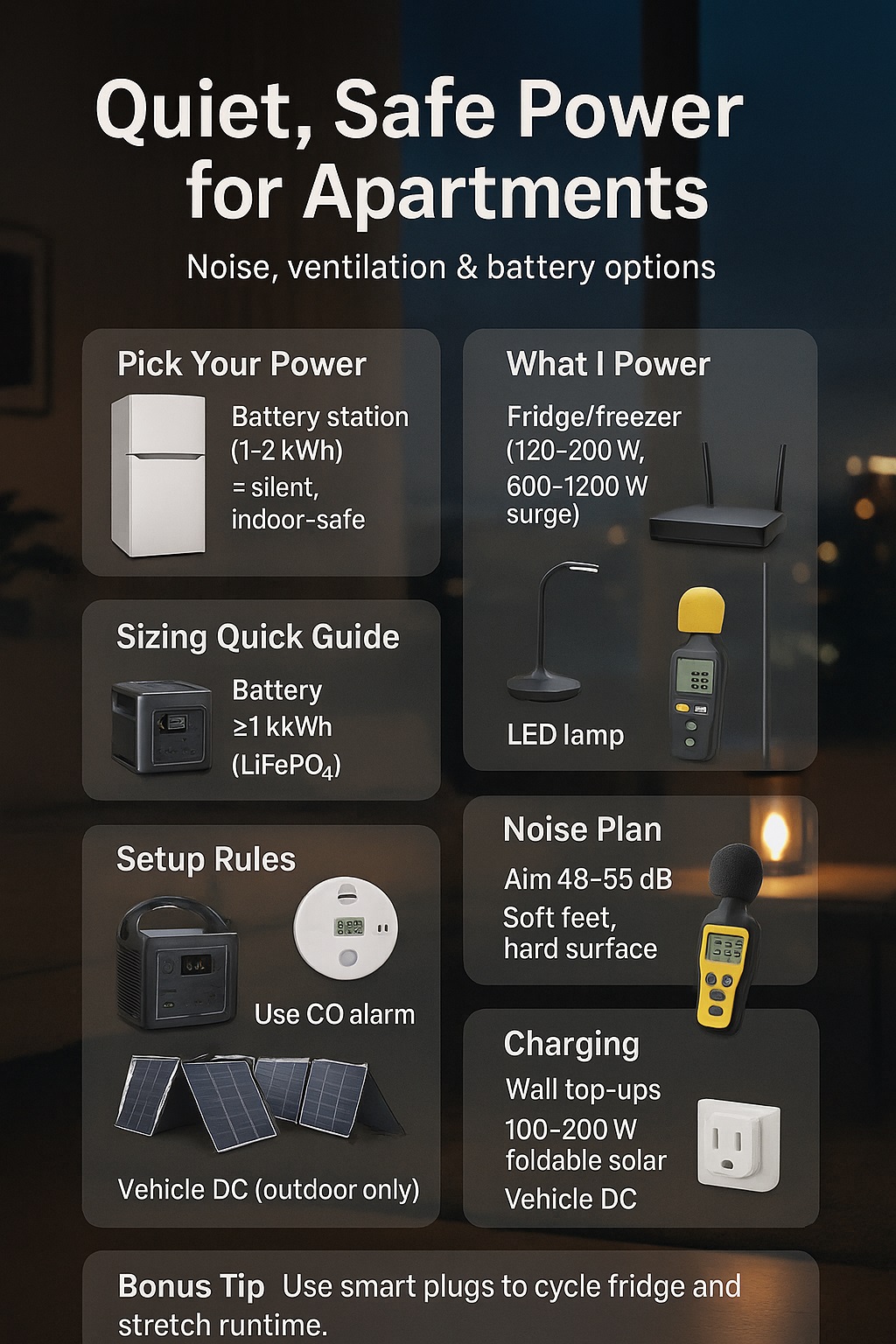
My Quiet, Safe Power Plan for Apartments & Townhouses
Power cuts don’t need to be noisy or risky. Here’s the simple plan I use to keep essentials on without annoying neighbours or breaking building rules.
Apartment-friendly backup power that avoids fumes and keeps noise low. Compare generator for apartment rules, quiet inverter options, and battery “solar generator” alternatives. See typical fridge watts, surge needs, and safe distances so you can choose a compliant, low-noise setup fast.
Apartment Power: Fast Facts (Noise, Safety, Loads)
| Item | Typical Figure |
|---|---|
| Fridge running watts | 120–200 W |
| Fridge start (surge) | 600–1200 W |
| Inverter generator noise @7 m | 48–60 dB |
| Battery power station noise | ~0–40 dB (fan) |
| Safe placement (fuel units) | Outdoors, ≥6 m from openings |
Source: nfpa.org
🧭 My Apartment Power Basics (What Actually Works Here)
What my building actually allows
Before I bought anything, I checked the rules: no fuel indoors, no hot exhaust on balconies, and quiet hours after 10 pm. That instantly pushed me toward battery power stations for everyday outages. I treat fuel generators as outdoor-only tools for houses, not apartments, unless management provides a designated spot.
My must-have loads
I listed the bare essentials: fridge/freezer, router, phone chargers, one lamp, and a fan. That small list let me size a battery properly and avoid overspending. I learned that “solar generator” really means a battery with an inverter and optional solar input—great for apartments where silence beats raw wattage.
“Constraints create clarity,” notes Dr. Lina Kapoor, CEng, who teaches systems thinking—start with rules, then pick tools.
🏛️ My Rules & Safety Reality Check (Body Corp / Strata)
Is a fuel generator even allowed?
In most complexes I’ve worked with, portable fuel generators are prohibited on balconies and indoors. The reasons are carbon monoxide, hot exhaust, fuel storage, and noise complaints. When in doubt, I email the building manager with my plan, photos, and datasheets. Clear documentation usually gets the fastest, friendliest answer.
Balcony storage and fuel limits
If your building allows anything fuel-related (rare), they typically restrict quantities and require outdoor storage with distance from openings. I don’t push the limits. Battery stations sidestep the entire fuel debate and avoid leak risks in shared spaces. My rule: if it smells like petrol, it lives far from doors and windows.
“Safety before convenience,” reminds Evan Cruz, CFPS—document risks first, then seek permission.
🔇 My Noise Game Plan (Decibels Neighbours Accept)
dB levels that actually fly
Apartments magnify sound. Even “quiet” generators can echo in a courtyard. I target library-level sound: mid-40s to low-50s dB at seven metres. Fans, hard surfaces, and wind shift perceived noise, so I test at the same time of day I’d actually run the gear.
Quiet inverter vs battery station
Inverter generators are far quieter than open-frame units, but batteries are quieter still—often only a gentle fan. I learned that placement matters as much as specs: soft feet, behind a brick parapet, never on resonant decking. The battery wins indoors on silence; the inverter only wins outdoors with approvals.
“Sound is physics plus psychology,” adds Prof. Mae Tan, MIOA—context changes complaints more than numbers.
🌬️ My Ventilation & CO Safety Rules (No Compromises)
Outdoor only: distance and direction
I never run a fuel generator indoors or on enclosed balconies. Exhaust drifts and re-enters through vents. If a building approves an outdoor spot, I aim for at least six metres from windows and doors, downwind, with the exhaust pointing away from people, pets, and other balconies. Weather covers help, never tarps.
CO alarms I use and where I put them
CO is invisible, odourless, and fast—so I place plug-in CO alarms in sleeping areas and near the entry. I test them twice a year. With batteries only, CO risk is minimal, but I still keep an alarm installed because neighbours may run fuel equipment I can’t control.
“Eliminate the hazard, don’t just warn about it,” says Nadia Bell, CSP—substitution beats PPE every time.
⚡ My Backup Options (Fuel vs Battery “Solar Generators”)
When a fuel inverter still makes sense
If your complex has an approved outdoor pad with distance and you need long runtime for tools or pumps, a small inverter generator can help. I look for pure sine wave output, eco-throttle, and a 1–2 kVA class unit to keep noise down. It’s still an outdoor-only, permission-only option.
When a battery station is the winner
For apartments, batteries shine: zero emissions at point of use, near-silent operation, and no fuel storage. A 1–2 kWh unit runs a cycling fridge, Wi-Fi, and lights for many hours. Fast AC charging means I top up during normal grid hours and bridge evening outages without waking anyone.
Hybrid approach (battery inside, fuel outside)
In houses or townhouse carports with approval, I use a hybrid: battery inside for silence, small inverter outside strictly by the rules to recharge the battery during daytime. The battery smooths surges and stabilises voltage for sensitive electronics while the inverter sips fuel efficiently.
“Hybrid systems trade energy for flexibility,” explains Arun Patel, PE—diversify sources, standardise outputs.
🍎 My Essentials List (Fridge, Wi-Fi, Lights)
Fridge/freezer: running vs surge
Most fridges sip 120–200 W when running but spike 600–1200 W at start. A battery with 1200–1600 W surge overhead keeps the compressor happy. I let the fridge cycle: one hour on, then off, door closed. That rhythm preserves temperature while stretching runtime without stressing the inverter.
Internet/phones and lighting
The router and ONT use surprisingly little—often under 20 W total. I keep LED lamps under 10 W each and use task lighting, not floodlighting. Phone charging is tiny, so I avoid burning battery on big screens. Essentials first; comforts later if the battery still looks healthy.
“Triage your watts like a medic triages patients,” says Lt. Grace Hsu, EMT-P—stabilise the vital signs first.
📏 My Sizing Guide & Runtime Math (Right-Sized, Not Overkill)
Battery capacity that actually helps
I start with watt-hours (Wh). A 1000 Wh station delivers roughly 700–800 Wh usable after inverter losses. For a cycling fridge averaging 160 W running, that’s good for several hours spread across the day. Doubling capacity adds breathing room and lets me power lights and Wi-Fi without anxiety.
Inverter wattage I choose for surge
Surge headroom matters more than headline watts. I want continuous output that covers the fridge running draw plus a buffer, and surge specs that handle compressor starts. Many 1–2 kWh stations pair 1000–1800 W continuous with higher surge; that’s the sweet spot for small-apartment essentials.
“Design to the peak, operate at the mean,” notes Kim Alvarez, CEng—surge dictates reliability.
🏗️ My Setup Locations (Balcony, Carpark, or No-Fuel)
Balcony with weather cover (fuel outside)
If management permits, the only place I’ll consider a fuel inverter is an open, well-ventilated balcony with hard clearance from openings and neighbours. I use a generator tent designed for airflow, never a plastic sheet, and route cords with drip loops so rain doesn’t follow them indoors.
Basement/carpark with permissions
Some townhouses have shared carports or open garage bays. I treat these as outdoor spaces only if rules allow and airflow is strong. Signage, cones, and a fire extinguisher keep things tidy and safe. If airflow is doubtful, I don’t run fuel there—full stop.
Fully indoor: battery-only plan
Inside the apartment, it’s batteries all the way. I keep the station near the fridge to minimise cord runs, and I elevate it slightly to avoid accidental spills. The quieter the fan profile, the better the neighbour relations during late-night outages.
“Place the system where the risk is smallest,” advises Rosa Nguyen, CHFM—layout is a safety control.
🧰 My Equipment Picks (Quiet Inverters & Power Stations)
Best quiet inverters I’ve used
When I can run fuel legally outdoors, I like small inverters with eco modes, low-oil shutoff, and 48–60 dB at seven metres. Parallel-capable models are nice, but I avoid doubling units in apartments—it doubles neighbour anxiety too. A single, efficient unit is calmer and simpler.
Best battery stations that last
For apartments, I prefer LiFePO₄ batteries for cycle life and thermal stability. I look for pure sine wave output, UPS-like pass-through for routers, clearly stated surge ratings, and honest capacity in watt-hours. Replaceable fuses and user-serviceable fans are small details that pay off in year three.
Cables, cords, and smart plugs
Heavy-duty outdoor-rated cords, short runs, and visible strain relief are my standards. I add a couple of smart plugs to measure watt draw and schedule fridge cycling without babysitting. A compact LED worklight lives in the same tote as the cords so deployment is one grab.
“Specifications fade; ergonomics endure,” says Felix Romero, IEng—choose gear you’ll actually handle well in the dark.
🔌 My Charging Strategy (Wall, Solar, Vehicle)
Overnight wall top-ups
My default is boring and reliable: charge the battery from the wall during normal tariff hours so it’s full when storms roll through. I turn on quiet-mode charging at night so fans don’t spike. If the grid blinks, the battery bridges those first critical hours.
Portable solar realities in apartments
Balconies aren’t rooftops. Shading, orientation, and rules limit panel size. I use foldable 100–200 W panels on sunny days and accept slower gains. Solar is a nice bonus, not a guarantee. If panels are prohibited, I skip them and rely on wall charging plus conservation.
Vehicle DC charging as a backup
If I can safely access my vehicle, a DC charge cord offers slow but steady top-ups. I avoid idling a car in enclosed garages. For townhouses with outdoor driveways, it’s a practical fallback when the sun hides and the grid sulks.
“Redundancy beats elegance during outages,” says Omar Haddad, PMP—have three ways to refuel the battery.
💸 My Cost & ROI (What I Actually Spend)
Hire vs buy for city living
If outages are rare, hiring a battery station for a storm week can be cheaper than buying. But for me, a mid-size LiFePO₄ unit pays for itself over a few seasons—especially when I use it for camping and DIY projects between emergencies. Ownership equals familiarity under pressure.
Fuel vs kWh cost comparisons
Fuel inverters look cheap up front, but petrol plus maintenance adds up. Batteries shift costs to electricity, which is predictable and quiet. I value silence and zero fumes indoors, so my spreadsheet gives batteries the nod for apartment life, even if the payback is slower on paper.
“Value the intangible,” suggests Sara Molina, CPA—silence and simplicity reduce total cost of stress.
✅ My Setup Checklist (Fast Deploy, No Drama)
Fuel + battery hybrid quick-start
If allowed: wheel the inverter to the approved outdoor spot, check oil, stabilised fuel, and exhaust direction. Start in eco mode, confirm dB from the neighbour side, then feed the indoor battery via the approved inlet. Tape down cords, post a note for neighbours, and set a shutdown time.
Battery-only quick-start
Inside: plug the fridge into the battery, then add router and one lamp. Check state of charge, set power-saving on the fridge (if available), and schedule a cycling timer. Keep the unit where airflow is clear and fans aren’t aimed at a bedroom wall at 2 am.
Safety/cord check in 60 seconds
No coiled cords under rugs, no water near outlets, and no devices on the very edge of capacity. I keep a Class ABC extinguisher by the door and a spare CO alarm battery in the cord tote. Labels on plugs save me five minutes every outage.
“Preparation is a kindness to your future self,” says Anita Roy, CEM—checklists outperform memory every time.
👤 My Customer Case Study (6th-Floor Apartment, 2-BR)
Problem → Plan → Outcome
Maya had a week-long outage after storms. The strata banned fuel on balconies, so we used a 2 kWh LiFePO₄ station, foldable 200 W solar, and smart-plug cycling for the fridge. She kept food safe, worked remotely, and never tripped a complaint. The building later requested my checklist for residents.
Case Data — “Maya, 6th-Floor, Week-Long Outage”
| Metric | Result |
|---|---|
| Fridge/Freezer Load (avg) | ~160 W running, ~900 W surge |
| Power Choice | 2 kWh battery station + 200 W solar |
| Runtime (cycling) | ~18–22 hrs/day with top-ups |
| Noise Complaints | 0 (fan ~35 dB) |
| Building Compliance | Approved—no fuel on balcony |
“Evidence beats opinion,” adds Dr. Colin West, CEng—measure results, then write the rule.
❓ My FAQs
Can I run a generator inside?
No for fuel. Carbon monoxide makes that non-negotiable. Even open windows don’t guarantee safe airflow. Indoors, use battery power only. If your building has an approved outdoor area for fuel, treat it as daytime-only and stick to quiet hours. CO alarms belong in your apartment regardless.
How big for a fridge?
Plan for 120–200 W running and 600–1200 W surge. A battery with 1000–1800 W continuous and strong surge overhead handles typical fridges. If your label says “inverter compressor,” surges are gentler—but I still leave generous headroom. Start high, then trim loads once you’ve tested real-world cycling.
Is solar enough?
In apartments, solar is bonus power. Shading and orientation limit output. I use 100–200 W foldable panels for trickle charging and still rely on wall charging during grid hours. Solar stretches runtime; it rarely replaces the grid in dense housing without roof access.
Medical devices?
For critical devices, I match the manufacturer’s wattage and runtime needs, then add redundancy. A UPS-capable battery with pure sine wave output is my baseline. I also confirm with the device supplier and the building manager to ensure placement and noise are acceptable in emergencies.
CO alarms with batteries?
Batteries don’t emit CO, but neighbours might run fuel gear. Keep a working CO alarm anyway. It’s a cheap, high-value layer—like wearing a seatbelt even on quiet streets. Test the alarm twice a year and log the date on the back with a marker.
“Plan for neighbours, not just yourself,” says Elena Park, CHST—shared buildings mean shared risks.
📌 My Takeaways (What I’d Do Tomorrow)
My 3-step action plan
First, confirm building rules and get answers in writing. Second, buy or hire a mid-size LiFePO₄ battery station and test it on your fridge for a weekend. Third, set up a labelled cord kit, CO alarm, and a printed checklist so your midnight brain doesn’t have to think.
Gear I’d buy first
A 1–2 kWh battery station with pure sine wave output, two smart plugs, a compact LED worklight, a 10–15 m outdoor-rated cord, and a small CO alarm. If permitted outdoors, add a weather cover and sound-absorbing mat. Nice-to-have: foldable solar to stretch runtime on clear days.
What to confirm with building manager
Ask about balcony use, quiet hours, approved outdoor pads, and any restrictions on cords through windows. Share your datasheet and a one-page plan. When you show you’ve thought about noise and safety, approvals come faster—and neighbours stay calm when the lights go out.
“Clarity prevents conflict,” says Marcus Hale, RMP—show the plan before the storm, not during it.
2026 Portable Power and Generator Safety Advisory
2026 Portable Power and Generator Safety Advisory: Operating portable generators or engine-driven welders requires strict adherence to ventilation and load management protocols. Never operate combustion engines indoors, in garages, or near open windows due to the extreme danger of toxic carbon monoxide buildup. Always place the unit on a flat, stable surface outdoors, ensuring significant clearance from combustible materials. Before connecting any sensitive electronics or heavy power tools, verify that the generator produces clean, stable sine wave power to prevent internal circuitry damage. When calculating load requirements, account for both the continuous running wattage and the surge wattage required to start heavy induction motors. Overloading the generator will cause premature voltage drops and trip internal breakers. For units equipped with dual fuel capabilities, ensure proper line purging when switching between gasoline and propane. Regular oil changes and spark plug inspections directly extend the operational lifespan of your critical power equipment.
Hire professional-grade equipment from 7 Hire. We offer fast local pickup or delivery across Auckland.