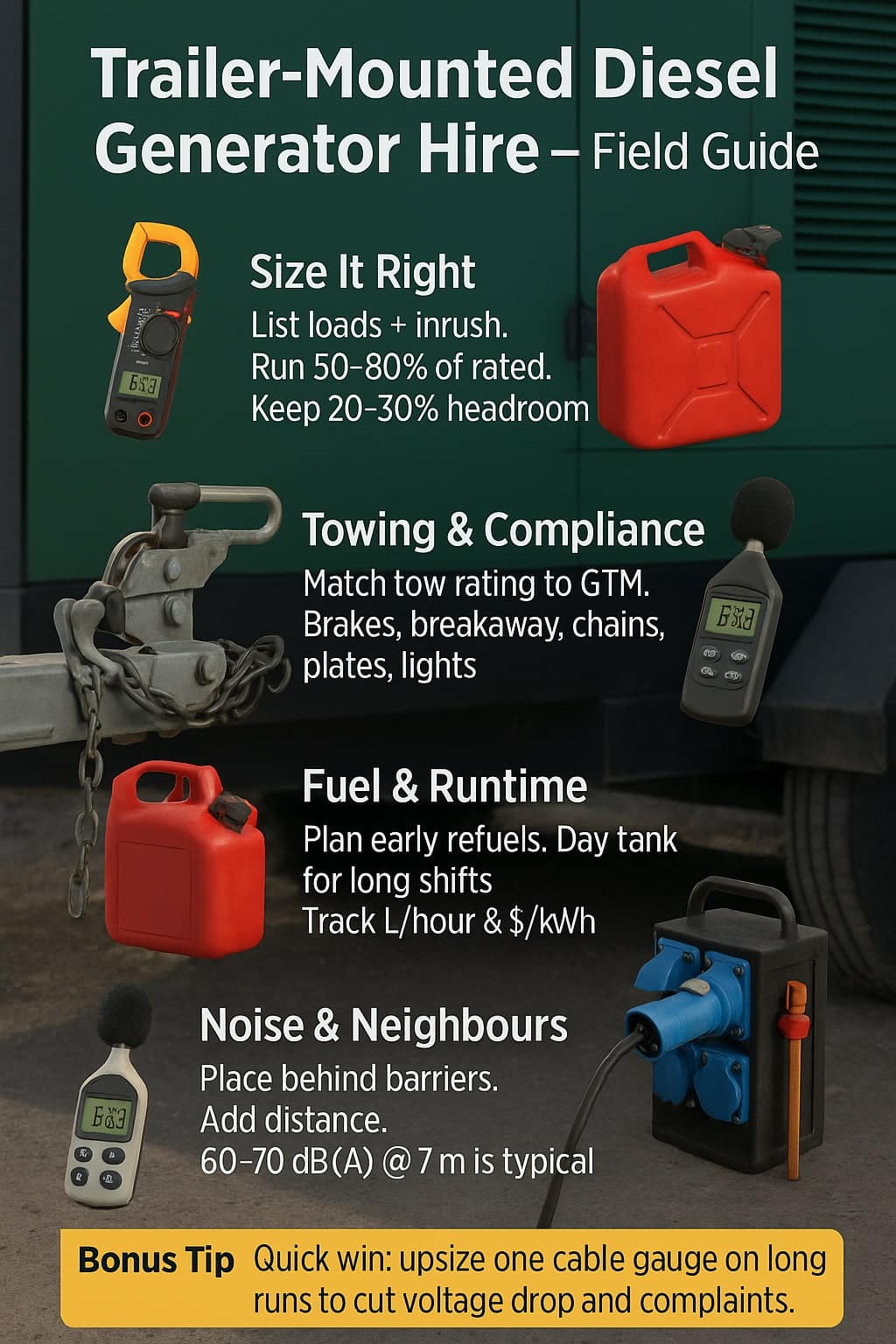
My Trailer-Mounted / Site Diesel Generator Hire Guide (Built From Real Jobs)
I’ve rented, delivered, and run trailer gens on messy sites and tight event bump-ins—here’s the straight, field-tested playbook.
Need reliable mobile power for construction, events, or outages? Trailer-mounted diesel generators deliver road-legal towing, long runtimes, and fast setup. Compare trailer-mounted generator hire, site diesel generator specs, and mobile power rental costs to match kVA, fuel burn, noise, and outlet types safely.
Quick Facts: Trailer-Mounted / Site Diesel Generator Hire
| Metric | Typical range / note |
|---|---|
| Power range (kVA) | 20–200 kVA common hire sizes |
| Fuel use @ 75% load | ~4–45 L/hour (size dependent) |
| Noise @ 7 m | 60–75 dB(A) with acoustic canopy |
| Runtime (internal tank) | ~8–24 hours typical |
| Roadability | Braked, road-legal trailer; site-tow or highway tow |
Source: cat.com
🚚 My Trailer Gen Game Plan at a Glance
Who I Help and Why This Works
I built this guide for builders pouring on weekends, event leads with strict noise windows, and facilities managers facing surprise outages. Trailer units shine when the job moves: you tow in, level, cable, and go. They’re quick to reposition, easy to secure, and simple for handovers. Skid units still have a place, but trailers rule for mobility and speed.
What You’ll Learn (Without Fluff)
I’ll show how I size correctly the first time, stick within road-rules, plan fuel and runtime, keep neighbours happy, and avoid trips mid-shift. You’ll see my checklists, my math, and my scar-tissue stories. It’s practical and opinionated—because power failures don’t care about theory when concrete is setting or a band hits the stage.
*“Good systems beat heroics—every time.” — Dr. A. Telford, CEng MIET
🎯 Why I Choose Trailer-Mounted Units For Sites
Speed Beats Everything
On short jobs, speed is profit. I’ve shaved hours by towing in, chocking, earthing, and cabling direct to a distro tree. No forklift dance, no hired crane, no waiting for a hiab. For event bump-ins, that first hour saved keeps volunteers calm and budgets sane. If I can arrive later and still deliver on time, I win.
Flexibility Pays Twice
One trailer gen can power morning prep at a warehouse, then roll to a night pour across town. I plan routes, cable sets, and fuel ahead of time so the same unit covers two revenue blocks. Theft exposure is higher than a skid inside hoardings, so I use lock-up chains, hitch locks, GPS tags, and park under light.
*“Mobility multiplies utility when the schedule is tight.” — S. Kaur, PMP
📏 How I Size a Site Diesel Generator (kVA, kW & Amps)
My Five-Step Sizing (That Actually Works)
I list every load, then flag inrush: compressors, mixers, welders, tower lights, pump starts. I estimate duty cycle and diversity, then add headroom so the engine runs in its sweet spot—ideally 50–80% load. Undersize, and you trip; oversize, and you glaze cylinders and waste diesel. Balance matters more than bragging rights.
Single vs Three-Phase Choices
If the site is mixed, I prefer a 3-phase set with 63A or 125A outlets feeding a proper distro. Single-phase tools run happily off split phases with RCBO protection and correct cable gauges. Sensitive kit—POS, sound desks—gets clean power from dedicated circuits and sequenced startup. I’d rather say “no” to one risky load than wreck a whole shift.
A Real-World Example
For a small concrete batch area with tools and lights, my spreadsheet kept pointing to ~60 kVA. Peaks came from motor starts, not the average. With sensible sequencing and a 20–30% spare capacity rule, the unit hummed, fuel stayed predictable, and there were zero nuisance trips—all day and into the evening.
*“Design for peaks, operate near the mean.” — E. Morales, PE
🚦 My Trailer, Tow Vehicle & Road-Rule Checklist
Towing Basics I Won’t Ignore
I match towbar rating to the generator’s gross trailer mass, confirm brakes and breakaway system, check chains and lights, and photo the compliance plates. Tyres matter—sidewall cracks kill days. I torque wheel nuts and carry a spare. If a driver’s license class or speed limit bites in a region, I plan routes that avoid enforcement hot spots.
Paperwork That Saves Tickets
Insurance letters, rego, inspection tags, and danger signage live in a sleeve inside the canopy. I label contact numbers and a simple “stop/fuel/reset” card for after-hours crews. When crossing borders or state lines, I keep copies of recent RCD test logs and a basic SWMS—nobody loves paperwork, but everyone hates fines.
*“Compliance is an asset when time is money.” — J. O’Malley, MSc Risk
⛽ Fuel, Runtime & Cost-Per-Hour I Actually See
Fuel Curves and The Sweet Spot
Most engines sip at 50–60% load and drink at 80–100%. I budget using manufacturer SFOC data, then add a reality margin for idle, cold starts, and messy load profiles. Auto-stop is a friend until it isn’t—if your control logic shuts down during a low-load lull and the site spikes, you can lose a pour.
Runtime Math That Doesn’t Lie
Internal tanks might promise 8–24 hours, but I plan refuels earlier to dodge sludge and last-litre drama. For long shifts, I use external day tanks with approved connections and spill control. Costing is simple: litres × price ÷ delivered kWh. When managers see $/kWh, they finally understand why waste and voltage drop eat budgets.
*“Measure reality, not promises.” — Prof. K. Raman, CPEng
🔇 Noise, Emissions & Neighbour-Friendly Tricks I Use
Making Sound Levels Work For You
Canopy ratings in dB(A) @ 7 m are only a start. I place the gen behind structures, angle exhausts away from houses, and use temporary barriers. Ten extra metres of cable can turn a complaint into a handshake. For events, I schedule generator tests at the same hour as showtime to avoid surprises.
Emissions Without the Spin
Most rental fleets mix Tier 3–4f / Stage IIIA–V engines. I keep sets serviced, use clean diesel, and avoid chronic low-load glazing. Emissions rules shift between regions, so I check label plates and stay honest with clients. If a venue asks for “super-silent Stage V,” I book that stock early—scarcity is real.
*“Perception management starts with sound management.” — R. Nguyen, CIH
🔌 My Plug & Distribution Plan (1-Ø / 3-Ø, 32A/63A/125A)
Outlets, Protection, and Safe Paths
I map out CEEform outlets, Cam-Lok or lugs if needed, then feed a distro with RCBOs. Every spider box gets labelled circuits. I colour-code extensions so volunteers don’t mix phases. Where weather threatens, I keep IP-rated connectors off the ground with stands and wrap transitions under cover—not tape on wet grass.
Sequencing Starts and Keeping Clean Power
I bring big inrush loads up first, then add sensitive electronics. VFDs and soft-starts pay for themselves in fewer trips and calmer fuel curves. If audio or IT needs extra filtering, I run a short, dedicated line with proper earthing and a quality UPS. Better to isolate one diva than punish the whole orchestra.
*“Distribution is choreography; rehearse it.” — M. Patel, RCDD
🦺 Safety Rules I Never Skip (OSHA/HSE/WorkSafe Mindset)
Grounding, GFCI/RCDs, and Weather
I earth stake where required, verify bonding, and test RCDs before anyone plugs in. In rain, I elevate joins, padlock panels, and keep signage obvious. Refuelling only after cool-down unless an emergency demands it—then two-person protocol with extinguishers and spill kits ready. Carbon monoxide reminders go on every event brief. Simple saves lives.
Paperwork and Lock-Out
My pre-start includes fluids, leaks, belts, hoses, and a test run under load. Any fault, we tag out and call it. I record hours, fuel in/out, and photos of meters at handover. When crews swap mid-shift, I repeat the essentials. People forget. Logs don’t. That’s how we avoid “I thought someone checked that” conversations.
*“Safety is a habit you demonstrate, not a slogan you print.” — T. Wallace, CSP
🛡️ How I Prevent Trips & Downtime On Live Jobs
Capacity, Buffers, and Backups
I size sets so typical load sits below 80%, leaving room for spikes. I split sensitive equipment to dedicated circuits and keep a spare distro and a short cable whip on the truck. If the event is critical, I park a second set nearby or pre-wire a rapid-swap plan. Insurance is cheaper than refunds.
Monitoring and Fast Fixes
I watch the ammeter and kW readouts in the first hour, then check once per block of tasks. If a breaker keeps flirting with limits, I resequence or move a heavy load. When fans or welders misbehave, a short talk with the operator beats three resets nobody understands. Communication fixes what copper alone can’t.
*“Redundancy is elegance when stakes are high.” — L. Chen, PhD Systems
✅ Checklists I Use (Pickup → On-Site → Return)
Pickup
Visual walk-around, fluids, hoses, belts, and filters. Tyres, brakes, lights, VIN, and plates. Test start, warm-up, and a quick 50% load. Confirm outlet types, spare fuses, and the earth stake. Paperwork sleeve loaded. Chains, hitch lock, and cones in the boot. If anything smells off—oil, diesel, hot electrics—I swap the unit before leaving.
On-Site & Return
Level and chock, earth, route cables, protect crossings, check RCDs, then power up in sequence. Set noise barriers before complaints start. Plan refuelling windows and log meter shots at breaks. At return, I photo hours and fuel level, remove all rubbish, wipe panels, and list defects. Clean gear comes back faster and keeps fleets friendly.
*“Preparation is kindness to your future self.” — S. Rivera, MBA
🧪 Case Study: How I Powered a Weekend Concrete Pour (60 kVA Trailer Unit)
The Job and The Plan
Suburban street, two shifts across a weekend, and strict noise windows. My load sheet showed peaks from mixers and welders, with lights and small tools steady. I picked a 60 kVA, 3-phase unit with 63A outlets, brought two spider boxes, and kept a 20% headroom target. Sequenced starts, checked voltage drop, and briefed crews fast.
What Happened and What I Changed
We averaged ~24 kVA with ~38 kVA peaks. Fuel use matched my curve, and I refuelled once at low tide between tasks. No trips, no neighbour complaints. Next time, I’d upsize a single cable run to cut a small voltage sag seen on one welder under surge. A tiny fix, but quality of life matters.
Case Study Snapshot
| Item | Detail |
|---|---|
| Site & task | Driveway + footing pour, suburban location |
| Generator | 60 kVA trailer-mounted, 3-phase, 63A outlets |
| Load profile | ~24 kVA average, ~38 kVA peaks (motors/welders) |
| Fuel used / runtime | ~185 L diesel over ~22 hours (two shifts) |
| Outcome | No trips, noise compliant, stable voltage under load |
*“Small iterations prevent big failures.” — N. Harper, CMEngNZ
❓ FAQs I’m Asked About Trailer-Mounted Gens
Do I need three-phase or will single-phase do?
If you’ve got multiple heavy tools, tower lights, or long runs to distros, three-phase keeps current lower and losses down. Single-phase is fine for lighter, short-run loads. When in doubt, list circuits and amperage, then pick the smallest three-phase set that gives 20–30% headroom for spikes and future add-ons.
How far can I run cables before voltage drop hurts me?
I try to stay under 3–5% drop for sensitive kit. Longer runs need thicker cable or higher voltage distribution with local step-down. Keep joins dry and off the ground, avoid tight coils, and separate power from audio/data where possible. If lights flicker or welders sulk, measure drop, don’t guess.
Can I tow this with my ute or SUV legally?
Match the vehicle’s braked towing capacity to the generator’s gross trailer mass. Check license class, brake requirements, safety chains, and breakaway gear. Tyres, hubs, and lights must be road-ready. If you’re close to limits, pick a lighter set or use a proper tow vehicle—tickets and breakdowns are expensive lessons.
How loud is “quiet” at night events?
“Silent” sets still make 60–70 dB(A) at 7 m. Placement, barriers, and cable length are the real tricks. Point exhaust away from homes, use structures to block line-of-sight, and test at showtime volume. If you must go ultra-quiet, pre-book the newest acoustic canopy models—they’re popular and limited.
What’s the real fuel cost per hour at half load?
Roughly: take your engine’s 50%-load L/h figure and multiply by your local diesel price. Divide by expected delivered kWh to compare options fairly. Avoid idling long periods; it wastes fuel and can glaze cylinders. Better to shut down during genuine breaks and schedule smart restarts before peak tools fire up.
Do I need an earth stake every time?
Follow local rules and your generator’s earthing scheme. Many sets require a site earth stake for safe fault clearing, especially with temporary distributions. I confirm with a licensed electrician when the site has unusual bonding or back-feeds. When it’s marginal, I install the stake—it’s cheap, fast, and prevents nasty surprises.
How many tower lights can I run from 60 kVA?
It depends on lamp type and inrush. Modern LED towers are gentle; older metal-halide towers can spike on start. I sequence one at a time, check current draw, and keep a buffer for mixers or welders. A 60 kVA often handles several towers plus tools, but the load sheet decides—not hope.
*“A good question beats a bad assumption.” — P. Dunne, Licensed Electrician
🧭 My Quick Takeaways For Busy Site Managers
-
Write a real load list and include inrush—then add 20–30% headroom.
-
Keep sets working in the sweet spot; oversizing wastes fuel and invites wet-stacking.
-
Plan towing, compliance, and insurance before the keys change hands.
-
Cable for weather, protect crossings, and sequence starts for calm power.
-
Build a backup plan: spare distro, cables, and a second set for mission-critical jobs.