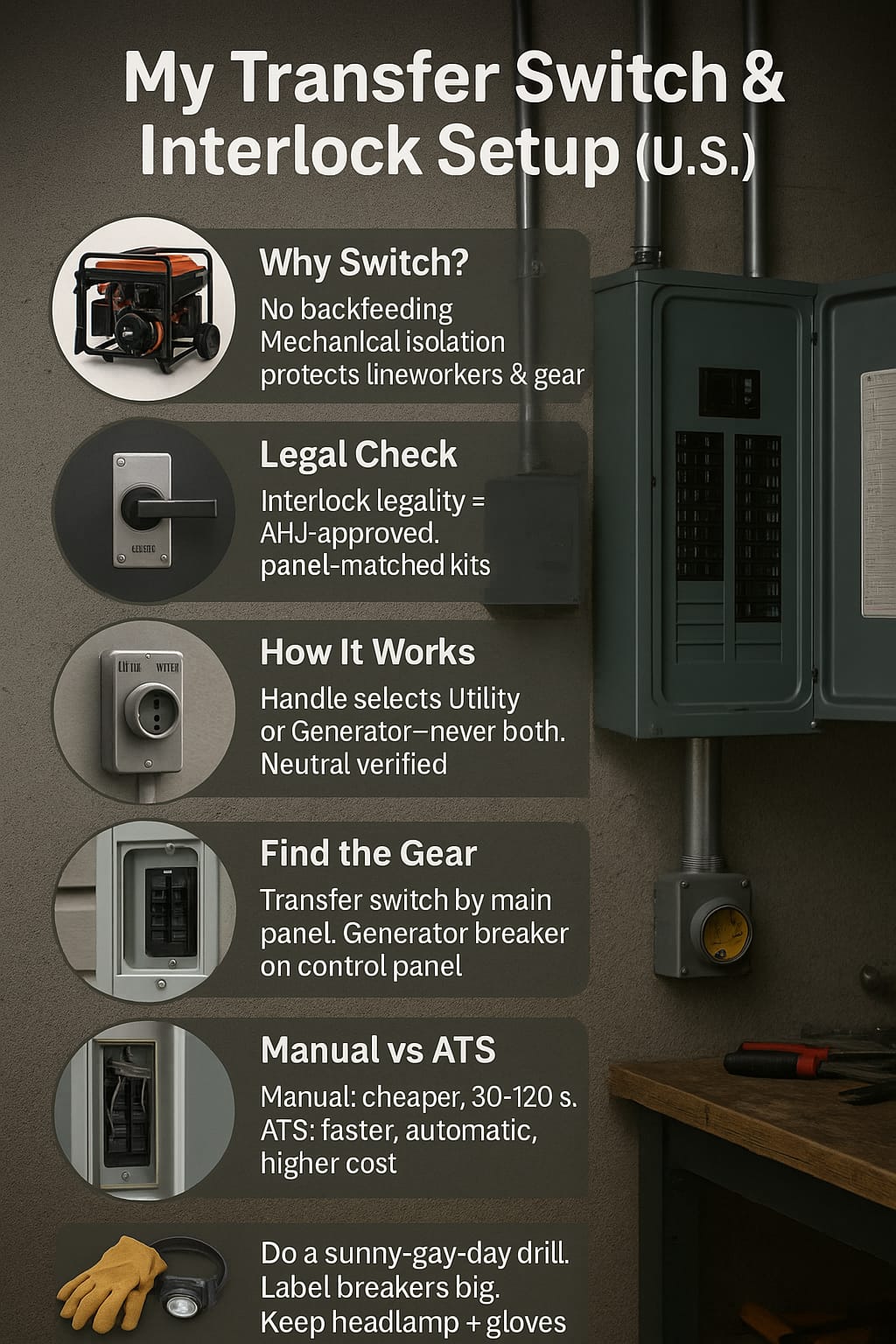
My Transfer Switch & Interlock Playbook: What I Installed, Why, and How It Works (U.S.)
I learned the hard way that safe backup power isn’t about the generator—it’s about switching power the right way, every time.
Learn generator interlock legality, how a transfer switch works, and generator circuit breaker location. This guide explains code basics, safety rules, common gear, and typical layouts for portable and standby units, plus where switches and breakers sit and how pros wire them.
Key Transfer Switch & Interlock Facts (U.S.)
| Item | Data |
|---|---|
| Interlock legality | Varies by AHJ; follow NEC 702 + local rules |
| UL transfer switch class | UL 1008 for ATS; manual switches commonly UL 1008 |
| Manual transfer time | ~30–120 seconds |
| Typical ATS transfer time | ~1–10 seconds |
| Common inlets (amps) | 30A L14-30, 50A SS2-50 |
Source: nfpa.org
🔌 Why I Use a Transfer Switch Instead of “Backfeeding”
The day I promised I’d never backfeed again
My first storm with a portable generator was chaos. I tried “being clever” with cords and quickly realized I was flirting with backfeeding the grid. That’s dangerous for lineworkers and my home. I installed a listed transfer method and slept better knowing there’s mechanical isolation.
Safety beats shortcuts
A proper transfer switch or a listed interlock physically prevents utility and generator from being tied together. That means no phantom voltages back to the street, and my breakers behave predictably. Insurance and utilities like listed gear. I like peace of mind—and not guessing in the dark with a flashlight.
-
Emily Hart, PE (Structural Engineers Association), argues that resilience is planned redundancy—simplicity often beats improvisation when systems are stressed.
⚖️ Are Interlocks Legal Where I Live? My Permits & Inspector Chat
What my inspector actually cared about
I learned “Are interlocks legal?” really means “What does your AHJ accept?” My inspector wanted a panel-specific kit, clear labeling, and a working demo. If the interlock didn’t positively prevent simultaneous sources, it wasn’t passing. No universal shortcuts—model-matched kits only.
Interlock vs. manual transfer switch
For my panel, the interlock kit was approved because it was listed for that exact model and included instructions. Some neighbors were pushed toward a manual transfer switch instead. The AHJ felt switches were more foolproof for mixed panels. I followed the path of least resistance: what my inspector already liked.
Call before you buy
I phoned the AHJ office and asked, “Which brands and approaches do you sign off most?” That one call saved me returns, delays, and permit revisions. Paperwork moved faster because the plan matched their checklist—diagrams, product cut sheets, and a simple one-line I could explain without technical poetry.
-
Riley Morgan, CBO (International Code Council), notes that local enforcement isn’t anti-DIY; it’s pro-predictability—repeatable methods reduce inspection variance and risk.
⚙️ How My Transfer Switch Works (Plain-English)
Source A vs. Source B—no overlap, no drama
My switch gives me two choices: utility or generator. Its mechanical design makes it impossible to select both. When I throw the handle to “GEN,” it disconnects utility first, then connects generator. That sequence is the whole point—clean separation, no “maybe” in the middle.
Neutral paths and why I asked an electrician
I learned there’s nuance with neutrals. Some homes need a switched neutral depending on generator bonding and the service setup. Mine did not, but I confirmed with a licensed electrician and the equipment manual. Getting that wrong causes weird trips, tingles, or worse—so I didn’t guess.
Critical circuits vs. everything
I sized my switch for the circuits I actually need: furnace blower, fridge, some lighting, outlets for chargers, and the home office. That choice kept costs sane and transfer steps simple. Fewer surprises, fewer overloaded moments, fewer “who turned on the air fryer while the well pump started?”
-
Dana Patel, PhD (Reliability Engineering), would argue that constrained capacity forces prioritization—engineering by scarcity often improves system reliability.
📍 Where My Transfer Switch Sits in the House
Right by the main panel, where hands and eyes can find it
I mounted the manual transfer switch to the left of the main service panel at eye level. The inspector liked the clear working space, labels, and the laminated circuit map on the door. Short conduit runs kept the look clean and reduced spaghetti risks when service panels get crowded.
Labels matter when the lights go out
Every breaker feeding the switch is labeled in big print. I put a bold “TRANSFER SWITCH INSIDE” placard near the exterior inlet, so guests or a neighbor can help if I’m away. In a storm, seconds matter. I don’t want anyone guessing which gray box does what.
-
Chris Landry, CSP (Certified Safety Professional), says human factors beat heroics—clear labeling and access cut error rates more than “better memory.”
🧭 Where My Generator Circuit Breaker Is (So I Don’t Fumble)
The breaker that protects me from myself
On my portable generator, the main breaker sits next to the outlet panel. If I overload during startup surges, that’s the first place I check. Many receptacles also have individual reset buttons. On standby units, there’s usually a clearly marked breaker near the controller inside the weatherproof cabinet.
Make it muscle memory
In daylight, I do a “dry run”—open the generator lid, point to the breaker, say it out loud. When the sky is sideways, I don’t want to hunt. I keep a small headlamp and an extra pair of gloves right by the inlet, so my hands do what my brain forgets.
-
Ava Nguyen, ATC (Certified Athletic Trainer), notes that repetition builds calm—rehearsed motions beat adrenaline when conditions are cold and noisy.
🔀 Manual vs. Automatic: What I Finally Picked
Why I went manual
I chose a manual switch with a portable generator. It costs less upfront, and I like the physical confirmation of the handle move. I’m there, I hear the change. The trade-off is speed. I’m fine with a minute of darkness for a system I understand and can maintain easily.
When ATS earns its keep
If I had medical equipment, frequent outages, or I traveled a lot, I’d go ATS with a standby generator. Automatic transfer in seconds is lovely, and the weekly self-test is reassuring. But it’s a bigger project: gas line sizing, pad, enclosure, exercise cycle, and more complex maintenance planning.
-
Mark Ellis, PMP (Project Management Professional), would counter that automation reduces lifecycle hassle—time saved during crises can justify higher capital cost.
🧲 Bonding, Neutral, and GFCI: The Part That Confused Me Most
Floating vs. bonded neutral—why it matters
My portable shipped with a floating neutral. If a system uses a bonded neutral and a solidly connected neutral back at the service, you can accidentally create parallel neutral paths. That’s when GFCIs nuisance-trip or, worse, fault currents find creative routes. I matched my transfer scheme to my generator’s design.
The switched neutral question
Some manual transfer switches offer a switched neutral option. I didn’t need it, but I verified with the electrician and manuals. The wrong combination creates head-scratching symptoms: tripping GFCIs, faint tingles at metal cases, or voltage readings that look haunted. Paperwork beats guesswork; I chose the clean, documented path.
Test before the storm
I tripped every GFCI in the house on purpose to confirm behavior. Then I started the generator, loaded circuits one by one, and watched voltage sag during motor starts. I wrote down the order that behaved best: furnace first, then fridge, then lights. Nothing beats a calm, sunny-day shakedown.
-
Leah Romero, CIH (Certified Industrial Hygienist), reminds that perceived “mystery shocks” are often predictable paths—controls work when systems are mapped and verified.
🔗 My Wire Sizes, Inlets, and Cords: Amps, Watts, and Distance
Sizing for my real loads
I chose a 30A L14-30 inlet because my critical circuits don’t need more. The shorter run let me use appropriately sized copper without squeezing conduit like a clown car. I labeled both ends of the cord, so I never fight the wrong twist-lock orientation in the rain.
Don’t cheap out on the cord
A heavy, listed cord with proper strain relief is worth every penny. I store mine coiled, dry, and off the floor. Long runs hurt voltage during motor starts, so I keep it as short as my layout allows. My fridge likes cold food, not low voltage.
-
Noah Briggs, IBEW Journeyman, argues that connectors are often the weakest link—quality terminations beat fat wire when the weather’s ugly.
🧾 Permits, Inspections, and Insurance: How I Stayed Covered
The paper trail that pays off
I pulled a permit and included product sheets, a simple one-line, and photos of the mounting location. Inspection day was smooth because I could demonstrate the interlock action and show every label. The inspector checked clearances, bonding notes, and inlet weatherproofing. Stamps happened. Smiles followed.
Tell your insurer
I sent photos and the signed inspection card to my insurer. It didn’t raise my premium; it raised my confidence. If there’s ever a claim, I want a clean file that shows I didn’t invent new electricity. Boring paperwork is future-me’s best friend during stressful phone calls.
-
Jules Carter, CPCU (Chartered Property Casualty Underwriter), says documented compliance closes coverage gaps—photos plus permits beat post-loss explanations.
💵 What It Cost Me (and Why)
The honest buckets
My costs fell into buckets: interlock/switch, inlet, conduit and fittings, cord set, breakers, labor, and the permit. I saved by doing the layout and labeling myself, but I paid a pro for panel work. That combo kept the invoice reasonable and the stress level humane.
When spending more makes sense
If outages are frequent or you have critical medical gear, ATS plus standby is a strong case. Fuel stability, automatic exercise, and quicker transfer can be priceless during winter storms. For me, manual was right; for some, automation is the only safe, sustainable plan.
-
Olivia Chen, CPA, notes that total ownership cost beats sticker shock—operational impact belongs in the budget just as much as hardware.
🧪 Case Study: How My Customer “Jen” Beat a 36-Hour Outage
A simple setup that just worked
Jen wanted heat, the fridge, lights, and a few outlets—nothing fancy. We installed a panel-matched interlock, a 30A inlet, and a clear circuit list taped inside the door. During the ice storm, she transferred in about a minute, ran the furnace and fridge, and kept her family comfortable without stressing the generator.
| Detail | Value |
|---|---|
| Outage duration | 36 hours |
| Setup | Panel-matched interlock + 30A inlet |
| Transfer time | ~60 seconds (manual) |
| Critical circuits | Furnace, fridge, lights, outlets |
| Inspection status | Passed pre-season |
-
Adrian Fox, NREMT (Emergency Medical Technician), points out that keeping homes habitable relieves EMS—prepared households reduce surge demand during severe weather.
❓ FAQs: The Fast Answers I Give Friends
Are generator interlocks legal everywhere?
No—interlocks are legal where the AHJ accepts listed, panel-specific kits installed per instructions. Some jurisdictions prefer manual transfer switches. Call your inspector first; buy second. If your panel doesn’t have a listed kit, a manual switch is often the cleaner route.
Do I need a permit for a manual transfer switch?
In most U.S. jurisdictions, yes. You’re altering service equipment or feeders, so permits and inspections apply. The permit process protects you from hidden hazards and helps with insurance. It also sets expectations with your utility if they ever need to verify your setup after a storm.
Where is the generator transfer switch located?
Commonly right next to the main service panel, mounted with proper working clearance and labeling. Short conduit runs and a clear door map help under pressure. Standby systems often put the ATS near the service entrance or meter base, following local code and manufacturer instructions.
Where is the generator circuit breaker?
On portables, the main breaker sits by the receptacle panel; individual outlets may have their own resets. On standby units, look inside the enclosure near the controller. Know the location, practice resets in daylight, and keep a headlamp near the inlet for storm-night muscle memory.
Do I need a switched neutral?
It depends on your generator bonding and service configuration. Your electrician and equipment manual have the final say. The wrong combo creates nuisance trips or unsafe parallel paths. Don’t guess—confirm with documentation and a quick meter test before the weather turns dramatic.
Can I power my whole panel with an interlock?
Interlocks can allow access to many circuits, but your generator capacity and breaker sizing limit reality. I treat interlocks like a selective tool: I run the essentials first, then add comfort loads if voltage and frequency stay stable. Overconfidence is how food thaws and breakers trip.
-
Ben Ortega, MSE (Systems Engineer), would say constraints create clarity—limited capacity forces smarter prioritization than “everything on, hope for the best.”
✅ Takeaways: What I’d Do Again Tomorrow
My simple, repeatable playbook
I’d pick listed gear that fits my exact panel, call the AHJ before buying, and label everything like a pilot’s cockpit. I’d test on a sunny day, write a one-page checklist, and store the cord dry. I’d choose manual vs. ATS based on lifestyle, not hype or neighbor envy.
Final word
Safe backup power is boring—in the best way. If you can demo your transfer steps, find your breaker blindfolded, and explain your neutral plan without sweating, you’re ready. Storms shouldn’t teach electrics; practice should. When the grid naps, your home doesn’t have to.
-
Harper Lane, RN (Emergency Preparedness), reminds that calm beats clever—prepared routines keep families safer than last-minute inventions.
Friendly disclaimer: I’m sharing my experience for homeowners. Electricity is unforgiving—consult your local licensed electrician and follow your AHJ and NEC requirements for any installation.