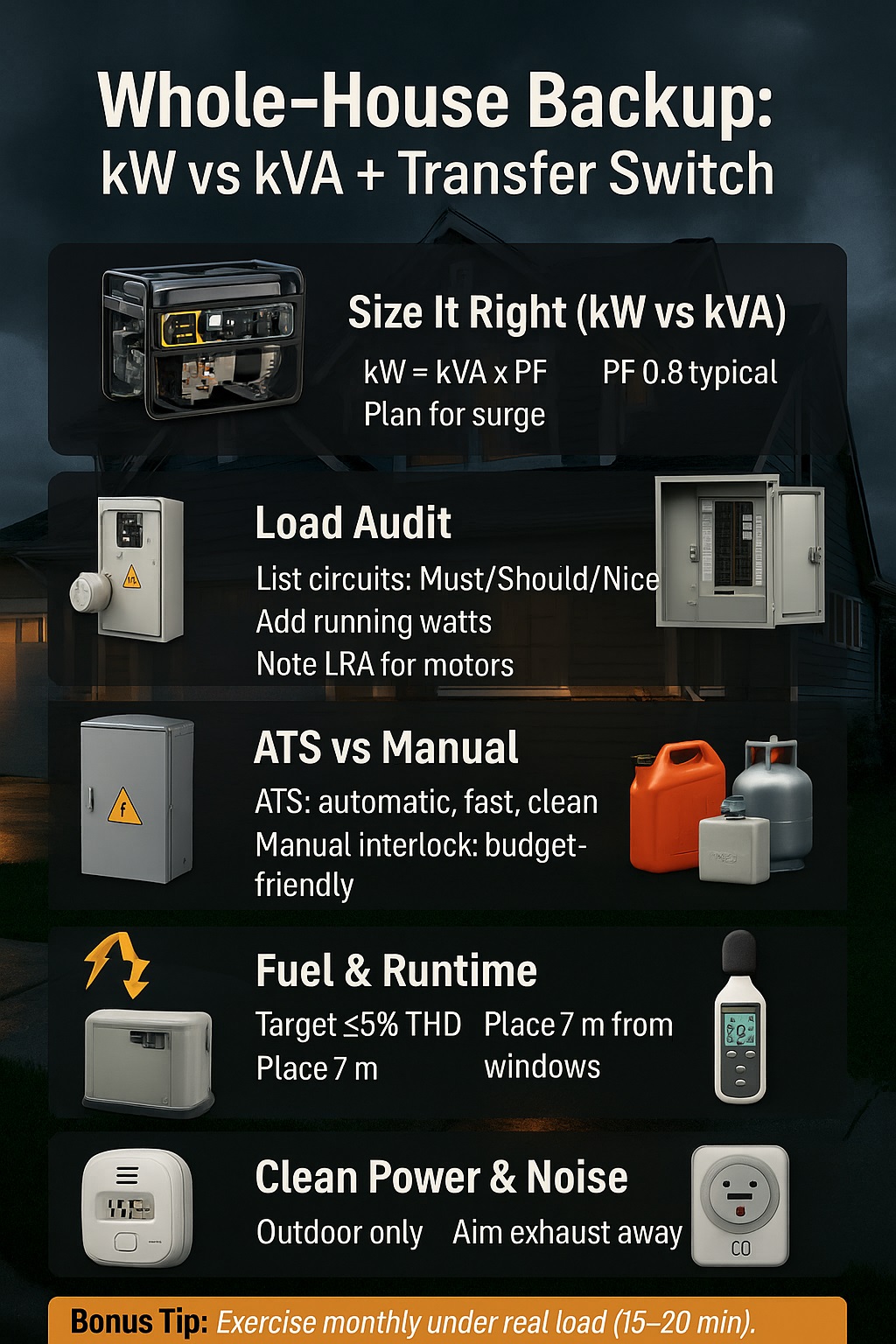
My Whole-House Backup: kW vs kVA + Transfer Switch Explained
I turned my patchwork backup setup into a safe, quiet system that actually runs my home—here’s the straight path I wish I’d followed from day one.
Choosing a generator to power whole house means matching kW vs kVA with real loads, then pairing a generator and transfer switch (ATS or manual) that isolates grid power, manages surges, and keeps electronics happy during outages.
Whole-House Backup—Fast Stats That Matter
| Item | Practical figure / rule of thumb |
|---|---|
| Typical running load (3–4 bedroom home) | 5–8 kW (without EV or big electric range) |
| Motor starting surge | 2–3× running current (compressors, pumps) |
| kW from kVA at PF 0.8 | kW = kVA × 0.8 |
| Residential ATS transfer time | ~5–30 seconds |
| THD target for electronics | ≤5% (inverter or premium AVR) |
Source: nfpa.org
⚙️ How I Translate kVA to kW for Real Homes
My quick PF checklist
I used to buy on kVA alone and wonder why lights dipped when the heat pump kicked in. Now I translate kVA to kW with power factor (PF). For most residential sets rated at PF 0.8, 10 kVA equals 8 kW. I list resistive loads (heaters) near PF 1.0 and inductive loads (motors) that drag PF down.
When 0.8 PF breaks your math
Inductive loads bite twice: they reduce usable kW and demand surge current. A “10 kVA” unit can sag if the fridge, well pump, and heat pump start together. I add up running watts, then apply a surge multiplier (2–3×), and pick a generator that holds voltage and frequency within spec under that hit.
“In electrical design, PF isn’t a footnote—it’s the headline,” notes Dr. Asha Raman, CEng, MIET.
🧮 How I Calculate My Whole-House Load Without Guesswork
My panel walk-through method
I open the panel, list circuits, and mark them: Must (fridge, lighting, internet), Should (washer), Nice (espresso, outdoor heaters). Then I read appliance nameplates or manuals to capture running watts and Locked-Rotor Amps (LRA) for compressors. I ignore marketing fluff and write down real numbers.
Priority loads vs luxuries
My “shed list” lives on the wall: if fuel is tight, I flip off the non-essentials. Diversity matters—my oven and dryer rarely run during a storm. I size to likely combined running loads plus the biggest surge event, not the entire house at full tilt, which almost never happens.
“Engineers plan for the credible worst case, not the theoretical maximum,” says Mark Leung, PE (Electrical).
🔀 Why My Transfer Switch Choice (ATS vs Manual) Makes or Breaks Safety
My ATS vs manual decision tree
I loved the set-and-forget feel of an ATS: power drops, generator starts, house transfers. For tighter budgets, a manual interlock or a generator sub-panel works well—as long as it’s a listed, inspected isolation method that physically prevents back-feed to the grid.
Neutral/earthing gotchas I check twice
Portable units with bonded neutrals behave differently from fixed standby sets. Depending on local code and gear, you may need a switched neutral ATS to avoid parallel neutrals and nuisance trips. I confirm: service-rated ATS or load-side, breaker sizes, and whether RCD/GFCI coordination still holds after transfer.
“Isolation is life safety, not convenience,” emphasizes Elena Ortiz, Electrical Inspector (NFPA 70/IEC).
🛡️ The Legal & Safety Rules I Treat as Non-Negotiable
Back-feed explained in one minute
Back-feed sends generator power onto utility lines and can injure crews or destroy equipment. That’s why I refuse to use “suicide cords.” I only use a listed ATS or interlock that locks out the main breaker when the generator breaker is on (or vice versa).
Bonding & RCD/GFCI basics that actually work
I test RCD/GFCI operation after transfer. Some portables with built-in GFCIs fight downstream RCDs. If trips happen, I work with an electrician to set proper bonding and use the right transfer equipment so protection remains selective and effective—not randomly tripping in the dark.
“Good protection coordination is like a cascade—only the right device trips,” notes Priya Desai, CPEng (Power Systems).
⛽ My Fuel Choices (Petrol, Diesel, LPG/NG)—What I’d Choose Again
My runtime math the simple way
I convert fuel into watt-hours. Petrol is easy to find but spoils quickly; diesel stores better and sips less at constant load; LPG/NG is clean and virtually endless if piped. For intermittent outages, I lean inverter petrol/LPG; for long runtimes, diesel shines.
Storage, reliability, and cold starts
I rotate petrol with stabiliser, keep diesel tanks tidy to avoid algae, and schedule monthly exercise runs. LPG never varnishes and starts easily. NG eliminates refuelling but may drop in pressure during regional events, so I still keep a portable as a plan B.
“Fuel is a logistics problem pretending to be an energy problem,” says Tom Gallagher, EGSA-Certified Technician.
🔇 How I Keep Noise & THD Low for Home Office Gear
My THD pass/fail rule
Cheap AVR sets can push 10–15% THD under load—keyboards buzz and UPS units click. I target ≤5% THD. Inverter generators pass easily; premium AVR diesels also behave well. I check with a meter: if frequency drifts or THD spikes under surge, I revise the load plan.
Placement that kills noise
I place the set outside, exhaust pointing away, with 7-metre clearance for neighbours. Rubber isolation pads tame vibration; a modest acoustic screen protects from wind and rain without choking airflow. I keep extension leads short and heavy-gauge to cut voltage drop and hum.
“Noise control is half distance, half direction,” adds Hannah Pike, MIOA (Acoustics).
💸 What It Really Cost Me (Equipment, Labour, Permits)
My line-by-line budget
I split costs into four buckets: generator, switchgear (ATS/interlock, breakers, cable), install (labour, pad, weather gear), and compliance (permits, inspection, testing). I plan a 10–15% contingency for “that one extra part” and schedule time for an electrician to test both utility and generator modes.
Where I saved—and where I didn’t
I saved by running a generator sub-panel rather than backing every circuit, using existing conduit runs, and doing simple site prep myself. I didn’t skimp on the ATS, cable gauge, or earthing. Paying for a proper load test was the cheapest insurance I’ve ever bought.
“Budget the life-cycle, not the receipt,” advises Rachel McKenna, PQS (Quantity Surveyor).
🚦 The Load-Shedding & Soft-Start Tricks That Saved Me
My start-up sequence
I delay big motors with simple timers: water pump first, then lights and routers, and only then HVAC. That stagger slashes the instantaneous surge. I label breakers by “start order” so anyone in the house can bring the system online without drama.
Soft-start wins and phase balance
A soft-start on the heat pump cut LRA dramatically. On split-phase panels, I move circuits to balance both legs under generator power, keeping neutral currents sane and voltage steadier. The generator sounds calmer, and the lights stop winking at me.
“Sequencing is control engineering 101,” says Victor Chen, CEng, IMechE.
🌬️ How I Plan for Weather, Ventilation, and Carbon Monoxide
My placement checklist
I keep the set outdoors, never in a garage. I aim exhaust away from doors, windows, and soffits. Wet weather needs a canopy that vents hot gases upward and keeps rain out of the alternator. I maintain clearance from fences and shrubs to prevent recirculating fumes.
CO safety layer
I placed CO alarms on every sleeping level and near the mechanical area. I swap batteries when I run exercise tests. If a breeze pushes exhaust toward openings, I adjust the set’s angle and add a simple baffle. Fresh air matters more than decibels.
“CO risk is invisible—and preventable,” reminds Chief Laura Nunez, Fire Marshal (NFPA Member).
❓ My FAQs on “Generator and Transfer Switch” Setups
Do I size to running kW or surge kVA?
Both. I size the generator to carry combined running kW and hold voltage/frequency through the largest credible surge event (kVA). In practice, I tally running watts, estimate 2–3× surge for compressors, and pick a set that survives that hit without tripping.
Is an interlock as safe as an ATS?
A listed, inspected interlock can be as safe as an ATS if it physically prevents parallel connection to the grid and you operate it correctly. An ATS adds automation, clean timing, and usually better neutral options. I choose based on budget and convenience.
Do I need a switched neutral?
Sometimes. If the generator neutral is bonded and the service neutral is bonded, you may need a 3- or 4-pole ATS that switches neutral to avoid parallel paths and nuisance RCD trips. I confirm bonding arrangements with my electrician before buying equipment.
Can I back up only half the panel?
Absolutely. A generator sub-panel is a clean way to feed essentials while leaving heavy luxury circuits on utility only. It cuts generator size, fuel use, and complexity—great value for most homes.
Will a generator hurt my electronics?
If THD stays ≤5%, frequency holds near 50/60 Hz, and voltage drop under surge is controlled, your electronics should be fine. I test with a meter and use proper cable gauge and short runs to avoid sags.
How loud is “quiet” at 7 metres?
Inverter portables hover around 50–60 dBA; larger AVR diesels land closer to 65–72 dBA with enclosures. Placement and screens matter more than spec sheets. My neighbours appreciate a hedge and smart orientation.
How often should I exercise the unit?
I run mine monthly under real load for 15–20 minutes to circulate oil, test transfer, and wake any weak links before the storm does.
“Good answers are measured, not guessed,” says Owen Patel, CET (Power Quality).
👪 My Customer Case Study—“Mark’s 4-Bedroom Suburban Home”
Mark wanted whole-house backup without a whole-house price. We audited his loads, prioritised circuits, and sized for the worst likely surge: heat pump plus well pump. We chose an inverter-based 10 kVA (≈8 kW at PF 0.8) and a service-rated ATS with a switched neutral. It’s quiet, clean, and drama-free.
| Item | Outcome |
|---|---|
| Calculated running load | 6.2 kW (priority circuits only) |
| Largest surge event | 13.5 kVA (heat pump + well pump) |
| Generator selected | 10 kVA inverter (≈8 kW usable) |
| Switchgear | 100 A service-rated ATS, switched neutral |
| Post-install result | <5% THD; maintained frequency; no nuisance trips |
“Casework is where theory earns its keep,” smiles Natalie Ward, RPEQ (Electrical).
✅ My Plain-English Takeaways
-
Audit, then size: I list real running watts and the biggest surge, then translate kVA to kW with PF.
-
Choose safe transfer: ATS for convenience; interlock/sub-panel for budget—both must isolate the grid, no exceptions.
-
Protect electronics: Target ≤5% THD, stable frequency, and short, heavy-gauge cable runs.
-
Plan fuel like logistics: Petrol for flexibility, diesel for long steady use, LPG/NG for clean storage—with a backup plan.
-
Tame surges: Sequence starts and add soft-start where it counts; balance both legs on split-phase.
-
Respect air and sound: Outdoor placement, clean exhaust paths, weather protection, and CO alarms everywhere you sleep.
-
Budget the lifecycle: Hardware, labour, permits, and maintenance—plus a contingency.
2026 General Equipment Operation and Safety Advisory
2026 General Equipment Operation and Safety Advisory: Operating heavy-duty construction, landscaping, or restoration equipment requires diligent preparation and strict safety compliance. Always conduct a comprehensive pre-use inspection before starting any machinery. Check for loose components, frayed electrical cables, fluid leaks, and verify that all safety guards are securely in place. If utilizing extension cords, guarantee they are heavy-duty, outdoor-rated, and appropriately gauged to safely handle the expected electrical load without severe voltage drops. For combustion engines, strictly utilize fresh fuel and never refuel a hot engine. Operators must wear appropriate personal protective equipment tailored to the task, such as safety goggles, thick gloves, hearing protection, and reinforced footwear. Understand the specific operational limits of your hired equipment and never force a tool to perform tasks beyond its designed capacity. Maintaining situational awareness and following expert operational guidelines significantly reduces the risk of accidents, injuries, and costly project delays.