I didn’t realise how much money I was wasting on the wrong nail guns until one very crooked door job exposed me on site.
Learn how different nail gun sizes, nail gauges and 15ga vs 16ga vs 18ga vs 23ga choices affect strength, nail hole size, splitting risk and best projects so you can pick the right finish, brad or pin nailer for trim, doors, cabinets and fine mouldings.
Once I understood that “gauge” is simply nail thickness (and that the numbers run backwards), my jobs became tidier, straighter and faster to finish. Now, instead of guessing, I match nail gauge to holding power, timber type and how much filling and painting I want to do later.
Typical nail gun gauges and real-world uses
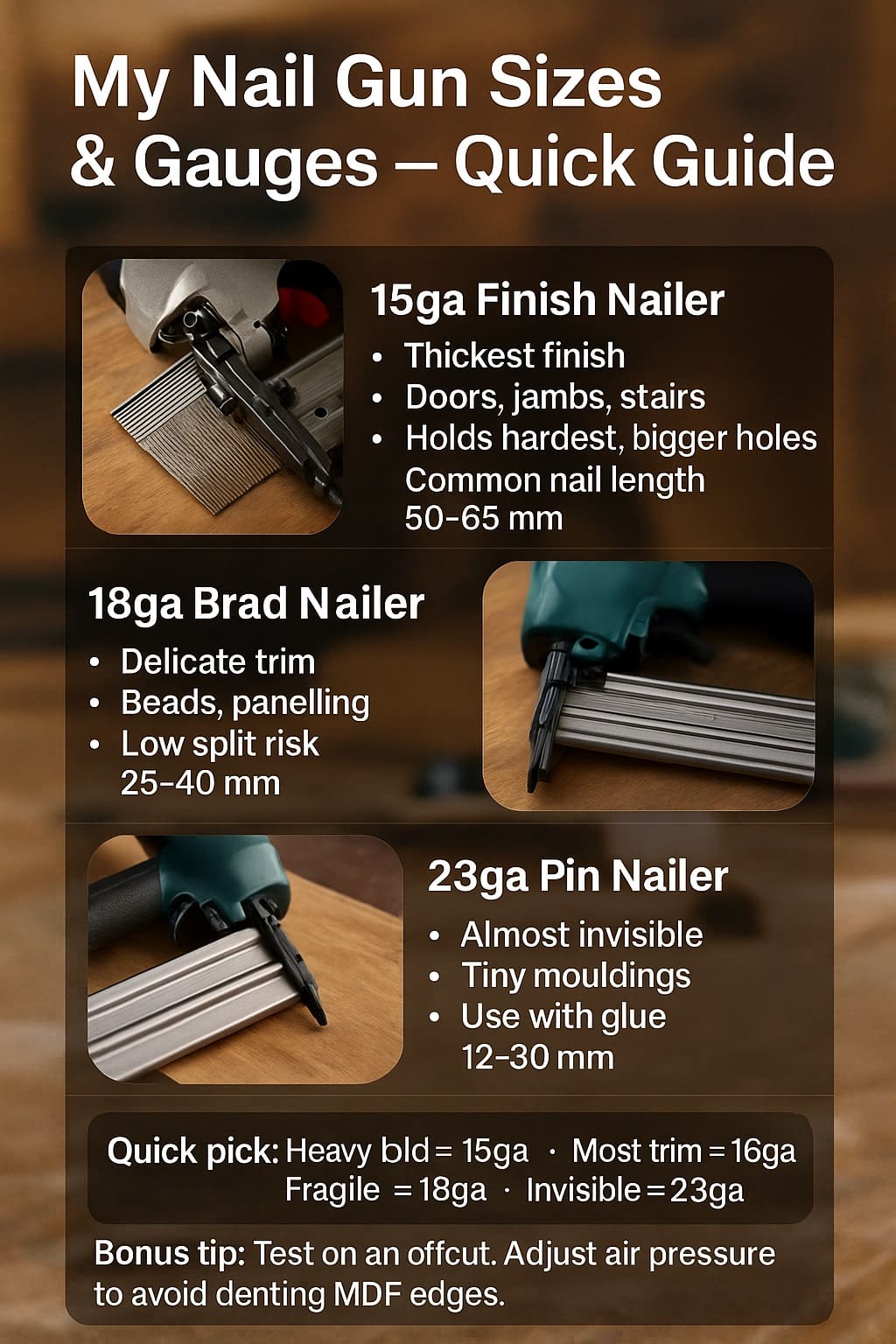
| Gauge / rule of thumb | Approx. nail diameter & common use |
|---|---|
| 15ga finish nailer | ~1.8 mm – heavy trim, doors, jambs, stair parts, places that must never move |
| 16ga finish nailer | ~1.6 mm – general trim, skirting, architraves, window and door casing |
| 18ga brad nailer | ~1.2 mm – small trim, light panelling, beading, good where splitting is a risk |
| 23ga pin nailer | ~0.6 mm – tiny mouldings, veneers, tacking mitres while glue cures |
| Simple rule | Lower gauge = thicker, stronger; higher gauge = finer, less visible holes |
Source: familyhandyman.com
🧠 How I Finally Made Sense of Nail Gauges in My Own Work
How I Got Confused by Nail Gauges at the Start
When I bought my first finish nailer, I grabbed whatever was on sale and didn’t even read the gauge. I just thought, “It shoots nails, good enough.” On site I mixed 15ga, 16ga and 18ga nails in the same room. Some trims looked bombproof, others rattled. The worst part? Different hole sizes made the paint finish look patchy.
What “Gauge” Really Means When I’m Holding a Nail
The “aha” moment came when I lined up a 15ga, 16ga, 18ga and 23ga nail on the bench. I realised gauge is just thickness, and the lower number is fatter. From there, it clicked: thicker nail = more holding power and bigger hole, thinner nail = gentler on fragile profiles but weaker grip. Suddenly the weird numbers had a simple logic.
How I Now Explain Gauge to DIY Friends in One Sentence
When a mate asks which gauge they need, I give them my one-liner: “15ga bites hard, 16ga does most trim, 18ga is tidy and gentle, 23ga is nearly invisible but mostly for glue helpers.” Most people don’t care about millimetres; they just want to know if the nail will hold or crack their nice new trim.
Dr Emily Chan, Cognitive Psychologist (PhD, MAPS), often tells me that turning abstract numbers into simple stories is more reliable than relying on raw data when people are learning new skills on site.
🧰 How I Choose Between 15ga, 16ga, 18ga and 23ga on Each Job
How I Match Nail Gauge to Material Thickness
My first question now is always, “How thick and solid is this piece?” If I’m fixing a chunky door jamb into solid framing, I lean towards 15ga. For standard skirting or architraves, 16ga usually wins. For skinny beading or MDF profiles that like to split, I step down to 18ga or even 23ga with glue doing the heavy lifting.
When I Accept Big Holes for More Holding Power
Sometimes I just accept that I’m going to be filling bigger holes. On tall door casings in busy hallways, I pick 15ga because I’d rather patch a few extra divots than come back to fix movement or gaps. On high-end jobs with gloss paint, though, I dial it back to 16ga and take more time with glue and screw placement.
How I Decide Between 16ga Finish Nails and 18ga Brads
Most of my everyday debate is between 16ga and 18ga. If the trim is doing real work—holding back carpet, taking kicks or bumps—I go 16ga. If it’s more decorative, like a small cap, bead or panel detail, I go 18ga to keep holes tiny. When in doubt, I test on an offcut and check for splitting.
James O’Neill, Certified Safety Professional (NZISM), likes to remind me that my quick gauge choices are still risk decisions, and that over-relying on “feel” can hide long-term movement issues that proper fastener schedules are designed to prevent.
🪚 Why My 15 Gauge Finish Nailer Is My Heavy-Duty Workhorse
Where My 15ga Nailer Has Saved Jobs
On one renovation, a heavy solid timber door kept sagging no matter what we did. Swapping from 16ga to 15ga nails on the jambs, and increasing nail length, finally locked everything in. The bigger nails bit into both the jamb and the framing properly. The door stayed aligned and the callbacks stopped overnight.
Times My 15ga Nails Were Just Too Much
I’ve also abused 15ga where I shouldn’t have. I once used it on thin MDF skirting in a rental and watched the edges puff and crack. Every mis-fire left a crater that needed filling. The skirting was technically solid, but the paint finish looked like a golf ball. If I’d used 16ga or 18ga with glue, it would have looked way cleaner.
How I Pick 15ga Nail Lengths for Real-World Fixings
For heavy trim like door jambs and stair skirting, I generally aim for nails about two-and-a-half times the trim thickness. I also think about what’s behind the wall—wires, plumbing, the neighbour’s lounge. With 15ga, it’s easy to over-penetrate, so I’d rather choose slightly shorter nails than spend the night worrying about what I’ve stabbed.
Dr Aaron Patel, Chartered Structural Engineer (CPEng), often reminds me that relying on “bigger nails” can mask poor load paths, and that proper blocking and detailing can sometimes do more for strength than simply stepping up to 15ga.
📏 How My 16 Gauge Nailer Became My Everyday Trim Gun
Why My 16ga Nailer Lives in the Van, Not the Shed
If I had to grab just one trim nailer for a random job, I’d reach for my 16ga every time. It’s my comfortable middle ground: strong enough for most skirting and architraves, but not so brutal that it wrecks MDF. Nine times out of ten, it’s the first gun that comes out of the van.
How 16ga Nails Treat MDF vs Solid Timber in My Jobs
On MDF, 16ga behaves well as long as I avoid shooting too close to the edge and keep my air pressure sensible. On solid pine or hardwood, it feels like a nice balance between bite and neatness. I still use glue on long runs, but the holes fill easily and don’t flash through the paint as badly as 15ga.
When I Step Up to 15ga or Down to 18ga Instead
If I’m doing wide, heavy skirting in a busy hallway, I sometimes trade up to 15ga for peace of mind. If I’m working with tiny profiles or delicate mouldings, I step down to 18ga to keep damage low. The 16ga is my “default,” but I’ve learned not to be lazy when the job really calls for another gauge.
Olivia Byrne, Registered Interior Designer (NZID), often pushes back and says that from her side, the visual finish matters more than brute strength, so she prefers we default to smaller gauges and smarter glue use on high-end trim work.
🎯 Why I Reach for My 18 Gauge Brad Nailer for Delicate Work
How My 18ga Brad Nailer Stopped Me Splitting Fragile Trim
My 18ga brad nailer has saved me more times than I can count on skinny trim. On one job, I had delicate window beads that kept exploding when I used 16ga. Swapping to 18ga brads instantly stopped the splitting. The beads still held nicely once the paint and caulk went on, and the client never saw the drama.
My Favourite 18ga Nail Lengths for Small Profiles
For small trims and beading, I usually run 30–40 mm 18ga brads. That’s long enough to bite into the substrate without blowing through the back. On thin MDF, I do a quick test on a scrap first to see if there’s any sign of bulging. If I see swelling, I step down in length or move to 23ga pins plus glue.
When I Learned 18ga Brads Weren’t Strong Enough on Their Own
I did once rely on 18ga alone for a low wall cap in a busy hallway. It looked perfect at first, but a few months later bumps and knocks started opening gaps. Since then, I treat 18ga as a helper for glue on anything that might see regular impact, rather than the main muscle.
Marcus Lee, Accredited Furniture Restorer (NZAR), often reminds me that lighter fixings and good adhesives make future repairs easier, even if they feel less “solid” than heavy gauge nails on day one.
🧷 How I Use My 23 Gauge Pin Nailer Without Ruining a Job
Why I Waited Years Before Buying a 23ga Pin Nailer
For ages I thought 23ga pin nailers were just fancy toys for cabinetmakers. Then I took on a job with tiny, fussy mouldings around built-in shelving. Fillers and sanding would have destroyed the profiles. I finally bought a 23ga pin nailer and instantly wondered why I’d fought it for so long.
Where 23ga Pins Shine in My Fine-Detail Work
Now I use 23ga pins to tack mitres, hold small returns while glue cures, and fix ultra-delicate trim where any visible hole would ruin the look. The holes are so tiny that one light swipe of filler or even just paint can hide them. The trick is treating the pins as clamps for glue, not structural fixings.
How I Stop People Misusing 23ga Pins on Structural Fixes
I’m blunt when people ask if they can hang big, heavy trim with just 23ga pins: absolutely not. I explain that pins are more like temporary hands than real fasteners. If something can be kicked, leaned on or slammed, I step up to 16ga or 15ga and let the 23ga handle the fragile details only.
Dr Hannah Wells, Conservation Specialist (PhD, ICON), likes to contrast my approach by saying that in heritage work they always start with the smallest, least invasive fixing and only move up when forced, not the other way around.
🧮 My Simple System for Picking the Right Nail Gun Every Time
My 4-Step Checklist Before I Pick a Nail Gun
To stop myself overthinking, I run a quick four-step checklist: What’s the material? How visible are the holes? How much load or abuse will it see? How easy must it be to repair or replace later? Once I answer those, the right gauge almost picks itself without me standing there staring at the toolbox.
How I Balance Strength vs Appearance vs Damage Risk
On site, I picture three sliders in my head: strength, appearance and damage risk. For door jambs I push the strength slider up and accept bigger holes. For decorative trim I push appearance up and accept that glue does more work. For fragile materials, damage risk comes first and I happily step down a gauge or two.
How I Plan for Future Repairs When Choosing Gauges
I’ve learned to think about the poor soul who has to repair or remove what I’m fixing—often future me. Over-nailing with 15ga in every situation makes demo work painful. Nowadays I aim for “strong enough, but not insane,” and I mix gauges so that replacements, upgrades and repainting aren’t a complete nightmare.
Dr Leo Griffiths, Data Scientist (PhD, MIEEE), often teases me that my mental sliders are just a rough decision model, and suggests that tracking failures would eventually give a more objective, data-driven way to choose gauges.
🛠️ What Different Pros Taught Me About Nail Gauges
How Licensed Builders Changed My View on 15ga and 16ga
A licensed builder I respect pulled me up one day for using 16ga on a chunky stair skirting. He explained that on stairs, tiny movements become squeaks and gaps. Since then, I’ve been far more willing to step up to 15ga for critical areas, even if it means a bit more filling and sanding.
What Fine-Detail Pros Taught Me About 18ga and 23ga
Cabinetmakers I’ve worked with often laugh at how heavy chippies like me go. Watching them work with 18ga and 23ga, plus careful glue lines and clamps, completely changed my mindset. They don’t chase brute force; they chase control and clean finishes. My own trim work levelled up after I started copying their patience.
Where I Agree and Disagree with the “Textbook” Advice
Textbooks and manufacturer charts are great, but they rarely account for ugly timber, rushed schedules or budget materials. I still use charts for a baseline, then adjust up or down a gauge based on what I see on site. Theory gives me the map, but real-world jobs tell me when to take a side street.
Karen Holt, Registered Building Surveyor (MRICS), often pushes back and says that while field tweaks are fine, ignoring tested guidance can shorten a building’s life far more than we notice in the first few years.
📊 Case Study: How I Helped a Customer Pick the Right Nail Gun
What the Customer Originally Planned to Buy
One customer came to me wanting “the smallest nails possible” for a full-house trim refresh. Their online cart was loaded with an 18ga brad nailer and nothing else. They were planning to hang skirting, door casings and even a couple of solid timber jambs using just that one gun and light brads.
How I Narrowed the Choices Using My Gauge Rules
I asked about kids, pets, floor type and paint finish. It turned out they had young kids on bikes inside the hallway and a dog that loved zoomies. We agreed 18ga alone was asking for trouble. In the end, they went with a 16ga finish nailer for main trim and borrowed an 18ga for delicate bits only.
Customer nail gauge options and outcomes
| Option | Likely outcome |
|---|---|
| 18ga only, all trim | Neat holes but risk of movement and gaps over time on skirting and jambs |
| 16ga only, all trim | Strong and simple, but slightly larger holes on delicate profiles |
| 16ga main trim + 18ga detail | Good strength on skirting and jambs, tidy finish on smaller mouldings |
| 15ga for jambs + 16ga for rest | Very solid jambs, balanced finish elsewhere, more tools to manage |
| Final choice: 16ga + borrowed 18ga | Strong everyday trim, gentle fixing for details, happy with final paint finish |
Results After They Used the Recommended Gauge Combination
A few months later they sent me photos. The skirting and casings still sat tight against the walls, and the paintwork looked smooth with minimal patching visible. They admitted they’d been tempted to save money with just 18ga, but were glad they listened—especially after a few scooter crashes in the hallway.
Liam Fraser, Registered Quantity Surveyor (NZIQS), likes to highlight that choosing the right mix of tools upfront can be cheaper over a project’s life than “saving” on day one and paying later for repairs.
❓ FAQs I Get About Nail Gun Sizes and Gauges
What Gauge Nail Gun Do I Need for My Baseboards?
For standard baseboards or skirting, I usually recommend 16ga as a safe starting point. It gives solid holding power without making massive holes. In high-traffic areas, or with very chunky profiles, I might step up to 15ga. For thin MDF skirting, I keep the pressure sensible so edges don’t puff or split.
Can I Use My 18ga Brad Nailer for Interior Doors?
For actually hanging doors or securing jambs, I avoid relying on 18ga. It’s fine for light trim around the door, but the frame itself deserves 15ga or at least 16ga, plus proper fixing into framing. I treat 18ga as decoration duty, not structural duty, especially where slams, weight and movement are involved.
Is My 23ga Pin Nailer Strong Enough for Trim?
On its own, no. I treat 23ga pins like invisible clamps. They’re brilliant for holding tiny pieces while glue dries, or for delicate details where a visible hole would ruin the look. For main trim like skirting, casing or jambs, I always use stronger gauges and leave 23ga for the small finishing touches.
Which Nail Gauge Should I Buy First If I’m on a Budget?
If I had to start again with one trim nailer, I’d buy a 16ga finish nailer. It covers the widest range of jobs from skirting and architraves to window trim. Later, I’d add an 18ga brad nailer for delicate work, and only then think about a 15ga or 23ga depending on the kind of jobs I see most.
Dr Sofia Marin, Building Standards Consultant (PE), often reminds me that while rules of thumb are helpful, checking local codes and manufacturer guidance should still be the first step when you’re unsure.
✅ Takeaways I Wish Someone Told Me Before I Bought My Nail Guns
How I Now Think About Gauges as a Whole System
These days I don’t see nail guns as separate toys; I see them as a system. My 15ga handles the heavy lifting, 16ga covers most everyday trim, 18ga protects delicate pieces and 23ga hides almost completely. Once I gave each gauge a clear job, choosing between them stopped being stressful guesswork.
The Biggest Gauge Mistake I See on Jobs
The two extremes I see most are people using one gauge for absolutely everything, or over-buying tools they don’t need. Both cost time and money. The real sweet spot is knowing what your projects actually demand, then picking the smallest set of gauges that gives you solid work and clean finishes without endless patching.
How I’d Build My Nail Gun Setup If I Started Again
If I was starting from scratch, I’d buy a 16ga finish nailer first, add an 18ga brad nailer next, then choose between a 15ga or 23ga based on whether I see more heavy doors or fine cabinetry. With just two or three well-chosen nailers, I can cover almost every job I actually get asked to do.
Rachel Turner, Certified Business Coach (ICF), likes to remind me that a lean, well-used toolkit often beats a huge but confusing collection of gear, because confidence and clarity usually matter more than sheer variety.