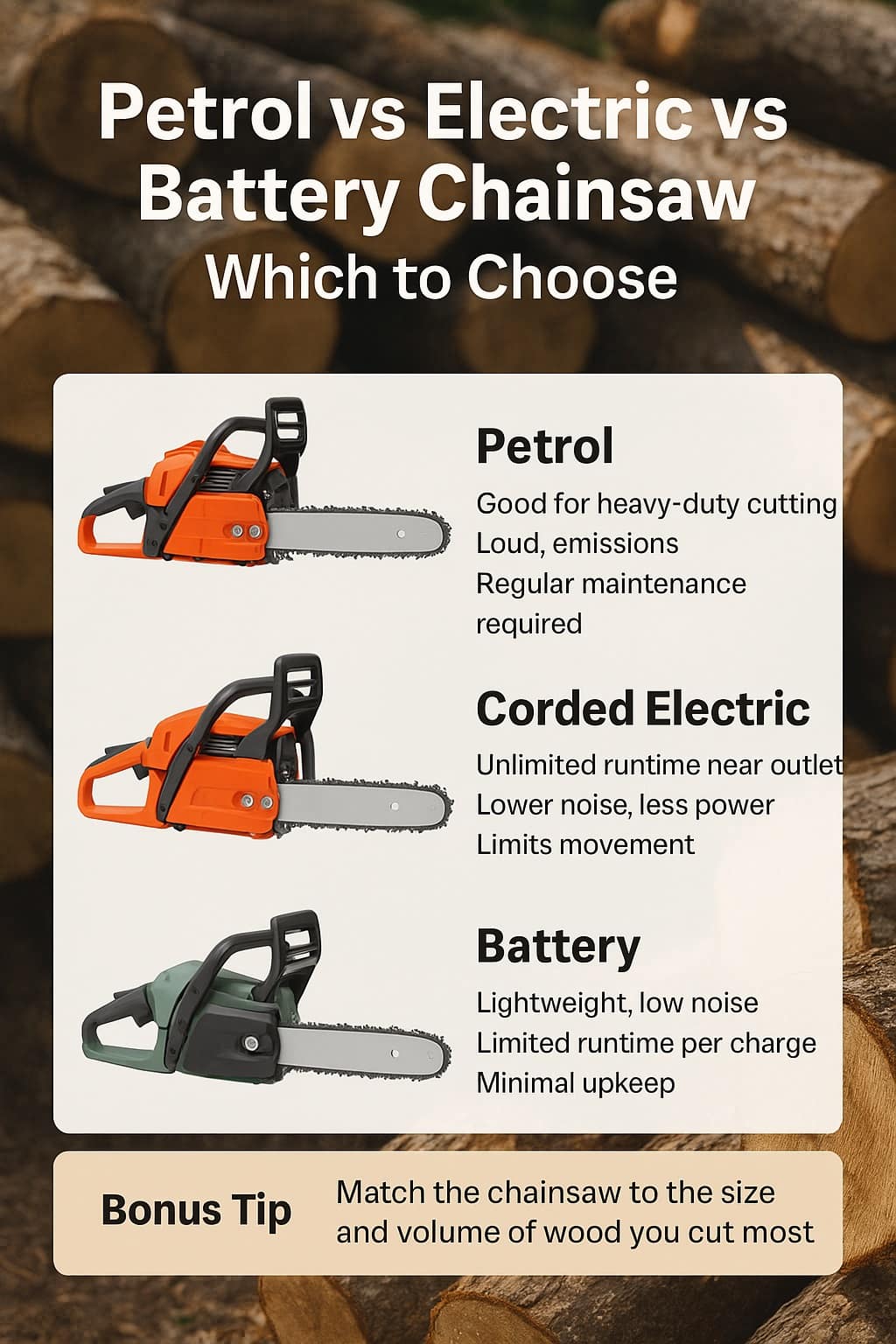
I’ve owned, borrowed, and “rage-tested” all three types. Some days I want raw power. Other days I want quiet and clean. And sometimes I just want the simplest tool that gets the job done without turning my weekend into a maintenance workshop.
Choosing between petrol chainsaws, corded electric chainsaws, and battery chainsaws comes down to power access, runtime, noise, and what you cut most. Petrol often runs louder (commonly around 100–115 dB at the operator), while corded and battery models are often lower (commonly around 85–100 dB). Chain speeds also vary: petrol can push higher speeds, but battery can feel “petrol-like” for many home jobs.
Quick stats I compare before buying or renting
| Metric I compare | Typical real-world range (varies by model) |
|---|---|
| Noise at operator ear | Petrol: ~100–115 dB • Corded/Battery: ~85–100 dB |
| Chain speed | Petrol: ~20–30 m/s • Battery: ~15–25 m/s • Corded: ~10–15 m/s |
| Continuous runtime | Petrol: refuel in minutes • Corded: as long as power • Battery: ~20–60 min per pack |
| “Best fit” in one line | Petrol = heavy work • Battery = convenience • Corded = simple yard work |
Source: stihl.com
✅ My Quick “Which One Should I Choose?” Checklist
When people ask me “which chainsaw should I buy?”, I don’t start with brand. I start with the job. I’ve learned the hard way that the wrong power type feels fine in the shop… and awful at home. My best purchases were boring choices that matched my most common cuts, not my biggest ego.
Here’s the shortcut I use. If I’m cutting thick logs all day or I’m away from power, I lean petrol. If I’m doing quick yard cleanups and I want low hassle, I lean battery. If I’m near a socket and I want cheap simplicity, I lean corded. Then I check noise, weight, and how much “walking around” the job needs.
If you only remember one thing: match your saw to wood size, cut volume, and where you’ll work. Most regrets happen when I buy for the “one big job” instead of the 20 small jobs I actually do.
_Daniel Kahneman, PhD (Nobel Laureate in Economics), would remind me that we overbuy for rare scenarios because the dramatic story feels more “real” than the boring average._
⛽ My Petrol Chainsaw Choice (When Gas Still Wins for Me)
Petrol is the one I grab when I don’t want excuses. If I’m bucking thicker rounds, chewing through dirty storm wood, or working somewhere remote, petrol keeps moving. The best part is the rhythm: cut, refuel, cut again. I don’t have to “plan” my batteries or baby a long extension lead across the lawn like it’s a pet snake.
But petrol is also the one that punishes laziness. If I leave old fuel in it, it sulks. If I forget air filter checks, it breathes like a clogged vacuum. And if I start it wrong, it makes me look weak in front of my own backyard. I’ve had days where my “powerful” petrol saw did zero work because I neglected basic care.
My honest petrol rule: choose petrol if the job is truly heavy or long, and you’re willing to own the maintenance. If you hate maintenance, petrol can turn into an expensive ornament that smells like regret.
_Capt. Chesley “Sully” Sullenberger (Airline Transport Pilot certificate) would say performance is useless without reliability, and reliability is built from routine checks, not hero moments._
Why I Like Petrol for All-Day Cutting
Petrol shines when the wood is thick and the cuts are many. It holds power under load, and I can refuel fast. If I’m processing a pile of logs for firewood, petrol feels like the steady “tractor” option. I also like that petrol models cover a huge range of bar lengths and power levels, from small to serious.
My Real Petrol Maintenance List
My petrol list is simple: fresh fuel, correct mix (if it’s a 2-stroke), clean air filter, sharp chain, bar oil topped up, and a quick look for loose parts. I store fuel properly and I don’t let it sit forever. The chain still needs sharpening like any other saw, or I’ll just create noise and smoke.
My Petrol Downsides People Underestimate
Noise and fumes are the obvious downsides, but the sneaky one is “friction” — it takes mental energy to prep fuel, start it, and clean it. If I’m only doing one tiny job, petrol can feel like using a sledgehammer to crack a peanut. That’s where battery and corded start winning my heart.
🔌 My Corded Electric Chainsaw Choice (The Plug-In That Surprises People)
Corded electric chainsaws are underrated, mostly because they’re not “cool.” But cool doesn’t clear branches. When I’m doing basic yard work close to a socket, corded can be the simplest option. No fuel, no charging, no battery juggling. I plug in, I cut, and I’m done. That simplicity is a real kind of power.
The biggest win is consistency. Corded doesn’t fade like a battery can when it’s hot or low. If I’m trimming branches, cutting small logs, or doing quick cleanup after a windy day, it feels like a reliable kitchen appliance: on/off, predictable, and drama-free. That’s a beautiful thing if I’m short on time.
The big downside is obvious too: the cord. I’ve had moments where I step back to avoid the bar… and almost step on the lead instead. Corded is only great when I can control the workspace, keep the lead safe, and avoid the “tangle dance.”
_Mike Holmes (licensed contractor and builder) would say the easiest tool is often the one you’ll actually use, and the one you’ll actually use is the one that keeps your home maintained._
Why I Like Corded for Simple Jobs
For small jobs, corded is quick and light. I don’t think about fuel, charging, or storage. It’s also less “vibraty” than many petrol setups, so my hands feel fresher. If my work is mostly pruning and small rounds, corded can be enough without paying battery platform prices.
My Extension Lead Rules (So It’s Not a Disaster)
I treat the lead like a hazard, not an accessory. I keep it behind me, I avoid wet areas, and I use proper protection like an RCD/GFCI where appropriate. I choose a thick, quality lead that doesn’t heat up under load. And I stop if the lead routing gets messy.
Where Corded Drives Me Crazy
Corded annoys me when the job needs movement: around trees, behind sheds, or anywhere I can’t keep a clean “cut zone.” It also limits distance. If I’m walking far or working awkward angles, I’d rather go battery than wrestle a cable like it’s a gym battle rope.
🔋 My Battery Chainsaw Choice (Where Cordless Is My Sweet Spot)
Battery chainsaws are what I reach for when I want fast, clean, quiet-ish cutting with the least hassle. For storm debris, quick pruning, and backyard tidy-ups, battery is the “grab and go” king. I used to think battery was a toy. Then I tried a decent brushless model with a sharp chain and realized the real limitation wasn’t power—it was my assumptions.
My trial-and-error lesson: battery performance depends heavily on sharpness and technique. A sharp chain makes battery feel strong. A dull chain makes battery feel weak and makes me blame the saw. Once I got serious about sharpening, battery jumped up a whole class. It’s like cleaning a dirty camera lens: suddenly everything “improves.”
Battery is also a lifestyle choice. You’re buying into a platform: batteries, chargers, and tool range. If I already own other tools on the same platform, battery chainsaws become an easy yes. If not, the “starter cost” is real, even if the running cost is low.
_Marie Kondo (organizing consultant) would argue the best tool is the one that reduces clutter and friction in your life, because messy systems quietly drain energy every day._
How I Think About Runtime (Minutes, Cuts, and Spare Packs)
I don’t obsess over minutes. I think in “jobs.” One battery might clear branches and small rounds. Two batteries usually covers a decent backyard session. If I’m doing bigger wood, I plan extra packs or I switch to petrol. My best battery setup isn’t the biggest saw—it’s the right saw plus a spare battery ready to go.
How I Compare Battery Performance Without Hype
I look at chain speed, bar length, and battery energy (Wh). I also consider heat management, because hot batteries can slow down. Brushless motors help, but the chain still does the real work. If the chain is sharp and the depth gauges are right, battery feels punchy. If not, it feels like I’m chewing with blunt teeth.
My Battery Ecosystem Trap (And How I Avoid It)
My biggest mistake was owning too many platforms. Different chargers, different batteries, and constant “where is that pack?” drama. Now I keep it tight: one main battery ecosystem for most tools. If a brand doesn’t support the tools I actually use, I don’t marry it just for the chainsaw.
💸 My Running Cost Comparison (Fuel vs Power vs Batteries)
People love arguing “petrol is cheaper” or “battery is cheaper,” but the truth depends on how you use it. If I cut once a month, petrol can cost me more in wasted fuel, maintenance, and hassle than it does in actual cutting. If I cut every weekend, petrol can be efficient because refueling is fast and performance stays strong over long sessions.
Battery tends to feel cheap per use, especially if I already own the batteries for other tools. Electricity is usually inexpensive compared to petrol energy, and maintenance is lighter. But batteries do age. After enough cycles and years, replacement cost appears like a surprise bill. It’s not scary, but it’s real.
Corded is often the cheapest to own, because there’s no fuel and no battery pack replacement. The “cost” is inconvenience and workspace limits. For many homeowners, that’s a fair deal.
_Ramit Sethi (personal finance author) would say the “cheapest” tool isn’t the lowest sticker price—it’s the one that matches your real habits and prevents expensive do-overs._
How I Estimate Cost Per Hour
My simple method: I estimate how many hours I’ll actually cut per year, then I spread purchase cost over that. Then I add expected running costs: petrol and 2-stroke oil, or electricity, plus chains and sharpening supplies. The surprising factor is chain sharpening time. If I’m blunt, I “pay” in frustration and slow progress.
My Hidden Costs People Forget
The hidden costs are boring: bar oil, chain files, spare chains, PPE, and storage. Battery adds the cost of spare packs if I hate downtime. Petrol adds fuel storage and maintenance. Corded adds a decent extension lead and safe power protection. The winner depends on which hidden costs annoy me least.
🦺 My Safety & Comfort Check (Noise, Kickback, Fatigue)
I treat chainsaws like power tools with teeth—because that’s what they are. My biggest safety upgrade wasn’t a fancy saw. It was better habits: stable stance, clear work area, and not rushing cuts when I’m tired. I also take noise seriously. Chainsaws can be loud enough to damage hearing fast, so hearing protection is not optional for me.
Kickback is the classic danger, and it tends to happen when I get lazy: cutting with the bar tip, cutting awkward angles, or letting the chain touch something unexpected. Battery and corded feel “friendlier,” so people sometimes get overconfident. But the chain doesn’t care what powers it. Sharp steel is sharp steel.
Comfort matters too. Weight, vibration, and balance change how long I can work safely. If a saw is too heavy, my form collapses, and that’s when mistakes arrive. I’d rather use a slightly smaller saw well than a big saw badly.
_Dr. Atul Gawande, MD (surgeon) would say checklists beat confidence, because skill fails quietly when fatigue and speed team up._
How I Reduce Kickback Risk
I avoid the upper tip zone when possible, I keep the chain sharp, and I cut with the saw supported and my body out of the line of fire. I use the chain brake properly and I don’t “freehand” risky cuts. If the log is unstable, I stabilize it first. Wood movement is how chainsaws surprise you.
How I Keep My Hands and Ears Happier
I take breaks before my grip turns into a claw. I wear hearing protection and eye/face protection every time. Gloves help with vibration and grip, but technique matters more. If I’m shaking and rushing, I stop. The job will still be there in ten minutes. My fingers are harder to replace.
🔎 My Buying Guide (Specs I Check So I Don’t Regret It)
When I’m shopping, I ignore the marketing words and look at the boring numbers. Bar length, chain type, chain speed, weight, and support. I also think about parts: can I easily buy a spare chain, file, and bar oil? If a tool is hard to maintain, I’m less likely to keep it safe and sharp.
I’ve also learned that “powerful” doesn’t automatically mean “fast.” A sharp chain on a mid-sized saw often beats a dull chain on a big saw. The most common reason people hate their chainsaw is not the motor. It’s a blunt chain, wrong chain type, or poor cutting technique.
I also consider service and support. If I’m using petrol, I want local servicing options. If I’m going battery, I want a reliable warranty and widely available batteries. If I’m going corded, I want a robust build and a safe, practical cord length.
_Tim Ferriss (author and experimenter) would say optimize the system, not the ego—because a “good enough” tool used consistently beats a perfect tool used rarely._
My 7 Spec Checks Before I Pay
-
Bar length that matches my wood size (not my fantasy projects)
-
Chain pitch/gauge compatibility I can actually buy locally
-
Weight and balance (especially if I’m working overhead or awkward angles)
-
Chain speed / cutting feel (not just power claims)
-
Easy tensioning and access for maintenance
-
Brand support for parts, warranty, and batteries
-
Safety features I’ll actually use (chain brake, guards, trigger feel)
🧰 My Customer Case Study (One Job, Three Chainsaws, One Clear Winner)
A common job for me is storm cleanup: branches everywhere, a few thicker limbs, and a couple of log sections that need bucking for disposal or firewood. The customer usually cares about speed, mess, and noise. This is where the “best chainsaw type” changes inside one job.
I started with battery for the scattered branches because it’s fast to pick up and move around. No cord to drag, and no petrol fumes near the house. The customer liked the lower noise, and I liked the quick stop/start. It felt controlled and clean, like using a neat tool instead of wrestling a machine.
Then the thick log sections showed up. Battery still worked, but I could feel it slowing as the wood got bigger and the cuts stacked up. That’s when petrol earned its keep. I switched to petrol for the heavy bucking and finished faster. Corded could have worked near power, but the job movement made the lead annoying.
| What happened on the job | What I saw (simple results) |
|---|---|
| Job type | Storm branches + thick limb sections + a few log rounds |
| What the customer cared about | Low noise, fast cleanup, minimal fuss |
| What ran smoothest for moving around | Battery (easy stop/start, no lead) |
| What finished thick cutting fastest | Petrol (steady power under load) |
| What slowed the workflow most | Corded lead management and repositioning |
_Henry Petroski, PhD (engineer and author) would say real-world “failure points” aren’t dramatic—they’re usually small friction points that repeat until the whole system feels bad._
❓ My FAQs (What People Always Ask Me)
How do I choose the right bar length?
I match bar length to what I cut most, not the biggest thing I might cut once. Longer bars add weight and can increase fatigue. If most of your cuts are small branches and modest rounds, a shorter bar feels safer and easier. If you regularly cut bigger logs, longer makes sense, but technique matters more than length.
Are battery chainsaws powerful enough?
For a lot of homeowners, yes. The “secret sauce” is a sharp chain and having enough battery energy for the job. Battery feels amazing for pruning, cleanup, and medium rounds. Where battery struggles is long, heavy bucking without spare packs. If you hate downtime and cut big wood often, petrol still wins.
Why does my chainsaw cut slow even when it’s “strong”?
Nine times out of ten it’s the chain, not the motor. A dull chain makes any saw feel weak, and it pushes you into bad technique. If the saw makes dust instead of chips, stop and sharpen. Also check chain tension and bar oiling. A dry bar creates drag, heat, and slow cutting.
Corded vs battery: which is safer?
Both can be safe, but they fail differently. Corded has the extra hazard of the lead. Battery removes the lead but still has a fast chain. I treat both the same: PPE, stable stance, clear cut zone, and no rushed awkward cuts. Safety is more about habits than power source.
How do I stop my chain from going blunt fast?
Avoid cutting into dirt, stones, and dirty bark near the ground. Support the wood so the bar doesn’t touch soil at the end of the cut. Keep the chain sharp with quick touch-ups rather than waiting until it’s totally dead. A few minutes of maintenance saves a lot of frustration and risky pushing.
_Dr. Anders Ericsson, PhD (psychologist, expertise research) would say small frequent practice beats occasional “big effort,” which is exactly why quick sharpening habits outperform emergency sharpening marathons._
🧾 My Takeaways (What I’d Tell a Friend in 30 Seconds)
If you cut big wood often, work away from power, or want nonstop heavy cutting, I’d lean petrol—if you’re willing to maintain it. If you want the easiest “pick up and cut” experience with less noise and mess, I’d lean battery—especially with a spare pack. If you mainly do simple yard jobs near a socket, corded electric can be the cheapest, simplest workhorse.
My personal rule is blunt: pick the option you’ll actually use safely and consistently. A sharp chain and good PPE will make any of these feel better. The wrong choice won’t just feel slow—it’ll sit unused, and that’s the most expensive outcome.
_James Clear (author, habit formation) would say the best choice is the one that makes the safe action the default, because consistency beats intensity when you’re building real results._