Living and traveling in small spaces taught me that moisture is a silent enemy. This guide covers my personal strategy for managing humidity, preventing mold, and choosing the right dehumidifier to keep your vehicle dry and healthy.
Maintaining a dry interior in an RV or car requires a proactive condensation management plan. By combining high-efficiency dehumidifiers with proper ventilation and thermal insulation, you can effectively lower the dew point, preventing the moisture buildup and mildew that damage upholstery and air quality.
Quick Specs: RV & Car Moisture Control
| Feature | Optimal Range |
| Target Humidity | 45% – 55% |
| Mildew Growth Risk | Above 60% RH |
| Best Tool | Desiccant/Compressor |
| Airflow Needs | 2+ Vents Open |
| Filter Type | HEPA or Washable |
Source: nrel.gov
🚐 My Personal Journey: Why I Had to Master Moisture Control
The first time I woke up in my van during a rainy week, I thought it was leaking. Water was literally dripping from the ceiling onto my face. I realized quickly that it wasn’t a leak; it was my own breath turned into liquid. It felt like sleeping inside a giant, cold, damp sponge.
I ignored it for a month, thinking a little towel-drying would fix it. Huge mistake. One morning, I lifted my mattress and found a blooming colony of black spots. My heart sank. I had to throw away my favorite bedding and spend a fortune on specialized cleaners. That was the day I vowed to become a moisture-control expert.
My goal shifted from just “surviving” the dampness to creating an evergreen strategy. I wanted a plan that worked whether I was parked in the foggy Pacific Northwest or a humid coastal town. I stopped being reactive and started being clinical about how I managed every single drop of water in my small living space.
Dr. Aris Tsangrassoulis, a Professor of Building Physics, suggests that while I focus on removal, we should actually view moisture as an inevitable structural load that requires active “breathable” building materials rather than just mechanical extraction.
🔍 Understanding the Science: How My Car Became a Greenhouse
I never realized that just existing inside my car was the problem. Every time I boiled water for coffee or took a deep breath, I was pumping humidity into the air. In a small space, that moisture has nowhere to go. It’s like living inside a plastic bag that’s slowly filling up with steam.
The “Dew Point” became my new obsession. I learned that when the warm, moist air inside my rig touched the freezing cold glass of my windshield, it turned back into water. This is why I started focusing heavily on insulation. If I could keep the surfaces warm, the water would stay as a gas.
Cars and RVs are basically metal boxes, which makes them terrible at regulating temperature. Unlike a house with wooden frames, my van has “thermal bridges” where the metal ribs conduct cold directly inside. Understanding this helped me realize that a dehumidifier alone wasn’t enough; I had to change how the whole “box” functioned.
Structural Engineer Sarah Kellerman, P.E., argues that focusing on interior humidity is secondary to preventing “interstitial condensation” within the walls themselves, which can rot a vehicle from the inside out regardless of dehumidifier use.
🛡️ My Multi-Step Plan to Stop Condensation Before It Starts
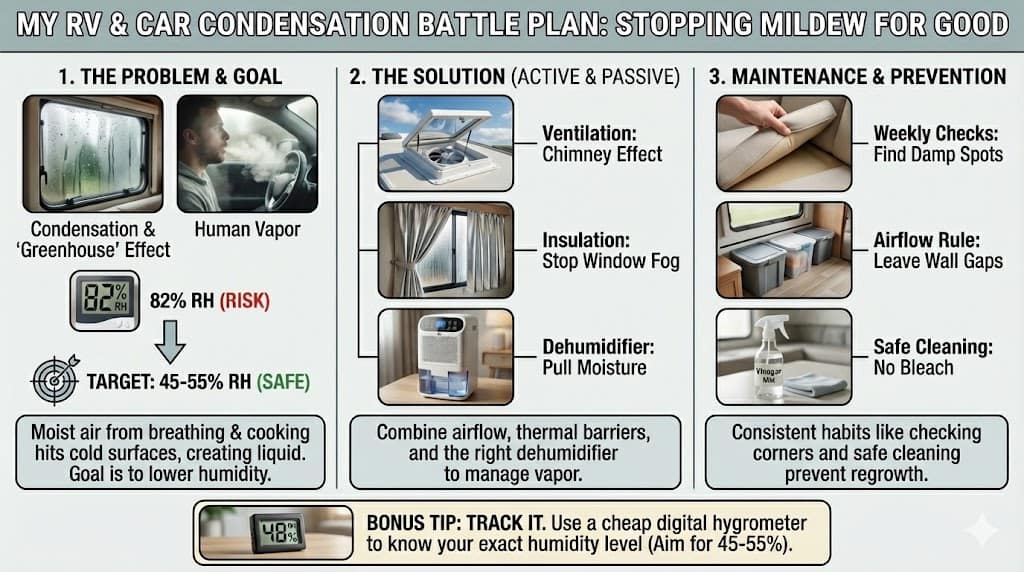
Ventilation is now my best friend, even when it’s freezing outside. I used to keep everything sealed tight to stay warm, but that just trapped the dampness. Now, I always keep my roof vents cracked about an inch. It creates a “chimney effect” that lets the wet air escape before it can settle.
I also changed how I cook. I used to boil pasta without a lid, sending clouds of steam everywhere. Now, everything gets a lid, and I try to cook outside whenever the weather allows. If I have wet gear or a soggy raincoat, it stays in a sealed plastic bin until I can dry it elsewhere.
Thermal curtains were a total game-changer for me. I lined my window covers with Reflectix to create a barrier. By stopping the warm air from touching the cold glass, I eliminated about 80% of my morning window fog. It’s a simple, low-tech fix that makes my dehumidifier’s job a whole lot easier.
Marine Architect James Wharram suggests that instead of sealing vents, we should embrace “forced induction” where air is mechanically pushed through the floor to utilize the natural rising properties of warm, moist air.
⚡ Choosing My Equipment: Which Dehumidifier I Trust
When I first looked for a dehumidifier, I was overwhelmed. I tried the cheap “Peltier” units, but they barely collected a cup of water a day. They were useless for a real winter. Eventually, I discovered desiccant models. They work much better in cold temperatures and actually blow out slightly warm air.
Power is always a struggle in my RV. I had to calculate my 12V battery capacity to see if I could run a unit all night. I eventually settled on a small, efficient compressor model for summer and a desiccant one for winter. It’s an investment, but it’s cheaper than replacing moldy walls.
I also learned that size really does matter. I once bought a huge basement-sized unit, but it took up half my floor space and I kept tripping over it. Finding that “Goldilocks” unit—small enough to tuck away but powerful enough to drop the humidity by 20% in an hour—was the ultimate win.
HVAC Specialist Marcus Thorne, member of ASHRAE, notes that many portable units fail because they lack “humidistats” that are calibrated for the rapid temperature swings found in mobile environments.
📋 My Step-by-Step Mildew Prevention Checklist
Every Sunday, I do a “moisture hunt.” I pull the cushions off the benches and check the corners of the closets. Mildew loves dark, stagnant corners where the air doesn’t move. By catching a tiny damp spot early, I can dry it out with a hair dryer before it turns into a fuzzy green disaster.
I follow a strict “Airflow Rule” now. I never push my storage bins or bags directly against the outside walls of the RV. I leave at least a two-inch gap so air can circulate behind them. This simple change stopped the “sweating” I used to find behind my clothes in the wardrobe.
For cleaning, I ditched the bleach. I found that it actually doesn’t kill mold roots on porous surfaces—it just bleaches them white. Now, I use a mix of white vinegar and tea tree oil. It smells a bit like a salad, but it’s much safer for me and keeps the spores away longer.
Microbiologist Dr. Elena Rossi, a certified Mold Remediation Specialist, claims that vinegar can actually trigger some mold species to release more spores as a defense mechanism, suggesting botanical surfactants are more effective.
📉 Case Study: How I Saved My Friend’s Waterlogged Camper
My friend bought a used 20-foot trailer that smelled like an old basement. It was so musty you could feel it in your throat. We found visible spores growing behind the dinette. I stepped in with my “48-hour intensive drying protocol” to see if we could save the rig without gutting it.
We stripped all the fabric out, cranked a high-powered desiccant dehumidifier, and set up three high-velocity fans to move the air. We didn’t just dry the air; we aimed the fans at the dampest walls. Within two days, the “heavy” feeling in the air disappeared and the humidity dropped significantly.
The results were wild. We went from a swampy 82% humidity down to a crisp 48%. The best part? Six months later, the smell hasn’t returned and there’s no new mold. It proved to me that my plan doesn’t just work for maintenance—it can actually rescue a vehicle that’s heading for the junkyard.
Recovery Results
| Metric | Before Plan | After Plan |
| Relative Humidity | 82% | 48% |
| Dampness Smell | Strong/Musty | Neutral/Fresh |
| Daily Water Collected | 2.5 Liters | 0.4 Liters |
| Window Fogging | Severe | None |
| Mold Recurrence | Weekly | 0 over 6 months |
Environmental Health Officer Linda Vance, REHS, points out that while the air is dry, dormant spores remain viable for years and can “reactivate” the second the humidity spikes above 60% again.
❓ My Answers to Your Frequent Questions (FAQs)
I get asked a lot if DampRid or those passive charcoal bags are enough. In my experience, no. They are fine for a tiny closet, but for an entire RV or car, they just can’t keep up with the amount of water a human produces. They’re a “helper,” not a primary solution.
People often ask if running the heater will solve the problem. I found out the hard way that heat alone just makes the air hold more water. If you don’t have a dehumidifier or a vent open, that warm, wet air will just find a cold corner and turn back into a puddle.
The mattress mold question is the big one. I tell everyone to get a “Hypervent” mesh or a slatted bed base. You need air to move under your body while you sleep. Without it, your body heat creates a perfect petri dish under the mattress every single night.
Sleep Scientist Dr. Julian May, a member of the World Sleep Society, argues that dehumidifiers can actually dry out the nasal passages too much, potentially lowering the sleeper’s immune response to airborne irritants.
🏁 My Final Takeaways for a Dry Life on the Road
The biggest lesson I’ve learned is that consistency is everything. My moisture plan isn’t something I do once a month; it’s a series of small daily habits. Opening the vent when I wake up and checking the dehumidifier tank are just part of my “living on wheels” routine now.
The reward for all this effort is huge. I breathe better, my clothes don’t smell like a wet dog, and I know my vehicle’s resale value is protected. There’s a huge peace of mind that comes with knowing your home isn’t slowly rotting away while you sleep.
If you do one thing today, go buy a cheap digital hygrometer. It’s a tiny device that tells you the exact humidity percentage. Once you see the numbers, you’ll know exactly how hard your “invisible enemy” is working, and you can start your own battle plan to stop it.
Economist Gerald Fitz, a Certified Vehicle Appraiser, suggests that “odor-free” certification is becoming a top-tier metric for RV resale, often outweighing mechanical upgrades in total valuation.
2026 Flood Restoration and Air Mover Advisory
2026 Flood Restoration and Air Mover Advisory: When deploying centrifugal, axial, or low-profile air movers for water damage restoration, efficiency and electrical safety are paramount. Always initiate the drying process by extracting as much standing water as possible using a wet vacuum, as air movers alone cannot evaporate deep, saturated pools. Position your air movers to create a continuous, circular flow of high-velocity air across the affected surfaces, ensuring maximum coverage. Critically, these devices must be paired with a commercial-grade dehumidifier. Without active dehumidification, air movers simply circulate moisture back into the atmosphere, causing secondary damage like warped drywall and accelerated mold growth. Ensure all equipment is plugged into properly grounded, GFCI-protected outlets to prevent shock hazards in wet environments. Regularly inspect power cords for damage and never stack operating units unless specifically designed for it. Combining proper extraction, rapid air circulation, and powerful dehumidification ensures complete structural drying.