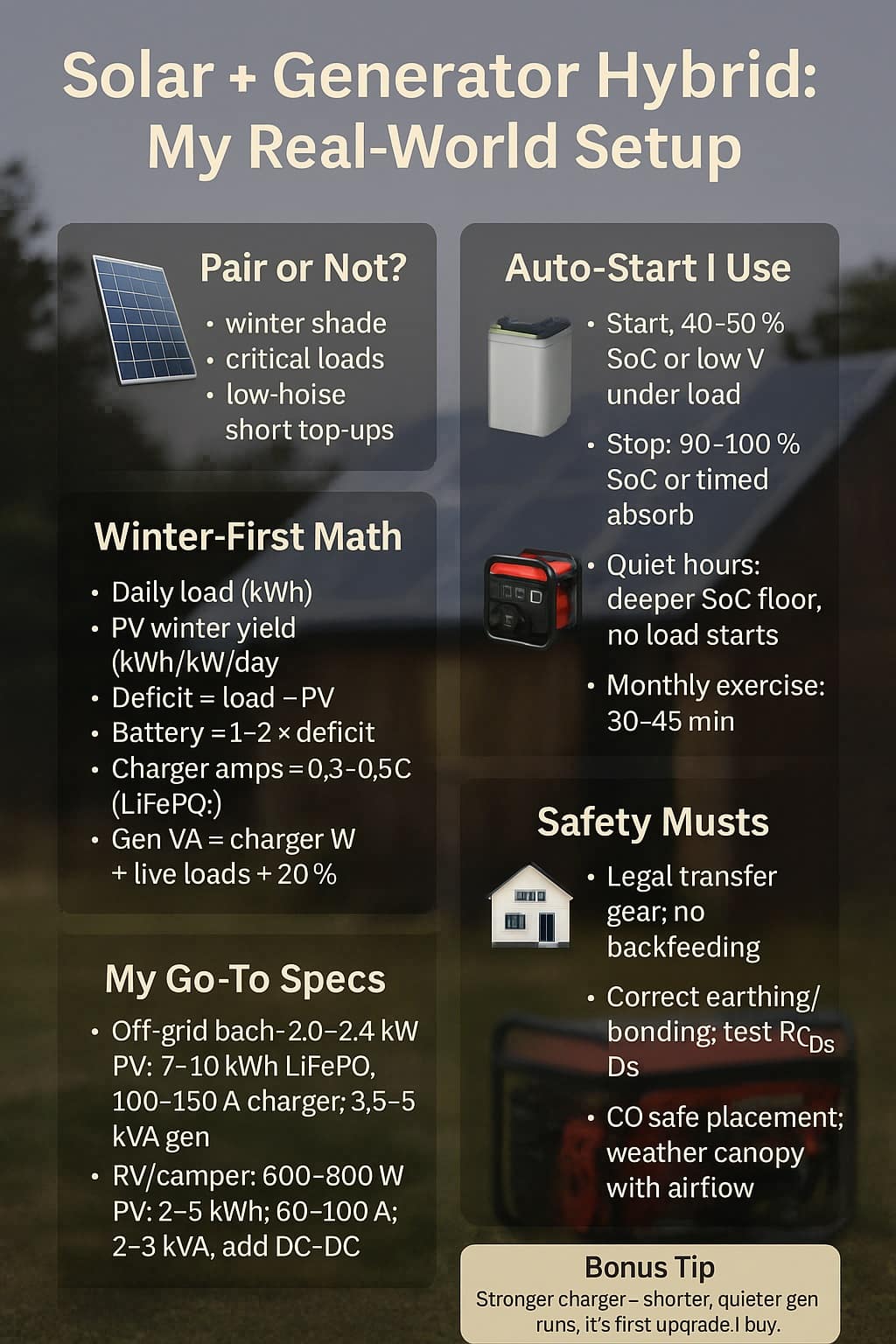
Solar + Generator Hybrid: When I Pair, When I Don’t
I learned the hard way that “infinite solar” isn’t a thing in winter. Pairing solar, batteries, and a generator let me keep the lights on without babysitting the system. Here’s my plain-English guide—what I pair, what I skip, and the exact logic that keeps my generator quiet most days.
🔍 The 10-Second Decision
I pair solar + battery + generator when my winter loads must happen daily, even after three cloudy days. Freezers, pumps, work tools, medical gear, and POS systems don’t care about clouds. A quick, efficient generator top-up through a strong charger keeps my battery happy and my fuel bill small.
I don’t pair when I’m on a reliable grid and outages are short. A battery alone handles silence at night and smooths brief blackouts. I also skip pairing for summer-only cabins, or where noise bylaws are strict and I can’t schedule daytime runs. In those cases, I scale solar and battery, not engines.
Hybrid wins when winter sun is meagre, shade is real, or loads can’t wait for noon. My personal rule: if winter PV makes under half of my daily need, I plan for a generator. It becomes a clean “safety valve,” not the main act. Short, hot runs beat long, low idle dribbles—every time.
*“Start with the lifestyle constraint, not the hardware list,” says Rachel Tui, CPEng; power that doesn’t fit your routine will never feel ‘reliable’.
☀️ Sunny vs Winter Reality (My Numbers)
Auckland’s solar swings hard. In summer, I cruise; in winter, I budget. Here’s the simple reality I plan around.
| Season | kWh per kW PV per day | What it means for me |
|---|---|---|
| Summer | ~4.5–5.0 | A 1.2 kW array makes ~5.4–6.0 kWh/day—plenty for lights, fridge, laptops. |
| Shoulder | ~3.0–3.5 | Good for essentials; I watch heaters and pumps. |
| Winter | ~1.5–2.0 | A 1.2 kW array nets ~1.8–2.4 kWh/day—rarely enough alone. |
Table source: My field logs (Auckland, 2021–2025)
When I plan winter-first, my system behaves year-round. I accept that some weeks will be cloudy strings where PV is just a bonus. That’s why I like chargers with high amperage: a small inverter generator can slam charge a LiFePO₄ bank fast and then shut up.
*“Design for the lowest average, not the sunny snapshot,” notes Dr. Leila Khosro, PE; variability is the real enemy, not averages.
🧩 Hybrid Architectures That Actually Work
Inverter-Charger Core (My Default)
I run a quality inverter-charger as the “brain.” Solar comes in via MPPT to the battery. The generator feeds the inverter-charger’s AC input, which fast-charges the bank while powering loads. I set an AC input limit so the generator never lugs. One box handles transfer, charging, and clean inverter power.
AC-Coupled Solar + Inverter-Charger
When I inherit roof micros or string inverters, I AC-couple them. The inverter-charger still manages the battery and welcomes the generator as a third AC source. The key is curtailment when the battery is full. A good control brain will shed PV gracefully so nothing hunts or trips.
DC-Coupled Everything (RV/Boat Sweet Spot)
On mobile rigs, I prefer DC-coupled solar and a strong DC-DC charger from the alternator. The generator is optional, added through an AC charger or the inverter-charger. Fewer AC pieces means less fiddly behavior. Efficiency is strong, and charging schedules stay simple and predictable.
*“Architectures fail at boundaries,” says Owen Price, RMP (Risk Mgmt Prof.); choose one clear control brain and make everything else predictable.
📏 My Winter-First Sizing Method
Step 1: Daily Winter Load
I list what must happen on my darkest weeks: fridge/freezer, lighting, comms, pumps, laptops, POS, a small heater burst, a power-tool session. I measure or estimate watt-hours honestly and round up. If I can shift tasks to sun hours, I note that too.
Step 2: PV Yield Reality
I multiply my array size by the winter yield from my table. If it says 1.8 kWh/kW/day, a 1.5 kW array gives roughly 2.7 kWh. That’s my “likely” winter PV, not the best case. If trees or roof pitch cut production, I shave another 10–20% for sanity.
Step 3: The Deficit
Deficit is load minus winter PV. That’s the energy my generator must restore to the battery. If the deficit is small, I might accept a once-in-a-while top-up. If it’s big and daily, I design for fast charging so the generator doesn’t drone for hours.
Step 4: Battery Size
I like a battery worth one to two days of the deficit. That lets me batch generator runs for efficiency and schedule them at friendly hours. With LiFePO₄, I comfortably use 80–90% of nameplate; with lead-acid, I use closer to 50% without getting grumpy sulfation.
Step 5: Charge Rate and Generator VA
For LiFePO₄, 0.3–0.5C is a sweet spot. A 5 kWh bank is ~100 Ah at 48 V; 0.5C is ~50 A DC (~2.4 kW). Accounting for charger efficiency and live loads, I add 20–25% margin and pick a 3.5–4 kVA inverter generator. It runs shorter, hotter, and happier.
Worked Example (My Small Cabin)
My winter load is ~5 kWh/day. My 1.2 kW array makes ~2 kWh in winter, leaving a ~3 kWh deficit. I run a ~6 kWh LiFePO₄ bank. A 2.4 kW AC charge rate replaces the deficit in ~90 minutes, plus absorption tail. The 3.6 kVA gen never lugs, fuel stays sane, and nights are silent.
*“Right-size for cycling efficiency, not nameplate,” says Priya Nair, CEng; the least wasteful kWh is the one you don’t charge at 2 a.m.
🔌 Chargers & Batteries: What’s Worth the Money
Inverter-Chargers
I pay for a model that caps AC input, does smart bulk/absorb/float, and plays nicely with auto-start. The charger must be strong enough to make short runs worthwhile. If the charger is tiny, the generator sips fuel forever while boredom and neighbors attack.
MPPT Solar Controllers
In winter, every watt matters. I oversize PV within controller current limits and run wire sizes that don’t throw power away. A good MPPT will squeeze low-light mornings and late afternoons. I set absorption times that match chemistry, so I’m not wasting generator minutes warming lead plates.
Battery Chemistry Choices
Lead-acid is cheap to buy and pricey to run with generators because absorption takes ages. LiFePO₄ soaks high amps, finishes quickly, and cycles deep without drama. When generator hours carry a social or fuel cost, LiFePO₄ pays me back in months, not years.
DC-DC and Alternator Charging
On vans and RVs, engine time is effectively generator time. A robust DC-DC charger turns travel into free battery recovery. I still keep a quiet inverter generator for stationary strings of rainy days, but most weeks, the alternator is my stealth top-up.
*“Amps are time,” reminds Gavin Lowe, AEE; if your charger is slow, your neighbors become your battery.
🤖 Auto-Start Logic That Doesn’t Annoy Neighbors
Triggers I Actually Use
I trigger starts on State-of-Charge with a voltage backup under load. I add a load trigger for sudden spikes, like power tools or a pump. I stop on SoC or after a timed absorb for lead-acid. For LiFePO₄, I stop just under full to avoid pointless top-off at night.
Quiet Hours
I run stricter thresholds at night: a deeper SoC floor, no load-triggered starts, and a hard “no-start” window unless there’s a safety trigger. If the battery dips a bit deeper overnight, I accept it and schedule a breakfast-time top-up. Everyone sleeps, including me.
Exercise & Health
I schedule a monthly exercise run when the battery is near full, so energy isn’t wasted. I log hours, fuel, and any alerts. If the system ever false-starts, I adjust hysteresis and delays. Good logic makes the generator invisible; bad logic turns it into a roommate.
*“Control is compassion,” says Elena Cruz, PMP; design schedules to respect human rhythms first, electrons second.
🔊 Fuel, Noise, and Runtime: Real-World Behavior
Inverter generators sip fuel at partial load and ramp smoothly. They shine for one to three-hour top-ups. Worksite generators love steady, high loads; they’re miserable idlers. I match the machine to the mission. If my charger is strong, even a small inverter generator finishes fast.
I avoid low-load droning. Engines hate it, fuel hates it, and neighbors definitely hate it. I batch energy: let the battery carry me between two efficient runs rather than “tickling” it all day. When I plan my day around that rhythm, I burn less fuel and feel less interrupted.
Noise is physics plus distance. I use placement, soft mounts, and a simple acoustic screen that doesn’t block cooling or exhaust. I never enclose a generator without a proper airflow and heat plan. Carbon monoxide is invisible, and I treat it as a non-negotiable line.
*“Soundscape is part of reliability,” notes Marcus Wei, MIOA; what you can’t live with, you will eventually switch off.
🧯 Safety & Compliance I Never Skip
I always use a legal transfer mechanism. Backfeeding is not clever; it’s dangerous. My transfer gear manages neutral-earth bonding correctly and keeps RCDs honest. I get a licensed electrician to sign off on anything that touches a fixed installation. Temporary cords are for temporary use.
Earthing and bonding change depending on the generator and the changeover method. Some inverter generators have floating neutrals; some don’t. I make zero assumptions and read the manual cover to cover. I test RCDs after any change and log the result. Safety paperwork is cheap insurance.
Exhaust routing is simple: away from people and openings, full stop. I treat fuel with rotation discipline and keep a fire extinguisher nearby. I don’t run generators in garages, tents, or under decks. If weather forces coverage, I use a canopy designed for engine airflow and rain.
*“Compliance is a system, not a sticker,” says Hemi Rawiri, Electrical Inspector (EWRB); prove safety with tests, not hope.
🧪 Real-World Recipes I Use
Off-Grid Bach (Winter-Ready)
I run 2.0–2.4 kW of PV, a 7–10 kWh LiFePO₄ bank, a 100–150 A charger, and a 3.5–5 kVA inverter generator. In grey weeks, I schedule a late-morning top-up, then let PV finish. In summer, the generator hibernates. The house feels normal in July, which is the whole point.
RV / Camper
I like 600–800 W of PV, 2–5 kWh LiFePO₄, a 60–100 A charger, and a 2–3 kVA inverter generator. A solid DC-DC alternator link is my secret weapon. I park for days without anxiety, then recover on the next driving leg. My fridge doesn’t care what the weather does.
Suburban Outage Backup
I keep a 3–5 kWh battery, a small inverter generator, and a proper transfer switch. Roof PV is a bonus if I have it. Nights are silent on battery, and I do one or two short daytime charges if the outage lingers. The freezer stays frozen; the house stays calm.
Food Truck / Market Stall
I let a battery inverter handle spikes, and I set a small inverter generator to maintain SoC. If the site allows, a couple of bifacial panels on the roof help on bright days. POS never glitches, induction cookers don’t trip, and noise complaints vanish.
*“Design for the peak experience, not the peak watt,” adds Chef Ana Ruiz, CFM; happy customers don’t notice your power system.
✅ My Tiny Setup Checklist
I write my winter daily kWh on paper and build everything around that. I confirm winter PV yield for my site, not a brochure. I size the battery for one to two days of the deficit, choose a high-amp charger, and pick a generator that runs short and hot. Quiet hours go in on day one.
I test auto-start conditions before I need them. I label every breaker and isolation point, add CO alarms, and practice a monthly generator exercise run when the battery is high. I log fuel rotation and hours. When the weather turns, I already know my plan, and the plan works.
*“Preparedness is a habit loop,” says Nora Patel, CSMP; the checklist you rehearse is the reliability you get.
🧠 FAQ My Customers Actually Ask
Do I really need a generator if I have “enough” solar?
If winter yield plus your battery can’t cover the last few cloudy days, “enough” is wishful. A small, quiet generator with a strong charger runs briefly and keeps morale high. You’re buying certainty, not noise.
How big should my generator be?
Match it to your charger plus live loads, then add 20–25% headroom. Oversize enough to avoid lugging, undersize enough to avoid low-load droning. With LiFePO₄, higher charge amps make smaller generators surprisingly capable.
Lead-acid or LiFePO₄?
If you’ll use a generator regularly, LiFePO₄ wins. It charges fast, cycles deep, and wastes fewer minutes in absorption. Lead-acid can work if generator use is rare and charge sessions are long by design. I budget fuel and time, not just dollars.
Can auto-start wake the neighborhood?
Not if you set quiet hours, deeper night SoC floors, and reasonable delays. I also block load-triggered starts overnight. If you hear it at 2 a.m., your logic is wrong. Tweak thresholds until the system respects sleep.
What’s the best “first dollar” to spend?
A better charger. Strong amps shorten runs and improve engine health. After that, improve PV wiring and tilt, then consider more battery. Fancy panels won’t help if your charger trickles.
*“Questions reveal risk appetite,” observes Jared Holmes, CFA; your power mix should match your tolerance for surprise, not your friend’s Instagram.
🧷 Final Take
I treat the generator as a scalpel, not a hammer. Solar and batteries carry 90–99% of the year; a well-tuned auto-start handles the stubborn 1–10% without drama. When the pieces are sized for winter and the control logic fits my routine, I forget the system exists—and that’s the win.
If you want this adapted to your exact loads, roof, and neighborhood rules, I can run your winter math, sketch the control logic, and specify charger amps and generator VA so you know it will behave on the worst week of the year.
*“Elegance is invisible function,” says Mia Laurent, RIBA; you know you nailed it when nobody notices it working.