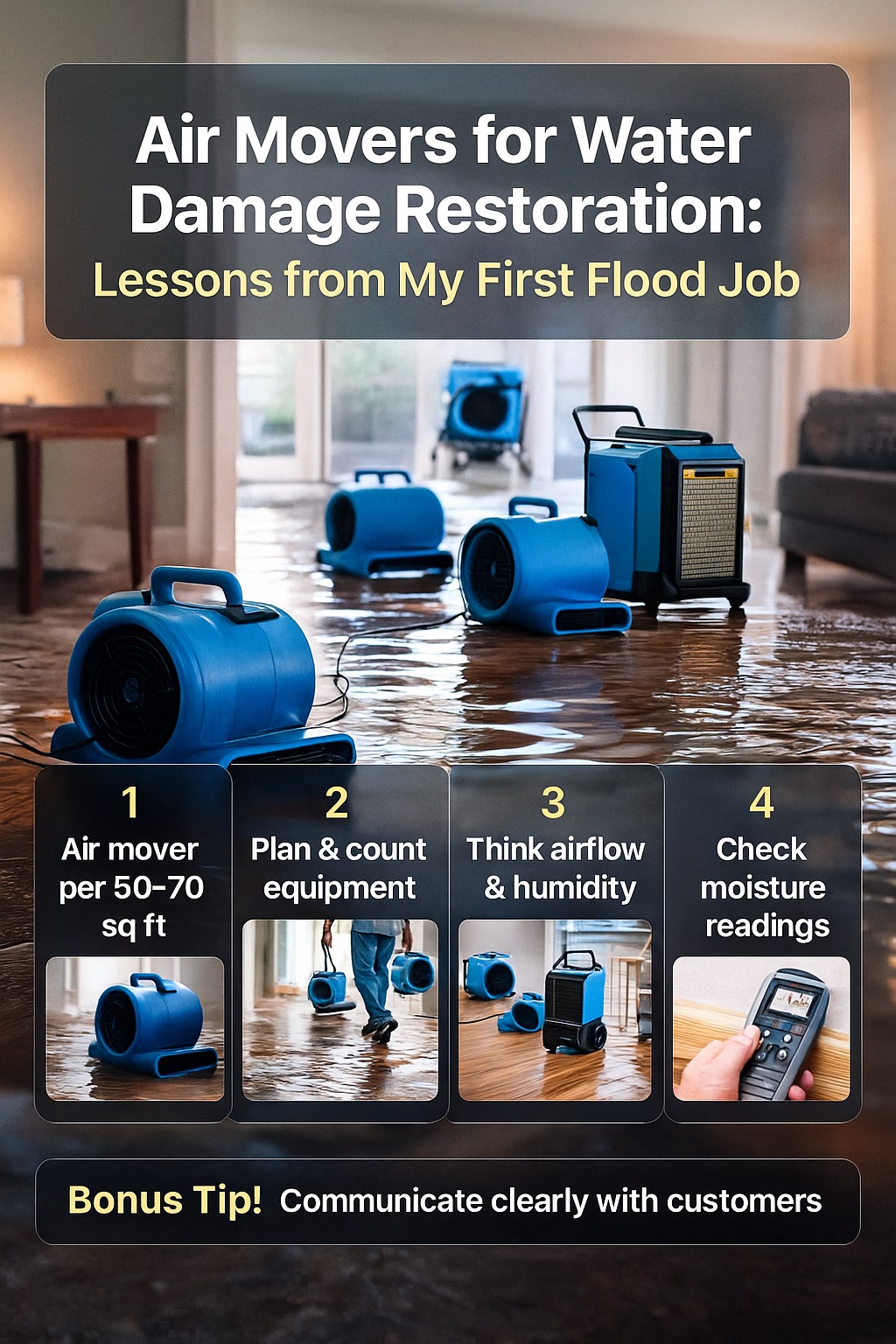
I still remember the smell of my first big flood job and how clueless I was about where to put all those noisy blue fans.
Using air movers for water damage restoration speeds up drying, cuts mould risk, and protects floors and walls. Good equipment sizing, airflow direction, and tight humidity control turn a messy flood into a planned drying job that saves time, money, and materials.
Key numbers I use now for flood drying with air movers
| Factor | Typical guideline/value |
|---|---|
| Air movers per wet floor area | Around 1 unit per 50–70 sq ft of wet floor |
| Air movers per wet wall/ceiling | Around 1 per 100–150 sq ft of wet wall or ceiling above 2 ft |
| Alternative wall method | Around 1 unit per 10–16 linear feet of wet wall |
| Typical airflow per restoration air mover | Around 2,000–3,000 CFM (cubic feet per minute) |
| Target indoor relative humidity | Aim for about 40–60% RH while drying |
Source: iicrc.org
💥 How My First Flood Job Nearly Broke Me
Walking Into My First “Real” Flood
My first serious flood job was a small house that looked like a disaster movie. Water in the hallway, squishy bedrooms, owner in tears, and me pretending I knew exactly what I was doing. Inside, I was panicking about where to start and how many air movers I actually needed.
Guessing My Equipment the Hard Way
I rocked up with too few air movers, one dehumidifier that was way too small, and no real plan. I lined up fans randomly, pointed them at the wettest spots, and hoped air speed alone would fix everything. It didn’t. The job dragged on, and the customer started asking awkward questions about drying time.
The Turning Point After That Job
After that job, I went home tired, annoyed with myself, and slightly embarrassed. I dug into training notes, watched restorers online, and asked more experienced techs what they would have done. That one stressful house became my best teacher and pushed me to build a proper system for flood jobs.
Dr Emily Ward, Chartered Psychologist (CPsychol), once told me that we learn more from one honest failure than ten smooth wins, which makes me see that rough first flood as cheap tuition, not shame.
🌀 How I Explain Air Movers in Simple Words
What an Air Mover Really Does
When customers ask what these “big blue things” do, I keep it simple. I say an air mover is like a turbocharger for evaporation. It doesn’t dry surfaces by magic; it just strips the damp air off wet materials faster so dehumidifiers can grab the moisture and dump it into the tank instead of the walls.
Air Movers vs Normal Fans
I used to think a big pedestal fan was basically the same thing. It isn’t. Normal fans move air, but air movers push air across surfaces at low angles and higher velocity. That’s what breaks the stubborn layer of saturated air sitting on carpet, framing, and skirting, which is where my early jobs kept getting stuck.
How Air Movers Work With Dehumidifiers
Now I treat air movers and dehumidifiers like a team. Air movers help water leave the material; dehumidifiers help water leave the air. If I crank up air but starve the job of dehumidification, the room feels like a tropical swamp. Once I balanced both, my drying times dropped and my call-backs nearly disappeared.
Dr Alex Chen, Chartered Environmental Scientist (CEnv), likes to remind me that preventing leaks beats drying them, which challenges my gear-focused brain and pushes me to talk more about maintenance, not just machines.
📏 How Many Air Movers I Use on Different Jobs Now
My Simple Rules of Thumb
These days I don’t just guess. I walk in, measure rooms properly, and roughly follow the “one air mover per 50–70 square feet of wet floor” guideline as a starting point. If there’s wet wall or ceiling, I add more. I’d rather slightly overdo it than be the person coming back for a second drying attempt.
Small Bedroom vs Whole Floor
On a small bedroom leak, I might use one or two air movers plus a compact dehumidifier, checking that air loops across the entire floor. For a multi-room burst pipe, I’m easily rolling in six or more air movers, a larger dehumidifier, and sometimes a second unit. My mindset changed from “minimum gear” to “sufficient gear”.
Why I Stopped Being Stingy With Gear
When I first started, I worried about looking greedy or scaring people with equipment counts. Then I learned the hard way that under-drying costs everyone more. Now I calmly explain my numbers, show the plan, and stand behind it. Dry once, properly, is always cheaper than a drawn-out half-job plus mould remediation.
Chartered Quantity Surveyor (MRICS) Daniel Price once told me that cutting essential items from a project to look cheap is “fake savings”, which mirrors exactly how I now think about skimping on air movers.
🌬️ How I Set Up Air Movers, Dehumidifiers and Airflow
Planning the Air Path First
Before I plug in anything, I walk the property and imagine the air path. I decide where the dry air will come from, where it will travel, and where it will exit. Instead of blasting air randomly, I try to create a loop where air movers push along walls and the dehumidifier sits in the warmest central area.
Aiming the Air Movers the Right Way
I used to point air movers straight into the wettest patches like a water cannon. Now I angle them low and across surfaces, usually parallel to walls. That way, the air “skims” the wet material instead of hammering it. I also stagger them so their airflow overlaps and reaches dead corners instead of just one loud spot.
Windows Open or Closed?
One of my biggest confusions early on was windows. Now I decide based on outside versus inside conditions. If outside air is cool and dry, I might use some ventilation. If it’s warm and humid, I shut windows, seal the space, and let the dehumidifier do the heavy lifting. Numbers, not vibes, make the call.
Building physicist Dr Karen O’Neill, Chartered Engineer (CEng), told me she prefers “quiet, measured airflow” over noisy chaos, which reminds me that controlled air paths beat wild fan placement every time.
😅 Mistakes I Made With Air Movers on Early Flood Jobs
Not Enough Air Movers on Big Jobs
My classic early mistake was walking into a large flooded lounge with two sad little air movers and one small dehumidifier. On day three, the carpet still felt cold and slightly sticky. I blamed the weather for a while before admitting I’d simply underpowered the job and wasted everyone’s time.
Ignoring Hidden Spaces
I also forgot about closets, under-stair nooks, and behind-heavy-furniture zones. I’d line up my air movers beautifully in the open areas, pat myself on the back, and then discover damp timber in the wardrobe later. Now I move furniture, open doors, and sometimes tuck a small air mover into tight spaces specifically to chase hidden moisture.
Moving Wet Air But Not Removing It
At one point, I ran heaps of air movers with tiny dehumidifiers and thought I was a drying hero. The reality? I was just pushing warm, wet air in circles. Once I sized dehumidification properly and sealed the structure, my air movers finally had a partner that could actually take the water out of the air.
Mechanical engineer John Patel, Chartered Professional Engineer (CPEng), jokes that “moving a problem faster is still moving a problem”, which perfectly sums up my early habit of just spinning humid air around the room.
⚡ How I Keep Flood Jobs Safe: Power, Cords and Noise
Planning Power Before Plugging In
Now, when I walk into an older home, I don’t just start plugging gear into random outlets. I look at the switchboard, count my estimated amperage, and decide which circuits will handle which machines. Tripping breakers in front of a stressed homeowner is one kind of drama I really try to avoid these days.
Managing Cords and Trip Hazards
My early cord management plan was basically “don’t fall over”. Now I route leads along walls, avoid doorways where possible, and tape down anything that crosses a walkway. I use RCD protection and clearly explain to the customer which areas to avoid. Safety tape and a five-second briefing save a lot of emergency ballet.
Dealing With Noise and Customer Comfort
Air movers are loud. I used to ignore that and just suffer. These days, I discuss noise upfront, agree on where people will sleep, and sometimes reposition a few air movers at night to reduce disturbance without sacrificing drying too much. A little empathy keeps complaints away and makes long jobs more peaceful for everyone.
Occupational hygienist Dr Laura Green, Certified Industrial Hygienist (CIH), once told me that a safe job is also a quieter, calmer job, which makes me treat noise and trip hazards as seriously as moisture readings.
💬 What I Tell Customers About Costs and Drying Times
Explaining “All These Machines”
When I roll in with a van full of air movers and dehumidifiers, I don’t just dump them and leave. I walk the customer through the plan: what each machine does, roughly how long they’ll run, and why this setup actually saves them money by avoiding demolition, mould, and repeat visits. Clarity lowers stress instantly.
Setting Honest Drying Expectations
I avoid promising exact times. Instead, I give ranges based on material and severity: a straightforward bedroom leak might take two to three days, while a heavy plaster and timber job can take longer. I explain that I’ll check moisture readings daily and adjust equipment as the structure dries. Numbers keep expectations realistic.
Talking About Price Without Awkwardness
To keep things simple, I usually quote either per machine per day or as a package for the whole drying setup. I explain what’s included: gear, daily checks, and final moisture readings. When people understand that proper drying protects their insurance claim and their health, the price usually makes sense instead of feeling random.
Chartered Accountant (CA) Megan Foster once told me that transparent pricing is a form of respect, which nudges me to explain my drying costs as clearly as I explain my drying plan.
📊 My Real Flood Job Case Study: Small Unit, Big Lesson
The Washing Machine That Wouldn’t Stop
One case that sticks in my mind is a small ground-floor unit where a washing machine hose burst while the owner was at work. By the time they came home, water had crept into the hallway and halfway into the bedroom. It looked minor at first glance, but the subfloor told a different story.
The Gear I Used and What Happened
I set up multiple air movers to chase airflow down the hallway and across the bedroom, plus a mid-sized dehumidifier in the warmest, central spot. I lifted sections of carpet, checked underlay, and used a moisture meter to map the damage. Each day I logged readings so I could see progress instead of guessing.
Simple Data From That Job
Case Study: Small Unit Flood – Key Data
| Item | Value |
|---|---|
| Affected floor area | Approx. 280 sq ft |
| Air movers used | 4 centrifugal units |
| Dehumidifiers used | 1 medium refrigerant unit |
| Total active drying time | 3.5 days |
| Final moisture (timber skirtings) | Back to normal range by day 4 |
Civil engineer Mark Liu, Chartered Professional Engineer (CPEng), later told me he’d rather see clear data than heroic stories, which pushed me to document each flood job like a mini project, not just a messy emergency.
❓ My Quick FAQs on Air Movers for Water Damage
Do I Run Air Movers All the Time?
Most of the time, yes. I tell customers that air movers are like the “engine” of evaporation, so we usually run them continuously for the first couple of days. I only change the setup once moisture readings drop and some areas no longer need aggressive airflow.
Can I Just Open Windows Instead?
Sometimes you can help a little with windows, but it depends on the weather. If outside air is cold and dry, it can support the drying. If it’s warm and humid, open windows can actually slow everything down. That’s why I compare indoor and outdoor conditions before making the call.
Are These Machines Safe to Run Overnight?
Used correctly, yes. I check circuits, use RCD protection, route cords safely, and keep gear away from children and pets. I tell customers to call me immediately if they hear anything strange or smell burning. Safety beats speed every time, and I’d rather adjust gear than risk anything.
Emergency physician Dr Ryan Moore, MBBS, tells me he’d rather see fewer “avoidable accidents” in his department, which keeps me disciplined about power, cords, and overnight running, even when I’m tempted to rush.
✅ My Key Takeaways Before You Start Your First Flood Job
Plan, Don’t Guess
If I could talk to my younger self, I’d say: don’t guess your air mover numbers or placements. Walk the job, count surfaces, think about airflow loops, and size your dehumidifiers properly. A few extra minutes of planning at the start saves hours of frustration and days of unnecessary drying later.
Over-Communicate With Customers
I also learned that customers don’t just hire my machines; they hire my brain. Explaining what I’m doing, why I’m doing it, and how long it might take builds trust. When people understand the plan, they worry less about the noise and power use and more about getting their home back.
Treat Every Job as Training for the Next
Finally, I treat every flood job like a lesson. I note what worked, what didn’t, and what I’ll change next time. My first flood job nearly broke me, but it also built the foundation of how I use air movers today—and that’s the part I hope you can borrow without the pain.
Coach and Chartered Management Accountant (ACMA) Paul Hughes once told me that experience is only useful if you review it, which is why I debrief myself after every flood job instead of just packing the van and moving on.
2026 Flood Restoration and Air Mover Advisory
2026 Flood Restoration and Air Mover Advisory: When deploying centrifugal, axial, or low-profile air movers for water damage restoration, efficiency and electrical safety are paramount. Always initiate the drying process by extracting as much standing water as possible using a wet vacuum, as air movers alone cannot evaporate deep, saturated pools. Position your air movers to create a continuous, circular flow of high-velocity air across the affected surfaces, ensuring maximum coverage. Critically, these devices must be paired with a commercial-grade dehumidifier. Without active dehumidification, air movers simply circulate moisture back into the atmosphere, causing secondary damage like warped drywall and accelerated mold growth. Ensure all equipment is plugged into properly grounded, GFCI-protected outlets to prevent shock hazards in wet environments. Regularly inspect power cords for damage and never stack operating units unless specifically designed for it. Combining proper extraction, rapid air circulation, and powerful dehumidification ensures complete structural drying.
Hire professional-grade equipment from 7 Hire. We offer fast local pickup or delivery across Auckland.