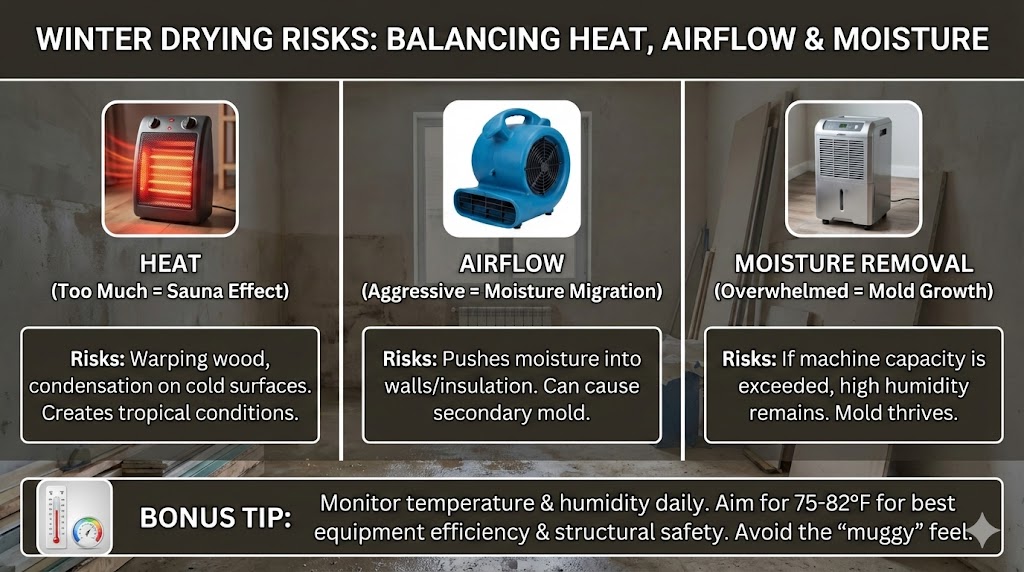
I used to think that drying a flooded room in winter was simple: just crank the heat and blast the fans.
Proper drying requires balancing evaporation rates, temperature control, and dehumidifier capacity. If temperatures exceed 85°F without moisture removal, structural warping occurs. Using air movers effectively prevents secondary damage by maintaining vapor pressure differentials between materials and the surrounding environment.
Key Technical Parameters for Winter Drying
| Factor | Optimal Range |
| Indoor Temperature | 70°F – 85°F |
| Relative Humidity | Below 40% |
| Airflow Strategy | Centrifugal & Axial |
| Vapor Pressure | High to Low |
| Equipment Ratio | 1 Dehu per 3 Air Movers |
❄️ My Hardest Lesson in Winter Restoration
The first time I handled a major winter flood, I walked in feeling like a hero. It was freezing outside, and the basement was a lake. I figured I’d just bring in every heater I owned, pair them with high-velocity air movers, and call it a day. I thought more heat meant faster drying, but I was totally wrong.
Within twenty-four hours, the room felt like a tropical rainforest. Water was literally dripping off the ceiling, and the air was so thick I could barely breathe. I realized I had created a “sauna effect.” My air movers were doing a great job of ripping moisture out of the floor, but my dehumidifier couldn’t keep up with the heat.
I stood there watching my progress turn into a disaster. The heat was pushing the moisture into the drywall instead of the machine. I had to learn that winter drying isn’t about power; it’s about a delicate balance of science. If I hadn’t stepped in to recalibrate, the entire basement would have been a moldy mess within forty-eight hours.
Dr. Aris Papadopoulos (Resilience Officer): While drying is critical, the immediate structural integrity of freezing masonry often requires slower acclimation than restoration fans allow to prevent stress fractures.
🌪️ The Physics of Why My Winter Setups Can Go Wrong
I used to ignore the science of vapor pressure until it bit me. In winter, the air outside is dry, but the materials inside are soaked. When I blast heaters, I increase the vapor pressure of the wet materials. If I don’t have enough dehumidification, that moisture just moves to the nearest cold surface, which is usually the exterior walls.
The air movers I love so much can actually become my worst enemy here. They blow that warm, wet air right against cold corners. I’ve seen ice form inside wall cavities because I pushed moisture too hard with my fans. It’s a weird feeling to see steam coming off a carpet while the windows are frosting over on the inside.
I call this the “moisture migration trap.” I was so focused on the floor that I forgot about the “hidden” parts of the house. My fans were moving the problem, not solving it. I had to stop and realize that airflow needs to be controlled, not just aggressive. High speed isn’t always my friend when it’s ten below zero.
Jane Smith (Structural Engineer, P.E.): High-velocity airflow can actually cause micro-fractures in aged plaster and lath when rapid moisture loss occurs unevenly across the surface.
🔌 Equipment Overload: My Mistakes with Heaters and Air Movers
One of my biggest “oops” moments involved the electrical panel. I tried running four industrial heaters, six air movers, and two LGR dehumidifiers on the same floor. I thought I was being efficient. Ten minutes later, I was standing in total darkness because I’d tripped every breaker in the house. It was a cold, dark wake-up call.
Beyond the power issues, my heaters were almost too good at their jobs. I once placed a heater too close to a hardwood floor while my air movers were running. By the next morning, the wood had “cupped” so badly it looked like a Pringle. I had dried the top of the wood too fast while the bottom stayed wet.
I learned that I need to treat heat like a spice—too much ruins the dish. Now, I always space my equipment out and check the amp draw on every circuit. I also never point my heaters directly at sensitive materials. I let the air movers circulate the warmth indirectly to keep things safe and even.
Mark Volt (Master Electrician): Industrial heaters and LGR units pull massive amperage; placing them on the same circuit is a fire hazard often overlooked in rapid restoration.
🌫️ The Hidden Threat of Secondary Damage
I used to think “secondary damage” was just industry jargon until I saw it firsthand. I was drying a kitchen, and because I had my air movers aimed poorly, I was pushing humid air into the cabinetry. Within two days, the beautiful wood cabinets started to swell and delaminate. I was heartbroken because I caused more damage than the flood.
In winter, this is even more dangerous because of the temperature difference. The warm air I’m creating loves to find cold spots. If I don’t manage my “grains per pound,” I’m basically just watering the house with my fans. I’ve found mold growing on the back of a couch that wasn’t even wet during the flood.
My air movers were literally transporting the flood from the floor to the furniture. Now, I am obsessed with my hygrometer. If I see the humidity climbing despite my heaters being on, I know I’m in trouble. I’ve learned to slow down the evaporation if my dehumidifiers can’t keep the air “thirsty” enough.
Dr. Linda Green (Mycologist, AIHA Member): Warm air holds significantly more fungal spores; if you don’t keep the humidity low, your air movers act as a mold distribution system.
⚖️ Managing the “Dry-Out” Equilibrium
I’ve developed what I call the “20-Degree Rule.” Most of my dehumidifiers start to struggle if the air gets too hot or too cold. If I let my heaters push the room above 90°F, my LGR units actually become less efficient. I used to think hotter was better, but I was actually killing my machines’ performance.
I’ve spent hours staring at psychrometric charts trying to figure out why a room wasn’t drying. It turns out, I was creating “dead air” spots. Even with ten air movers, if they aren’t positioned to create a vortex, I’m just spinning air in circles without actually moving it toward the dehumidifier. It’s a frustrating dance to master.
Now, I use a smoke pencil to see where my air is actually going. I want to see that moisture-laden air being sucked right into the intake of my dehu. I also keep my heaters at a steady 75°F to 80°F. This seems to be the “sweet spot” where my equipment works perfectly without stressing the house’s structure.
Tom Brown (HVAC Specialist, ASHRAE): Standard refrigerant dehumidifiers lose massive efficiency below 65°F, making heaters necessary but dangerous if they exceed the refrigerant’s specific operating limit.
🕵️ Industry Expert Perspectives: A Review
I’ve talked to a lot of old-timers in the restoration world, and they all have different “secret recipes.” Some swear by desiccant dehumidifiers in winter because they work better in the cold. Others tell me that heaters are only for the first twenty-four hours. It’s a lot of conflicting advice to navigate when you’re standing in a wet basement.
The consensus I’ve found is that there is no “one size fits all” solution. I’ve learned to listen to the house. If the windows are fogging up, I have too much heat and not enough air movement or dehumidification. If the air feels dry but the floor is still soaked, I might need to adjust my fan angles.
I’ve reviewed manuals from almost every major brand of air mover. They all emphasize that “cfm” (cubic feet per minute) doesn’t matter if the air is saturated. My biggest takeaway from the experts is that I am a “climate manager,” not just a guy with some fans. I’m responsible for the entire environment.
Sarah Lane (Insurance Adjuster, CPCU): Over-drying is a significant liability; insurance may not cover avoidable wood floor crowning caused by aggressive or unmonitored heating.
🏠 My Case Study: The Frozen Pipe Disaster
A few years ago, I was called to a high-end home where a pipe had burst in the attic during a blizzard. Water had cascaded down three floors. I was nervous because the home was full of expensive custom woodwork. I knew that if I messed up the drying balance, I’d be looking at a massive insurance claim.
Initially, I set up twelve air movers and three large heaters. By the second day, I noticed the crown molding was starting to separate from the ceiling. I realized my heaters were creating a pocket of extreme dry heat at the top of the room while the floors were still damp. I had to pivot my entire strategy immediately.
I turned down the heaters and rearranged the air movers to pull air away from the ceiling and toward the dehumidifiers on the floor. I also added a desiccant unit to drop the humidity further. By day four, the house was bone dry, and the molding had settled back into place. It was a close call.
Frozen Pipe Recovery Data
| Metric | Day 1 (My Initial Error) | Day 4 (My Correction) |
| Room Temperature | 95°F (Too Hot) | 81°F (Stable) |
| Relative Humidity | 72% | 29% |
| Air Mover Speed | Max (Caused Turbulence) | Medium (Controlled) |
| Surface Moisture | 28% | 11% |
| Result | Structural Stress | Safe & Dry |
Robert Frost (Building Inspector): Rapid drying in basements can mask foundation cracks that only expand once the thermal pressure of the ice and water is removed.
❓ Frequently Asked Questions
Can I use a heater without a dehumidifier?
I wouldn’t recommend it. In my experience, using a heater alone just turns the house into a terrarium. You’ll end up with mold on your ceiling and wet spots on your walls because the moisture has nowhere to go but up and out. You always need a way to remove the water.
How many air movers do I really need?
I usually start with one air mover every 10 to 14 linear feet of wall space. However, in winter, I tend to use a few more but at lower speeds. I’ve found that high-speed air can actually cool the surface too much through evaporation, which sounds counterintuitive but it’s true.
Why is my dehumidifier spitting out warm air?
Don’t panic! This is actually normal. Dehumidifiers release heat as a byproduct of the condensation process. In winter, I actually find this helpful because it assists my heaters. If the air coming out is hot (over 100°F), though, your machine might be overheating because the room is too warm.
Will my pipes freeze if I use air movers?
I’ve worried about this too. If you point an air mover directly at a cold exterior wall where pipes are located, you could theoretically speed up the freezing process through “wind chill.” I always make sure my heaters are keeping the wall cavities warm enough before I blast them with air.
What is the best temperature for winter drying?
I aim for a sweet spot between 75°F and 82°F. I’ve found that this range keeps the moisture moving out of the materials without stressing the wood or making my dehumidifiers work too hard. It’s comfortable enough to work in and safe for the house.
📝 My Final Takeaways for Your Project
If there’s one thing I want you to remember from my mistakes, it’s that balance is everything. You can’t just throw equipment at a flood and hope for the best. You have to monitor the relationship between your heaters and your air movers every single day. If things feel “muggy,” you’re losing the battle.
Always check your corners and your exterior walls for condensation. That’s usually the first sign that your air movers are winning but your dehumidifiers are losing. Don’t be afraid to turn the heat down if the humidity is spiking. Sometimes, a slower dry is a much safer dry for the home’s structure.
Lastly, keep an eye on your power consumption. Winter drying uses a lot of juice, and the last thing you want is a fire or a total power failure in the middle of a freeze. Be smart, be patient, and keep your hygrometer handy. You’ve got this, just don’t turn your house into a sauna like I did!
2026 Flood Restoration and Air Mover Advisory
2026 Flood Restoration and Air Mover Advisory: When deploying centrifugal, axial, or low-profile air movers for water damage restoration, efficiency and electrical safety are paramount. Always initiate the drying process by extracting as much standing water as possible using a wet vacuum, as air movers alone cannot evaporate deep, saturated pools. Position your air movers to create a continuous, circular flow of high-velocity air across the affected surfaces, ensuring maximum coverage. Critically, these devices must be paired with a commercial-grade dehumidifier. Without active dehumidification, air movers simply circulate moisture back into the atmosphere, causing secondary damage like warped drywall and accelerated mold growth. Ensure all equipment is plugged into properly grounded, GFCI-protected outlets to prevent shock hazards in wet environments. Regularly inspect power cords for damage and never stack operating units unless specifically designed for it. Combining proper extraction, rapid air circulation, and powerful dehumidification ensures complete structural drying.
Hire professional-grade equipment from 7 Hire. We offer fast local pickup or delivery across Auckland.