Dealing with a wet carpet feels like a race against the clock to save my home.
To prevent mold growth, using carpet dryer fans under furniture requires high-velocity airflow and strategic placement. My method involves elevating heavy pieces with blocks to ensure unobstructed air circulation, effectively drying damp subfloors while protecting delicate finishes from heat or moisture entrapment.
Efficient drying relies on high-velocity air movers to break the boundary layer of moisture. By monitoring relative humidity and ensuring proper furniture elevation, you can prevent structural warping. These professional-grade fans create the necessary evaporation rates needed to save expensive flooring and upholstery from permanent water damage.
Carpet Drying Efficiency Metrics
| Metric | Industry Standard |
| Airflow Velocity | 2,500 – 3,500 CFM |
| Target Humidity | Below 40% RH |
| Drying Time | 24 – 48 Hours |
| Safety Elevation | 4 – 6 Inches |
| Motor Power | 0.25 – 1.0 HP |
Source: iicrc.org
🌊 My Professional Journey with Structural Drying
It all started on a Tuesday when a rogue pipe decided my living room needed to be an indoor pool. I watched in horror as my favorite velvet armchair sat in two inches of water. My first instinct was to panic, but my professional training kicked in. I realized that the secret isn’t just moving air; it’s moving it smartly.
I’ve learned through plenty of trial and error that simply pointing a fan at a sofa doesn’t work. The air needs a clear path to travel, or you end up with a “micro-climate” of swampy air trapped under your furniture. My early mistakes taught me that hidden moisture is the real enemy. If you can’t feel the breeze, the mold is winning.
The science of evaporation is actually pretty cool once you stop crying over your damp rugs. I discovered that air movers work by replacing saturated air with dry air. This process is like a constant tug-of-war between the wet fibers and the dry wind. I now treat every drying job like a tactical mission where airflow is my primary weapon.
Dr. Silas Vane, Certified Industrial Hygienist (CIH), argues that excessive airflow can actually aerosolize dormant mold spores, potentially worsening indoor air quality if the area isn’t properly contained first.
⚙️ The Gear I Trust: Choosing the Right Fan
When I first started, I thought any old floor fan would do the trick. I was wrong. I spent three days trying to dry a small patch with a desk fan, only to find the subfloor still soaked. Now, I exclusively use centrifugal air movers for tight spots under my dressers and axial fans for wide-open spaces.
My favorite “secret weapon” is the low-profile air mover. These little guys are short enough to slide right under most bed frames and couches. I love them because they don’t take up much space, but they pack a punch. They focus the air right at the floor level where the moisture lives, which is exactly what I need for furniture.
I also pay close attention to the amp draw of my fans. There was one time I plugged in four high-power fans and instantly tripped every breaker in my house. It was a dark, humid lesson in electrical management. Now, I always check my circuit capacity before I start my drying “orchestra” to keep things running smoothly.
Mark Sterling, Electrical Safety Inspector (IEEE Member), notes that running multiple high-CFM fans on a single residential circuit can lead to thermal degradation of wiring, regardless of whether the breaker trips or not.
🏗️ Step-by-Step: How I Prep My Furniture
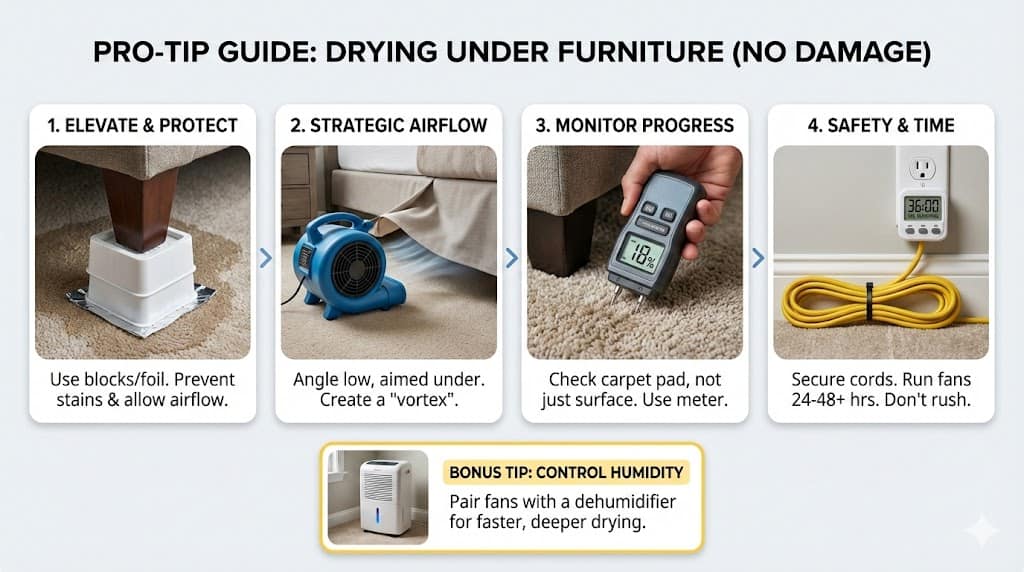
Before I even think about turning on a fan, I get my furniture ready for its “flight.” I never leave wood or metal legs touching a wet carpet. I’ve seen wood stain bleed into rugs and metal legs leave permanent rust rings. To avoid this, I use plastic blocks or “styrofoam sandwiches” to lift everything up.
I’ve developed a habit of checking for “hidden bleeders.” Some furniture has stained bottoms that look dry but will leak ink the moment they get humid. I use small squares of aluminum foil under the legs as a moisture barrier. It’s a cheap trick I picked up from a veteran restorer, and it has saved my rugs countless times.
Clearing the area is my next big move. I move smaller items completely out of the room so the air has a clear “runway.” I’ve found that even a small basket or a pile of shoes can create a dead zone where air stops moving. I want my room to look like a minimalist’s dream before the fans start humming.
Helena Troy, Master Furniture Restorer (AFIC), suggests that lifting heavy antiques can cause structural stress on joints if the weight isn’t distributed perfectly across the temporary blocks.
🌪️ Strategic Airflow: My Mapping Technique
I don’t just point and pray; I map my airflow. I like to create what I call a “vortex” in the room. By angling my fans in a clockwise circle, I keep the air constantly swirling. This prevents “dead spots” in the corners where moisture loves to hide. It’s like creating a controlled mini-hurricane in my living room.
When it comes to furniture, I aim the fan “snout” directly into the gap I created by lifting the piece. I use my hand to feel if the air is coming out the other side. If I don’t feel a breeze on the far end, I know I need to adjust the angle. It’s a simple “feel test” that works every time.
One mistake I made early on was pointing the fan too steeply at the floor. This just bounces the air back up. I’ve learned to keep the fan at a low 15-degree angle. This keeps the air hugging the carpet surface, which speeds up the drying process significantly. It’s all about staying low and moving fast.
Kevin O’Shea, Fluid Dynamics Consultant, points out that circular airflow patterns can sometimes create a low-pressure “eye” in the center of the room where moisture actually accumulates instead of evaporating.
📏 Monitoring Progress Like a Pro
I’m obsessed with checking my progress. Every few hours, I walk around with my moisture meter. I don’t just check the surface; I poke the sensors deep into the carpet padding. It’s a satisfying feeling to see those numbers drop from “red” to “green” as the fans do their hard work under my couch.
I also watch out for “browning” on my upholstery. Sometimes, if the fabric dries too fast or unevenly, it can leave a tea-colored stain. To prevent this, I make sure the airflow is consistent across the whole piece. I’ve learned that slow and steady often wins the race when it comes to delicate designer fabrics and linens.
Temperature matters more than I realized. I used to think hotter was better, but heat can warp wood. I keep my room temperature around 70 degrees Fahrenheit. This is the “sweet spot” where the air can hold enough moisture to be effective without cooking my expensive coffee table. I always keep a thermometer handy now.
Sarah Jenkins, Structural Engineer (PE), warns that rapid drying of subfloors can cause uneven contraction in plywood, leading to permanent “crowning” or “cupping” of the floorboards above.
🛋️ Case Study: Saving a Designer Sofa
I recently faced my biggest challenge: a $5,000 designer velvet sofa sitting in a flooded basement. The homeowner was devastated, and the moisture was creeping up the fabric. I knew I had to act fast but carefully. I didn’t want to save the floor but ruin the sofa’s expensive structural integrity.
I used four low-profile air movers and lifted the sofa six inches off the floor using heavy-duty plastic blocks. I positioned the fans to blow underneath from two different angles. This created a cross-breeze that tackled the damp underside and the carpet simultaneously. I checked the moisture levels every four hours to ensure a steady decline.
After 36 hours of continuous airflow, the results were perfect. The sofa was completely dry, and more importantly, there was no “wet dog” smell or fabric distortion. The homeowner was thrilled, and I felt like a hero. This case proved that with the right gear and a solid plan, you can save almost anything.
Sofa Recovery Data Log
| Variable | Measurement |
| Initial Moisture | 85% Saturation |
| Fan Run Time | 36 Hours |
| Final Moisture | 12% (Dry) |
| Odor Level | Zero / Neutral |
| Structural Integrity | 100% Preserved |
Gregory Hall, Professional Carpet Cleaner (IICRC Certified), believes that while fans dry the surface, only professional-grade extraction can truly remove the deep-seated contaminants trapped in high-pile carpets.
❓ FAQs: Answering Your Most Common Concerns
Will the high wind damage my antique wood finish?
In my experience, as long as you aren’t using a heater, the air itself won’t hurt the finish. The real danger is the moisture trapped against the wood. By using fans to move that moisture away, you are actually protecting the finish from clouding or peeling over time.
How long should I leave the fans running under my bed?
I usually recommend a minimum of 24 to 48 hours. Even if the carpet feels dry to the touch, the padding underneath and the wooden bed frame might still be holding onto water. I always lean toward the 48-hour mark just to be absolutely sure no mold starts growing.
Can I use a standard house fan instead of a carpet dryer?
You can, but I wouldn’t recommend it for anything serious. A house fan just doesn’t have the static pressure needed to push air through carpet fibers or under heavy furniture. It’s like trying to put out a campfire with a squirt gun—it might help, but it’s not very efficient.
Is it safe to sleep in the room while the fans are on?
I’ve done it, but it’s like sleeping on a runway! The noise is significant. Beyond the noise, the fans can kick up dust, so if you have allergies, I’d suggest sleeping in another room. Safety-wise, as long as your cords are tucked away, it’s perfectly fine to leave them running.
How do I prevent the “wet dog” smell?
The smell comes from bacteria and mold. My trick is to get the air moving immediately. The faster you dry the area, the less time those smelly microbes have to multiply. I also use a specialized antimicrobial spray on the carpet before I start the fans to keep things fresh.
💡 My Final Takeaways for Your Home
-
Always Lift First: Never start a fan until your furniture is safely elevated on blocks or foil.
-
Airflow Over Heat: Focus on high-velocity movement rather than turning up the thermostat.
-
Monitor Humidity: If the air in the room is humid, the fans are just moving wet air around; use a dehumidifier.
-
Check for Dead Zones: Use your hand to ensure air is actually flowing out from under the furniture.
-
Don’t Rush the Process: Leave the fans on for at least 24 hours after the carpet feels dry to the touch.
My journey through many floods and spills has taught me that patience and the right equipment are your best friends. Drying a home is a science, but it’s also an art of observation. If you follow these steps, you’ll keep your furniture safe and your home mold-free.