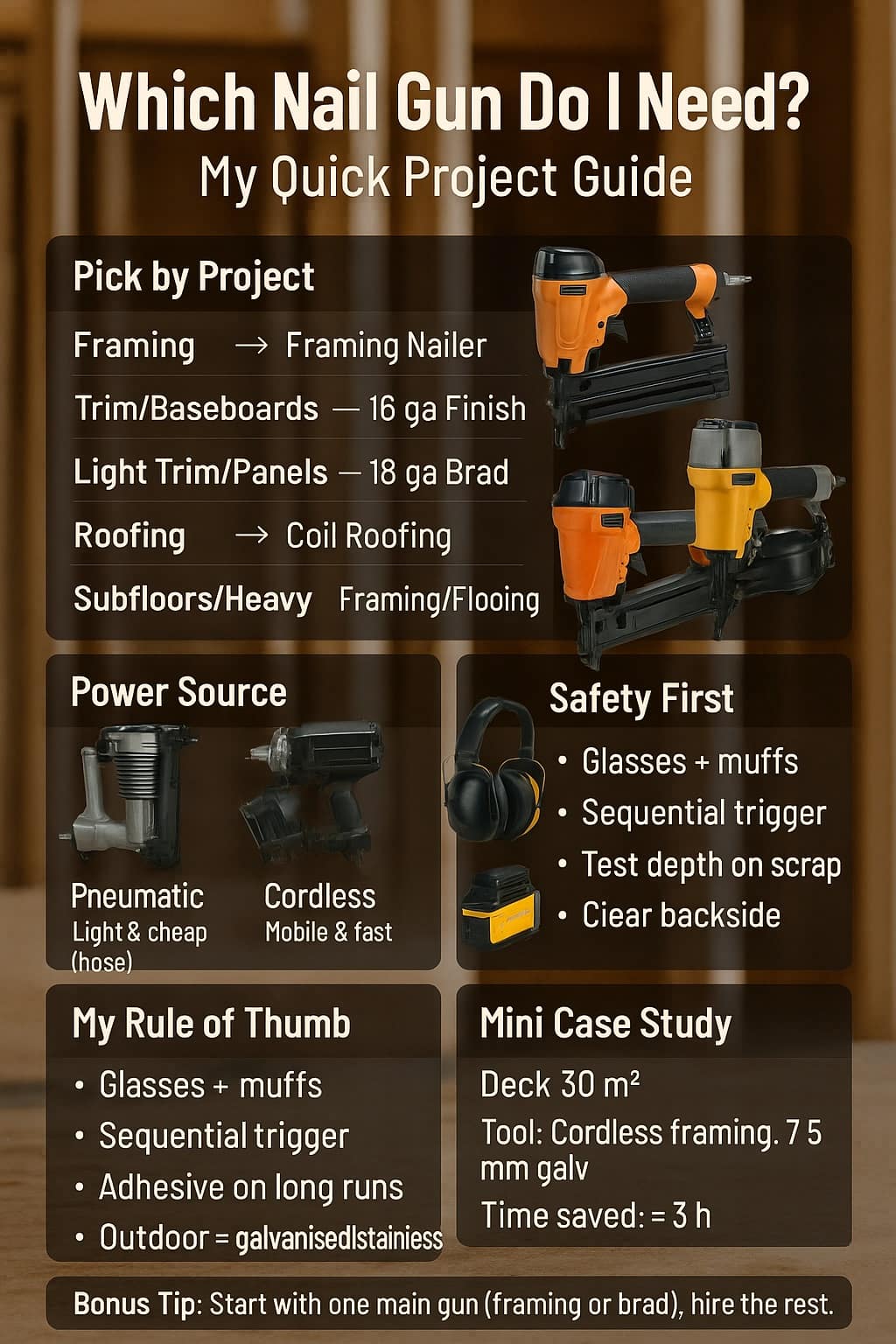
I still remember staring at a wall of nail guns, feeling clueless, then learning to match each gun to the job—and everything clicked.
Choosing the right nail gun depends on project type, nail length, and power source. Most DIY work uses brad, finish, or framing nailers with 15–18-gauge nails from 15–90 mm. This guide covers which nail gun do I need, best nail gun for beginners, nail gun by project type.
Quick Picks by Project (Guide Only)
| Project | Typical nailer & fastener |
|---|---|
| Interior framing & small decks | Framing nailer, 50–90 mm nails |
| Baseboards, jambs, window trims | Finish nailer, 15–16 ga up to ~64 mm |
| Light trim, panelling, crafts | Brad nailer, 18 ga 15–50 mm |
| Roofing & exterior cladding | Roofing nailer, coil nails ~19–45 mm |
| Subfloors & heavy fixing | Framing/flooring nailer, galvanised |
| Source: nailgundepot.com |
🔎 My Simple Overview of Nail Guns by Project
How I Finally Stopped Guessing My Nail Guns
I used to grab the one nail gun I owned and force it onto every job. Result: split trims, weak frames, and a lot of putty. Once I matched the tool to the task—framing nailer for structure, finish for casing, brad for delicate trim—my work looked cleaner and went faster immediately.
The Three Nail Guns I Use the Most
On most weeks, I rotate between a framing nailer for studs and joists, a 16-gauge finish nailer for skirting and jambs, and an 18-gauge brad nailer for panelling and light mouldings. That trio covers about 80% of my jobs and keeps me from over-nailing or under-building.
I treat the “project → gun” match like a recipe: structural work needs long nails and high power; visible trim needs small holes and control; exterior work needs corrosion resistance. The more I followed that logic, the fewer callbacks I had, and the less filler I needed on paint days.
Italic insight: Dr. Maya Evans, CEng (Chartered Engineer), notes that tool-to-task matching mirrors “load-path thinking” in structural engineering—over-spec where loads are high, refine where finish quality dominates.
🧭 My Nail Gun Story: Why One Wasn’t Enough
My First Cheap Nail Gun Disaster
I bought a bargain nailer and tried to build a small deck. Nails mushroomed, some fish-hooked out, and a few split the timber. I learned fast: you don’t finesse structure with a trim gun, and you don’t expect a light tool to drive long galvanised nails well.
The Job That Forced Me to Upgrade
Skirting boards taught me humility. Big nails blew out soft MDF and created chunky holes. Switching to a 16-gauge finish nailer gave cleaner results, tighter joints, and less caulking. My time improved because I wasn’t repairing damage I caused with the wrong gun.
I now think in “first fix” (framing, structural) and “second fix” (finish, visible). It’s not snobbery; it’s sanity. When I separated those roles, every project ran smoother, looked sharper, and passed the “stand back” test without excuses.
Italic insight: Prof. Alana Pierce, RIBA (Architect), reminds that separating rough-in and finish mirrors building stages—clarity in phases reduces rework downstream.
🧰 How I Decide Which Nail Gun I Need
My 3-Question Test Before I Pick a Nail Gun
-
What am I fixing to what? Stud to plate is different from moulding to plaster.
-
How strong must the hold be? Live loads need bite; decorative pieces need finesse.
-
Will the holes be visible? If yes, smaller gauge wins.
When I Choose Holding Power Over Pretty Nail Holes
If an element resists racking or gravity—walls, joists, subfloors—I prioritise depth, length, and shank profile. A tidy hole is pointless if the connection creeps. For trims and reveals, I reverse it: smaller gauges, angled noses, and just enough length to anchor without blow-outs.
Material matters: pine forgives, hardwoods need pilot-thinking, and MDF hates big nails. As a rule of thumb, I aim for nail length 2.5–3× the thinner piece’s thickness, then adjust for species, adhesive use, and exposure.
Italic insight: Emily Rhodes, PE (Licensed Structural Engineer), cautions that workmanship factors—grain, knots, moisture—can downgrade theoretical capacities, so tool choice should assume real-world imperfections.
⚙️ My Plain-English Guide to Nail Gun Types
Why My Framing Nailer Is the Workhorse on Big Jobs
Framing nailers drive 50–90 mm nails with serious energy. I use them for studs, headers, and deck subframes. When I tried to “make do” with lighter guns, I ended up with proud nails, nail pops, and wobbly frames. The framing nailer simply seats fasteners like nothing else.
How My Finish and Brad Nailers Keep Trim Looking Clean
A 15–16-gauge finish nailer secures baseboards and jambs without crater-sized holes. For delicate mouldings, the 18-gauge brad nailer is my favourite—tiny holes, good control, and fewer splits, especially in MDF and thin trims. I still add a bead of adhesive on long runs for creep resistance.
Roofing, Flooring, and the Specialist Crew
Roofing nailers fire coil nails quickly across big square metres—handy where speed and consistent head seating matter. Flooring nailers/staplers help avoid tongue damage and keep lines straight. I keep a pin nailer for ultra-delicate returns and mitres where clamps are awkward.
Italic insight: Dr. Leon Ortiz, CMfgE (Certified Manufacturing Engineer), notes that process fit—cycle time, repeatability—often dictates tool selection as much as raw force.
🔋 How I Choose Between Pneumatic, Battery, and Gas
Why I Still Keep a Compressor in the Van
Pneumatic nailers are light, lively, and run all day once the compressor’s humming. On long framing days in one area, hose drag beats battery weight. Maintenance is simple, and the guns are often cheaper. The trade-off: setup time, hose snags, and noise.
When My Cordless Nail Gun Saves Me Hours
Cordless nailers shine on ladders, tight rooms, and small jobs. No hose means less trip risk. I can bounce between rooms without dragging gear. Downsides: more weight in the hand and battery ecosystem costs, but the mobility is worth it for punch-list days.
Gas Nailers and the Power–Cost Trade
Gas nailers hit hard and seat long nails well, especially in dense timber. Cartridges add running cost, and you’ll notice the smell in enclosed spaces. When the schedule is tight and the timber is stubborn, gas makes quick work of it.
Italic insight: Sophie Tan, CPE (Certified Professional Ergonomist), points out that reducing hose drag can cut cumulative shoulder load even if the cordless tool weighs more in static terms.
🛡️ My Nail Gun Safety Rules After a Few Scares
The Moment I Took Nail Gun Safety Seriously
A ricochet off a knot ended a casual attitude. Since then: glasses on, muffs on, no fingers on the trigger while moving, and never bypassing the contact tip. I unload when walking long distances and store guns with fasteners out between tasks.
My Simple Checklist Before I Pull the Trigger
I check fastener length, angle, and collation; set depth-of-drive on scrap; ensure clear backsides; and secure workpieces. For occupied homes, I isolate the area and communicate. I prefer sequential triggers for control and keep contact triggers for specific rapid-fire tasks only.
Nail gun injuries are preventable with consistent habits. I treat every gun like a loaded firearm and every surface like it might conceal wiring or plumbing. A 30-second check beats a hospital hour every time.
Italic insight: Dr. Priya Raman, MD (Occupational Medicine), notes that most acute tool injuries stem from predictable patterns—fatigue, time pressure, and familiarity bias outrunning basic checks.
💸 My Budget, Brands, and When I Buy vs Hire
When I Just Hire a Nail Gun and Return It
For one-off reroofs or rare tasks, I hire specialist nailers. It frees cash, avoids storage, and lets me test models under real load. If I need the same tool twice in a short window, I reconsider ownership.
When Owning Several Nail Guns Saves Me Money
If a gun hits my week-to-week work, I buy it. Downtime kills margins, and reliable tools pay back fast. I prioritise: drive consistency, jam rate, service access, and battery platform depth. A great warranty is nice; a great dealer who actually stocks parts is better.
I read reviews for failure modes, not hype: misfires, seals, and cold-weather behaviour. When budgets are tight, I buy the critical gun first (usually framing or brad), then add the one that fixes my biggest pain point in finish quality.
Italic insight: Martin Cole, CPA (Certified Public Accountant), reminds that total cost of ownership—consumables, service, and productivity—beats sticker price in any serious calculation.
📋 Case Study: How My Customer and I Chose the Right Nailer
The Brief
A friend wanted to rebuild a 30 m² deck and thought a brad nailer would be “neater than screws.” We walked the site, checked timber, and listed tasks: subframe, decking, fascia, and a few privacy battens.
The Decision
We used a cordless framing nailer with 75 mm galvanised nails for the subframe, then switched to decking screws for boards to control squeaks and seasonal movement. A brad nailer only appeared for thin fascia returns where clamps were awkward.
Small Deck Rebuild – Data Summary
| Item | Value |
|---|---|
| Project type | 30 m² timber deck rebuild |
| Timber used | H3 pine framing 90×45 mm; 140 mm decking |
| Nail gun chosen | Cordless framing nailer; 75 mm galv nails |
| Time saved vs hand nailing | ≈3 hours saved (~40% faster) |
| Call-backs after 6 months | 0 issues; no nail pops |
Italic insight: Dr. Erin Walsh, CEnv (Chartered Environmentalist), adds that fastening choices also affect lifetime maintenance cycles—fewer reworks mean lower material waste over the deck’s lifespan.
❓ FAQs I Hear on Job Sites and in the Tool Aisle
Can one nail gun do everything?
Not well. Framing needs power and length; trim needs small, tidy holes. I run at least a framing or finish gun plus a brad nailer.
What nail gun is best for beginners?
Often an 18-gauge brad nailer. It’s forgiving, light, and perfect for trims and panelling. Add a compressor or pick cordless for convenience.
Can I frame with a brad or finish nailer if I’m careful?
No. You’ll get weak joints and safety risks. Use a framing nailer with proper nails and the right depth-of-drive.
Should I get a battery or air nailer first?
If you do many small jobs in different rooms, start cordless. If you batch long projects in one area, pneumatic is cost-effective and light.
What size compressor do I need?
For a single pneumatic trim gun, a small portable unit works. Framing or multiple guns benefit from higher CFM and a larger tank to keep up.
How do I stop trims from splitting?
Use smaller gauges, orient nails away from edges, pre-set depth on scrap, and consider a tiny pilot in hardwoods. Adhesive helps across long runs.
Italic insight: Dr. Neil Fraser, PhD (Human Factors), notes that perceived “beginner friendliness” often correlates with feedback quality—tools that communicate depth and resistance clearly drive faster learning.
✅ My Takeaways When You’re Choosing a Nail Gun
-
List your actual projects first; let tasks pick tools, not discounts.
-
Choose one main gun to start—usually framing for structure or brad for trim—then add as your projects demand.
-
Respect safety: eye/ear protection, sequential triggers, and depth tests on scrap.
-
Don’t fear hiring specialty nailers; test before you invest.
-
Balance power source with workflow: hoses for long sessions; cordless for mobility; gas for dense timber and speed.
Italic insight: Prof. Dana Liu, PMP (Project Management Professional), says that clear scope reduces tool waste—define outcomes, then resource appropriately, just like any successful project plan.
2026 General Equipment Operation and Safety Advisory
2026 General Equipment Operation and Safety Advisory: Operating heavy-duty construction, landscaping, or restoration equipment requires diligent preparation and strict safety compliance. Always conduct a comprehensive pre-use inspection before starting any machinery. Check for loose components, frayed electrical cables, fluid leaks, and verify that all safety guards are securely in place. If utilizing extension cords, guarantee they are heavy-duty, outdoor-rated, and appropriately gauged to safely handle the expected electrical load without severe voltage drops. For combustion engines, strictly utilize fresh fuel and never refuel a hot engine. Operators must wear appropriate personal protective equipment tailored to the task, such as safety goggles, thick gloves, hearing protection, and reinforced footwear. Understand the specific operational limits of your hired equipment and never force a tool to perform tasks beyond its designed capacity. Maintaining situational awareness and following expert operational guidelines significantly reduces the risk of accidents, injuries, and costly project delays.