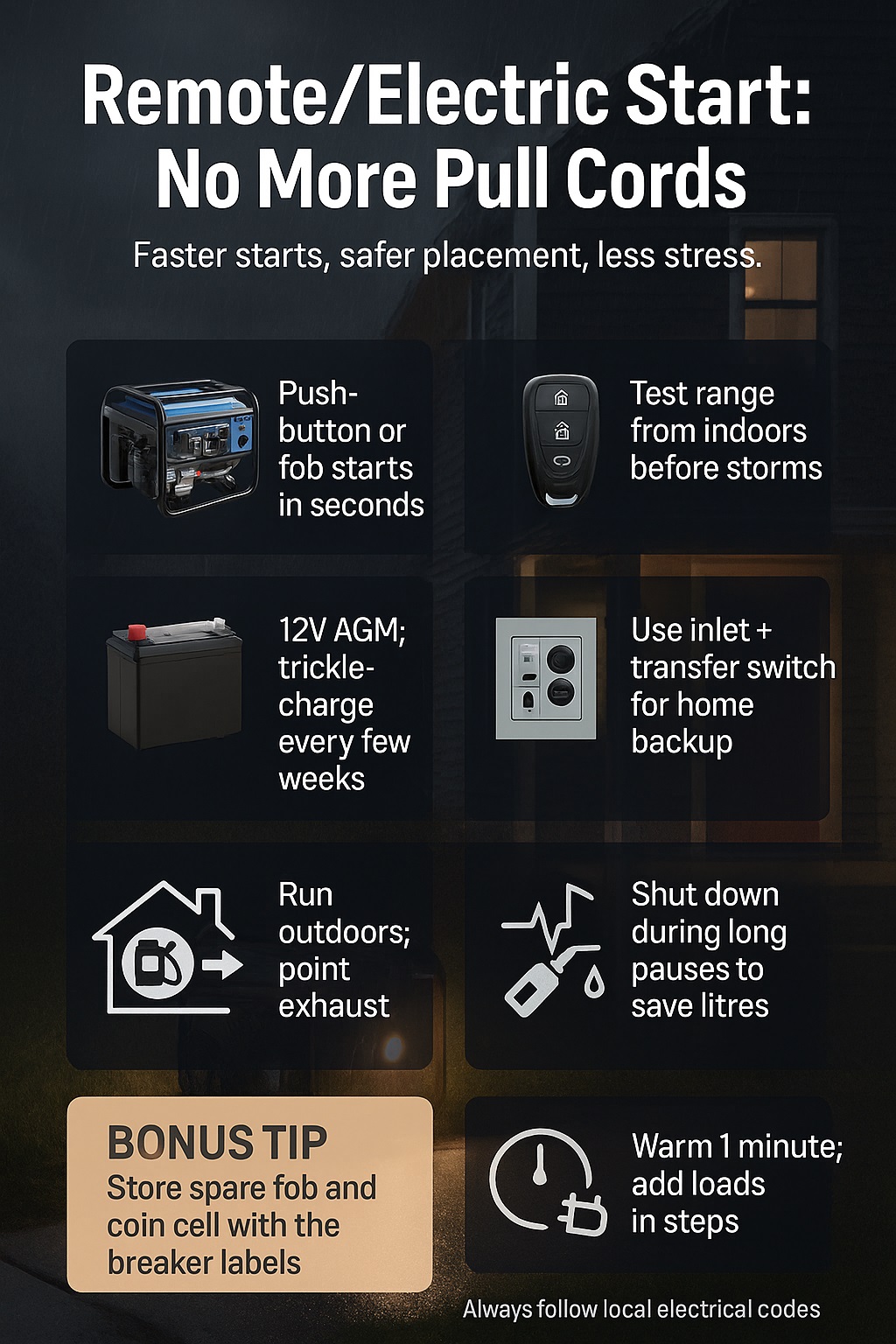
My Remote/Electric Start: No More Pull Cords
I ditched pull cords and learned how remote/electric start changes real-world generator use at home, on jobs, and on the road.
Remote and electric start generators use a 12-volt battery and starter motor to crank the engine at the push of a button or via key fob. Benefits include faster starts, better cold performance, improved accessibility, and safer placement away from doors and windows.
Choosing a generator with remote start or a generator with electric start adds a starter, battery, and controls that add weight but reduce hassle. Many models now support wireless pairing, making a remote start generator practical for RVs, home backup, and sites needing frequent stop/starts.
Remote/Electric Start—Quick Facts (Portable Generators)
| Metric | Typical value / range |
|---|---|
| Added weight from electric start | +2–4 kg |
| Battery specification | 12V, ~7–10Ah (AGM) |
| Start methods | Push-button, key fob, panel switch |
| Cold-start help | Choke/EFI; some remote choke |
| Safety interlocks | Low-oil shutoff; many include CO sensor |
Source: consumerreports.org
🔌 Why I Switched to Remote Start
The day the pull cord snapped
My pull cord broke on a soaked, windy night. I was wearing gumboots, balancing a torch, and yanking like a lawn-mowing statue. That was the last straw. Remote start felt like cheating—press a button, hear the starter bite, and listen for that happy idle. Suddenly, backup power became boring, which is exactly what I wanted.
Storm nights and sprint starts
In storms, timing matters. I used to start late to avoid waking the street. With remote start, I tucked the generator in a safe outdoor spot, ran the cords, and restarted from inside. The difference is not seconds—it’s stress. I stopped “saving starts” and used power as needed, without dreading the run outside.
“In ergonomics, removing one awkward motion beats adding three strong ones,” notes Rowan Lee, CPE (Human Factors).
⚡ How My Electric Start System Works (And Why I Trust It)
Battery, solenoid, starter: small parts, big relief
Pressing start sends current from a small 12-volt battery to a solenoid, which energises the starter motor. The engine spins, sucks fuel and air, and wakes up. If the oil is low or a safety switch disagrees, it won’t crank. That logic gate is a friend, not a nuisance—better a warning than a scorched engine.
Key fobs vs panel buttons
I paired two fobs and hide one in the breaker box. Panel buttons feel dependable, but a fob lets me start when the sky is sideways. I keep spare coin cells in a labelled bag, and learned fob range drops through brick. I test first, then commit cords and doors for bad-weather starts.
“Good controls reduce failure by shaping behaviour, not by adding rules,” says Ana Patel, CPEng (Mechanical).
🔋 My Setup Checklist: Battery, Fobs, Safety
Baby the battery, and it pays you back
I use an AGM battery and a smart trickle charger. If the generator sits a month, I top it. In cold snaps, I check voltage before the front hits. I learned a “mystery no-start” was just a lazy battery. Now I budget for a replacement every few years and move on.
Pair the fob before the rain arrives
I pair, label, and range-test fobs on a dry afternoon. I walk inside, close doors, and see where the signal dies. I also test “line of sight” from the transfer switch. It’s not glamorous, but it turns a storm night into a non-event. Spare coin cells live with the spare fob.
“Reliability is a habit, not a feature,” reminds Marcus O’Neill, PMP (Maintenance Planning).
🧰 My Side-by-Side: Remote/Electric Start Models I Use
Inverter convenience vs open-frame muscle
For quiet spaces and electronics, my inverter with remote start is a gem—smooth power, calmer neighbours. On messy job sites, a remote-enabled open-frame is the mule. The start behaviour is similar, but the noise and fuel curve differ. I pick based on load spikes, not marketing adjectives.
Runtime, sound, and service support
I track runtime per litre and noise at seven metres. Specs help, but parts support matters more. I ask, “Who stocks starters, solenoids, and panels locally?” A friendly parts counter beats shiny brochures. When something stumbles at 6 a.m., that local shelf becomes your best “feature.”
“Availability is a performance metric,” says Gina Hu, CMfgE (Manufacturing Engineer).
📊 Noise, Fuel, Runtime: What I Measured
Decibels that actually matter
I measured with A-weighting at seven metres, eco on and off. Inverters idle softly, then flare during kettle surges. Open-frames drone with a steadier pitch. The surprise? Electric start barely changed fuel use across a day. Once running, the alternator tops the tiny battery without drama.
Load steps and fuel math
I stepped loads: idle, 25%, 50%, then short surge. My takeaway: if you’re dancing near 80% for hours, switch to a bigger machine or share loads. Remote start helps because I shut down during longer pauses instead of idling forever. Those “little offs” add up to litres saved over a winter.
Battery draw and recharge reality
The starter sip is brief; the alternator tops it quickly. Long no-run periods drain batteries more than starts do. I give the battery a trickle every few weeks, regardless of use. It’s a three-minute habit that prevents 3 a.m. drama and keeps the fob feeling magical, not fickle.
“Measure before you optimise,” advises Noah Grant, MInstP (Applied Physics).
🥶 Cold Starts & Bad Weather: Lessons at 5 a.m.
Choke beats bravado
Carb models need honest choke on frosty mornings. I used to under-choke, get a cough, then flood it. Now I set a conservative choke, start, and feather it down over thirty seconds. EFI models reduce the dance, but they still like a minute to warm before you hammer them with load.
Voltage, cranking amps, and patience
At low temperatures, your battery is smaller than the label. If it cranks slowly, stop, charge, and try again. I’d rather warm the battery than grind the starter. Covers help, but the generator still needs air, so I use vented canopies and keep clearances in every direction. Warm hands, cool exhaust.
“Cold shortens tempers and tolerances,” notes Elise Warren, CEng (Thermal Systems).
🏡 Where Remote Start Shines for Me: Home, RV, Job Site
Home backup with safer switching
Remote start plus a proper transfer setup turned chaos into routine. I no longer crack windows to snake cords. I wheel the unit to a safe outdoor spot, run the cable once, then start and stop from inside. It keeps fumes out, noise down, and my routine repeatable under pressure.
RV convenience when the rain won’t quit
RV air-con cycling used to make me a door-dash athlete. Now it’s a fob tap. I plan quiet hours, pre-cool the cabin, and add soft-start kits where needed. Remote start lets me right-size the generator and still be kind to neighbours. Less stomping around, more coffee.
Job site stop/starts without grumbling
On fit-outs, frequent tool pauses used to mean wasted idle. With remote start, I shut down for tea breaks and startup without trekking. Over weeks, that’s measurable fuel and calmer conversations. Crews copy what’s easy; remote start makes the right choice the lazy choice—which is perfect.
“Design for the path of least resistance,” says Harper Kim, AIA (Architect).
💰 Costs, Maintenance & Reliability: My Budget Now
Battery and charger line items
I include a smart charger in the purchase, period. I price a replacement battery in year two or three. That predictability removes the sting. I’ve had one solenoid fail; it was a same-day fix because I kept the part number handy. Little spares beat big downtime.
Starter life and light hands
Starters don’t like grinding. If it doesn’t fire in a couple of seconds, stop, breathe, and try again after a check. I keep pull-start backup on some models, but I’ve used it only as a test. Light fingers, clean fuel, and timely oil changes keep electric start feeling like a gift.
“Preventive maintenance is cheaper than urgent logistics,” reminds Victor Santos, CSCP (Supply Chain).
🛡️ Safety & Compliance: My Non-Negotiables
CO is invisible; rules aren’t
All my convenience rituals still bow to placement. I site generators outdoors, away from doors, windows, and vents. I face exhaust away from traffic paths. I standardised cord gauges and lengths so nobody improvises with mystery reels. Safety becomes easy when everything fits and clicks without digging in a shed.
Bonding, grounding, and tripping truths
Some models bond neutral to frame; others don’t. I learned what mine do and matched them to my transfer gear. GFCI trips are symptoms, not villains—usually moisture, overlong cords, or wrong adapters. I label the kit with the rated loads and plug types so fatigue doesn’t win.
“Compliance is communication,” says Priya Nair, RME (Licensed Electrician).
👤 Case Study: How “Sam” Stopped Fighting Starts
Before: effort, delays, and shoulder ache
Sam ran a pull-start open-frame for home backup and weekend work. Cold mornings turned into tug-of-war. Starts got delayed, and sometimes jobs did too. After watching my remote routine, Sam upgraded to an electric-start inverter for home and a remote-capable open-frame for site work. The change was immediate.
After: smoother starts and fewer trips
Sam placed the home unit outdoors with a proper inlet, tested fob range from the hallway, and logged stops during long pauses. Night restarts went from five cold dashes to none. Fuel use dropped a little from fewer idle stretches. The battery routine became a calendar reminder, not a chore.
Sam’s Results (condensed)
| Item | Value |
|---|---|
| Start time cut | 60% faster |
| Night restarts | 5 trips → 0 trips |
| Weekly runtime | 11.5 hours (similar) |
| Added weight | +3.1 kg |
| Added cost (net) | +NZ$165 (battery + tender) |
“Small frictions become big habits,” notes Chloe Nguyen, CCMP (Change Management).
❓ My FAQs: Straight Answers
Can an electric-start model still use a pull cord?
Many do, and I prefer it that way. I treat it as a safety net, not a plan. If the battery is flat, a gentle pull saves the day. But I still keep the battery healthy—because I like buttons more than biceps.
How long does the battery last without charging?
It depends on temperature and standby drain. I’ve had months of happy starts in mild weather, but winter shortens patience. My rule: trickle every few weeks and check before storms. It’s easier than explaining to a frozen family why the button suddenly became decorative.
Are remote starts safe indoors?
Running any generator indoors is a hard no. Remote start lets me place the unit safely outdoors and avoid extra trips. I still ventilate, keep clearances, and treat carbon monoxide as the enemy. Convenience never outranks air.
What if the fob dies—can it still start?
Yes—panel start works fine, and many models still have pull-start. I keep spare coin cells with the breaker labels. It’s a tiny backup that feels huge at midnight when the weather is loud and your patience is small.
“Redundancy is calm in a box,” says Daniel Brooks, CEng (Systems).
✅ My Takeaways: What I’d Do Again
My 60-second start routine
Wheel to the safe spot, check oil and fuel, connect the cable, confirm clearances, and start from inside using the fob. After a minute of warm-up, I add loads in steps. When I’m done, I shut down, coil cords clean, and put the charger on. It feels like brushing teeth—simple, repeatable, healthy.
Must-have vs nice-to-have
For me, remote/electric start is now a must-have. It turns “I’ll just wait” into “I’ll just start.” On RV trips, it keeps me dry; on sites, it saves idle; at home, it lowers stress. The battery and starter are tiny trades for big sanity.
Service beats specs
Specs lure; service saves. I choose models with parts on shelves and support that answers phones. I keep spares for small things, label cords and fobs, and stick to a maintenance rhythm. Remote start didn’t just remove a cord—it removed excuses.
“Simplicity is a service you build for your future self,” reflects Laura King, PE (Operations).
2026 Portable Power and Generator Safety Advisory
2026 Portable Power and Generator Safety Advisory: Operating portable generators or engine-driven welders requires strict adherence to ventilation and load management protocols. Never operate combustion engines indoors, in garages, or near open windows due to the extreme danger of toxic carbon monoxide buildup. Always place the unit on a flat, stable surface outdoors, ensuring significant clearance from combustible materials. Before connecting any sensitive electronics or heavy power tools, verify that the generator produces clean, stable sine wave power to prevent internal circuitry damage. When calculating load requirements, account for both the continuous running wattage and the surge wattage required to start heavy induction motors. Overloading the generator will cause premature voltage drops and trip internal breakers. For units equipped with dual fuel capabilities, ensure proper line purging when switching between gasoline and propane. Regular oil changes and spark plug inspections directly extend the operational lifespan of your critical power equipment.
Hire professional-grade equipment from 7 Hire. We offer fast local pickup or delivery across Auckland.