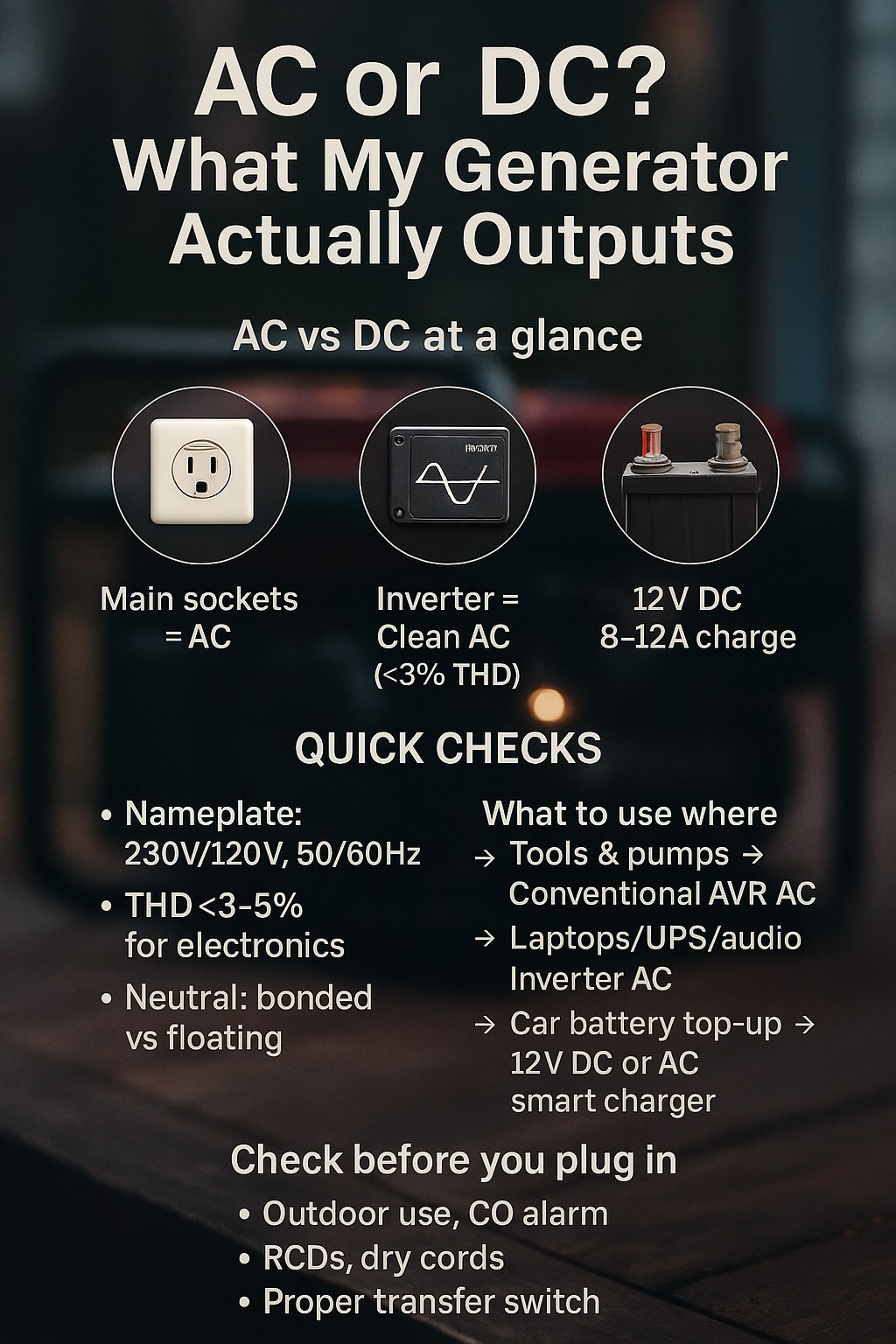
My Generator: AC or DC? What It Actually Puts Out
If you’ve ever stared at your generator’s sockets and wondered what’s really coming out, you’re not alone.
Most portable generators create alternating current for appliances, while some also provide 12V direct current for battery charging. Inverter models convert messy internal power to DC, then back to low-THD AC. Expect AC output on the main outlets, a small 12V DC charging port on some units, and cleaner sine-wave from an inverter generator.
Generator Output at a Glance (AC vs DC)
| Spec/Label | What it means in practice |
|---|---|
| 230V 50Hz (NZ/AU) or 120/240V 60Hz (US) | Main outlets are AC for appliances |
| “Inverter” badge | Clean sine-wave AC, usually <3% THD |
| 12V DC 8–12A port | Low-amp charging, not a main power feed |
| AVR on conventional unit | Voltage regulated AC, higher THD under nonlinear loads |
| Neutral bonded vs floating | Affects RCDs/transfer switches and safety checks |
Source: ieee.org
🔌 My Plain-English Answer Up Front
The 10-second rule
Here’s my rule after years of field calls: the big sockets on the front are almost always AC; the little 12V posts are DC and only good for modest battery charging. If the word “inverter” is on the fascia, that AC is cleaner and safer for laptops, UPS units, and smart chargers.
What I actually do first
I glance at the nameplate for voltage, frequency, and THD notes. If there’s a 12V port, I assume it’s limited to around 8–12 amps. For delicate gear, I choose my inverter generator. If I’m unsure, I measure with a meter and throw on a real load to see how the voltage and frequency behave.
“Assume AC at the outlets and verify the rest,” says Alex Wong, CPEng.
🏷️ How I Read My Nameplate and Manual
What my eyes hunt for
I scan for voltage (230V/120V), frequency (50/60Hz), rated and surge watts, the word “inverter,” THD percentage, neutral bonding notes, and any 12V DC rating. If THD is listed under 5%, I relax about plugging in sensitive electronics. If not, I keep things like gaming PCs on an inverter set.
Why the manual still matters
The manual tells me whether the neutral is bonded or floating, which changes how RCDs and transfer switches behave. It also spells out any DC charging caveats and recommended oil viscosity, which affects stable RPM and frequency. I mark up those pages so I can confirm site setups quickly when I’m in a hurry.
“Nameplate for facts, manual for context,” notes Priya Nair, IEng MIET.
🧪 How I Test With a Multimeter (Safely)
My simple test routine
I inspect leads, place the generator outdoors, start it, and let it warm up. Then I measure AC voltage at the receptacle (no load, then with a known load like a heater). I note frequency if my meter supports it. On the 12V posts, I check polarity and resting voltage before connecting any battery.
Mistakes I learned to avoid
I’ve seen people measure DC on the AC sockets—don’t. I’ve also watched cheap meters freak out near ignition noise. If readings jump, I switch to a better meter or add a resistive load. And I never test while standing in wet grass; dry footing, insulated leads, and RCD protection are my non-negotiables.
“Measure under load or you’re guessing,” advises Sam Patel, Registered Electrical Inspector.
⚙️ How Portable Alternators Make My AC
The conventional path
On non-inverter sets, the engine spins an alternator that makes AC directly. An AVR (automatic voltage regulator) trims voltage as load changes. It’s simple and rugged. The catch is waveform quality—plug in a tool with a variable-speed controller, and distortion can rise, especially at light loads or with long cables.
Why THD and load shape matter
Nonlinear loads—phone chargers, UPS units, LED drivers—pull current in pulses. The alternator can supply them, but the wave gets lumpy. I’ve had sump pumps chatter on a cheap set until I added a small resistive load (a lamp) to smooth things out, or I swapped to an inverter unit.
“Rugged doesn’t always mean clean,” says Michael Reyes, MIEEE.
🎛️ How My Inverter Generator Makes Clean AC
DC bus, then controlled AC
Inverter generators make wilder internal AC, rectify it to DC, then synthesize a clean sine-wave AC at the output. The inverter holds frequency steady even when the engine speed varies. That’s why eco-modes can drop RPM without breaking 50/60Hz at the socket—handy for fuel and noise.
Why I reach for it with electronics
When I’m powering laptops, studio gear, or a finicky UPS, I grab my inverter unit. The AC is typically under 3% THD, and frequency stays solid under silly-light loads. Yes, they cost more, but I’ve saved clients’ data and tantrums by choosing the inverter every time for sensitive stuff.
“Frequency stability beats brute force,” notes Dr. Hannah Clarke, PE (Power Systems).
🔋 My DC Port: What I Use It For (and Its Limits)
What it’s good for
That 12V 8–12A port is a helper. I use it to top up a flat ute battery or keep a camping battery from sagging. It’s not a welder, not a jump-start miracle, and not a primary feed for a big 12V inverter. Think trickle and maintenance, not heavy lifting.
Why I prefer smart chargers on AC
Smart chargers plugged into the AC outlet are gentler on batteries. They regulate properly, do desulfation cycles, and taper current safely. I’ve cooked a motorcycle battery once by over-trusting a dumb DC port—lesson learned. Now I park a quality charger on the AC and let it manage the chemistry.
“Treat the 12V post like a tap, not a hydrant,” says Marco Ruiz, ASE-Certified Auto Electrician.
🧰 What I Power on AC vs DC in Real Life
AC: the daily drivers
On AC I’ll run fridges, sump pumps, pressure washers, heaters (with care), corded tools, and lighting. With an inverter set, I’m comfortable adding PCs, NAS boxes, and audio gear. If a UPS argues with a conventional unit, I either add a small resistive load or switch to the inverter model.
DC: small jobs only
On DC, it’s topping up a starter battery, running a two-way radio through a regulator, or trickle-feeding a small AGM. Anything beyond about 10 amps continuous I offload to an AC-powered smart charger or a dedicated DC-DC charger. Clean, controlled charging beats “raw” 12V every day for battery life.
“Match the source to the sensitivity,” advises Laura Bennett, MInstMC (Instrumentation).
📈 Grid Power vs My Generator Power Quality
What changes and why it matters
Grid power typically has low THD and tight frequency control. Generators—especially conventional ones—wander a little with load steps. Most appliances don’t care, but some UPS units and laser printers do. When I see beeping or refusal to switch, it’s usually the wave, not the watts, causing the drama.
How I make them get along
I keep an inverter generator for IT and medical devices, and a robust conventional unit for pumps and worksite tools. If someone insists on a conventional set with a UPS, I add a small resistive load or choose a UPS that tolerates wider input. Compatibility beats brute capacity nine times out of ten.
“Power quality is a system property,” notes Chen Li, CPEng (Power).
🛡️ Safety & Compliance I Follow Before Testing
Earthing, neutral, and changeover
Before any test, I confirm neutral bonding (bonded vs floating) and the changeover method. Backfeed risks and RCD behaviour hinge on these details. I always use purpose-built transfer equipment—no home-made interlocks. I also ensure the generator frame is suitably earthed per local code and site conditions.
CO, fuel, and lead discipline
Generators live outdoors—full stop. I run long-enough leads, protect them with RCDs, and keep them out of puddles and doorways. Fuel gets stored away from heat, and I cool down before refuelling. A cheap CO alarm in the doorway has saved more than one family in storm season.
“Neutral arrangements aren’t optional trivia,” warns Sarah Lloyd, Licensed Electrical Inspector.
🛒 Buying Tips I Learned Running My Hire Fleet
When I pay extra for an inverter
If you’ll power electronics, variable-speed tools, or mixed home loads, pay for an inverter model. If your life is pumps, compressors, and saws, a conventional alternator with a decent AVR is solid value. Noise, weight, service access, and local parts support matter more than brochure watt numbers.
What I read between the lines
I care about rated vs surge watts, genuine receptacle types, THD figures (if published), fuel burn at 25–50% load, and noise at seven metres. I ignore dreamy “peak” numbers and look for the continuous rating. A good local service agent beats a mystery brand with magical specs.
“Availability of parts is a spec,” adds James O’Connor, MIMechE.
🧩 Troubleshooting: When My Label Says AC but Things Misbehave
The usual suspects
If outlets are dead, I check breakers and GFCI/RCD resets first. If voltage sags and lights flicker, I suspect a gummy carb or clogged air filter—the engine can’t hold RPM. Wild frequency? On a conventional set that’s governor or load step; on an inverter, I check the DC bus for overloads.
My quick isolation trick
I unplug everything, start fresh, and add one known resistive load—say, a heater. If the generator behaves, I add the questionable device next. If problems return, it’s compatibility or device fault, not generator capacity. Process of elimination beats guesswork, and it avoids swapping good parts for no reason.
“Start simple, add complexity,” says Noor Ahmed, Licensed Electrical Worker.
🧾 Case Study: How I Helped a Home Office Customer
The situation
A customer wanted to run a home office (PC + monitor + router), a fridge, and a small sump pump during outages. Their old UPS kept rejecting a conventional generator. Noise was a concern, and they didn’t want to baby-sit the setup on storm nights. Budget allowed one good purchase.
What I recommended and why
We sized a 3kVA inverter unit with <3% THD and eco-mode, added a proper transfer switch, and kept a small space heater as an optional “smoother” if the UPS got fussy. For the car battery, I paired an AC smart charger rather than relying on the generator’s 12V port. Result: seamless cutovers.
Home Office Backup Snapshot
| Item | Detail |
|---|---|
| Site | Suburban home office |
| Loads | PC, monitor, router, fridge, sump pump |
| Constraint | Low noise, UPS compatibility |
| Choice | 3kVA inverter, proper transfer switch |
| Outcome | Stable IT, quiet nights, easy operation |
“Design to the fussiest device,” notes Olivia Hart, CEng MIET.
❓ FAQs
How can I tell fast if it’s AC or DC?
Look at the faceplate: the big sockets are AC (230V/120V). A 12V post or socket is DC. If the fascia says “Inverter,” the AC is synthesized and generally cleaner. When in doubt, measure with a meter and test under a small resistive load like a lamp.
Do all inverter generators make “pure sine”?
Quality inverter units produce a low-THD sine wave that’s effectively “pure” for household use. Specs under 3–5% THD are common. Cheaper no-name models can be noisier electrically, so I stick to reputable brands and confirm performance with sensitive gear before promising UPS compatibility to clients.
Can I trickle-charge my car battery from the DC port?
Yes—carefully. The 12V port is typically limited to around 8–12 amps. It’s fine for topping up, but it’s not a smart charger. For battery health, I prefer an AC smart charger that handles absorption and float phases correctly, especially on AGM or calcium batteries.
Why does my UPS click or refuse generator power?
UPS units watch frequency, voltage, and waveform. Conventional generators can wander or have higher THD at light loads, making some UPS models reject them. An inverter generator usually fixes it. Alternatively, add a small resistive load or choose a UPS with wider input tolerances.
Is the neutral bonded or floating—and why care?
Bonded neutrals can affect RCD trip behavior and transfer switch wiring. Floating neutrals behave differently with portable RCDs. You must match the generator’s neutral scheme to the changeover method. When I install a proper transfer switch, I confirm the scheme and label it clearly for future you.
“Compatibility beats capacity in home backup,” says Daniel Price, RBP (Building Practitioner).
✅ My Takeaways
What I actually do every time
I read the nameplate, skim the manual, and assume AC on the outlets. I treat the 12V post as a helper, not a workhorse. For sensitive electronics, I use an inverter generator with low THD. I verify neutral arrangements before any transfer connection and I always test under a real load.
One simple closing rule
If it’s tools and pumps, a conventional alternator set is usually perfect. If it’s laptops, UPS units, or mixed home loads, I reach for the inverter without thinking. Measure, don’t guess—your devices will thank you, and future-you won’t be rewiring things at midnight in a raincoat.
“Good power is the right power for the load,” concludes Sophie Kim, PE (Electrical).
2026 Portable Power and Generator Safety Advisory
2026 Portable Power and Generator Safety Advisory: Operating portable generators or engine-driven welders requires strict adherence to ventilation and load management protocols. Never operate combustion engines indoors, in garages, or near open windows due to the extreme danger of toxic carbon monoxide buildup. Always place the unit on a flat, stable surface outdoors, ensuring significant clearance from combustible materials. Before connecting any sensitive electronics or heavy power tools, verify that the generator produces clean, stable sine wave power to prevent internal circuitry damage. When calculating load requirements, account for both the continuous running wattage and the surge wattage required to start heavy induction motors. Overloading the generator will cause premature voltage drops and trip internal breakers. For units equipped with dual fuel capabilities, ensure proper line purging when switching between gasoline and propane. Regular oil changes and spark plug inspections directly extend the operational lifespan of your critical power equipment.
Hire professional-grade equipment from 7 Hire. We offer fast local pickup or delivery across Auckland.