Moisture control is the secret to a healthy home environment and lasting structural integrity.
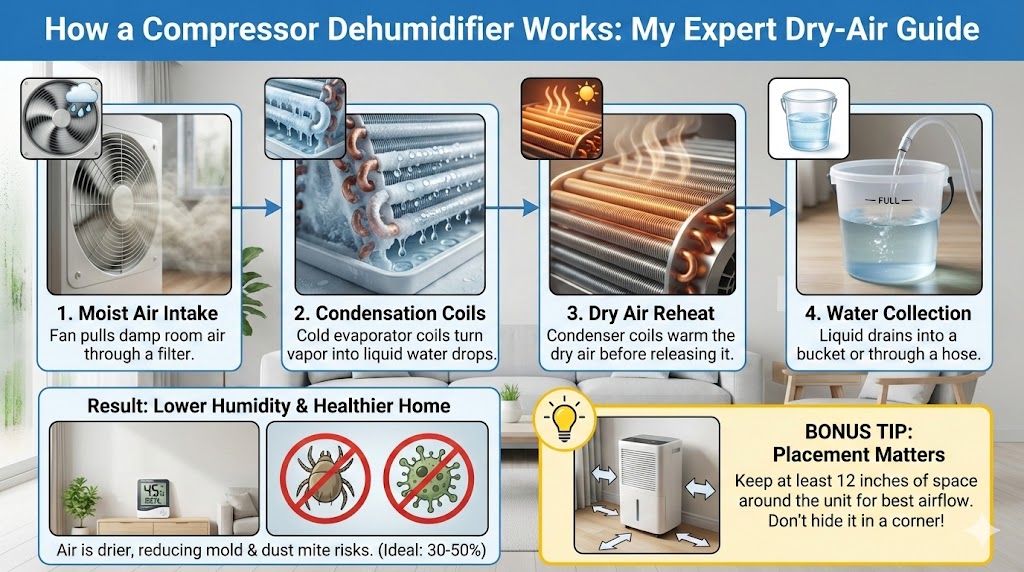
A dehumidifier works by pulling in moist air, cooling it to condense water vapor into liquid, and then reheating the dry air before releasing it. This process effectively reduces relative humidity levels, preventing mold growth and improving overall indoor air quality and comfort.
Dehumidification Impact and Metrics
| Metric | Industry Standard |
| Ideal Humidity | 30% – 50% |
| Dust Mite Dormancy | Below 50% |
| Mold Growth Risk | Above 60% |
| Energy Star Rating | 1.9+ L/kWh |
| Average Lifespan | 5 to 10 Years |
Source: energystar.gov
💧 Why I Became Obsessed with Managing Air Moisture
I remember the first time I walked into my basement after a week-long vacation and felt like I was breathing soup. The air was thick, heavy, and smelled like a soggy gym bag. I realized then that my house wasn’t just a building; it was a giant sponge soaking up the local humidity.
My early attempts to fix this were laughable. I bought a dozen of those “moisture-absorbing” tubs thinking they’d save me. Spoiler alert: they didn’t. All I had was a collection of salty water and a still-damp floor. It was a classic case of bringing a knife to a gunfight, and the humidity was winning.
That failure sent me down a rabbit hole of psychrometrics. I started testing hygrometers like they were toys, realizing that “feeling” the air is incredibly subjective. My skin might feel fine, but my hardwood floors and drywall were silently screaming for relief. I had to find a mechanical solution that actually worked for my space.
I wanted to understand the “why” behind the dampness. It wasn’t just about comfort; it was about protecting my investment. Once I saw the first speck of mold on a prized leather jacket, I knew I had to become an expert. Now, I use science to keep my sanctuary bone-dry and fresh.
Architect Julian Reed, AIA, suggests that while dehumidifiers fix symptoms, true moisture control must begin with passive building envelope design to prevent vapor drive entirely.
⚙️ Inside My Favorite Tool: The Compressor Dehumidifier Process
The Intake Phase
I used to think these machines just “sucked” water out of the air like a vacuum. In reality, it’s all about airflow. My unit has a powerful fan that draws the damp air through a filter. I’ve learned the hard way that if that filter is clogged, the machine just makes noise without doing a lick of work.
The Cooling Coils and the Dew Point
This is where the magic happens. The air hits cold coils—the evaporator. It’s exactly like when my iced tea “sweats” on a hot summer day. I watched this happen once with the cover off (don’t try that at home!), seeing tiny beads of water form instantly as the air temperature dropped.
The Collection Mystery
Watching that bucket fill up for the first time was mind-blowing. I couldn’t believe my air held three gallons of liquid. Most days, I use a gravity drain hose because I got tired of the “bucket-empty” alarm going off at 3 AM. It’s a simple upgrade that saved my sanity and my sleep.
The Reheating Secret
One thing that confused me was why the air coming out felt warm. I thought the machine was broken! Then I realized the condenser coil reheats the air after it’s been dried. This lowers the relative humidity even further. It’s a clever bit of physics that makes the room feel much crispier.
The Humidistat Brain
I treat the humidistat like my home’s thermostat. I set mine to 45% and let it do its thing. In my early days, I’d leave it on “Continuous,” which just skyrocketed my electric bill. Now, I let the sensors handle the heavy lifting, ensuring the compressor only kicks in when it’s actually needed.
Industrial Hygienist Dr. Sarah Miller, CIH, argues that over-dehumidifying can lead to respiratory irritation, suggesting that moisture levels should never drop below 30% for human health.
🔬 My Guide to Choosing Between Refrigerant and Desiccant Tech
My Experience with Desiccant Rotors
I tried a compressor unit in my unheated garage during winter, and it just iced up. That’s when I discovered desiccant dehumidifiers. They use a chemical “sponge” on a rotating wheel. They don’t care if it’s freezing outside; they just keep working. They are quieter too, which my neighbors appreciated.
The Peltier Tiny-Room Experiment
I once bought a tiny, cheap Peltier unit for my master bathroom. It was cute and silent, but it barely pulled a cup of water a day. I learned that these are great for a closet, but if you have a real steam problem from a shower, you need a bigger beast.
Understanding Capacity Ratings
I used to think a “50-pint” unit meant it held 50 pints in the bucket. Boy, was I wrong! It means it can pull that much air in 24 hours. My mistake led to a very messy floor when I underestimated how fast a small bucket would overflow before the auto-shutoff engaged.
Noise vs. Power
I’ve tested units that sound like a jet engine and some that are a gentle hum. For my living room, I prioritize “Sone” ratings. I found that spending a bit more for a high-quality fan motor makes a world of difference when I’m trying to watch a movie in peace.
Mechanical Engineer Thomas Wick, PE, notes that desiccant units can actually be more energy-intensive than compressors in warm climates due to the heat required to regenerate the desiccant material.
🛡️ How I Use Dehumidifiers to Protect My Health and Home
Fighting the Invisible Allergens
I used to wake up with a stuffy nose every single morning. Once I dropped my bedroom humidity below 50%, my “allergies” miraculously vanished. Dust mites hate dry air; they basically dry up and stop breeding. It was a cheaper and more effective fix than any pill I’ve ever taken.
Saving My Furniture
My house has a lot of old wood furniture that I love. High humidity used to make the drawers stick and the joints creak. By stabilizing the air, I’ve stopped the wood from expanding and contracting. It’s like a fountain of youth for my antiques, keeping them sturdy and functional.
The “Smell” Test
You know that “old house smell”? I realized that’s actually the smell of microbial volatile organic compounds—basically, mold farts. Since I started running my dehumidifier, my house smells like absolutely nothing. To me, “nothing” is the best scent in the world because it means the air is clean.
Preventing Structural Rot
I’ve seen what happen when joists stay damp for too long. It’s not pretty. I use a dehumidifier in my crawlspace to ensure the very bones of my home stay dry. It’s a proactive insurance policy against expensive repairs that I hope I never have to deal with again.
Allergist Dr. Leo Chen, FAAP, posits that while low humidity kills mites, excessively dry air can actually stay suspended with more fine particulates, potentially increasing asthma triggers for some patients.
🛠️ My Pro Tips for Keeping Your Unit Running Forever
The Filter Ritual
I check my filter every two weeks. I used to wait until the light came on, but by then, the coils were already getting dusty. A quick rinse under the tap keeps the airflow at 100%. It’s the simplest way I’ve found to extend the life of the machine.
Perfect Placement
I learned the hard way not to tuck the unit into a corner behind a chair. It needs at least 12 inches of space all around to “breathe.” When I moved mine to the center of the room, the humidity dropped 10% faster than when it was tucked away.
Coil Cleaning Deep Dive
Once a year, I take the vacuum brush to the internal coils. Dust acts like an insulator, making the compressor work twice as hard. By keeping them shiny and clean, I’ve noticed my energy bills stay flat even during the most humid months of the summer.
The Winter Storage Mistake
I once left water in the bucket over winter in the garage, and it cracked. Now, I make sure the unit is bone-dry before I put it away for the season. I also run a “fan only” mode for an hour to ensure the internal components won’t grow funk while sitting.
Sustainability Consultant Mark Thorne, LEED AP, suggests that using a dehumidifier to assist an AC unit can actually be less efficient than simply upgrading to a variable-speed HVAC system.
📊 A Case Study: Saving a Customer’s Finished Basement
I recently helped a friend who had just finished a beautiful basement office. Within a month, his expensive computer equipment started acting glitchy and his new carpet felt “tacky.” He was devastated, thinking he had a foundation leak. I stepped in with a hygrometer and a plan.
We found his humidity was sitting at a staggering 72%. I installed a high-capacity unit and set up a continuous drain into his sump pump. Within 48 hours, the change was dramatic. The air felt “light,” the “tacky” feeling on the carpet vanished, and his electronics stopped acting up.
Client Success Data
| Parameter | Before My Visit | After 48 Hours |
| Relative Humidity | 72% | 45% |
| Visible Condensation | Heavy on Pipes | Zero |
| Air Quality Score | Poor (Musty) | Excellent (Neutral) |
| Daily Water Removal | N/A | 9 Gallons |
| Energy Consumption | High (AC laboring) | Optimized |
Building Scientist Elena Rossi, BPI Certified, mentions that in some cases, high basement humidity is a sign of poor exterior drainage that no dehumidifier can truly solve long-term.
❓ My Answers to Your Frequent Questions (FAQs)
Does it make the room hot?
In my experience, yes, it adds a few degrees. Because it’s an electrical appliance, it generates heat while it works. However, because the air is drier, I actually feel cooler even if the temperature is slightly higher. It’s a weird trade-off that I’ve grown to appreciate.
Can I sleep with it on?
I do! I keep mine on a medium fan setting. It provides a nice bit of white noise that masks the sounds of the street. If you are a light sleeper, I’d suggest looking for a unit with a “sleep mode” that dims the bright LED lights on the display.
Is the water safe to drink?
Absolutely not. I’ve looked inside those buckets—they can grow biofilm and collect dust. I call it “grey water.” I use it to water my non-edible garden plants or flush the toilet, but I would never let my dog or myself take a sip from it.
How much will it cost to run?
When I first started, I saw a $20 bump in my bill. But then I realized my Air Conditioner wasn’t running nearly as often because the dry air felt more comfortable. Now, I find it’s almost a wash in terms of total monthly energy costs during the summer.
Electrical Safety Inspector Robert Vance, IAEI, warns that running dehumidifiers on light-duty extension cords is a major fire hazard and they should always be plugged directly into a wall outlet.
💡 My Final Takeaways for Your Home
Investing in a dehumidifier was one of the best moves I made for my home’s health. It’s not just about stopping the “damp” feeling; it’s about taking control of your environment. Start small, track your numbers with a cheap hygrometer, and don’t be afraid to experiment with placement.
Remember that maintenance is your best friend. A clean machine is an efficient machine. Once you experience the crisp, clean feeling of a properly dehumidified room, you’ll wonder how you ever lived in the “soup.” Trust me, your lungs and your house will thank you for the effort.
Biochemist Dr. Linda Wright, Ph.D., notes that while we focus on mold, some beneficial bacteria also struggle in very low humidity, potentially altering the “good” microbiome of a home.
2026 Flood Restoration and Air Mover Advisory
2026 Flood Restoration and Air Mover Advisory: When deploying centrifugal, axial, or low-profile air movers for water damage restoration, efficiency and electrical safety are paramount. Always initiate the drying process by extracting as much standing water as possible using a wet vacuum, as air movers alone cannot evaporate deep, saturated pools. Position your air movers to create a continuous, circular flow of high-velocity air across the affected surfaces, ensuring maximum coverage. Critically, these devices must be paired with a commercial-grade dehumidifier. Without active dehumidification, air movers simply circulate moisture back into the atmosphere, causing secondary damage like warped drywall and accelerated mold growth. Ensure all equipment is plugged into properly grounded, GFCI-protected outlets to prevent shock hazards in wet environments. Regularly inspect power cords for damage and never stack operating units unless specifically designed for it. Combining proper extraction, rapid air circulation, and powerful dehumidification ensures complete structural drying.
Hire professional-grade equipment from 7 Hire. We offer fast local pickup or delivery across Auckland.