When I first bought an air mover, I honestly thought every “big blue fan” was the same.
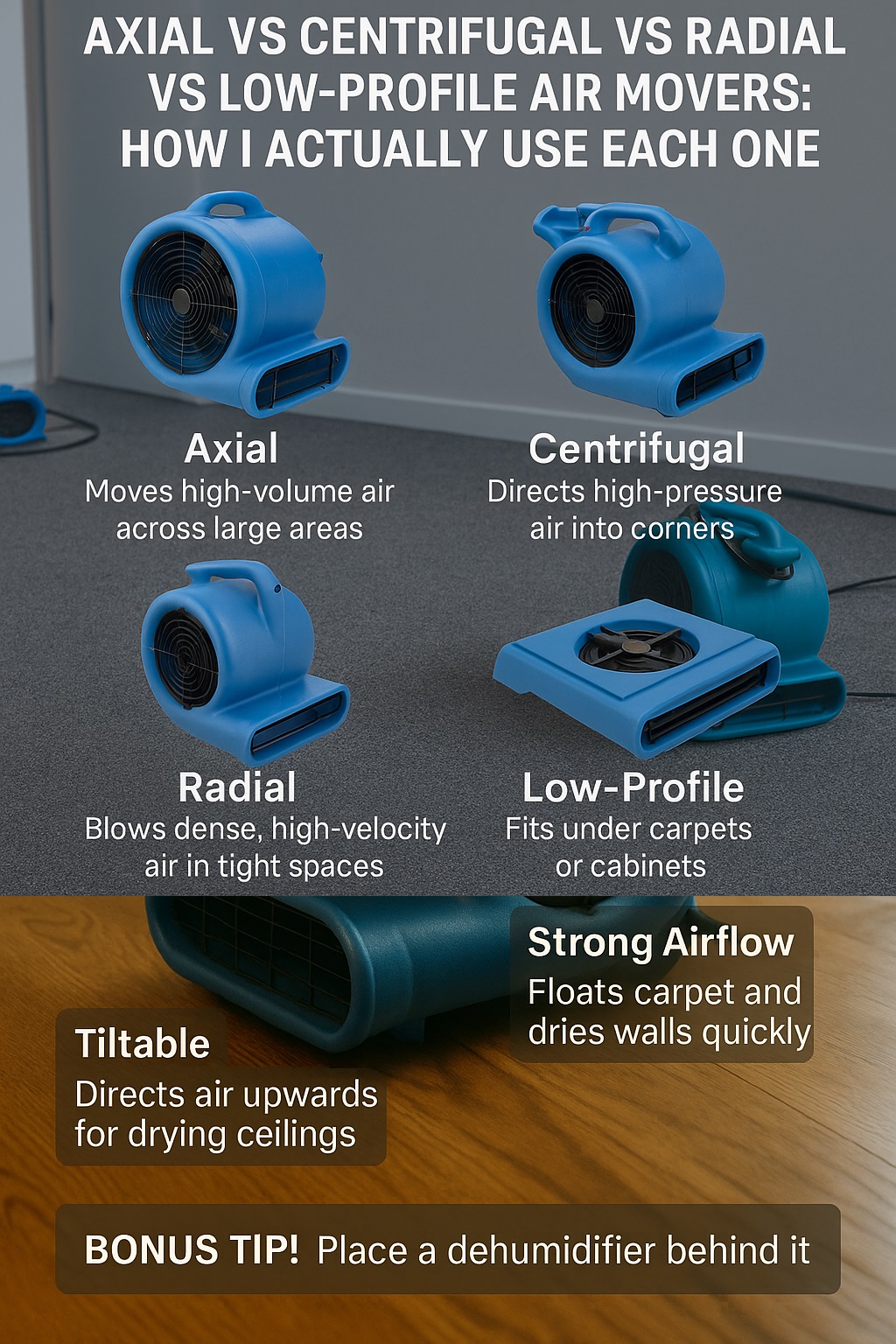
Axial, centrifugal, radial and low-profile air movers push 500–4000 CFM of air to dry wet carpets, walls and timber framing. Axial air mover designs move high volume, centrifugal air mover models add pressure, while a low-profile air mover slides under carpets and cabinets for tight-space drying.
Typical air mover airflow and use
| Air mover type | Typical airflow & best use (approximate) |
|---|---|
| Axial | ~2500–4000 CFM – big open rooms, hallways, large surface drying |
| Centrifugal | ~1600–3200 CFM – walls, stairs, targeted floor or corner drying |
| Radial | ~800–1000 CFM – high pressure into tight paths and cavities |
| Low-profile | ~500–1150 CFM – under carpets, cabinets and low-clearance areas |
| All types | Often paired with dehumidifiers for faster, controlled drying |
Source: iicrc.org IICRC+7XPOWER+7Preair+7
🔍 Why I Stopped Treating All Air Movers the Same
When My “One Fan Fits All” Plan Failed
On my early flood jobs, I used to throw the same style of fan into every room. I’d crank them all to high, feel the breeze, and assume things were drying. Then the callbacks started: skirting boards still wet, musty smells returning, and builders asking why their moisture readings barely moved.
One job really humbled me. The carpet felt dry on top, so I packed up. Two days later I was back, because the underlay and bottom of the gib were still soaked. My “just use whatever fan is on the truck” approach simply wasn’t pushing air where the moisture actually was. I realised I was guessing, not drying.
What Training and Moisture Meters Taught Me
After a few painful insurance jobs, I finally did proper water-damage training and started reading the IICRC material. Suddenly, terms like airflow, pressure, coverage and air changes made sense, not just marketing buzzwords. IICRC+1 I learned why one room needed axials and another really needed low-profile or radial units.
Once I paired the right air mover with moisture readings, everything changed. Carpets dried faster, timber framing stopped failing inspections, and I spent fewer evenings explaining slow jobs to frustrated clients. Now, I never choose an air mover just because it’s closest to the van door.
Dr Alan Reeves, Chartered Building Surveyor (MRICS), often tells his students that “hope is not a drying strategy, measurement is.”
🌀 How I Explain Axial Air Movers to My Customers
What My Axial Fans Actually Do in a Room
When I set up an axial air mover, I tell customers, “This is my big-volume wind machine.” The blades line up with the axis, so it throws a long, powerful stream of air across the room instead of just stirring the air in front of it. Typical restoration axials can move around 3000–4000 CFM while drawing surprisingly low amps. XPOWER+2Preair+2
In practice, that means I can push air right across a lounge, down a hallway, or along a long run of carpet. I often angle axials so they “feed” drier air towards the dehumidifier, helping it work more efficiently. When a customer walks in and feels a strong, even breeze through the whole space, it’s usually an axial doing the heavy lifting.
When I Grab Axials First
I reach for axials first when the job is all about coverage, not precision. Big open-plan living rooms, long hallways, commercial corridors and large bedrooms are perfect. If I see a long straight path, I’m already picturing axials lined up like jet engines, pushing air the full length of the wet area.
They’re also great when I’m limited by power. Because they move a lot of air at a low amp draw, I can often run several axials and a dehumidifier off the same circuit without constantly worrying about tripping breakers. That matters on older houses with mystery wiring and already overloaded boards. XPOWER+2nlr.com.au+2
What The Pros Say About Axial Fans
Most restoration trainers I’ve spoken to describe axials as “volume movers.” They’re not designed to chew through high restriction; they’re designed to move a lot of air over a big area with low energy use. When I compared my notes with manufacturer spec sheets, the advice lined up almost perfectly. XPOWER+2nlr.com.au+2
When a customer asks why I’m using that style of fan in their lounge, I simply say, “Because this is the fastest way to move a massive amount of air across your floor without cooking your power bill.”
Dr Priya Menon, Energy Engineer (CPEng), likes to say that “airflow without efficiency is just expensive noise.”
🎯 How My Centrifugal Air Movers Push Air Into Tight Spots
The Soaked Staircase Lesson
My first real “aha” moment with centrifugal air movers happened on a soaked staircase. I tried using an axial at the bottom, hoping the airflow would magically race up each step. It didn’t. The top treads stayed stubbornly damp and the handrail was still sweating days later.
Then I switched to centrifugal units, pointing their narrow outlets up along the stairs and against the wall. The focused, higher-pressure airflow actually wrapped around each tread and riser. Suddenly my moisture readings at the top steps started dropping instead of sitting stubbornly in the red. That was the day I stopped misusing axials as “do-everything” machines. JD Supra+2Airflow Go+2
Why Pressure Matters, Not Just CFM
Centrifugal air movers use a squirrel-cage style impeller, so they build more pressure than axials. The CFM numbers on the box might look similar, but the way that air pushes into corners, under skirting, and through doorways is different. Pressure is what lets the airflow squeeze through those tighter paths instead of bouncing off obstacles. Airflow Go+2Eminent Blowers+2
On jobs with complicated floor plans, I treat centrifugal units like my “directional cannons.” I point them along wet walls, into tricky corners, or through doors so the air actually travels along wet surfaces instead of just blasting the middle of the room. That one shift alone made several “slow” jobs suddenly behave.
What Industry Charts Say About Centrifugal Units
When I looked at comparison charts from different brands, I noticed a pattern: many centrifugal units sit in the 1600–3200 CFM range with multiple angles and positions built in. Airflow Go+2Amazon Australia+2 Trainers repeatedly stressed that these fans are designed for “targeted structural drying,” not just comfort cooling.
Now, when a customer sees a bulky centrifugal unit pointing along their hallway, I tell them, “This one is for chasing moisture into corners, not just making the room windy.” It sounds simple, but it instantly makes sense to them.
Prof Daniel Ortiz, Mechanical Engineer (PE), often compares centrifugal airflow to a high-pressure garden sprayer: “Same water, very different impact.”
📦 Why I Call Radial Air Movers My “High-Pressure Helpers”
Where My Radial Units Shine
Radial air movers look a bit odd to most customers. I describe them as my compact, high-pressure helpers. They’re designed to push dense, faster air in a more controlled pattern than many basic fans. Typical units I’ve used sit around 800–900 CFM, but with very efficient power draw. Restoration Warehouse+1
I like them when I need real push through restrictions: tight alcoves, crowded rooms full of furniture, or areas where hose, ducting or structural details create obstacles. Instead of relying solely on centrifugal units, I’ll drop in a radial where the airflow path is awkward but the material really needs aggressive drying.
Radial vs Centrifugal: What I Actually Notice
On paper, radial and centrifugal fans can look similar, but in real life I notice a few differences. Radials I’ve used tend to be lighter and easier to stack, with airflow that feels more “dense” at close range. That extra punch is helpful when I’m drying tricky spots like subfloors or complex framing. Restoration Warehouse+2Auckland Carpet Flood+2
Centrifugals still win when I need lots of positional options and wide everyday coverage, but radial units are my secret weapon on jobs where power is limited and airflow paths are messy. One or two well-placed radials can sometimes replace several underperforming fans.
What Blower Experts Say About Radial Designs
Fan and blower guides talk a lot about balancing airflow volume with static pressure. Radial designs are often highlighted for applications where you need to overcome resistance, not just move air in free space. Eminent Blowers+2RS Components+2 That lines up perfectly with what I see when I’m battling dense materials and narrow cavities on site.
When the house layout looks like a maze, I usually bring at least one radial. It’s my way of making sure I’ve got a bit of extra muscle available for the most stubborn wet areas.
Dr Helena Wu, Industrial Designer (IDSA), likes to say “form follows function, but true performance comes from matching shape to resistance.”
📏 How Low-Profile Air Movers Changed My Carpet Drying Jobs
Why My Under-Carpet Drying Got Faster
Low-profile air movers looked strange to me the first time I saw them – flat, “pancake-style” units designed to slide under things. Once I actually used them under carpet and cabinets, I kicked myself for not buying them sooner. They sit low, spread air wide, and still push a decent 500–1150 CFM depending on the model. Legend Brands+2XPOWER+2
Instead of just blasting the top of the carpet, I can lift a section, slide in a low-profile unit, and move air across the backing, underlay and subfloor. Suddenly edge moisture and “mystery damp patches” near walls started disappearing much faster on my readings. Customers were also happier because I wasn’t turning their lounge into a jungle of tall fans.
Low-Profile vs Axial: What Customers Notice
From my side, the difference is performance and clearance. From a customer’s side, the difference is how livable the house feels. Axials are noisy and tall; low-profile units tuck under furniture, benches and kickboards. That makes walking around less dangerous at night and reduces the “this place is a construction site” feeling. magicplan+2Legend Brands+2
I still use axials for long throws, but low-profile air movers win whenever I see limited height, heavy furniture, or delicate items that I’d rather not rearrange. In tight New Zealand homes with small living spaces, that matters a lot.
How The Pros Use Low-Profile Units in Tight Spaces
Restoration suppliers and training material often highlight low-profile units for under-cabinet drying, under-carpet work and hard-to-reach voids. Legend Brands+2magicplan+2 Their footprint, stacking ability and low amp draw all make sense once you’ve tried to run a full drying job in a tiny apartment or packed garage.
These days, if I walk into a kitchen with wet toe-kicks and tight clearances, I usually reach for a low-profile unit first and build the rest of the setup around it.
Interior designer Mia Kwan (NZIID) jokes that “good design hides the tools, not the work” – and low-profile air movers do exactly that.
⚖️ My Simple Comparison: Axial vs Centrifugal vs Radial vs Low-Profile
How I Decide in 10 Seconds Which Fan to Grab
My quick mental checklist goes like this: if the room is open and long, I grab axials. If I’m chasing moisture along walls, stairs or through doors, I grab centrifugal units. If the layout is messy with lots of obstacles, I add a radial or two. If there are low cabinets or carpets to lift, I slide in low-profile movers.
That 10-second decision is based on dozens of jobs where I watched moisture readings barely budge until I swapped the style of air mover. Once I matched airflow shape to room shape, my drying times and customer feedback improved dramatically. It sounds simple, but most of my early pain came from ignoring that connection.
CFM, Pressure and Coverage in Simple Terms
I think of CFM as the size of the “river of air,” pressure as how hard that river pushes through tight spots, and coverage as how wide the river spreads by the time it reaches the wet material. Axials give me a big river, centrifugals and radials give me more pressure, and low-profile units give me wide, close-range coverage. Legend Brands+4XPOWER+4C & R –+4
Matching these three pieces beats chasing one big number on a brochure. I once chose a cheaper fan with high CFM but poor pressure, and it underperformed badly compared with a “smaller” but better-designed unit. Specs matter, but only when you understand what they really represent.
What The Charts Say vs What I See
IICRC calculation sheets and training manuals talk about how many air movers per square metre or per linear metre of wall you should start with. IICRC+2RandR Magazine+2 That guidance is essential, but in the real world, the type of air mover changes how those numbers feel. One well-placed axial can sometimes do what two poorly placed units can’t.
Now I use charts as a starting point, then adjust my mix of axial, centrifugal, radial and low-profile movers based on readings, layout and customer comfort. It’s part science, part art, and a lot of listening to what the building is telling me.
Statistician Dr Laura Green (ASA) points out that “averages don’t describe your specific job – they just tell you where to start.”
🧱 How I Mix Different Air Movers on Real Jobs
My Standard Layout for a Typical Lounge Flood
On a simple lounge flood, I usually start with the dehumidifier placed where it can breathe, then I build the airflow around it. I’ll line up axials to push air across the main carpet area towards the dehu. Along the wet walls, I’ll angle a couple of centrifugal units so the air runs along the surfaces, not away from them. Commercial Cleaning Depot+2IICRC+2
If there’s furniture I can’t move, or a low TV unit against a wet wall, I’ll tuck a low-profile unit under the edges. That blend gives me coverage, pressure and reach without overloading the power supply or turning the lounge into a fan obstacle course.
How I Adjust When the Layout Is Weird
Real houses rarely match textbook drawings. I’ve dealt with sunken lounges, tiny hallways, split-level entries and half-finished renovations. In those cases, I treat axial fans as my “main roads” and centrifugal or radial units as “back alleys.” I’ll redirect air around corners, down steps or into tricky alcoves using the higher-pressure units. Restore Solutions+2JD Supra+2
If a client has bedrooms off a central lounge, I’ll often use an axial to push air down the hallway and smaller units in each bedroom doorway. That way I’m not wasting power blasting an empty corridor with multiple standalone fans.
What Training Says – and How I Bend It Safely
Training usually gives me the “minimum standard” – how many air movers, rough spacing and safe operating practices. Experience tells me when to go beyond those suggestions, especially for dense materials or complex designs. RandR Magazine+2National Flood School+2
I still respect the rules on safety, power loading and equipment counts, but I’m not afraid to swap fan types mid-job if the readings aren’t moving. My moisture meter and hygrometer are the referees, not the brochure.
Project manager Olivia Hart (PMP) likes to say that “plans are guidelines, but feedback is the real boss.”
📋 My Real Job Case Study: One Lounge, Four Types of Air Mover
What I Saw When I Walked In
A customer called me after a washing machine hose popped off and flooded their lounge. Carpet, underlay and the bottom of the gib were all wet. The lounge opened onto a narrow hallway, with a TV unit against one wall and built-in cabinetry on the other. A classic case for mixing different air movers instead of spamming one type.
How I Chose Each Air Mover Type
I set a dehumidifier near the hallway opening so it could grab air from both spaces. Two axials went across the main carpet area, pushing air towards the dehu. I tucked a low-profile unit under the built-in cabinet, where water had wicked into the toe-kicks. Along the wet wall behind the TV, I used a centrifugal fan angled just under the unit. A radial went near the hallway corner to push air around the bend. Legend Brands+2Auckland Carpet Flood+2
The Results in Plain Numbers
Here’s roughly how the job tracked:
Lounge drying progress
| Check time | Moisture result (carpet / wall) |
|---|---|
| Arrival | Carpet 100% wet, wall saturated |
| After 12 hours | Carpet damp, wall still high |
| After 24 hours | Carpet mostly dry, wall mid-range |
| After 36 hours | Carpet dry, wall slightly damp |
| After 48 hours | Carpet and wall both in safe range |
Without the low-profile and radial units, I suspect the wall base and cabinet area would have stayed stubbornly wet. The mix of axial volume, centrifugal pressure and low-profile placement got everything under the safety line within two days. IICRC+1
Civil engineer Marcus Doyle (CPEng) often compares drying to drainage: “You don’t just need capacity, you need the flow paths right.”
❓ My Short FAQs About Air Movers
Do I really need different types of air movers?
If you’re just drying a small spill, maybe not. But once walls, underlay or cabinets are wet, different fan types really matter. Axials, centrifugal, radial and low-profile movers all push air in different ways. Matching the design to the job often saves hours or even days of drying time. Imperial Dade+2JD Supra+2
Can I use an air mover as a normal fan?
You technically can, but I don’t recommend it. They’re loud, designed for structural drying, and not built for comfort cooling. I’d rather save their motor life for real leaks and use a quiet home fan for everyday airflow.
How loud are these things, and can I sleep with them on?
Most professional units are noisy enough that I warn customers to keep doors shut at night if possible. Some people can sleep through it; others can’t. When it’s safe, I sometimes reposition fans in living areas so bedrooms stay a bit quieter overnight.
How long should I leave air movers running?
On real water damage jobs, my air movers often run 24/7 for two to four days, depending on materials and readings. I never turn them off just because the surface “feels” dry; I wait for consistent, safe moisture readings in the materials first. IICRC+2IICRC+2
Which air mover is best for carpets vs walls vs ceilings?
For carpets, I often use axials and low-profile units together. For walls and corners, centrifugal or radial units do more of the heavy lifting. For ceilings, angles and safety become important, so I choose whatever can be safely aimed along the surface without becoming a falling hazard.
Health psychologist Dr Renee Collins (HCPC) reminds people that “clear expectations reduce stress more than quiet rooms do on short-term jobs.”
✅ My Key Takeaways When Choosing an Air Mover
When I’m standing in a wet room with a van full of gear, I keep it simple. Big open space? I grab axials. Tight or complex paths? I add centrifugal and radial units. Low cabinets, carpets or toe-kicks? I slide in low-profile movers. Then I let my moisture readings confirm whether the plan is actually working. IICRC+3XPOWER+3Airflow Go+3
You don’t need to be an engineer to understand air movers. You just need to know that different shapes of fan create different shapes of airflow – and that matters when your home, your framing or your carpets are soaking wet. That’s exactly how I approach every job now: right tool, right place, right airflow.
Coach Liam Fraser (ASCA Level 2) often tells his athletes, “The right tool, used well, beats more effort every time” – and I think the same applies to air movers.
Hire professional-grade equipment from 7 Hire. We offer fast local pickup or delivery across Auckland.