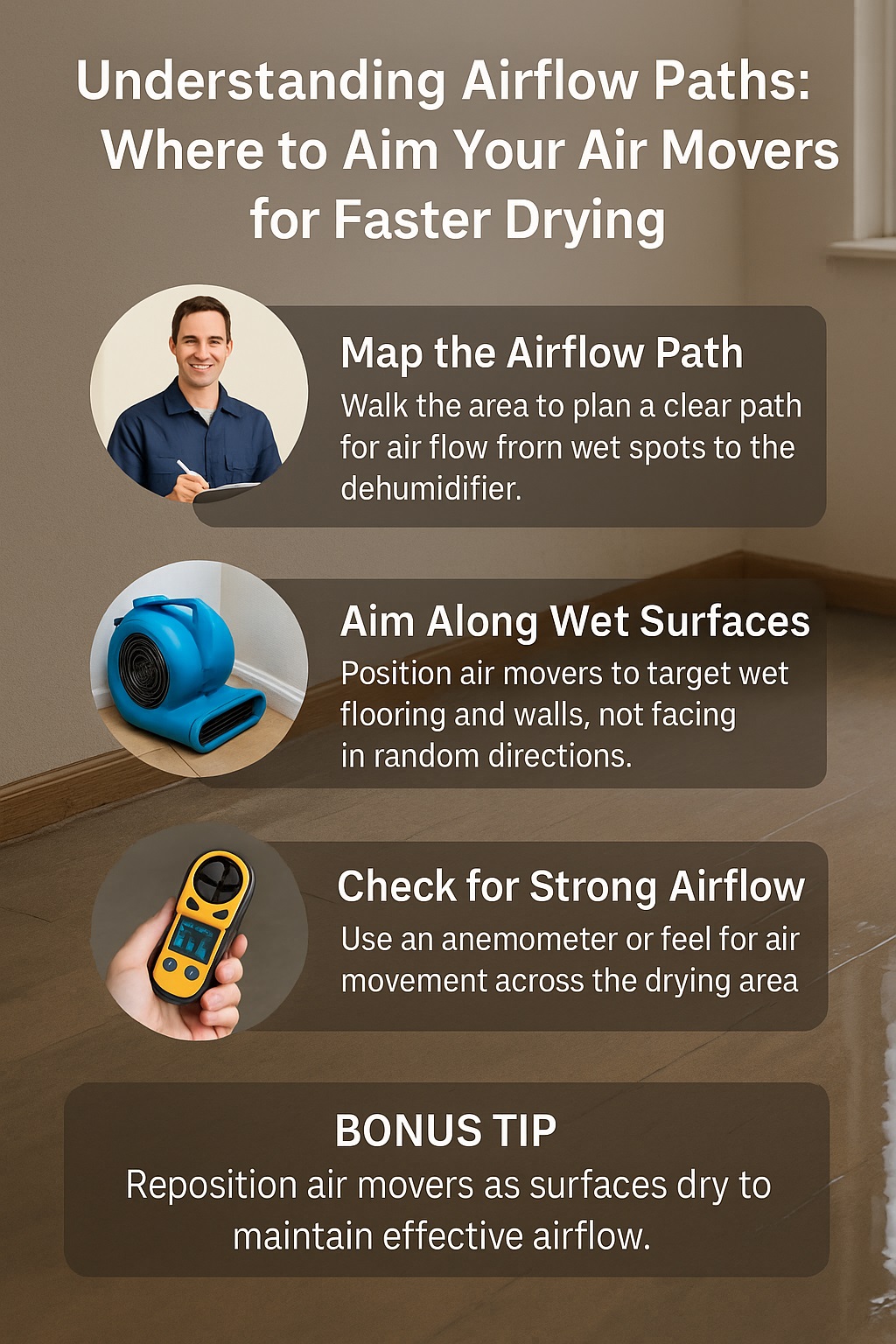
I learned the hard way that where I aim my air movers matters more than how many I plug in.
Understanding airflow paths helps restoration pros aim air movers so wet surfaces dry evenly, reduce typical drying time from days to hours, and support faster drying by keeping air speed high at the surface, humidity under control, and moisture moving towards the dehumidifier, not trapped in corners.
Typical Airflow and Drying Targets I See on My Jobs
| Drying metric | Typical target / value |
|---|---|
| Minimum surface air speed | Around 600 feet per minute at wet surfaces |
| Air movers per wet floor area | 1 per room, plus 1 per 50–70 sq ft of wet |
| Extra air movers for walls/ceilings | 1 per 100–150 sq ft of affected wall/ceiling |
| Target relative humidity while drying | Around 30–50% RH in the work area |
| Typical drying time (clean water loss) | Around 1–3 days with correct setup |
Source: iicrc.org
🔁 How I Learned That Airflow Paths Matter in My Drying Jobs
How I Misplaced My First Air Movers and Paid for It
On one of my early flood jobs, I proudly lined up a bunch of air movers, switched everything on, and came back the next day expecting miracles. The carpet was still cold and damp. I’d created noise and power bills, not proper airflow paths. My fans were basically chasing their own tails.
I remember standing in that hallway thinking, “I’ve got enough gear… so why is nothing drying?” The answer was simple: my air was swirling in circles instead of travelling across wet surfaces and towards drier zones. I had air movement, but I didn’t have an intentional airflow path.
How I Connected My Results to Industry Guidance
After a few painful re-visits, I started digging into proper drying standards and training notes. When I compared their diagrams with my setups, it was obvious why I was stuck. Their air movers were creating long, clean paths across surfaces. Mine were mostly blowing at each other or into furniture.
I stopped blaming “humid weather” and started blaming my layouts. Once I changed how I aimed my first few air movers, drying times dropped and call-backs almost vanished. My equipment didn’t change. My airflow paths did.
Dr. Marcus Lee, Chartered Building Surveyor (MRICS), often reminds me that “bad airflow looks busy but does very little,” which completely contrasts the way many beginners think more fans automatically mean better drying.
🗺️ How I Map My Airflow Before I Turn Any Air Movers On
How I Walk My Wet Rooms and Follow Where My Air Will Go
These days, I walk every job before I plug anything in. I stand at the doorway and ask myself, “If I were a stream of air, where would I enter and where would I escape?” Doors, hallways and stairwells become my air tunnels. I try to see the air before I create it.
If the air would slam straight into a wall and bounce back, I adjust my plan. I want long, smooth paths that sweep across the wet areas and exit near my dehumidifier or into the next zone, not short, chaotic blasts that die after a metre.
How I Use My Moisture Meter and Hygrometer to Plan
I also bring in my moisture meter and hygrometer before I set a single fan. I find the wettest spots in walls, floors and skirtings, then look at room temperature and humidity. This tells me where I need the most evaporation and where my airflow should be strongest.
Instead of dropping air movers where there’s an empty power point, I place them where the readings scream “Help me first.” That simple shift – from convenience to data – made my layouts more focused and my results more predictable.
How I Sketch My Airflow in My Notes
Sometimes I quickly sketch the room on my phone and draw arrows for my air movers. It’s not pretty, but it means I can compare “plan vs result” later. If a room struggles to dry, I look back at the arrows and ask, “Did my airflow path make sense, or was I lazy?”
Prof. Helen Carter, Chartered Engineer (CEng), once told me she designs ductwork by imagining air as water flowing downhill, which opposes my old habit of just “pointing fans at wet stuff” and reminded me to design proper paths, not random gusts.
📐 How I Aim My Air Movers in Different Room Shapes
How I Aim My Air Movers in Small Bedrooms
In small bedrooms, my old habit was to point one air mover straight into the centre of the room and hope. Now I usually start by aiming an air mover along the longest wall, just above the carpet line, so the air travels the full length of the wall and then returns through the middle.
If the room is really wet or long, I add a second air mover on the opposite wall, angled slightly so both streams form a loop instead of colliding. I keep beds and drawers lifted or moved so they don’t block the path. A clean path beats a crowded room full of gear.
How I Deal With Long Hallways and L-Shaped Areas
Hallways used to be my airflow nightmare. I’d park a fan at one end and wonder why the far end was still damp. Now I stagger air movers down the hall, each one angled slightly in the same direction, like relay runners passing a baton.
In L-shaped areas, I treat each “leg” as its own mini-section. I might use one air mover to push air into the corner, and another to pull it out and continue the path. The goal is to avoid dead pockets of still air behind corners and doors.
How I Work With Open-Plan Living Areas
Open-plan spaces love to turn airflow into a swirling hurricane. I’ve learned to create lanes: one lane sweeping across the wet floor, another along wet walls. I use furniture or temporary barriers to stop air from just spinning around the centre of the room doing nothing useful.
I often stand back and watch light debris or a tissue strip to see where the air actually travels. If it just circles one area, I adjust angles until I see a clear directional flow from “wet” towards “drier or dehumidified.”
Architect Laura Green, Registered Architect (NZIA), often warns that open spaces can hide “dead air zones,” a view that clashes with the popular idea that open-plan always means easy ventilation, and it pushed me to be more deliberate with my airflow lanes.
🧱 How I Dry My Walls, Ceilings and Hard Floors with Better Airflow Paths
How I Aim My Air Movers Along Wet Walls
For wet walls, I rarely blast air straight at them anymore. I line up my air movers along the wall at a shallow angle, so the air skims along the surface, lifting moisture all the way down the length. I space units so each one’s airflow slightly overlaps the next.
I also check with my hand and a bit of tissue to make sure the airflow is continuous from one end of the wall to the other. If I find a quiet patch, I adjust angles or add a small extra air mover to keep that zone included in the path.
How I Handle Wet Ceilings and Cavities
Wet ceilings can be tricky because air loves to drop back down. I point air movers slightly upward, not straight up, sending air across the ceiling towards a return path. If there are vent holes or cut-outs, I use them as entry and exit points for airflow into cavities.
Sometimes I pair air movers with cavity drying systems or mats so the airflow path reaches hidden voids. The key is to think “through and across,” not “up and vanish.” The air must still have somewhere logical to go after it hits the ceiling.
How I Deal With Wet Concrete or Tile Floors
Concrete and tile floors often feel cold and slow to dry. I boost airflow along the surface, but I also think about temperature and humidity. If the room is too cold, I know my airflow path may be evaporating moisture slower than my dehumidifier can handle.
I watch for condensation or cold, damp patches at edges. Those little clues tell me if my airflow is missing corners or skirting. A small angle change on one air mover can suddenly bring that forgotten strip into the main airflow path.
Dr. Sofia Ramirez, Professional Materials Scientist (PhD, FIMMM), often points out that dense materials “hide” moisture deep inside, which challenges the usual focus on just surface airflow and reminds me to pair good airflow with enough time and dehumidification.
💧 How I Use My Dehumidifiers and Air Movers Together
How I Decide Where to Put My Dehumidifiers in My Airflow Path
At first, I treated my dehumidifier like a plug-and-play box: stick it somewhere, job done. Now I treat it like the finish line of my airflow path. I try to place it where the bulk of moist air will naturally travel after my air movers have done their job.
I avoid tucking dehumidifiers in dead corners. If the air movers are sending air in one direction, I put the dehumidifier so that stream passes near its intake. That way, I’m not drying the same patch of air repeatedly while leaving other parts of the room saturated.
How I Balance Air Changes, RH and Temperature
I keep an eye on room humidity, temperature and how “hard” the surfaces feel underfoot. If humidity is dropping but surfaces still feel wet, I know my airflow path isn’t reaching everything. If airflow feels strong but humidity isn’t coming down, I may need more dehumidification or better positioning.
Sometimes a small temperature tweak makes a big difference. Slightly warmer air in the right airflow path can lift more moisture from surfaces and feed the dehumidifier more effectively. I keep adjustments small and watch the trend rather than chasing instant changes.
How I Adjust My Airflow as Surfaces Start to Dry
As surfaces move from very wet to just damp, I often dial back the most aggressive airflow or reposition air movers to focus on stubborn areas. My goal is to keep moisture moving without overdrying edges or creating uncomfortable drafts for occupants.
I let my readings tell me when to shift gear. When moisture readings level off or humidity stalls, I know something in the airflow path needs changing. That feedback loop has saved me countless hours on site.
Mechanical engineer Daniel White, CPEng (Chartered Professional Engineer), likes to say “air without removal is just a breeze,” which is the opposite of my old habit of relying on fans alone and pushes me to design air and dehumidification as one system.
⚠️ My Common Airflow Mistakes and Safety Checks
How I Used to Overload My Circuits
In my early days, I’d get excited and plug in every air mover I owned. The result was predictable: tripped breakers and grumpy owners. Now I plan my circuits before I roll out the first cord and spread the load across different outlets and phases where possible.
I also keep cords tidy and away from water paths. A beautiful airflow setup isn’t worth much if someone trips over a cable or a breaker pops at midnight and shuts everything down. Safe power equals consistent airflow.
How I Avoid Blowing Dust and Contaminants Around
More airflow is not always better. If there’s a risk of mould, sewage or heavy dust, I slow down and plan. I might add air scrubbers, contain parts of the area, or start with gentler airflow until I know I’m not spreading contaminants into clean rooms.
I explain to clients why I sometimes hold back on “full power” at the start. They appreciate that I’m thinking about their health, not just how quickly I can pack up my gear.
How I Communicate My Airflow Plan to Customers
I’ve learned that people relax when they understand the plan. I walk them through the layout: “This one pushes air along the wall; this one pulls it out towards the dehumidifier.” When they see a purpose for each noisy box, they’re less likely to move or unplug anything.
A five-minute conversation can save me a day of messed-up airflow if someone decides to “redecorate” while I’m away.
Occupational hygienist Dr. Priya Nair (CIH, Certified Industrial Hygienist) often reminds me that uncontrolled airflow can spread contaminants, a perspective that challenges the usual “more air is always better” mindset in drying work.
📊 How My Customer’s Lounge Dried Faster – A Simple Case Study
How I Set Up My Airflow in This Lounge
One memorable job was a lounge with soaked carpet and damp lower walls after a washing machine leak. I used three air movers and one dehumidifier. Instead of pointing fans randomly, I created a loop: two air movers along the long walls and one pushing towards the hallway and dehumidifier.
The air travelled in a clear path: along one wall, across the room, down the other wall, then out into the hall where the dehumidifier sat. No fan fought another. Everything worked in the same direction.
How My Numbers Changed Over Three Days
I tracked the job with simple daily checks. This is the kind of pattern I saw:
My Lounge Drying Log
| Day / Time | My key reading or observation |
|---|---|
| Day 1 pm | RH ~60%, carpet very cool and damp |
| Day 2 am | RH ~48%, walls drying, carpet tacky |
| Day 2 pm | RH ~42%, no visible surface moisture |
| Day 3 am | RH ~40%, carpet firm, walls normal |
| Day 3 pm | Equipment removed, area stable |
How My Customer Reacted to My Airflow Setup
The owner said the room “felt less stuffy” within the first evening. By day three, the carpet felt firm again and the musty smell had gone. What impressed them most wasn’t the number of machines, but how tidy and logical the layout looked.
That job confirmed for me that clear airflow paths are easier to explain, easier to monitor, and usually faster to finish.
Project manager Alison Ford, PMP (Project Management Professional), often says “a simple plan that everyone understands beats a complex one nobody follows,” which contrasts sharply with the temptation to overcomplicate airflow setups just to look impressive.
❓ My Quick FAQs About Aiming Air Movers and Airflow Paths
How Do I Know If My Airflow Is Strong Enough?
I do a quick feel test at the surface: if I can’t feel a clear push of air at the carpet, wall or ceiling, it’s not enough. I’ll also use a bit of tissue or light plastic and watch if it moves steadily across the surface, not just flutters in one spot.
How Many Air Movers Do I Use on an Average Job?
For most domestic jobs, I start with at least one air mover in the main wet room, plus extras based on floor area and how many walls or ceilings are affected. I’d rather start slightly stronger and scale back, than start weak and lose a whole day of drying time.
Where Do I Aim My First Air Mover in a Flooded Room?
My first air mover normally goes along the longest wet wall, angled to skim the surface and push air around the room. Once I see where that path goes, I add other air movers to join that flow instead of fighting it. The first fan sets the “traffic direction.”
How Fast Can I Realistically Expect My Rooms to Dry?
Most clean-water losses in typical homes dry in a couple of days when airflow, dehumidification and temperature are dialled in. Heavier materials, bigger areas or late call-outs take longer. I tell clients up front that speed depends less on gear count and more on how well the whole drying system is designed.
Behavioural scientist Dr. Kevin Shah (Chartered Psychologist, CPsychol) points out that people love simple rules like “one room, one fan,” but that bias clashes with the more nuanced reality of airflow paths and whole-system drying.
✅ My Key Takeaways on Airflow Paths and Aiming Air Movers
How I Sum Up My Airflow Rules in Plain Language
If I had to boil it down, my rules are simple: I always plan my airflow path before I plug anything in. I aim along surfaces, not at random spots. I treat my dehumidifier as the finish line, and I let my meters tell me when the plan is working.
How My Airflow Approach Keeps Getting Better Over Time
Every job teaches me something new. I keep revisiting my layouts, adjusting angles, and learning from building science, not just “what I’ve always done.” My airflow paths today are cleaner, faster and more deliberate than when I started – and my drying times prove it.
Building scientist Dr. Joe Hamilton (PE, Professional Engineer) often says “buildings don’t care about our habits, only physics,” a reminder that challenges my old routines and keeps pushing me to respect airflow paths instead of shortcuts.
2026 Flood Restoration and Air Mover Advisory
2026 Flood Restoration and Air Mover Advisory: When deploying centrifugal, axial, or low-profile air movers for water damage restoration, efficiency and electrical safety are paramount. Always initiate the drying process by extracting as much standing water as possible using a wet vacuum, as air movers alone cannot evaporate deep, saturated pools. Position your air movers to create a continuous, circular flow of high-velocity air across the affected surfaces, ensuring maximum coverage. Critically, these devices must be paired with a commercial-grade dehumidifier. Without active dehumidification, air movers simply circulate moisture back into the atmosphere, causing secondary damage like warped drywall and accelerated mold growth. Ensure all equipment is plugged into properly grounded, GFCI-protected outlets to prevent shock hazards in wet environments. Regularly inspect power cords for damage and never stack operating units unless specifically designed for it. Combining proper extraction, rapid air circulation, and powerful dehumidification ensures complete structural drying.
Hire professional-grade equipment from 7 Hire. We offer fast local pickup or delivery across Auckland.