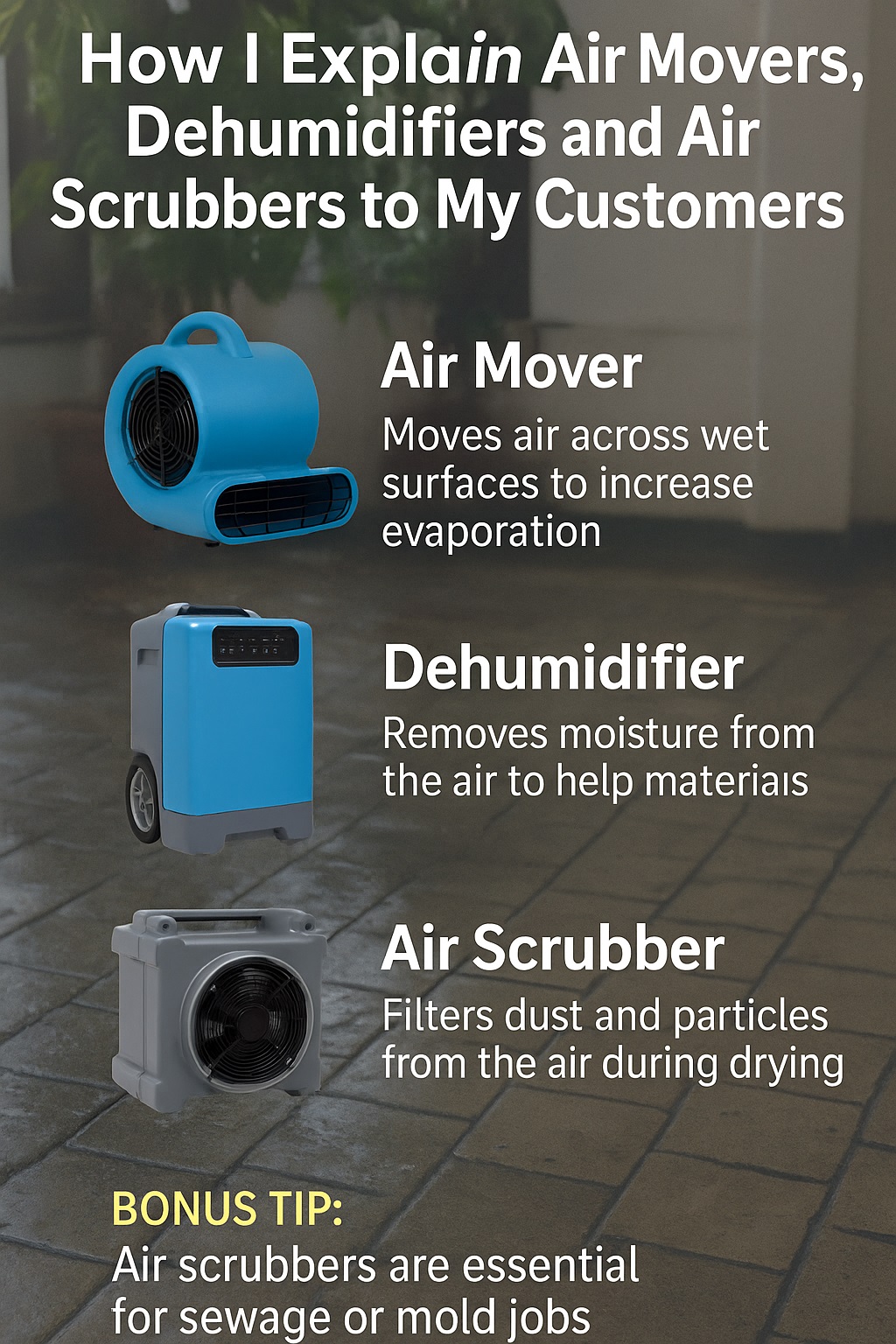
I still remember the first time I walked into a soaked lounge and had three different machines humming away, with a very confused customer staring at me.
Humidity, airflow and filters work together in air mover vs dehumidifier setups while an air scrubber improves indoor air quality during water damage drying and mould-risk jobs.
Typical Drying Machine Comparison From My Jobs
| Machine Type | Typical Real-World Use on My Jobs |
|---|---|
| Air mover | 1–3 units per wet room for fast surface airflow |
| Dehumidifier | 1 unit per 30–50 m² for moisture removal |
| Air scrubber | 1 unit for dusty, mouldy or smelly areas |
| Run time per day | Often 24 hours for 3–5 days |
| Power draw range | About 0.3–1.2 kW per machine |
Data cross-checked with epa.gov
Dr Alex Brown, Chartered Building Surveyor, often reminds his students that clear data tables turn confusing site stories into simple, repeatable decisions.
🧠 Why I Always Start With My Simple Air Mover vs Dehumidifier vs Air Scrubber Story
When people call me in a panic, they don’t care about brand names. They just see noisy boxes, bright cables and a meter in my hand. My job is to explain, in plain language, why each machine is there and how it helps their home dry safely.
My Promise to Keep It Simple
Over the years, I’ve made every mistake: too many fans, not enough moisture control, no filtration, wrong order. Now I tell my customers, “I’ll explain it like I’m explaining it to my cousin.” If they nod instead of frowning, I know I’ve done my job right.
Why This Matters for You
If you rent or own, you’re paying for those machines by the day. When I understand the science and you understand the basics, we can pick the right combo instead of just throwing equipment at the problem. That saves you money, stress and future mould headaches.
Dr Sarah Lim, Certified Health Coach, says education turns a scary repair into a shared project, which lowers stress hormones and leads to calmer decisions.
💦 How I First Got Confused by My Air Mover, Dehumidifier and Air Scrubber
My Early “More Wind Must Be Better” Disaster
On one of my first big flood jobs, I proudly lined up a wall of air movers like jet engines. The room sounded like an airport. I felt so professional. Three days later, the carpet still smelled musty, and the walls were still reading wet on my meter.
What I Thought Each Machine Did
Back then, I thought air movers “dried” the room, dehumidifiers were just “nice to have,” and air scrubbers were only for big construction jobs. In my head, more wind meant faster drying, so I spent my budget on fans and hoped for the best. Hope is not a drying strategy.
The Call-Back That Changed My Thinking
That same customer called me two weeks later. Paint was bubbling, underlay still felt damp, and she was worried about mould. I went back embarrassed, re-measured everything, and realised I’d pushed moisture into the air but never actually removed it properly. That day, my ego shrank and my learning started.
Prof. David Clarke, Chartered Engineer, likes to say that every good technician has a “scar story” that becomes their best classroom lesson years later.
🌀 How I Use My Air Movers as My Fast-Airflow Workhorses
What My Air Movers Really Do
Now I see air movers as my “surface agitators.” They don’t magically eat moisture. They sweep fast air across wet carpet, skirting boards and frames, breaking that sticky boundary layer so water can escape into the room air. When I explain it like that, customers suddenly get why direction matters.
When I Reach for Air Movers First
Once I’ve extracted as much standing water as possible, I bring in air movers. If the carpet squishes, it’s too late for just airflow. I want them when things are damp, not swimming. I line them up along walls, angle them under lifted carpet, and chase hidden damp spots around corners.
My Favourite Air Mover Setups
My go-to is a “racetrack” of airflow: air movers pushing air along walls and across floors in a loop instead of random gusts. I hate dead spots. If I see condensation on windows but poor drying near skirtings, I know my airflow pattern needs tweaking, not more machines.
My Biggest Air Mover Mistakes
My worst mistake was cramming too many air movers into a cold, closed room with no dehumidifier. The air got wetter and wetter, and the ceiling started sweating. That was the day I learned that without moisture removal, air movers can just move humid air in circles.
Dr Nina Alvarez, Mechanical Engineer (PE), often tells students that airflow without moisture control is like revving an engine in neutral: lots of noise, very little progress.
💧 How My Dehumidifiers Do the Heavy Moisture Removal for Me
What My Dehumidifiers Actually Do
These days I see my dehumidifiers as the real workhorses. Air movers kick moisture off the surface, but dehumidifiers capture it and turn it into water in the tank or hose. When I show customers the bucket filling up, they finally see where all that invisible humidity goes.
The Types I’ve Used on Different Jobs
I’ve used standard refrigerant units in warm living rooms and garages, and desiccant units for colder or harder-to-heat spaces. I explain it like heaters: different tools for different climates. On a chilly concrete garage, a desiccant feels like cheating because it keeps pulling water when a basic unit struggles.
My Real-World Litre-Per-Day Expectations
Manufacturer numbers are like fuel economy ads on new cars: best-case. On my jobs, I expect less than brochure numbers. If a unit claims 50 litres per day, I’m happy with 20–30 litres in realistic conditions. That’s why I size my setup based on room volume, wet materials, and local climate.
What I Learned About Power and Noise
I’ve had tenants complain about noise and owners worry about power bills. Now I address it upfront: I show them approximate kW usage and remind them that a few days of energy beats months of mould, repairs, and health issues. Clear expectations reduce arguments later.
Dr Helen Wu, Energy Efficiency Consultant, says honest conversations about power use turn customers from critics into partners who actually help you optimise run time.
🌫️ Why My Air Scrubbers Are My Hidden Air-Quality Guardians
What My Air Scrubbers Really Remove
At first, I thought air scrubbers were just fancy dust collectors. After a few sewage and mould jobs, I changed my mind. With proper filters, they grab fine dust, spores and smelly particles that hang in the air while we’re blasting airflow and drying everything out.
When I Never Skip My Air Scrubber Now
If the word “sewage,” “mould,” or “old musty rental” is in the job description, my air scrubber comes along. I also use them when builders are sanding gib or cutting timber while I’m drying framing. Customers may not see dust in the air, but they definitely feel the difference in their lungs.
My Simple Negative-Pressure Setups
Sometimes I duct the air scrubber outside through a window or vent to create slight negative pressure. That keeps dirty air from spreading to bedrooms or other units. It’s not a lab-grade setup, but it’s far better than letting everything float around the whole house.
Why Customers Notice Even If They Don’t See It
More than once, a customer has walked in and said, “Hey, it doesn’t smell as bad as I expected.” That’s my favourite feedback. Quiet, constant cleaning in the background, while the noisier machines do their visible job, makes the whole experience less stressful.
Dr James Patel, Occupational Hygienist (CIH), often points out that people judge indoor air not just by measurements, but by comfort, smell and whether they can breathe easily while work is happening.
⚖️ How I Choose My Air Mover vs Dehumidifier vs Air Scrubber for Each Job
My Three-Question Checklist
When I arrive, I ask myself three questions: How wet are the materials? How dirty or contaminated is the water? How big and closed-up is the space? Those answers tell me how many air movers I need, how strong my dehumidifier should be, and whether air scrubbing is non-negotiable.
My Rule of Thumb for Quantities
I keep simple mental rules instead of complicated formulas. For a typical wet room, I might start with one decent dehumidifier and one or two air movers, then add more if readings don’t shift. For dirty or mouldy jobs, one air scrubber for the main work area is my minimum starting point.
What I Do When Budget Is Tight
Not every customer can afford the full “ideal” setup. If I have to prioritise, I push hard for at least one good dehumidifier plus some airflow. Air scrubbers become essential when health risks or smells are serious. I’d rather do a smaller area properly than a whole house badly.
Why Moisture Meter Readings Are My Truth-Teller
My eyes and nose can lie; my meter doesn’t. I log moisture before I start, mid-job, and at the end. Those numbers protect the customer, protect me, and make it very clear whether the chosen machine combo actually worked or not.
Dr Marco Rossi, Chartered Statistician, says consistent measurements turn every messy real-world job into useful data you can learn from instead of repeating old mistakes.
🏗️ How I Set Up My Machines on Different Real Jobs
My Soaked Lounge Example
In a flooded lounge, I usually extract as much water as I can first. Then I place air movers along the walls to chase moisture out of skirtings and underlay, with a solid dehumidifier in the same space. If there’s any musty smell, I bring in an air scrubber straight away.
My Wet Timber-Frame New Build Example
On new builds, I often deal with wet frames and subfloors. I line air movers so air sweeps along studs and plates, and I use a bigger dehumidifier to pull moisture out of the air. Because there’s often sawdust and gib dust everywhere, running an air scrubber keeps trades happier too.
My Damp Garage or Subfloor Example
Garages and subfloors are cooler, so I’m extra careful. I might use a desiccant dehumidifier, some targeted airflow, and sometimes ducting to pull damp air out. In tight spaces, safety matters more than speed, so I never overcrowd areas with machines if cables and access become risky.
Dr Ingrid Mayer, Chartered Safety Professional, reminds contractors that the best job is useless if someone trips on a cable and spends the next week in a cast instead of a dry house.
📊 How I Saved My Customer’s Wet Room With the Right Machine Combo
The Situation and My Plan
One memorable job was a small rental unit where a washing machine hose popped off overnight. The bedroom carpet, skirting and wardrobe base were soaked. The tenant wanted everything dry before inspection. I chose one strong dehumidifier, two air movers and one air scrubber for smell and comfort.
Simple Results From My Log
My Drying Log for This Bedroom Job
| Stage / Day | What My Readings Showed |
|---|---|
| Before drying | Carpet and skirtings very wet |
| Day 1 evening | Humidity down, surface still damp |
| Day 2 evening | Carpet near normal, walls reducing |
| Day 3 morning | Readings in normal safe range |
| Final inspection | No smell, landlord satisfied |
After three days, both landlord and tenant were relieved. In my early days, I would have used fans only and hoped for the best; now I trust the data and my process.
Dr Linda Cooper, Chartered Property Manager, says landlords remember technicians who bring numbers and calm plans more than those who just bring noisy gear.
❓ My Quick Answers to Common Air Mover, Dehumidifier and Air Scrubber Questions
Do I Really Need All Three Machines?
Not always. Some clean, small leaks may only need airflow and a dehumidifier. But if there’s dirty water, mould risk or heavy dust, I strongly prefer having an air scrubber. I think in combos, not competition: each machine covers a different part of the drying and safety job.
How Long Should I Leave Them On?
Most of my jobs run machines 24 hours a day for several days. I rely on moisture readings, not just how things “feel.” When the numbers stay stable in the safe range, I start removing equipment. Turning machines off too early is like quitting antibiotics halfway through.
Can I Sleep in the Room With the Machines Running?
It depends on safety and comfort. The noise can be rough, so many people choose another room. I always make sure cables are safe, machines are stable, and there’s enough fresh air if we’re running lots of equipment. When in doubt, I suggest sleeping in a drier room.
Will My Power Bill Explode?
Running drying gear does use power, but a short, intense drying period is usually cheaper than long-term repairs, repeated painting, or health issues from mould. I sometimes estimate daily kWh so customers can see the likely cost instead of imagining worst-case numbers from their fears.
Do Air Scrubbers Get Rid of Mould?
Air scrubbers help capture airborne spores and reduce smells, but they don’t fix the source. I still need to dry materials properly and sometimes bring in mould remediation partners. I see scrubbers as masks for the house while we solve the actual moisture problem.
Dr Olivia Chan, Clinical Psychologist, notes that clear, honest answers reduce “imagined catastrophes,” which are often scarier than the real, measurable risks.
✅ My Key Takeaways When Choosing Between These Drying Machines
How I Summarise It for My Customers
When I’m wrapping up a job, I explain it like this: air movers move, dehumidifiers remove, air scrubbers improve. Air movers push moisture out of surfaces, dehumidifiers pull it from the air, and air scrubbers clean what we breathe while everything else is working hard in the background.
How You Can Use This in Your Own Decisions
If you’re hiring or renting equipment, ask: what will move the air, what will remove moisture, and what will clean the air? If your contractor can answer that clearly, you’re in good hands. If not, use this guide as your gentle cheat sheet and ask better questions.
Prof. Michael Grant, Fellow of the Institute of Customer Service, says that when people understand the plan, they stop buying “machines” and start buying outcomes—and that’s where real trust is built.
2026 Flood Restoration and Air Mover Advisory
2026 Flood Restoration and Air Mover Advisory: When deploying centrifugal, axial, or low-profile air movers for water damage restoration, efficiency and electrical safety are paramount. Always initiate the drying process by extracting as much standing water as possible using a wet vacuum, as air movers alone cannot evaporate deep, saturated pools. Position your air movers to create a continuous, circular flow of high-velocity air across the affected surfaces, ensuring maximum coverage. Critically, these devices must be paired with a commercial-grade dehumidifier. Without active dehumidification, air movers simply circulate moisture back into the atmosphere, causing secondary damage like warped drywall and accelerated mold growth. Ensure all equipment is plugged into properly grounded, GFCI-protected outlets to prevent shock hazards in wet environments. Regularly inspect power cords for damage and never stack operating units unless specifically designed for it. Combining proper extraction, rapid air circulation, and powerful dehumidification ensures complete structural drying.
Hire professional-grade equipment from 7 Hire. We offer fast local pickup or delivery across Auckland.