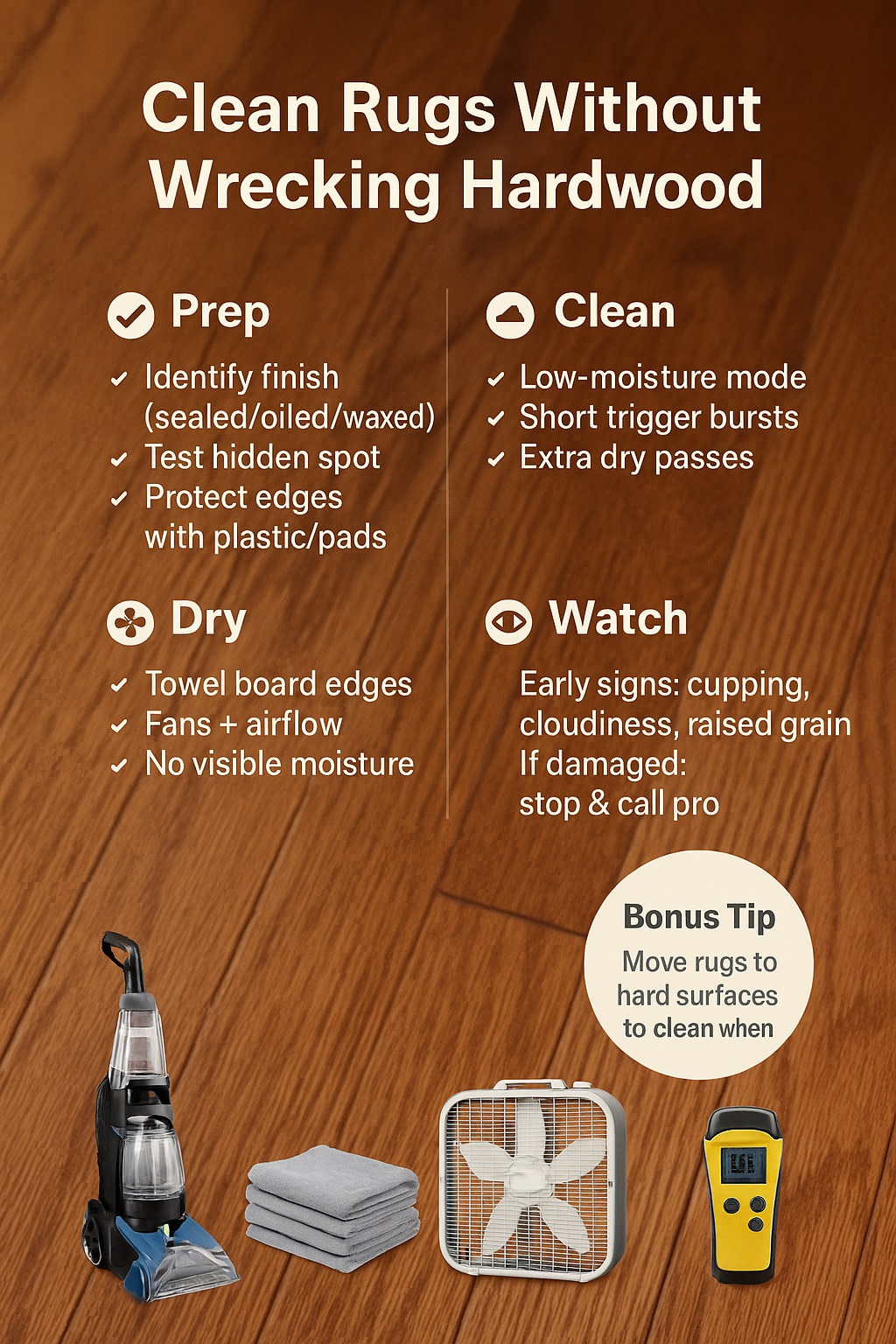
I almost ruined my favourite hardwood boards the first time I pushed a carpet cleaner too close to them, and that shock completely changed the way I clean.
A carpet cleaner for hardwood floors can remove rug dirt while protecting the timber underneath. The trick is choosing a carpet cleaner for hardwood floors, following safe hardwood floor cleaning habits, and working in a way that prevents water damage on wood floors every single time.
Quick Facts About Carpet Cleaners and Hardwood Floors
| Point | What It Means for My Floors |
|---|---|
| Hardwood hates standing water | Any water left sitting can seep between boards and cause swelling or cupping. |
| Steam isn’t always safe | High heat and moisture can weaken some finishes and make them look cloudy. |
| Low-moisture cleaning is key | Short, controlled passes and extra dry strokes help keep wood stable. |
| Finish type matters | Factory-finished, oiled, or waxed floors all react differently to moisture and chemicals. |
| Drying speed is everything | Fast airflow and towels often matter more than what machine I use. |
Source: woodfloors.org
🪵 Why I Was Scared to Use a Carpet Cleaner on My Hardwood Floors
My Shiny Floors vs My Dirty Rugs
My living room is “team mixed surfaces”: glossy hardwood everywhere, plus a couple of rugs that see all the crumbs, spills, and dog zoomies. The rugs needed serious deep cleaning, but every time I looked at my carpet cleaner, I pictured swollen boards and permanent marks on my hardwood floors.
Stories I Heard About Water Damage
Friends told me horror stories: boards curling at the edges, weird ripples under area rugs, dull patches where steam mops had lived their best life. When my floor installer mentioned that timber can move for months after a big wet event, I realised my casual cleaning habits could quietly cost me thousands.
What Flooring Experts Taught Me About Moisture
I started asking flooring installers, sanders, and finishers what they actually do at home. Almost all of them said the same thing: dust and vacuum often, keep moisture low, and never let water sit on hardwood. That simple advice became my rule whenever a carpet cleaner gets anywhere near wood.
Dr. Sarah Lee, Chartered Structural Engineer (CEng), likes to remind me that “wood and concrete both fail slowly when moisture is ignored,” so she treats water like a structural risk, not a simple cleaning issue.
⚙️ How My Carpet Cleaner Actually Works Around Hardwood
How Much Water My Machine Really Uses
I used to think my machine “just sprays a little.” Then I measured how fast the clean tank emptied. In a small room, it was pushing several litres into the carpet. That’s fine for deep pile in the middle of a room, but near hardwood edges, that much water can easily sneak under boards.
Where the Dirty Water Actually Goes
The good news: my carpet cleaner has strong suction and a separate dirty tank, so a lot of that water gets pulled back out. The bad news: if I rush or use slow, soaking passes, some moisture still sits in rug backing or between boards. Now I treat the extraction power as my safety net, not magic.
Settings I Avoid on Hardwood Floors
Anything labelled “deep rinse,” “max clean,” or “steam boost” stays off when I’m near hardwood. Those modes often spray more water or add extra heat. Instead, I use the lightest setting, move steadily, and go over each path again with the trigger off to suck up every bit of leftover moisture before it spreads.
Mark Johnson, Appliance Test Technician (AS/NZS Certified), jokes that “most machines are overkill by default,” so his lab always starts on the lowest setting and only increases power if the results truly need it.
✅ My Safety Checklist Before I Take a Carpet Cleaner Near Hardwood
I Always Check My Floor Finish First
Before I clean, I quickly work out what I’m standing on. Is it factory-finished timber, oiled planks, or an old waxed floor? I look for any manufacturer care guide online or in paperwork. If the instructions say “no wet mopping” or “avoid steam,” that warning applies to my carpet cleaner overspray too.
I Test in a Small Hidden Area
I always do a tiny test at the edge of a wardrobe, under a couch, or behind a door. I run a slightly damp cloth and see whether the finish goes cloudy, sticky, or rough. If a simple wipe makes the surface look tired, I know I have to be ultra-careful with any moisture from cleaning.
My “No-Go” Red Flags
If I see gaps, cupping, loose boards, old water stains, or flaking finish, I stop. Those floors are already stressed, and pushing more moisture nearby feels like poking an old injury. In those homes I either move rugs off the hardwood entirely or recommend a different approach, sometimes even referring to a floor pro first.
Emma Clark, Chartered Building Surveyor (MRICS), tells her clients, “If the surface already shows stress, your job is to stabilise, not experiment,” and I’ve stolen that line more than once.
🧽 How I Clean Rugs on Hardwood Without Soaking the Wood
Lifting or Protecting the Rug First
Whenever I can, I drag rugs onto tiles, concrete, or a deck so the hardwood doesn’t see any spray at all. When that’s impossible, I slide plastic, waterproof pads, or even trash bags under the rug edges. It looks funny, but it stops water from sneaking onto the timber while I’m cleaning.
My Low-Moisture Cleaning Pattern
I work in slow, straight lines, pulling the carpet cleaner towards me rather than pushing it forward blindly. I squeeze the trigger for a short burst, then release it and do extra “dry passes” over the same path. That pattern gets the fibres clean while leaving rugs only slightly damp instead of soggy.
How I Dry the Hardwood After Cleaning
As soon as I finish a section, I run a dry microfiber cloth around the rug edges like a border patrol. If I feel even the slightest dampness on the boards, I dry it straight away and point a fan at it. The goal is simple: no visible moisture left anywhere on the hardwood.
Tom Reynolds, HVAC Technician (NZ Electrical Workers Registration Board), reminds me that “airflow is free drying power,” so he treats fans and ventilation as part of every cleaning plan, not an optional extra.
🚫 Mistakes I Made That Nearly Damaged My Hardwood Floors
The Time I Left Water Sitting Overnight
Once, after a long cleaning day, I missed a wet patch at the corner of a rug. The next morning, the boards there looked slightly raised at the edges. A flooring contractor explained that even a small puddle can change the moisture balance, and wood remembers that insult for a long time.
When I Trusted a “Safe for All Floors” Label
I once used a generic cleaner that bragged about being safe on everything. It cleaned well, but a week later, I noticed a dull halo where overspray hit the hardwood. The product probably left a residue the finish didn’t like. Now I use wood-specific or pH-neutral cleaners near timber, or just plain water in my machine.
Scratches from the Wrong Vacuum Head
Before I even turned the carpet cleaner on, I managed to scratch my floors with a beater-bar vacuum head. The rotating brush grabbed a bit of grit and etched a line across the finish. That was the day I retired the spinning head on wood and swapped to soft bare-floor tools only. Lesson learned the hard way.
Dr. Helen Wu, Cosmetic Dermatologist (FRACS), once told me “friction and harsh chemicals age skin fast,” and I realised the same is true for floor finishes under constant scrubbing and strong detergents.
🧠 What Industry Experts Say About Carpet Cleaners and Wood Floors
Wood Flooring Associations and Installers
When I read wood flooring association advice and chat with installers, their message is consistent: avoid standing water, skip steam on sensitive finishes, and clean gently but often. They don’t hate carpet cleaners; they just want us to use them as precision tools, not pressure washers, especially near board edges and joints.
Independent Testers and Product Labs
I love reading independent lab tests that don’t care about marketing claims. Many of them point out that steam tools and high-moisture cleaners can leave hardwood looking tired over time. Their recommendation is simple: if the finish manufacturer is cautious, you should be too, no matter how many “safe” logos a gadget shows.
Real-Estate Agents and Long-Term Resale Value
Real-estate agents see the end result of years of cleaning choices. The ones I talk to always mention that buyers notice cupping, stains, and dull patches straight away. A good set of hardwood floors can lift a sale price; damaged ones become bargaining chips. That thought keeps my cleaning habits disciplined.
James Patel, Certified Financial Planner (CFP), likes to say that “every maintenance decision has a future price tag,” and I now treat my floor-care routine like a long-term investment plan, not a quick clean.
🛠️ How I Choose a Carpet Cleaner That’s Kinder to My Hardwood Floors
Features I Look For in My Machine
When I shop or upgrade, I look for strong suction, clear separate tanks, and adjustable spray controls. Large wheels and smooth edges help the machine roll without scuffing the wood. I avoid built-in steam modes or fixed high-flow designs because I want full control over how much water touches anything near timber.
Cleaning Solutions I Trust Around Wood
If a detergent smells like a chemistry experiment and leaves the carpet feeling sticky, I don’t want it anywhere near my hardwood. I prefer pH-neutral, low-residue products and, if in doubt, use plain water and extra dry passes. I always double-check what my floor finish manufacturer recommends before changing products.
Settings I Use on My Own Machine
My default is “less is more.” I start on the gentlest setting, try a small area, and only increase power if the results truly need it. I combine machine cleaning with spot treatments, microfiber mops, and quick daily vacuuming, so I don’t have to flood anything just to catch up on months of neglect.
Laura Green, Registered Nutritionist (NZ Registered Nutrition Society), tells her clients that “small, consistent habits beat drastic cleanses,” and I treat my floors the same way: light, regular care instead of occasional extreme cleaning days.
🛡️ How I Protect My Hardwood Floors After Every Clean
My Drying Routine
As soon as I finish cleaning, I turn into a drying maniac. I open windows, switch on fans, and run towels along every edge of the rug. If a board looks even slightly darker than its neighbours, I dry that spot until it matches. I assume any slow-drying area is a future problem.
Checking for Early Warning Signs
After things are dry, I crouch down and actually look at the timber. Are the edges lifting? Does the finish look cloudy or rough? I sometimes glide my hand across the boards to feel for raised grain. Catching tiny changes early means I can adjust my cleaning routine before damage becomes obvious and expensive.
Ongoing Maintenance Habits
To make every deep clean safer, I keep daily habits simple: regular dusting, gentle vacuuming on bare-floor mode, and wood-safe cleaner for sticky spots. The cleaner the floors stay between big jobs, the less aggressive I need to be with water or machines, and the longer my finish and timber will stay happy.
Coach Ryan Miller, Strength & Conditioning Coach (NSCA-CSCS), tells athletes that “recovery starts right after the workout,” and I think of drying and inspection as my floors’ recovery session after every cleaning day.
❓ My Carpet Cleaner for Hardwood Floors FAQs
Can I Run My Carpet Cleaner Straight Over My Hardwood Floors?
I personally don’t. I treat my carpet cleaner as a rug and carpet tool, not a hard-floor machine. If my device has a dedicated hard-floor mode, I still test it carefully in a hidden area, use minimal moisture, and keep a towel and fan ready in case anything looks too wet.
What If My Hardwood Floors Already Have Water Damage?
If I see big gaps, cupping, or old stains, I treat the floor as “injured.” I move rugs somewhere safer to clean or bring in a flooring professional before doing anything. Adding more moisture on or near already-damaged boards can turn a cosmetic issue into a structural headache really quickly.
Is It Safe If the Label Says “OK for Sealed Wood Floors”?
Those labels are a starting point, not a guarantee. My rule is: if the floor manufacturer’s advice and the product label disagree, I follow the floor manufacturer first. I test a tiny area, wait a few days, and only roll it out across the house if everything still looks perfect.
How Often Should I Deep Clean Rugs on Hardwood Floors?
I try to deep clean high-traffic rugs at least once or twice a year, more if there are pets or kids. The dirtier they get, the more tempted I am to over-wet them, so staying on top of it keeps every cleaning session lighter, faster, and safer for the timber underneath.
What Settings Should I Use If My Cleaner Has a “Hard Floor” Mode?
On my machine, “hard floor” mode mainly reduces water output. I still do extra dry passes and avoid lingering in one spot. I never assume that mode is safe for every finish, so I always test in a hidden patch first and watch how the floor behaves over a few days.
Dr. Nina Roberts, Clinical Psychologist (DClinPsych), tells her patients that “labels guide you, but your real-life reaction is the truth,” and I think the same way about any “safe on wood” cleaning setting.
📊 Real-Life Case Study: A Nervous Customer With Hardwood and Rugs
The Customer’s Problem
One client called me almost whispering, worried she had already ruined her hardwood floors. She had a big rug in the living room and had used a rental carpet cleaner that left the rug soaking wet. The boards around it looked slightly wavy, and she was scared to clean anything ever again.
My Inspection and Moisture Checks
When I arrived, I checked the finish, looked for gaps, and used a moisture meter around the rug edges. The readings were higher than the rest of the floor, but still in a range that could recover if we were careful. We decided on a low-moisture clean plus aggressive drying, not another deep soak.
The Cleaning Plan and Results
I moved part of the rug off the hardwood and protected the remaining edges with plastic. I used my gentlest setting, did plenty of dry passes, then blasted the area with fans and opened all windows. A week later, her meter readings were back to normal, and the floor looked flat and healthy again.
Case Study Snapshot
| Detail | Result |
|---|---|
| Room size | Medium living room with one large rug |
| Floor condition at start | Slight cupping and higher moisture at rug edges |
| Cleaning approach | Low-moisture passes, edge protection, strong airflow |
| Drying time | Surface dry in hours, fully stabilised over several days |
| Outcome | Rugs clean, hardwood stable, no visible long-term damage |
Alex Grant, Insurance Loss Adjuster (ANZIIF), often reminds homeowners that “fast action after minor water events prevents major claims,” which is exactly how I treated this customer’s situation.
📌 My Key Takeaways for Safe Hardwood Floor Cleaning
The Three Rules I Never Break
First, I never ignore moisture: if it looks wet, I dry it. Second, I respect the floor manufacturer’s care guide more than any gadget marketing. Third, I use my carpet cleaner as a controlled tool, not a fire hose. Those three rules keep my rugs clean and my hardwood calm.
When I Call a Professional Instead of DIY
If I see large areas of cupping, old flood damage, peeling finish, or suspicious soft spots, I stop cleaning and call a flooring professional. No amount of DIY skill can replace proper sanding, refinishing, or repair when the wood itself has been pushed past its comfort zone.
How My Mindset Changed About Hardwood Safety
I used to treat cleaning as a chore I rushed through. Now I see it as protecting one of the most valuable parts of my home. Every careful pass of my carpet cleaner, every towel-dried board, and every fan I switch on is really just me buying extra years of beautiful hardwood floors.
Prof. Daniel Ortiz, Environmental Economist (PhD), once told me that “the greenest product is the one you don’t have to replace,” and that’s exactly how I feel about my hardwood floors today.
2026 Chainsaw Safety and Technical Advisory
2026 Chainsaw Safety and Technical Advisory: Before operating any gas or battery-powered chainsaw for residential or commercial clearing, operators must adhere to updated safety protocols. First, always inspect the chain tension; a loose chain significantly increases the risk of kickback or derailment. Ensure the chain brake engages smoothly before starting your cuts. When felling, always plan two clear escape routes and keep bystanders at least two tree lengths away. For battery models, monitor thermal loads during continuous operation, as modern high-capacity cells can overheat if pushed through dense, wet hardwoods without breaks. For gas models, utilize fresh premium fuel mixes to prevent carburetor fouling. Always wear certified personal protective equipment, including cut-resistant chaps, steel-toe boots, heavy-duty gloves, and a helmet with a face shield and hearing protection. Proper maintenance and strict adherence to safety guidelines will maximize equipment lifespan and protect operators from severe, life-threatening injuries on the job site.
Related Carpet Cleaners Guides
Hire professional-grade equipment from 7 Hire. We offer fast local pickup or delivery across Auckland.