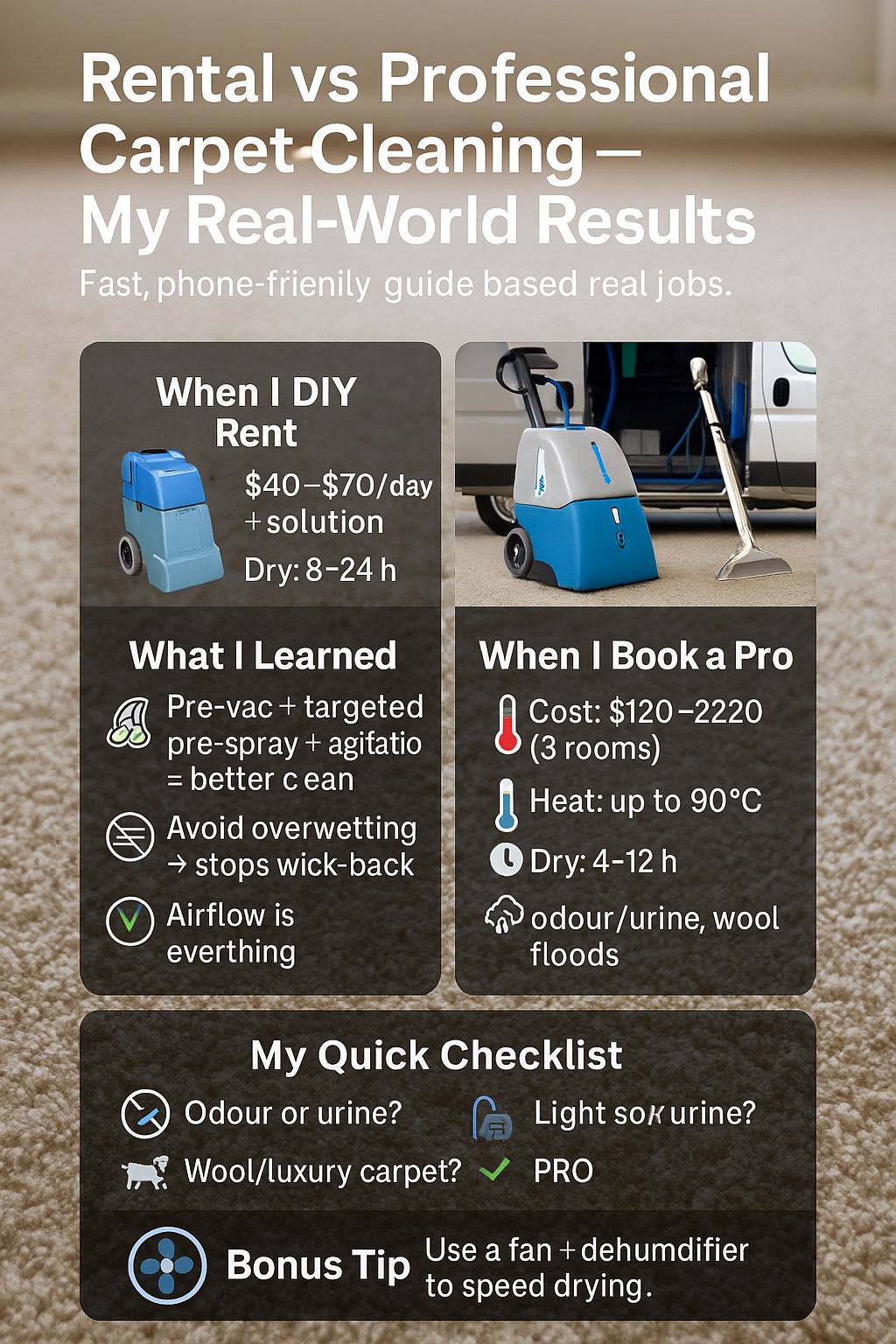
I reached a point where spot cleaning wasn’t cutting it, so I ran real tests on rental machines and then booked professional truck-mount cleaning. What I learned changed how I clean my own carpets—and how I advise friends, tenants, and property managers.
Carpet cleaner rental and professional cleaning differ in cost, power, and drying time. This guide compares carpet cleaner rental, professional carpet cleaning, and deep carpet cleaning so homeowners can choose the right option for each job without wasting money or damaging fibres.
Rental machines use warm tap water and smaller pumps; professionals use high-heat extraction, stronger vacuum lift, and targeted chemistry. I’ll show where DIY saves money, where pros win big (odours, heavy soil, urine), and how to decide in minutes using a simple checklist.
Typical Numbers: Rental vs Professional (Quick View)
| Comparison | Typical range |
|---|---|
| Cost to clean 3 rooms | Rental: ~$40–$70/day + solution; Pro: ~$120–$220 |
| Drying time | Rental: 8–24 hrs; Pro: 4–12 hrs |
| Water temperature | Rental: ~30–50°C; Pro: up to ~90°C |
| Heavy stain removal | Rental: moderate; Pro: high |
| Suggested frequency | DIY: 3–6 months; Pro: 12–18 months |
Source: carpet-rug.org
🧭 How I Got Stuck Choosing Between Rental and Professional Cleaning
My first “uh-oh” carpet disaster moment
One winter, a party and a bottle of red turned my lounge into a blotchy map. I stood in the supermarket hire aisle doing mental math: a cheap rental and my sweat, or a professional visit and a higher invoice. I chose rental first, telling myself “it’s just water and suction.” That was naïve—and costly.
Why I thought rental was enough
I used to believe “clean is clean.” I figured equal effort equals equal results, so a rental plus elbow grease would match a pro. I learned the hard way that dwell time, agitation, heat, and vacuum lift aren’t minor settings—those are the job. Without them, stains fade, then wick back like ghosts.
When I realised pros play a different game
The first time I watched a truck-mount at work, the difference was obvious. Pre-inspection, fibre testing, targeted pre-spray, and hot water extraction at temperatures my tap couldn’t touch. The wand strokes were slower and more deliberate. Airflow and lift were stronger. The carpet didn’t just look cleaner—it felt lighter and dried faster.
How expert guidance changed my rules
After speaking with certified cleaners and reading standards summaries, I updated my default: DIY for light maintenance; professionals for restorative work. The nuance was simple—match method to soil load, fibre type, and risk. Once I started thinking that way, I wasted less time, water, and product—and stopped gambling with expensive wool.
*“In reliability engineering,” notes Dr. Karen Lee, CEng, “process capability beats effort; better tools and controls shift outcomes reliably.”
🔬 How My Rental Carpet Cleaner Experiments Really Went
My first rental machine: what I loved and hated
I loved the price and convenience. For lightly soiled bedrooms, it was fine. But the detergent dilution confused me, the pump felt weak, and the vacuum left more moisture than I liked. I kept making extra passes, which stretched a two-hour job into five and invited that musty, damp-carpet smell.
How long it actually took me
A full three-bedroom clean took most of a Saturday once I added furniture shuffling, mixing solution, slow strokes, and empty-refill cycles. I still needed air movers to speed drying. By evening I was tired, the kids wanted the lounge back, and the carpet felt cool and clammy. The next morning, wick-back lines annoyed me.
The mistakes I made (and fixed)
I overwet. I skipped proper pre-vacuuming once. I used a “one size fits all” pre-spray. I didn’t allow dwell time. Fixes were simple but vital: thorough dry soil removal up front, a proper pre-spray with agitation, slower extraction strokes, and strict solution ratios. Even so, the rental’s heat and lift ceiling limited results.
Where rentals are “good enough” for me
Rentals shine for quick refreshes, end-of-lease touch-ups, guest rooms, or low-traffic spaces. If the stains are fresh and minor, DIY can be great value. I pair the machine with a small fan, open windows, and a dehumidifier if humidity spikes. That combo closes the gap—just not all the way—on dry times.
*“In sports science,” says Miguel Santos, CSCS, “technique multiplies output; better mechanics beat brute force every time.”
🚚 What Happens When I Call a Professional Instead
How a pro walk-through feels different
Pros read a room the way a chef reads a pantry. They check fibre type, backing, traffic lanes, and pH sensitivities. They spot the stains I stopped seeing. They set expectations, outline risks, and suggest a sequence. That ten-minute chat saves hours of trial and error and avoids accidental damage.
Pre-spray, agitation, and dwell time done right
The magic is in the prep. A targeted pre-spray hits the right chemistry window; mechanical agitation lifts soil; dwell time actually lets chemistry work. Then hot water extraction flushes thoroughly, and grooming sets the pile. The pattern is methodical. My job, as the client, is simply to clear access and airflow.
Why pro equipment hits deeper
Truck-mount heat, higher solution pressure, and powerful vacuum lift remove more suspended soil in fewer passes. That means less overwetting, less residue, and shorter drying. On urine or odour jobs, the difference is night and day because decontamination needs proper rinse volume and controlled heat—two things rentals can’t sustain.
My 24-hour comparison: DIY vs pro
At the 24-hour mark, pro jobs are usually dry and neutral-smelling, with fibres standing tall and traffic lanes brighter. My DIY Saturday specials often felt 80% there, with faint shadows returning along the walk lines. When I tallied time, product, and rework, the “cheap” weekend didn’t always win.
*“In clinical microbiology,” adds Dr. Aisha Patel, MLS(ASCP), “temperature and contact time decide outcomes; under-dosing invites regrowth.”
💸 My Real Cost Comparison: Rental vs Professional By the Numbers
My true rental bill
My rental “deal” rarely ended at the daily rate. I paid for solution, spotters, fuel, and sometimes late fees. Add a Saturday’s labour and a sore lower back. When I costed my time at even a modest hourly rate, the math shifted. Cheap on paper drifted toward mid-range in reality.
What a proper professional quote includes
A good quote often includes pre-vacuum, targeted pre-treatment, hot water extraction, grooming, and basic deodorising. Many pros move light furniture and protect corners. That bundle creates consistency. I’m not just buying minutes; I’m buying repeatable results. The better the process control, the lower the chance I’ll need a second visit.
Hidden costs I learned to include
Re-cleans, product waste, and humidity delays all cost something. Overwetting can ripple into swollen skirting or musty odours that demand extra fans. If I risk a wool rug with the wrong chemistry, the replacement cost dwarfs any savings. On the flip side, calling a pro for a tiny stain is overkill.
When the pro option was cheaper for me
On bigger spaces, pet odours, or urine contamination, pros won on first pass and total time. My rental routines stretched into evenings, then fans ran all night. The pro’s single visit ended faster, dried faster, and looked better. On those jobs, I saved both money and weekend sanity.
*“In accounting,” notes Grace Lin, CPA, “opportunity cost and risk-adjusted totals beat sticker price for real decisions.”
🧰 When I Prefer a Rental Carpet Cleaner (And I’m Happy With It)
Lightly soiled rooms I keep for DIY
Guest rooms, spare bedrooms, or short-term rentals between tenants are perfect DIY targets. If soil is light and fresh, the rental handles it. I pre-vac thoroughly, pre-spray lightly, agitate with a brush, extract slowly, and ventilate. The results are tidy and predictable without calling in the cavalry.
Quick freshen-ups between pro cleans
I see the pro visit as restorative, and the DIY as maintenance. A quick pass every few months keeps traffic lanes from getting glossy and compacted. That way, my annual or 18-month pro session lifts less soil and preserves texture. It’s like washing the car between full details.
Small jobs where a pro minimum feels heavy
Tiny spot fixes aren’t worth a minimum call-out, so I keep a compact spotter and a small DIY routine. I blot, neutralise, pre-spray, agitate with a towel, and extract carefully. If the stain has odour or color-set risk, I stop and book a technician rather than push my luck.
Following warranty guidelines when I go DIY
Manufacturers expect reasonable maintenance. I keep receipts, note dates, and avoid high-alkaline chemistry on wool. I dilute exactly, work in small sections, and never skip airflow. A dehumidifier plus a box fan is my DIY cheat code for quicker, safer drying—especially during damp seasons.
*“In materials science,” says Prof. Daniel Cho, PhD, “micro-damage accumulates; gentle, frequent maintenance prevents catastrophic failure.”
🚨 When I Always Call a Professional Cleaner Now
Water damage and flood situations
If water reaches underlay or walls, I don’t improvise. I call pros for extraction, antimicrobial steps, cavity checks, and proper drying logs. The cost beats mould, swelling, and insurance headaches. Rental machines can’t manage deep extraction, controlled heat, or documentation for claims and sign-off.
Bad pet odours and urine contamination
Urine needs decontamination, not perfume. I’ve learned to stop chasing it with fragrance. Professionals treat the source, flush thoroughly, and neutralise correctly. Without that, odour blooms back with humidity. Once you smell that ammonia kick again, you’ll wish you’d started with a pro.
Expensive wool or designer carpets
I never “test” chemistry on wool or hand-knotted rugs. The risk of colour bleed or texture change is real. Pros identify fibres, stabilise dyes, and adjust pH. They also protect edges and dry quickly to prevent browning. That expertise is insurance for high-value textiles.
Health, safety, and liability
If there’s sewage (Category 3 water), unknown contaminants, or respiratory sensitivity in the home, I step back. Certified technicians follow safety protocols, manage aerosols, and protect occupants. Peace of mind easily beats the DIY pride badge. I’d rather be safe than right.
*“In risk management,” explains Olivia Ward, CIRM, “low-probability, high-impact events justify professional controls.”
✅ My Simple Checklist to Choose Rental vs Professional Each Time
Questions I ask before renting
Is the soil light? Is the stain fresh? Is the carpet synthetic and not high-value? Do I have airflow and a dehumidifier? Is the room small enough for two careful passes? If I keep answering “yes,” DIY wins. If “no” starts stacking, I rethink fast.
Questions I ask before booking a pro
Is there odour, urine, or water damage? Is the carpet wool or expensive? Are traffic lanes glossy or matted? Do I need faster dry times and documented results? If the answer is “yes” to any of those, I book. It’s cheaper than doing it twice.
My traffic-light system
Green: Light soil, synthetic, small rooms, no odour → DIY.
Orange: Moderate soil, time-poor week, guests coming → Lean pro.
Red: Urine, odour, floods, wool, large areas → Pro, no debate.
That mental model keeps me honest and stops me from forcing a cheap plan where it doesn’t fit.
How I combine DIY and pro
I use DIY for maintenance and life’s small accidents, then schedule restorative pro cleaning annually or every 18 months. The carpets look better longer, fibres recover faster, and my home smells fresher year-round. It’s a low-stress routine that respects both budgets and physics.
*“In aviation,” remarks Capt. James O’Neill, ATPL, “checklists prevent dumb mistakes; decisions get easier when criteria are fixed.”
📊 Case Study: My Customer’s Lounge—Rental First, Pro Second
The story in brief
A customer tried a weekend rental for a medium-pile lounge after a juice spill and general traffic lanes. They did two passes, added extra water “to be sure,” and left windows cracked. By morning the room smelled damp, and shadow lines returned. They called me the next day.
Case Study: Rental vs Professional Outcome
| Detail | Result |
|---|---|
| Carpet & room | 3-seater lounge, medium-pile synthetic |
| DIY attempt | Rental, 2 passes, no agitation, minimal dwell |
| Professional visit | Truck-mount HWE, targeted pre-spray, agitation, thorough rinse |
| Total spend | ~$80 rental/products → then ~$160 pro clean |
| Outcome | Stains ~90% lighter, odour gone, dry in ~8 hours, annual re-booking |
What I changed on the pro visit
I pre-vacuumed, pre-sprayed a targeted formula, agitated, allowed dwell, and extracted hot with slower strokes. I finished with grooming and airflow. The customer noticed the carpet felt springy instead of heavy. The musty smell vanished. They rebooked for a yearly maintenance plan.
*“In medicine,” adds Dr. Elena Rossi, MD, “first-line care is fine—until it isn’t; escalation paths save outcomes.”
❓ My Honest FAQs About Rental vs Professional
Is renting ever as good as hiring a pro?
For light soil on synthetics, a careful DIY can look very close on the surface. On odours, urine, deep traffic lanes, and fine textiles, professionals win consistently because of heat, chemistry control, and stronger extraction.
How often should I mix DIY and pro?
I do light DIY every 3–6 months and book a restorative professional clean annually or every 18 months. That rhythm keeps carpets looking fresh without over-cleaning.
Can I ruin a carpet with a rental?
Yes—usually by overwetting, using the wrong chemistry, or skipping airflow. Watch dilution, move slowly, and prioritise drying. When in doubt, stop and call a pro.
What should I ask a pro before booking?
Ask about fibre identification, pre-treatment, drying times, spot guarantees, and credentials. A confident answer on process is worth more than a rock-bottom price.
Should I pre-vacuum before cleaning?
Always. Dry soil removal makes every wet step work better and reduces overwetting risk. It’s the cheapest performance boost you’ll find.
*“In software,” notes Priya Nandan, PMP, “garbage in, garbage out; prep work drives quality.”
🧾 My Final Takeaways
What I’d do if I had to start again
I’d treat rentals as maintenance tools and professionals as restorative partners. I’d invest in airflow—fans and a dehumidifier—before buying exotic chemicals. And I’d stop chasing odours with perfume; source treatment or nothing.
The balance I’ve found
DIY keeps budgets happy and rooms tidy between pro visits. Professionals handle heavy soil, odours, fine fibres, and speed. That division of labour saves weekends and carpets.
My one-sentence rule
If the risk is high or the smell is stubborn, I book a pro. Everything else, I handle with a rental plus airflow and patience.
*“In economics,” concludes Dr. Samuel Wright, FRSA, “specialise where the marginal return is highest; outsource the rest.”
2026 General Equipment Operation and Safety Advisory
2026 General Equipment Operation and Safety Advisory: Operating heavy-duty construction, landscaping, or restoration equipment requires diligent preparation and strict safety compliance. Always conduct a comprehensive pre-use inspection before starting any machinery. Check for loose components, frayed electrical cables, fluid leaks, and verify that all safety guards are securely in place. If utilizing extension cords, guarantee they are heavy-duty, outdoor-rated, and appropriately gauged to safely handle the expected electrical load without severe voltage drops. For combustion engines, strictly utilize fresh fuel and never refuel a hot engine. Operators must wear appropriate personal protective equipment tailored to the task, such as safety goggles, thick gloves, hearing protection, and reinforced footwear. Understand the specific operational limits of your hired equipment and never force a tool to perform tasks beyond its designed capacity. Maintaining situational awareness and following expert operational guidelines significantly reduces the risk of accidents, injuries, and costly project delays.
Related Carpet Cleaners Guides
Hire professional-grade equipment from 7 Hire. We offer fast local pickup or delivery across Auckland.