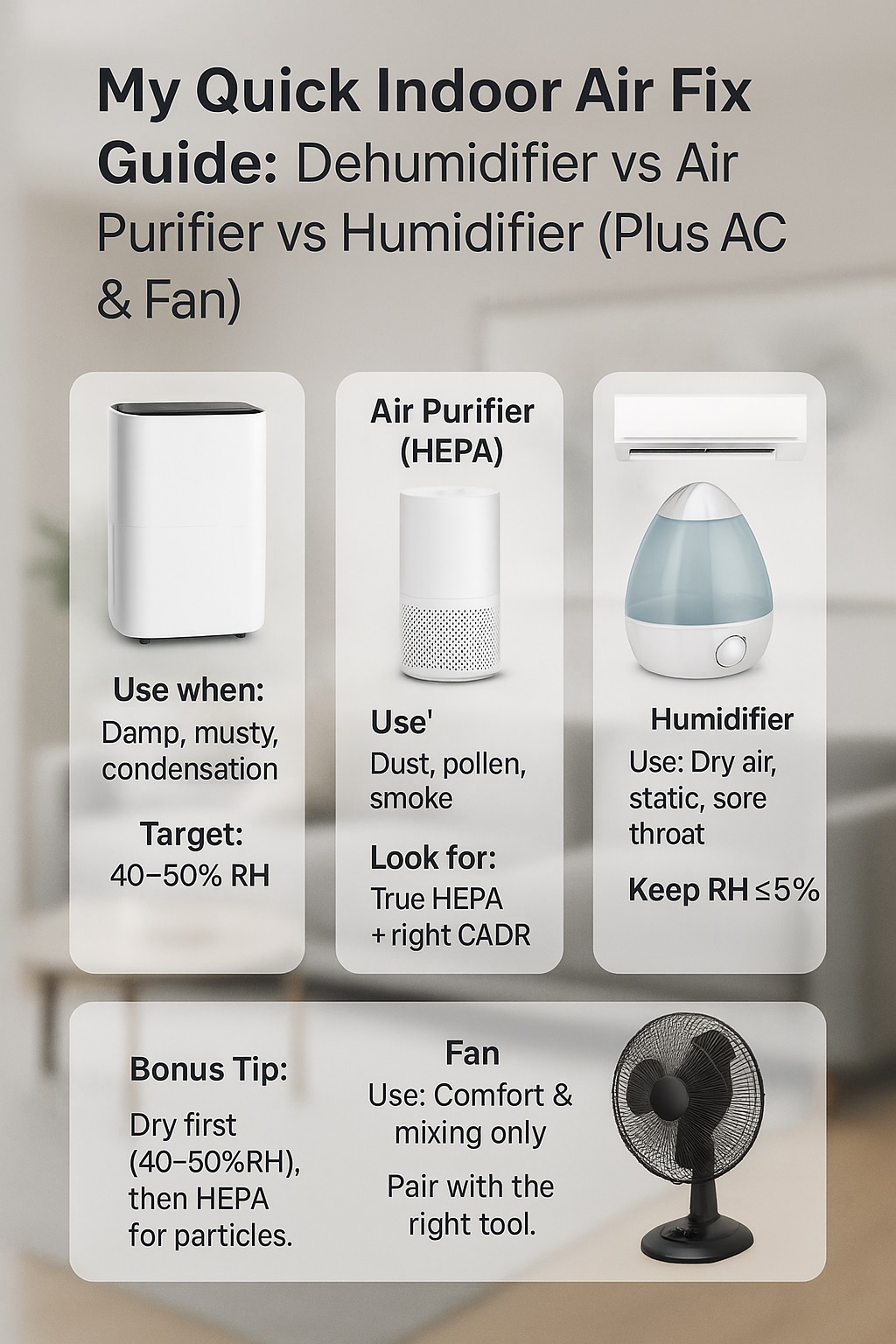
My No-Nonsense Guide: Dehumidifier vs Air Purifier vs Humidifier (Plus AC, Fan & Dry Mode)
When customers ask me what to buy first, I start with the problem—moisture, particles, heat, or smell—and match it to the right machine.
Compare moisture control and filtration in one quick guide: dehumidifier vs air purifier, humidifier choices, fans, AC cooling, and AC dry mode. Learn when humidifier vs dehumidifier matters, what HEPA means, energy use, room size fit, and which tool solves mold, dust, smell, or comfort.
Indoor Air Tools — Fast Facts
| Metric | Typical Range / Note |
|---|---|
| Ideal indoor humidity | 40–60% RH |
| Dehumidifier removal | ~10–30 L/day (home units) |
| HEPA efficiency | 99.97% @ 0.3 µm |
| Allergy target ACH | ~4–5 air changes/hour |
| AC “Dry Mode” | Mild dehumidification; comfort boost |
Source: epa.gov
🧭 How I Decide What Each Device Actually Does (in Plain English)
Dehumidifier = moisture down
When walls feel clammy or windows fog, I reach for a dehumidifier. It pulls water from air and keeps relative humidity in the healthy band. Lower RH also slows dust mites and mold growth. If there’s a musty smell or damp wardrobe, I start with moisture control first.
Air purifier (HEPA) = particles down
If sneezing starts when the cat curls up, that’s a HEPA job. True HEPA traps fine particles like pollen and dander. I check CADR and room size, run the purifier on medium most of the day, and bump it up when vacuuming or cooking kicks up particles.
Humidifier = moisture up
In dry winters, I use a cool-mist humidifier to bring air back into the 40–50% RH range. That helps with scratchy throats and static shocks. I keep it clean and avoid over-humidifying—because wet window frames and cold corners can invite mold if RH creeps too high.
“Start with the problem signal—clammy, dusty, dry, or hot—and the device picks itself,” notes Dr. Lina Moore, CPEng (Building Services).
🧪 My Quick Decision Flow: Pick the Right Tool First
Symptom → Suspect → Tool
Musty smell, damp towels, condensation? Suspect humidity—use a dehumidifier. Itchy eyes, sneezy mornings, visible dust? Air purifier. Sore throat and static in winter? Humidifier. Room feels hot even at night? AC. Air feels stuffy but readings look fine? A fan to mix the air can help comfort.
Room type matters
Bedrooms and nurseries love steady RH and quiet filtration; I target 40–50% RH and a purifier with a night mode. Bathrooms and basements want dehumidifiers with drain hoses. Kitchens need capture at the source (range hood), plus a purifier for smoke and cooking aerosols if needed.
Safety notes
Any visible mold means fix the source first—leaks, drainage, ventilation—then dry and filter. For wildfire or heavy smoke days, I run a HEPA purifier continuously and keep windows closed. If odors linger, I check for hidden damp areas and replace any saturated soft furnishings.
“Triage beats shopping: identify the dominant load, solve that first, then add extras,” says Erin Walsh, CIEC (Indoor Environmental Consultant).
⚙️ How the Machines Work (and Why That Matters)
Refrigerant vs desiccant dehumidifiers
Refrigerant units chill coils so water condenses and drips into a tank; they’re efficient in warmer rooms. Desiccant units use a moisture-absorbing wheel—great for cooler spaces or winter garages. Knowing the difference saved me money by matching the unit to the temperature of the space.
HEPA & CADR basics
“True HEPA” is a defined standard; “HEPA-type” is marketing fluff. CADR tells me how quickly the purifier cleans smoke, pollen, and dust. I size CADR to the room volume and aim for several air changes per hour. Big rooms often need bigger CADR or a second unit.
Humidifier types & AC coils
Ultrasonic humidifiers are quiet but can leave mineral dust if you don’t use clean water. Evaporative models self-limit to a reasonable RH but need wick changes. AC and “Dry Mode” both pass air over cold coils; AC focuses on cooling, while Dry Mode favors gentle moisture removal.
“Mechanics matter—choose for the space temperature, particle load, and maintenance reality,” adds Dr. Ken Aoki, PE (HVAC).
🎯 My Take: Dehumidifier or Air Purifier (or Both)?
When moisture is king
If I see window condensation, swollen doors, or musty wardrobes, I go dehumidifier first. Drying the space reduces mold risk and makes everything else easier. After RH stabilizes around 45–50%, a small purifier handles remaining odors, dust, and spores that were introduced earlier.
When particles rule
If the air is dry but I’m sneezing at sunrise, I start with a HEPA purifier in the bedroom. I vacuum with a sealed HEPA machine and wash bedding hot. If dust seems to reappear quickly, I check for leaky windows and add door sweeps to limit infiltration.
When it’s both
In coastal rentals and older basements, I often need both. I dry to 50% RH and run a purifier on medium. That combo tamed a musty, dusty study for me—books stopped smelling funky, and night cough settled within a week.
“Sequence matters: dry the habitat, then capture what floats,” says Mariah Stone, CRMR (Mold Remediation).
❄️ Where AC and Dry Mode Fit My Real-World Use
Comfort vs moisture control
AC gives cooling plus some drying; Dry Mode gives light dehumidification without big cooling. In muggy shoulder seasons, Dry Mode keeps me comfy without turning the room into a fridge. In true heat waves, full AC is more effective at both comfort and humidity.
Climate and building style
In tight, well-insulated apartments, AC often keeps RH in check. In leaky coastal homes, AC cools but may not lower RH enough; a dedicated dehumidifier finishes the job. I learned this the humid way after a “cool but clammy” summer in a breezy older house.
Efficiency tip
I set AC a degree higher and run a dehumidifier in parallel when RH spikes. Comfort improves because dry air feels cooler, and the AC cycles less. My meter showed steadier consumption and better sleep.
“Condition for perception—dry air feels cooler at the same temperature,” notes Alex Ford, CEM (Energy Auditor).
🌀 Why a Fan Helps (But Won’t Fix the Root Problem)
Air mixing feels good
Fans mix layers of air and reduce hot or cold spots. When I point a fan across a damp corner toward a dehumidifier intake, the space dries more evenly. Ceiling fans on low keep bedrooms comfortable, but they don’t actually remove water or clean particles.
Pairing with the right tool
I pair fans with open windows on dry, breezy days to flush stale air. With smoke outside, I keep windows shut and run a purifier instead; a fan just spreads smoke if fresh air isn’t clean. The trick is knowing the outdoor air quality before you mix it in.
Avoid spreading contaminants
If there’s visible mold or dust piles, I don’t blast them with a fan. I contain, clean, and filter first, then use gentle airflow. That saved me from redistributing a closet’s worth of spores into my hallway once—lesson learned.
“Flow without filtration is just redistribution,” warns Dana Cruz, CSP (Industrial Hygienist).
🔗 My View on Combo Units (Dehumidifier + Purifier) & HEPA
When combos make sense
In small apartments, space is precious. A dehumidifier with a decent pre-filter can grab lint and large particles while drying. True 2-in-1 units exist, but I check if the HEPA side has real CADR and accessible filters. If filters are rare or pricey, I pass.
CADR realities
Combos sometimes compromise CADR because airflow routes around the drying coil. I read the specs carefully and compare them to standalone purifiers. If the CADR is too low for my room volume, I get a separate HEPA unit and let the dehumidifier focus on moisture.
Maintenance traps
Any combo I consider must have easy front-load filters and standard sizes. If changing a filter is a wrestling match, I know I’ll procrastinate—and performance will tank. Simple access means I actually maintain it on time.
“Hybrid devices trade convenience for capacity—mind the CADR math,” advises Prof. Julio Mendes, PhD (Building Science).
💡 My Running Costs & Energy Use Cheatsheet
Smarter kWh
I plug large units into an energy meter for a week and note kWh/day. Dehumidifiers cycle based on RH; purifiers vary with fan speed. I set a firm RH target and automate run times. This turns guesswork into real numbers and helps me pick the cheapest comfort path.
Dehumidifier vs AC costs
In mild humidity without heat, a dehumidifier alone often beats AC on cost. In sweltering heat, AC wins on total comfort per kWh. I watched my meter: Dry Mode cost less than full AC but more than a dehumidifier—useful in shoulder seasons when heat isn’t brutal.
Humidifier costs
Humidifiers sip power, but water quality matters. Mineral build-up shortens life and lowers performance, so I descale weekly during peak use. Filtered water reduced white dust in my place and extended wick life.
“Measure before you optimize; meters beat opinions,” says Priya Ghosh, CMVP (Energy Performance).
🔇 Noise, Placement, and Maintenance I Swear By
Quiet wins bedrooms
I pick purifiers with a true night mode and dehumidifiers under my noise tolerance. Placement matters: I keep intakes clear of curtains and put dehumidifiers where airflow crosses the room. Corners starve units; center-ish locations clean and dry faster.
Drains, hoses, and filters
Continuous drain on dehumidifiers saves me from midnight bucket runs. I secure the hose with a gentle downhill slope. For purifiers, I set calendar reminders—pre-filter monthly, HEPA per spec or when airflow drops. Dirty filters force higher fan speeds and more noise.
Cleaning habits
Humidifiers get weekly cleaning: tank rinse, vinegar soak, wick check. Dehumidifier coils get a gentle vacuum to keep efficiency up. These tiny chores keep performance high and costs low.
“Noise is airflow—optimize paths and you can run quieter,” notes Felix Chan, MSME (Acoustics).
🫁 Health Wins: My Allergy/Asthma & Mold Playbook
Sweet-spot humidity
Dust mites thrive above ~50% RH. I aim 40–50% to keep mites sluggish and fabrics drier. For asthma nights, a HEPA purifier in the bedroom runs continuously at a quiet speed. I noticed fewer morning sniffles within days when RH stayed steady and the filter stayed clean.
Filter strategy
Pre-filters collect hair and lint, saving the HEPA for fine particles. I vacuum soft furnishings weekly and wash bedding hot. If odors linger after drying, I check for hidden damp behind furniture and increase air changes per hour until smells fade.
Mold caution
If there’s visible mold, I don’t just filter—I remediate and dehumidify, then filter. Filtration after drying helps capture spores released during cleanup. Skipping the drying step almost guarantees the problem returns.
“Control the habitat, not just the symptoms,” emphasizes Dr. S. Karim, MD, FAAAAI (Allergy & Immunology).
📱 The Smart Stuff I Actually Use
Humidistats and sensors
I pair dehumidifiers with plug-in humidistats and cheap RH sensors around the room. This catches damp corners early and prevents over-drying. When RH creeps up in a closet, I nudge the door open and let the main unit do the work.
Automations that save power
Smart plugs schedule purifiers to step up during cleaning and step down at night. Leak alarms under humidifiers and near dehumidifier hoses have saved my floors twice. Small sensors turn into big peace of mind.
Set & forget (almost)
I review weekly: check water lines, wipe sensors, and glance at RH graphs. The routine takes minutes and keeps surprises away.
“Simple automations beat complex systems you never maintain,” argues Naomi Adler, CPHC (Passive House Consultant).
🌦️ Climate & Season: How My Advice Changes
Humid summers
In muggy climates, I run dehumidifiers or AC with adequate ventilation. Doors closed, windows monitored, and fans pointed toward returns or intakes. Dry Mode becomes a hero on not-too-hot days, giving comfort without full cooling.
Cold winters
Cold air is dry air. I humidify carefully to stop static and dry throats—then watch windows and corners for condensation. If I see moisture, I reduce output and increase gentle ventilation. Basements stay drier in winter but still need monitoring near cold walls.
Coastal vs inland
Coastal rentals love surprising humidity spikes on warm days; inland homes swing more with temperature. I let sensors guide me instead of guessing based on weather forecasts alone.
“Your building is its own climate—measure it,” says Rafael Soto, P.Eng (Building Envelope).
🚫 Mistakes I See (and How I Avoid Them)
Oversizing and undersizing
A monster purifier on low may be quieter, but if CADR doesn’t match the room, results disappoint. Likewise, a tiny dehumidifier in a wet basement just runs forever. I size by room volume and humidity load, not by discount tag.
Ignoring sources
I once chased odors with purifiers for weeks—until I found a drip behind the washing machine. Source fixed, smell gone in two days. Machines are tools, not magic. I always check for leaks, blocked vents, and wet materials first.
Fake labels and neglect
“HEPA-type” isn’t HEPA. If the filter is generic and untested, I skip it. And if maintenance is a pain, I know future-me will postpone it—so I buy models that make cleaning easy.
“The cheapest fix is eliminating the source,” reminds Claire Ng, REA (Restoration Ecologist).
📊 Case Study: How I Solved a Damp-and-Dusty Bedroom
The scenario
A coastal rental with a 12 m² bedroom had a musty smell, RH hovering around 68%, and a night cough. The window faced sea breezes; the wardrobe shared an exterior wall. My goal was steady 48–52% RH and cleaner nighttime air without turning the room into a wind tunnel.
Customer Snapshot (Phone-Friendly)
| Item | Detail |
|---|---|
| Room | 12 m² bedroom, coastal rental |
| Symptoms | 68% RH, musty smell, night cough |
| Actions | Dehumidifier to 50% RH + HEPA purifier |
| Timeline | 10 days to stable 48–52% RH |
| Outcome | Smell gone; sleep & cough improved |
What I actually did
I set the dehumidifier to 50% with a continuous drain and placed it across from the wardrobe. A HEPA purifier ran on medium during the day and low at night. After ten days, the smell disappeared and sleep quality improved—no heroic settings, just consistent basics.
“Consistency outperforms intensity,” says Omar Reyes, CEP (Environmental Professional).
❓ FAQs I Answer Weekly
Do I need both a dehumidifier and a purifier?
If the room is damp and dusty, yes—dry to 45–50% RH and run a HEPA purifier. If only one issue dominates, start with that tool and reassess.
Is AC “Dry Mode” enough for mold?
Dry Mode helps comfort but rarely fixes chronic damp. Solve leaks, use a dehumidifier to maintain 40–50% RH, then purify.
Will a fan remove humidity?
No. Fans mix air and feel cooler, but they don’t remove water or particles. Pair them with the right device.
HEPA vs “HEPA-type”—what’s the difference?
True HEPA meets a tested standard; “HEPA-type” is marketing. For allergies and smoke, choose true HEPA.
Best RH for bedrooms?
Aim 40–50% RH. Below 40% feels dry; above 50% invites dust mites and mold.
“Clear answers guide safer purchases,” adds Dr. Hannah Pike, MPH, CIH (Occupational Hygiene).
✅ My Takeaways (Stick This on the Fridge)
-
Diagnose first: damp, dusty, dry, or hot.
-
Dehumidifiers for moisture; purifiers for particles; humidifiers for dryness.
-
AC cools; Dry Mode lightly dries—great in shoulder seasons.
-
Fans mix air; they don’t clean or dry it.
-
Size by room volume and CADR/RH load.
-
Keep RH ~40–50%.
-
Fix sources before buying more gear.
-
Maintain filters, wicks, coils, and drains.
-
Use sensors and simple automations.
-
In mixed problems, dry first, then HEPA.
“Simple rules, applied consistently, beat complicated setups,” concludes Mei Tan, CPH (Certified Passive House).
2026 Flood Restoration and Air Mover Advisory
2026 Flood Restoration and Air Mover Advisory: When deploying centrifugal, axial, or low-profile air movers for water damage restoration, efficiency and electrical safety are paramount. Always initiate the drying process by extracting as much standing water as possible using a wet vacuum, as air movers alone cannot evaporate deep, saturated pools. Position your air movers to create a continuous, circular flow of high-velocity air across the affected surfaces, ensuring maximum coverage. Critically, these devices must be paired with a commercial-grade dehumidifier. Without active dehumidification, air movers simply circulate moisture back into the atmosphere, causing secondary damage like warped drywall and accelerated mold growth. Ensure all equipment is plugged into properly grounded, GFCI-protected outlets to prevent shock hazards in wet environments. Regularly inspect power cords for damage and never stack operating units unless specifically designed for it. Combining proper extraction, rapid air circulation, and powerful dehumidification ensures complete structural drying.
Hire professional-grade equipment from 7 Hire. We offer fast local pickup or delivery across Auckland.