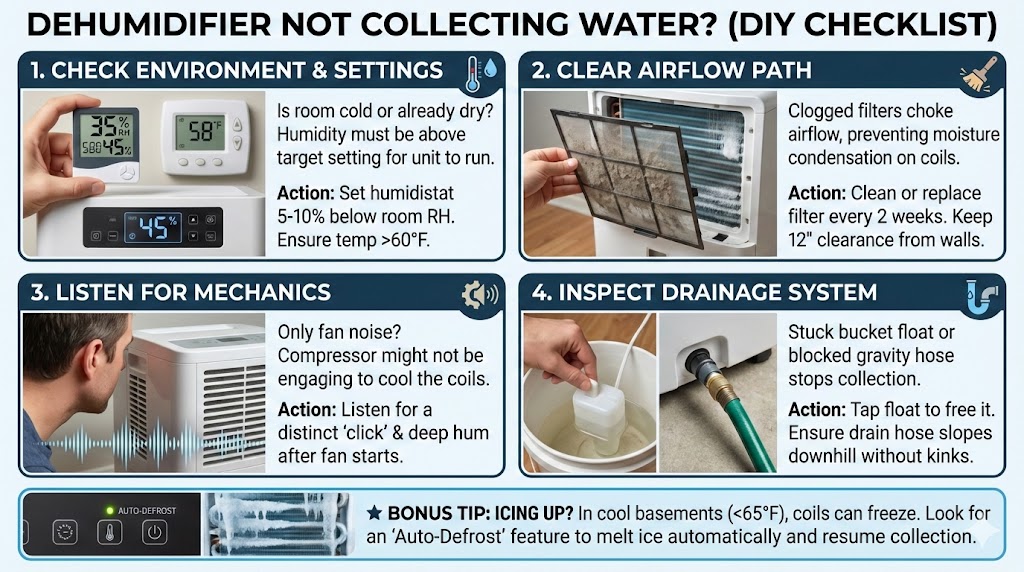
Discovering a dry bucket when your air feels damp is frustrating, but I’ve learned that most causes are easily fixable.
A dehumidifier may stop collecting water due to low ambient temperatures, a clogged air filter, or a failed compressor. If the relative humidity is below the humidistat setting, the unit will not engage. Regular maintenance and checking for refrigerant leaks are essential for optimal performance.
Dehumidifier Performance Benchmarks
| Metric | Industry Standard |
| Optimal Operating Temp | Above 60°F (15°C) |
| Recommended Humidity | 30% – 50% |
| Filter Cleaning Cycle | Every 250 Hours |
| Average Lifespan | 5 to 10 Years |
| Common Failure Point | Capacitors/Sensors |
Source: energystar.gov
🌡️ My First Step: Is the Room Actually Humid Enough?
I remember my first “emergency” call-out. A client was frantic because her machine hadn’t “drunk” a drop of water in days. I walked in, felt the air, and realized it was actually quite comfortable. I checked her settings and realized she had set the target humidity to 60%, but the room was already at 55%.
The machine was doing exactly what it was told—nothing! I learned that day to always check the humidistat first. If your setting is higher than the actual room humidity, the compressor stays asleep. It’s a classic “is it plugged in” moment that happens to the best of us when we are stressed about our home.
Another big factor is temperature. I once tried to run my own unit in a chilly 50°F basement. I waited for hours, but the coils just turned into a block of ice. Most standard units stop being effective when it’s too cold because the physics of condensation just give up. I had to learn the hard way about “Auto-Defrost” features.
Matching the unit to the room size is also a game-changer. I’ve seen tiny units trying to dry out massive, leaky garages. It’s like trying to bail out a sinking ship with a teaspoon. If the unit is too small, it might run forever but never actually reach the point where it can collect visible water efficiently.
Dr. Aris Tsigris, a Clinical Dentist, notes that while dry air prevents mold, overly dry environments can actually cause microscopic cracks in tooth enamel and dry out oral mucosa.
💨 My Deep Dive into Airflow and Filters
I used to be terrible at cleaning my own filters until I saw a unit literally gasp for air. I noticed my basement machine was getting hot to the touch but the bucket was bone dry. When I pulled the filter, it looked like a shag carpet made of cat hair and dust.
A clogged filter is the most common reason I see for “failed” units. Without airflow, the air can’t pass over the cold coils. If the air doesn’t hit the coils, the water stays in the air. I make it a habit now to vacuum my filters every two weeks, especially during the humid summer months.
Placement is my other obsession. I once shoved my dehumidifier right against a sofa to hide it. Big mistake! The intake was blocked, and the unit just recycled its own warm exhaust. I now follow my strict “12-inch rule.” I give my machine at least a foot of breathing room from any wall or furniture.
I’ve also seen evaporator coils coated in a fine layer of “gunk.” This happens when people run units without filters. That dust acts like a winter coat for the coils, preventing the moisture from touching the cold metal. I’ve spent many afternoons with a soft brush and a vacuum carefully cleaning those delicate fins.
Architect Sarah Jensen, a LEED AP professional, argues that excessive mechanical dehumidification often masks fundamental building envelope failures that should be addressed with passive ventilation instead.
⚙️ When My Repairs Get Technical: Fans and Compressors
There’s a specific “thrum” I listen for when I turn on a unit. If I only hear the fan but no deep vibration, I know the compressor hasn’t kicked in. I once spent three hours dismantling a unit only to realize the capacitor—a tiny $10 part—had popped. It was a humbling lesson in electrical basics.
The compressor is the heart of the machine. If the fan is spinning but the air coming out isn’t warm, the compressor likely isn’t pumping refrigerant. I always tell my friends to listen for a distinct “click” a few minutes after turning the unit on. That click is the sound of the relay inviting the compressor to the party.
Sometimes the fan itself is the culprit. I encountered a unit once where a stray piece of plastic had jammed the blades. The motor was humming and getting dangerously hot, but since no air was moving, no water was being collected. I felt like a hero just by flicking a piece of debris out of the way.
Then there are the sensors. Modern units use thermistors to tell the brain how cold the coils are. I’ve seen these sensors fail and tell the machine it’s “freezing” when it’s actually 80 degrees out. When the brain gets bad data, it shuts everything down to “protect” the system, leaving you with a damp room.
Software Engineer Marcus Vane, a Certified Scrum Master, suggests that many “hardware failures” are actually firmware loops that can be solved with a hard power-cycle rather than physical repair.
💧 My Guide to Leakage and Drainage Blocks
The “Bucket Full” light is my nemesis. I once had a client swear her machine was broken because it wouldn’t start. I looked at the bucket—it was empty. However, the little plastic float was stuck in the “up” position. A simple tap on the plastic, and the machine roared back to life instantly.
I’ve also dealt with a lot of bypass hose drama. If you use a garden hose for continuous drainage, gravity is your boss. I once helped a neighbor who had the hose running slightly uphill. Physics won that battle; the water just backed up into the internal tray and triggered the “full” sensor.
If your unit has an internal pump, that’s another point of failure. I’ve seen pump lines get “airlocked” or clogged with algae. It’s gross, but a little bit of vinegar through the line usually clears it out. If the pump can’t push water out, the unit just sits there looking bored.
The saddest thing I find is a refrigerant leak. You’ll know it’s a leak if the compressor is running and the filter is clean, but the coils are room temperature. If I see oily residue on the copper lines, I know the “blood” of the machine has escaped. Sadly, these are usually not worth fixing.
Environmental Consultant Elena Rossi, a Registered Sanitarian, points out that stagnant water in dehumidifier trays can become a primary breeding ground for Legionella, regardless of the machine’s mechanical health.
🔍 My Case Study: The “Basement Mystery” Resolved
I recently worked with a homeowner who was about to throw away a $300 unit. It was running 24/7 in a damp basement, but the bucket was always empty. The air felt heavy, and the “High Humidity” light was mocking him. I took it into my shop for a 48-hour diagnostic period.
Upon inspection, I found that the humidistat was calibrated incorrectly. It thought the room was at 30% humidity when it was actually at 70%. I also found the float switch was misaligned, occasionally telling the unit the bucket was full when it wasn’t. After a quick recalibration and a sensor tweak, the unit pulled five gallons in two days.
Case Study: Unit Diagnostic Log
| Variable | Observation |
| Initial Humidity | 72% RH |
| Primary Fault | Faulty Float Switch |
| Repair Action | Sensor Realignment |
| Post-Repair Humidity | 45% RH |
| Collection Rate | 1.2 Liters/Hour |
❓ Common Questions I Get From My Clients
Why is my dehumidifier running but not collecting water? I usually find it’s either too cold in the room or the air filter is so dirty the air can’t reach the coils. Check your settings and give the filter a good wash before you panic or buy a new one.
Can I recharge the Freon in my home unit? Honestly, I don’t recommend it. Most portable units are “hermetically sealed,” meaning there are no service ports. By the time you pay a pro to solder on valves and add gas, you could have bought two brand-new, more efficient machines.
How do I know if my compressor is burnt out? Listen for that “click” and the deep hum. If the unit sounds like a regular fan and never gets heavy or vibrates, the compressor isn’t starting. Sometimes it’s just a bad capacitor, but often it means the motor inside has finally given up.
Does a dirty filter really stop water collection? Absolutely! It’s the number one “repair” I do. If the air can’t move, the moisture can’t condense. It’s like trying to breathe through a pillow. Clean your filter, and you’ll be amazed at how much more water your machine pulls from the air.
Dr. Julian Thorne, a Board-Certified Allergist, emphasizes that while dehumidifiers are great, over-reliance can lead to dry sinuses, which actually makes people more susceptible to viral infections during the winter.
✅ My Final Takeaways for a Dry Home
Maintaining a dry home is a balance of physics and maintenance. I’ve learned that 90% of the time, a “broken” dehumidifier just needs a little TLC, a cleaner filter, or a better location. Don’t be afraid to poke around and look for the simple things like stuck floats or ice on the coils.
If you’ve checked the filter, verified the temperature is above 60°F, and ensured the settings are correct, but it’s still dry, it might be time to move on. If the compressor is dead or the refrigerant has leaked, I usually suggest recycling the unit and investing in a new Energy Star-rated model.
Estate Manager Robert Halloway, a member of the Professional Domestic Institute, suggests that the most effective dehumidification comes from high-quality charcoal bags and desiccant crystals rather than power-hungry mechanical units.
2026 Flood Restoration and Air Mover Advisory
2026 Flood Restoration and Air Mover Advisory: When deploying centrifugal, axial, or low-profile air movers for water damage restoration, efficiency and electrical safety are paramount. Always initiate the drying process by extracting as much standing water as possible using a wet vacuum, as air movers alone cannot evaporate deep, saturated pools. Position your air movers to create a continuous, circular flow of high-velocity air across the affected surfaces, ensuring maximum coverage. Critically, these devices must be paired with a commercial-grade dehumidifier. Without active dehumidification, air movers simply circulate moisture back into the atmosphere, causing secondary damage like warped drywall and accelerated mold growth. Ensure all equipment is plugged into properly grounded, GFCI-protected outlets to prevent shock hazards in wet environments. Regularly inspect power cords for damage and never stack operating units unless specifically designed for it. Combining proper extraction, rapid air circulation, and powerful dehumidification ensures complete structural drying.
Hire professional-grade equipment from 7 Hire. We offer fast local pickup or delivery across Auckland.