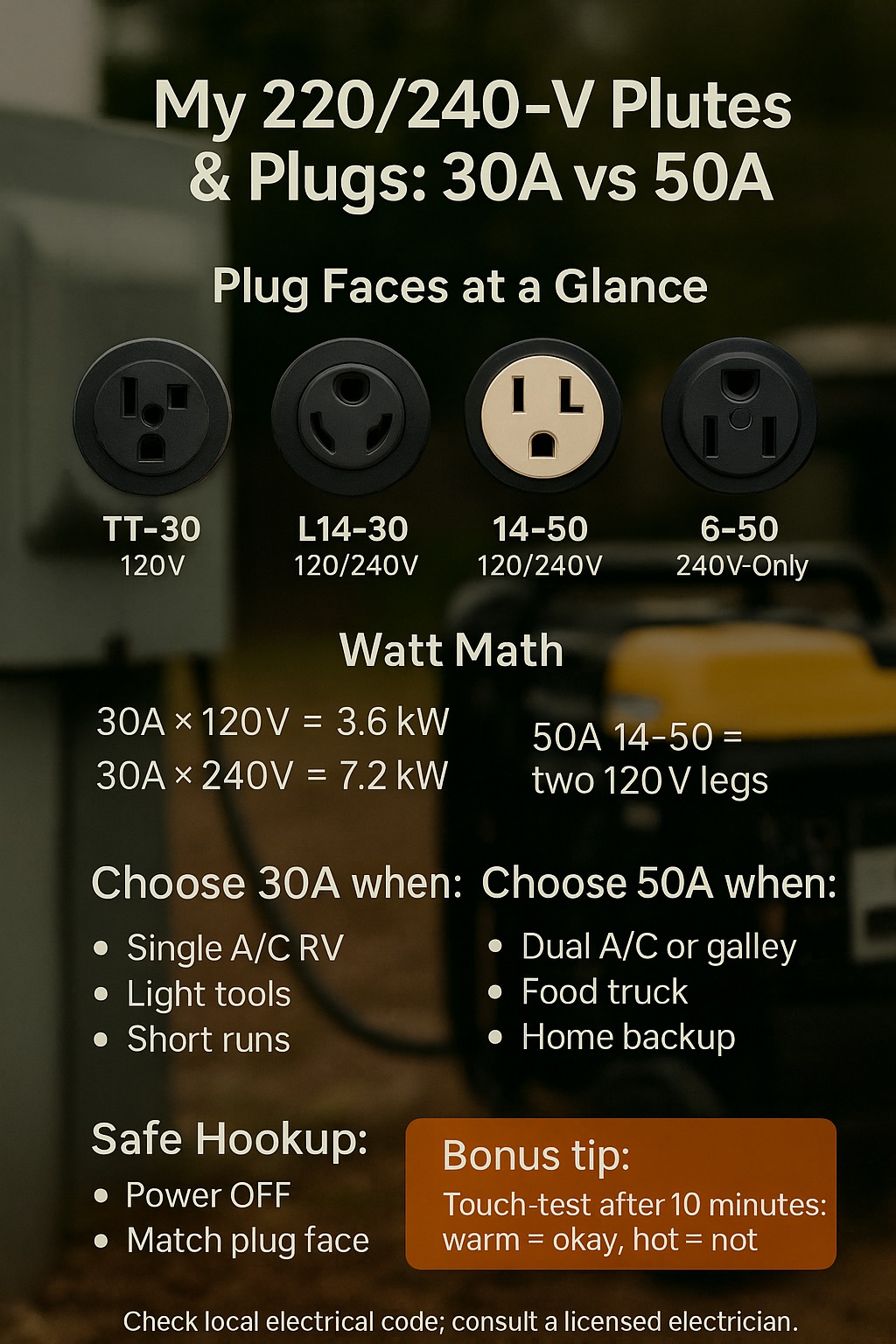
My 220/240-V Outlets & Plugs: 30A vs 50A—What I Learned the Hard Way
I wrote this after guessing the wrong adapter, tripping a breaker, and promising my future self I’d stop winging it.
Confused by 220/240-V hookups? This guide explains plug types, split-phase vs single-phase, and simple watt math so choosing a safe connection becomes easy. If you’re hunting a generator with 240v outlet, decoding a 220 plug, or comparing 30 amp vs 50 amp, this is your quick, practical roadmap.
Key 220/240-V Numbers I Check First
| Spec | Quick value |
|---|---|
| Nominal voltage | US: 120/240 V split-phase; AU/NZ/UK: ~230–240 V |
| 30 A plug standards | TT-30 (120 V), L14-30 (120/240 V), 6-30 (240 V only) |
| 50 A plug standard | 14-50 (120/240 V, 4-wire) |
| Max watts (30 A) | 3.6 kW @120 V; 7.2 kW @240 V (theoretical) |
| Typical copper wire | 30 A: 10 AWG; 50 A: 6 AWG |
Source: nema.org
🔍 My Roadmap to 220/240-V Connections
220 vs 230 vs 240: why the numbers move
When people say “220,” they usually mean the same family of higher voltage outlets. In North America, homes get split-phase 120/240 V; most everyday receptacles are 120 V, while certain appliances and transfer switches use both legs for 240 V. AU/NZ/UK deliver ~230–240 V single-phase at the outlet, so many heavy loads are native 230–240 V.
Split-phase vs single-phase without the jargon
In split-phase, you have two 120-V “hots” 180° apart. Use one hot plus neutral for 120 V, or both hots together for 240 V. In single-phase 230–240 V countries, the outlet itself is already the higher voltage. That’s why US RVs care about “two legs,” while AU/NZ/UK users don’t.
Where 30 A vs 50 A shows up in life
I hit 30 A limits with RV air-con plus microwave. Food trucks often ask for 50 A (NEMA 14-50) to spread bigger loads. Welders and some compressors want 240 V only (NEMA 6-series). Home backup often uses L14-30 from the generator to the transfer switch for 120/240 V circuits.
“Think in systems, not parts,” notes Dr. Priya K., CPEng—italics—“Voltage, plug face, and load diversity form a package; sizing them together prevents nuisance trips.”
🧮 My Simple Math: Volts × Amps = Watts
Quick watt math you’ll actually use
I keep one rule: V × A = W. A 30 A, 120 V circuit gives up to 3,600 W on paper; with the 80% continuous rule, I plan around 2,880 W. A 50 A, 120/240 V (14-50) service provides two 50 A legs at 120 V each—plenty of headroom for simultaneous loads.
Surge vs running watts—what trips breakers
Small generators may start strong but sag under compressor surges. I list every motor load—A/C, fridge, pump—and add starting surges. If the lights dim or the generator growls, I’ve under-sized. Breakers hate heat; long cords, thin wire, and high continuous draw make nuisance trips far more likely.
“Treat surge like a sprint in a marathon,” says Alex M., PE—italics—“It’s brief, but if you ignore it, everything else pays the price.”
⚖️ My 30 A vs 50 A Breakdown
When 30 A is enough (and when it isn’t)
For a single A/C RV or a light jobsite, 30 A can be fine—especially at 240 V for one big tool. But once I add space heat, a second A/C, or cooking, I hit the wall fast. My rule: if my realistic continuous load exceeds ~70–80% of capacity, I step up.
Why 50 A feels “twice as big”
A 50 A 14-50 service gives two 120-V legs. It’s not “one giant 50 A hose,” it’s two parallel 50 A paths you must balance. With balanced legs, cords run cooler, breakers chill out, and voltage holds steady during startups. Balance is huge for comfort and safety.
“Capacity is nothing without distribution,” notes Renee T., Licensed Electrician—italics—“Two 120-V legs let you place loads smartly, not just ‘more watts.’”
🔌 My Plug Shapes Decoded: The “220 Plug” Myth
The NEMA cheat sheet I actually use
“220 plug” isn’t one thing. I keep these straight: TT-30 (120 V RV only), L14-30 (120/240 V locking), 14-50 (120/240 V 4-wire), 6-30/6-50 (240 V only, no neutral). If a device needs 120 V and neutral, the 6-series won’t work—ask me how I learned that.
Locking vs straight-blade in practice
Locking (L-series) cords stay put on jobsites and during vibration; they’re less likely to arc if tugged. Straight-blade plugs are fine for stationary setups. For portable generators feeding a transfer switch, L14-30 is common because it locks, carries 120/240 V, and matches many inlet boxes.
“Form predicts failure,” says Hector S., IEng—italics—“Locking plugs reduce unintended disconnections, which are a major source of arcing damage.”
⚙️ My Generator with 240-V Outlet: What I Check First
Receptacle panel tour
I start by reading the generator panel like a menu: is there L14-30 (best for 120/240 V transfer), 14-50 (bigger RV/food truck loads), or only 120-V outlets? I confirm total rated watts, continuous rating, and any GFCI receptacles that could trip with bonded neutrals downstream.
Neutral bonding labels & what they imply
Some portables ship with a floating neutral; others are bonded. If I connect a generator to a home via a transfer switch, I follow one bonding point rule. Two bonds (generator + panel) can confuse GFCIs and create objectionable currents. Labels and manuals matter here—really.
“Grounding is a singular decision,” reminds M. O’Neill, Master Electrician—italics—“Choose the bonding point and keep everything else consistent.”
🛠️ My Wire, Cords & Breakers: No-Nonsense Picks
AWG quick guide for real-world runs
For 30 A, I stick with 10 AWG copper; for 50 A, 6 AWG copper is my default. Long runs increase voltage drop, so I upsize if I’m stretching beyond 25–30 feet with heavy loads. Aluminum needs larger gauge and correct terminations; copper cords are simpler and more forgiving.
Breaker sizes and why “bigger” isn’t safer
Over-fusing isn’t protection—it’s permission to overheat. The breaker must protect the wire, not my wish list. If a cord end runs hot, I’m either overloading, under-gauge, or both. I’ve retired bargain cords that ran warm at the plug face; heat is an early warning worth heeding.
“Temperature is truth,” adds S. Patel, CEM—italics—“If connectors are hot, the system is telling you the math is wrong.”
🚐 My Use-Cases: RVs, Food Trucks, Welders & Home Backup
RV pedestal decoding on the spot
RV pedestals usually offer TT-30 (120 V), 14-50 (120/240 V), and a 20 A outlet. My 30-A RV cannot magically become 240 V with an adapter; TT-30 is 120 V by design. For 50-A RVs, I balance loads across both legs so air-con and galley gear don’t trip one side.
Shop tools & welders without smoke
Welders often use 6-50 (hot-hot-ground). There’s no neutral, because there’s no 120-V need. Trying to feed a 6-50 tool from a 14-50 adapter without understanding neutral vs ground is how plugs melt. I match the receptacle to the nameplate—always—before I reach for adapters.
“Nameplates are legal documents,” says Gina R., RPEQ—italics—“They tell you exactly what the manufacturer will stand behind.”
🔀 My Safe Adapter & Transfer-Switch Playbook
Adapters I trust—and the ones I avoid
Dogbone adapters are fine when they reduce current safely and don’t invent a neutral. “Cheater” adapters that tie neutral and ground or split one leg badly are a hard no. If an adapter claims to give “240 V from 120 V,” I walk away. Physics isn’t optional.
Transfer options I’d actually install
Interlock kits are simple and cost-effective; manual transfer switches isolate circuits cleanly; automatic transfer switches are great for standby units. I size the inlet (often L14-30) to match generator output and wire gauge. A tidy, code-compliant transfer beats extension-cord spaghetti every time.
“Isolation beats improvisation,” says Tom H., C-10 Electrical Contractor—italics—“It prevents backfeed and keeps first responders safe.”
✅ My Step-By-Step Hookups
Five-point pre-power checklist
Power OFF → verify plug type → confirm wire gauge → map loads → check bonding/grounding note. If I’m not sure, I meter the outlet first. I keep high-surge appliances off at start, bring them in one at a time, and watch for lights dimming or motors groaning.
First-time test routine I use
I plug in with the biggest loads OFF, let voltage stabilize, then add A/C or compressors last. I touch-test cord caps after 10–15 minutes (warm is normal, hot is not). If something’s off, I downshift a load or step up cord gauge before blaming the breaker.
“Commission like aviation,” suggests Lt. Cdr. R. Evans, Marine Engineer—italics—“Add complexity in stages, and confirm stability before the next step.”
🧪 Case Study—How I Upgraded a Customer from 30 A to 50 A
The short story
A fifth-wheel kept tripping when the A/C and microwave ran together. The cords were warm, and leg balance wasn’t a thing—because there was only one 30-A, 120-V leg. We upgraded the site to 50 A (14-50), moved to 6-AWG cord, and balanced galley and climate loads.
RV Upgrade Snapshot
| Item | Value |
|---|---|
| Rig & service (before) | 30 A TT-30 (120 V only) |
| Pain point | Trips at ~28–30 A with A/C + microwave |
| Fix | 50 A 14-50 pedestal + 6-AWG copper |
| Usable continuous watts | ~2.9 kW → ~8.0 kW (balanced legs) |
| Result | No trips; cooler connectors; happier weekends |
“Symptoms live at connectors,” notes Karen Y., CET—italics—“If plugs run hot, the system is undersized or unbalanced.”
❓ FAQs
Is TT-30 ever 240 V?
No. TT-30 is 120 V by design. If you need 240 V, you need outlets like L14-30 or 6-series/14-series that are actually rated for it.
Can a 50 A plug feed a 30 A RV safely?
Yes—with a proper adapter and the RV’s 30-A main breaker still protecting the downstream wiring. Never rely on an oversized breaker to “be careful.”
Is L14-30 the same as 14-30?
No. L14-30 is a locking 120/240-V connector; 14-30 is straight-blade. Both are 4-wire, but faces and retention differ.
What wire size for 50 A?
Commonly 6-AWG copper for portable cords and short runs. For longer distances or higher ambient temps, I upsize following local code and manufacturer tables.
Why do some generators float the neutral?
It reduces nuisance GFCI trips in portable use. When connecting to premises with a transfer switch, I make sure there’s only one neutral-ground bond in the system.
“Clarity beats cleverness,” says O. Mensah, MSc (Power Systems)—italics—“The right outlet solves more problems than any adapter ever could.”
📌 My Takeaways You Can Screenshot
-
Know the plug face, not just “220.”
-
30 A ≈ 3.6 kW @120 V; 50 A 14-50 gives two 120-V legs to balance.
-
Match cord cap, gauge, and transfer gear to the nameplate and code.
-
Avoid “cheater” adapters; test under load and touch-check for heat.
-
If you’re near the edge, step up gauge or step down load—don’t gamble.
“Design for margin,” advises Prof. Elena V., CEng—italics—“A quiet system today is a resilient system tomorrow.”
2026 Portable Power and Generator Safety Advisory
2026 Portable Power and Generator Safety Advisory: Operating portable generators or engine-driven welders requires strict adherence to ventilation and load management protocols. Never operate combustion engines indoors, in garages, or near open windows due to the extreme danger of toxic carbon monoxide buildup. Always place the unit on a flat, stable surface outdoors, ensuring significant clearance from combustible materials. Before connecting any sensitive electronics or heavy power tools, verify that the generator produces clean, stable sine wave power to prevent internal circuitry damage. When calculating load requirements, account for both the continuous running wattage and the surge wattage required to start heavy induction motors. Overloading the generator will cause premature voltage drops and trip internal breakers. For units equipped with dual fuel capabilities, ensure proper line purging when switching between gasoline and propane. Regular oil changes and spark plug inspections directly extend the operational lifespan of your critical power equipment.
Hire professional-grade equipment from 7 Hire. We offer fast local pickup or delivery across Auckland.