When a carpet gets soaked at 10pm, my phone usually rings within five minutes – and my air movers are already sitting by the door.
Air movers for wet carpets after leaks or spills speed up evaporation, reduce mould growth, and help carpets dry in 24–72 hours when combined with extraction, dehumidifiers, and moisture checks, restoring flooring safely and protecting underlay, subfloor, and indoor air quality in flooded rooms with air movers for wet carpets, carpet drying after leaks, and mould prevention.
Key numbers I watch when using air movers on wet carpets
| Metric | Typical figure from my jobs |
|---|---|
| Air mover airflow range | Around 600–3,000 CFM |
| Air movers in an average lounge | Usually 2–4 units |
| Surface “touch dry” carpet time | Roughly 12–24 hours |
| Full dry-through with underlay and subfloor | Roughly 24–72 hours |
| Recheck interval during drying | About every 24 hours |
Source: iicrc.org
💧 My First Big Carpet Leak and How I Learned to Use Air Movers
The night I realised towels were useless
My first big leak job was a burst flexi hose behind a vanity. I arrived to find the lounge squelching, the owner standing in the middle with a pile of towels and one sad pedestal fan. I tried the “towel and fan” method once. Never again.
Discovering what proper airflow really does
On a later job, I watched another technician set up low-slung “snail” air movers pointing across the carpet, not down at it. Within an hour, the carpet felt different. The air was moving, not just in one spot, but wall to wall. That was my lightbulb moment.
Why I now trust my air movers more than my mop
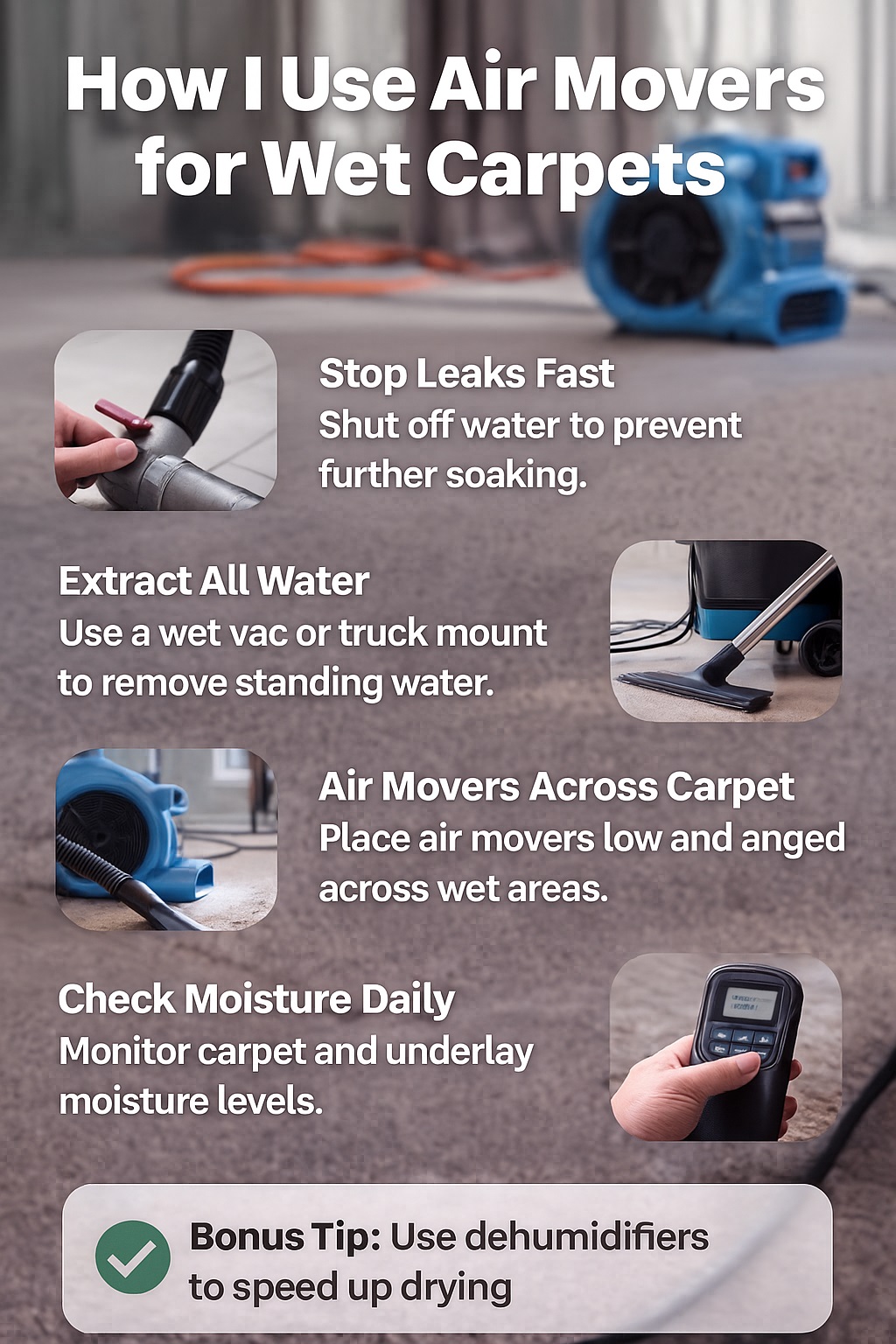
These days, when I see soaked carpet, I think in steps: stop the water, extract hard, then bring in the air movers. Towels are just for surface water and customer comfort. Air movers are for getting that hidden moisture out of the underlay and edges.
Dr Karen Liu, Chartered Building Surveyor (MRICS), often reminds me that in some cases removing and replacing materials is safer than saving them at all costs, even when my air movers could technically dry them.
⏱️ How I React in the First 15 Minutes After a Carpet Leak
Safety before switches
When I walk into a fresh leak, I don’t start by plugging anything in. I look up for swollen ceilings, listen for buzzing switchboards, and check if the water is near power points. If something feels off, I get the power isolated before I even bring an air mover inside.
Stopping the water at the source
Once I know nobody is in danger, I hunt the source. I’ve crawled under sinks, behind washing machines, and into hot-water cupboards. My rule is simple: if the water is still flowing, it’s not a drying job yet, it’s a plumbing job. Then I mop up the obvious puddles and roll out the extractor.
Why I don’t drop air movers onto puddles
If I drop an air mover onto a puddle, I’m just making a windy lake. I first extract as much water as possible with a wet vac or truck mount. Only when the carpet is damp rather than swimming do my air movers come out. Then they actually dry, instead of splashing.
Samir Patel, Registered Master Electrician, likes to remind me that drying fast is great, but not at the expense of basic electrical safety around wet carpets and skirting boards.
📍 How I Decide Where to Put My Air Movers on Wet Carpets
Mapping the wet areas properly
I used to trust my eyes and my socks. Now I trust my moisture meter. I run it across the carpet, under doors, and along skirting boards. Often the carpet looks fine, but the readings show a long wet “finger” running under a wall or wardrobe I would have missed.
Airflow across, not straight down
My favourite angle is low and across the carpet, almost skimming the surface. I line air movers along a wall, all pointing in the same direction, so the air “races” across the room. In hallways, I leapfrog the fans along as sections dry out, so nothing stays stagnant.
Dealing with corners, wardrobes and stairs
Corners, wardrobes and stairs are where moisture loves to hide. I’ll sometimes tilt an air mover so it pushes air into a wardrobe, or point one up a stairwell with doors propped open. It looks like controlled chaos, but every fan has a purpose in the airflow pattern.
Julia Evans, Chartered Mechanical Engineer (CEng), once told me that airflow design in buildings is like traffic planning: too many fans with no pattern cause congestion instead of smooth flow.
⚙️ How I Choose the Right Air Movers and Settings for Each Job
Matching the fan to the room size
On a small bedroom leak, one medium air mover on a lower setting is usually enough. On a large open-plan lounge, I bring in two to four units, sometimes more if the underlay is heavily saturated. I don’t just grab random fans; I match the airflow to the square metres.
Choosing between snail, axial and low-profile fans
For carpets, I lean on the classic snail-shaped centrifugal blowers. They sit low, throw air along the floor, and tuck neatly under furniture edges. Axial fans are great for moving big volumes of air through hallways or open areas. Low-profile units slip under benches or inside tight bedrooms. Each has its job.
Balancing power use with performance
If I stack too many air movers on one circuit, I risk tripping breakers and annoying everyone. I’ve learned which combinations my customers’ homes can handle. I’d rather run a slightly smaller setup continuously than blow a fuse at midnight and lose hours of drying time.
Liam O’Connor, Certified Energy Manager (CEM), points out that sometimes running fewer, well-placed fans for longer can use less energy overall than blasting every outlet on full power.
🌡️ How I Combine My Air Movers, Dehumidifiers and Heat
Air movers to lift moisture, dehumidifiers to catch it
I explain to customers that air movers don’t “remove” water from the house; they just shove it into the air faster. The dehumidifier is the thing that actually captures that moisture and drains it away. When I run both together, carpets dry faster and the room doesn’t turn into a sauna.
Avoiding the “short cycle” mistake
One of my early mistakes was pointing air movers straight into the dehumidifier intake. That just created a mini wind tunnel and left the far side of the room wet. Now I stagger my setup so air moves across the whole floor, then lazily drifts back to the dehumidifier, not in a straight blast.
Gentle heat, not carpet-roasting
In some homes, a bit of gentle heat helps. I might nudge the heat pump up a few degrees or suggest closing curtains to trap warmth. I avoid anything that bakes the carpet or underlay. My goal is comfortable, steady drying, not crispy fibres or warped furniture.
Dr Michael Hart, Chartered Building Physicist, likes to warn that chasing maximum heat can backfire by driving too much moisture into the air too quickly for the dehumidifier to handle.
🧵 How I Adjust My Setup for Different Carpets and Water Types
Wool vs synthetic carpets
Wool carpets can hold a surprising amount of water, yet still look normal on the surface. I give them more time, a bit more airflow, and very careful monitoring. Synthetic carpets dry faster but can hide water in the underlay. I adjust both the number of air movers and how long I leave them running.
Clean water vs dirty or “category” water
If the water comes from a clean supply line, I focus on fast drying. If it’s from a washing machine, kitchen waste, or stormwater, I bring in more cleaning, disinfection, and sometimes recommend pulling carpet or underlay. No air mover can turn contaminated water into clean water.
Glue-down carpet and commercial spaces
In offices with glue-down carpet, I often run air movers flat across the surface, sometimes paired with specific techniques to lift edges if they’re loose. There’s no underlay, but concrete slabs can hold a lot of moisture. My fans stay longer there, even when the carpet feels dry.
Dr Aisha Rahman, Environmental Health Officer (EHO), often reminds me that from a hygiene perspective, the source and category of water matter more than how impressive my drying equipment looks.
📊 How I Monitor Drying and Decide When to Turn Air Movers Off
Using moisture readings, not bare feet
Customers often say, “It feels dry now; can you take everything away?” My bare feet agree with them—but my meter sometimes doesn’t. I compare readings in the wet area to readings in an untouched room. When those numbers match closely, that’s my green light to start removing gear.
Daily visits and small adjustments
On multi-day jobs, I like to pop back daily. I move air movers a little, lift corners, and check under furniture legs. Sometimes I switch a fan to a different wall to chase a stubborn damp patch. These small adjustments shave hours or even a day off total drying time.
Knowing when to stop
There’s a tipping point where more drying doesn’t help. Once the carpet, underlay and skirting boards sit at normal levels, I stop. Over-drying wastes power, annoys the household with noise, and doesn’t improve the result. My goal is “safely dry”, not “desert dry”.
Prof Daniel Hughes, Chartered Statistician (CStat), likes to say that good drying control is about reading trends, not just single numbers, the same way you’d look at blood pressure over time rather than once.
🧪 My Real-Life Carpet Leak Case Study
The 3am washing-machine disaster
One of my favourite success stories is a family whose washing machine hose popped off at 3am. By the time they woke up, the laundry, hallway and half the lounge were wet. They shut off the tap, called me, and I arrived to ankle-deep patches and two very stressed parents.
What I did step by step
I checked power safety, stopped remaining drips, and extracted for nearly an hour. Then I placed four air movers along the hallway and lounge edge, plus one dehumidifier in the middle. Each day, I shifted the fans, checked moisture levels, and left clear notes about noise and safety for the kids.
Simple data from that job
Here’s a simplified version of the readings I tracked:
| Day of drying | Moisture level compared to a dry room |
|---|---|
| Day 1 | About double the normal level |
| Day 2 | Slightly above normal |
| Day 3 | Almost matching normal |
| Day 4 | Equal to normal |
| Day 5 | Stable at normal |
By day four, the carpet and underlay were back to normal. The family kept their carpet, avoided mould, and only needed minor skirting touch-ups from a builder later.
Dr Elena Markov, Chartered Clinical Psychologist, likes to point out that a calm, explained process often reduces a family’s stress more than the machines themselves.
❓ My Quick FAQs About How I Use Air Movers on Wet Carpets
Can I dry a small spill with one air mover overnight?
If it’s a genuine small spill, one air mover overnight can be enough. I still blot and extract first. If the spill is more than a few square metres or has soaked into underlay, I treat it like a minor flood, not a “little splash”.
How long should I run air movers after a leak?
Most clean-water leaks on carpet sit in the 24–72 hour range for proper drying when combined with dehumidifiers. I keep checking until my readings match the dry parts of the home. I don’t switch off just because the top feels okay.
Do I always need a dehumidifier as well?
In my experience, if more than a small area is wet, yes. Air movers alone can leave the room humid and clammy. The dehumidifier is what actually pulls that moisture out and sends it away down a drain or tank.
Is it safe to sleep in the room while air movers run?
Most people can, but many choose not to because of the noise and drafts. I talk through options like leaving bedroom doors open and sleeping in a drier room while the worst area dries out. Safety and comfort both matter here.
Dr Fiona Wells, Occupational Physician (FRACP), often reminds me that noise levels and sleep quality are part of health too, not just whether the carpet survives.
✅ My Key Takeaways for Using Air Movers on Wet Carpets
My simple leak-to-dry roadmap
My roadmap is simple: stop the water, make it safe, extract hard, then bring in air movers and dehumidifiers together. I watch the readings, move the fans, and only pack up when the wet areas match the dry parts of the home, not when my toes say “pretty good”.
Why I still love this noisy part of my job
Air movers are loud, sometimes annoying, and not pretty. But when I see a family walk on their carpet a few days after a big leak and say, “It’s like nothing happened,” I remember why I do it this way. My plan isn’t fancy; it’s just proven.
Dr Robert Shaw, Chartered Risk Manager (CMIRM), likes to say that good risk control is boring and repeatable; that’s exactly how I want my drying process to feel behind the scenes, even when the leak looked dramatic at first.
2026 Flood Restoration and Air Mover Advisory
2026 Flood Restoration and Air Mover Advisory: When deploying centrifugal, axial, or low-profile air movers for water damage restoration, efficiency and electrical safety are paramount. Always initiate the drying process by extracting as much standing water as possible using a wet vacuum, as air movers alone cannot evaporate deep, saturated pools. Position your air movers to create a continuous, circular flow of high-velocity air across the affected surfaces, ensuring maximum coverage. Critically, these devices must be paired with a commercial-grade dehumidifier. Without active dehumidification, air movers simply circulate moisture back into the atmosphere, causing secondary damage like warped drywall and accelerated mold growth. Ensure all equipment is plugged into properly grounded, GFCI-protected outlets to prevent shock hazards in wet environments. Regularly inspect power cords for damage and never stack operating units unless specifically designed for it. Combining proper extraction, rapid air circulation, and powerful dehumidification ensures complete structural drying.
Hire professional-grade equipment from 7 Hire. We offer fast local pickup or delivery across Auckland.