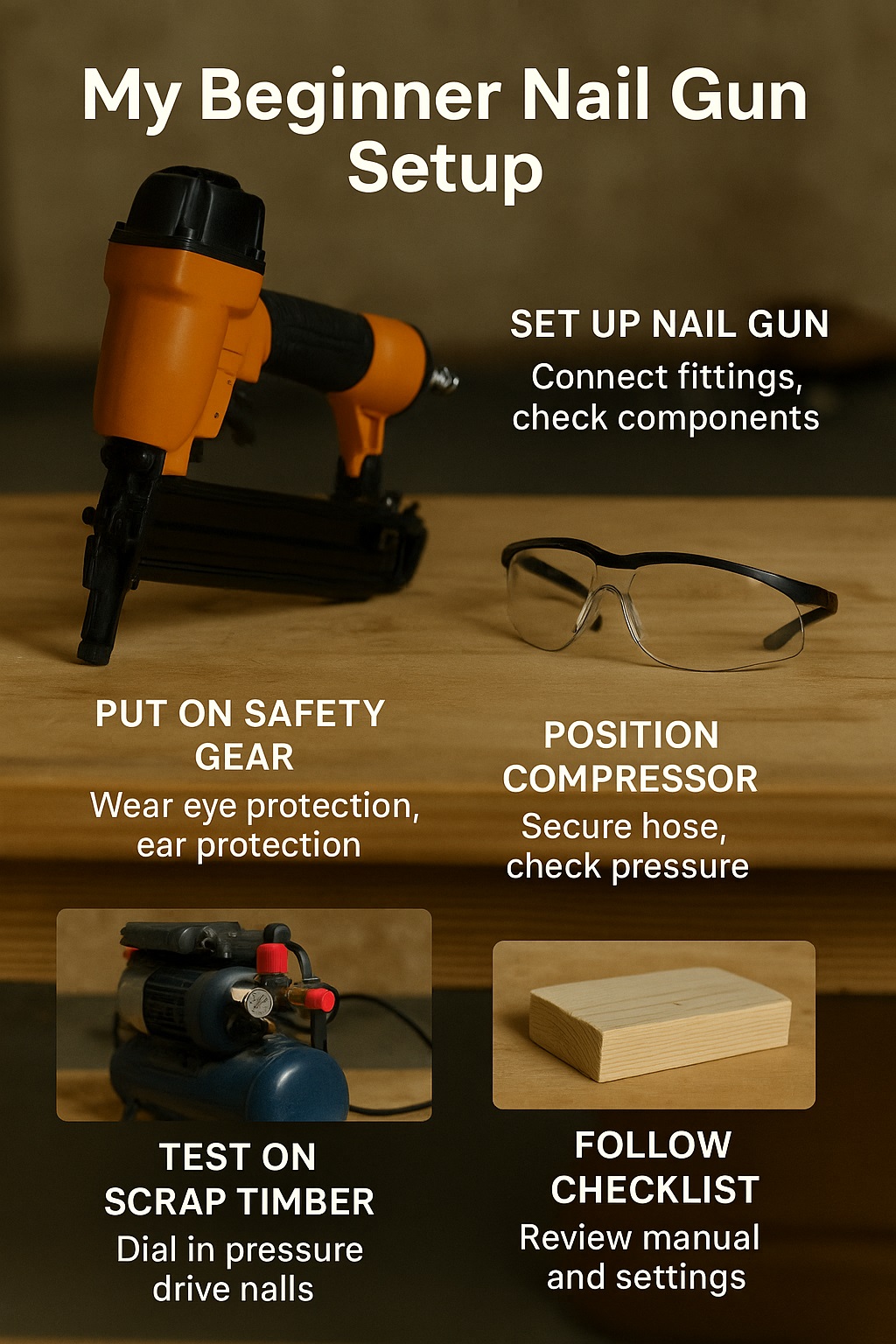
When I first bought a nail gun, I was excited and slightly terrified, so I built a simple routine that takes me from box to first nail without drama, blood, or dented studs.
This step-by-step nail gun setup guide walks any beginner nail gun user from unpacking to a safe first nail, covering tools, pressure, stance, and simple safety checks so every shot feels controlled, accurate, less stressful, and more fun on both DIY and job sites.
Beginner nail gun setup quick stats
| Item | Data |
|---|---|
| Typical first-time setup time | 20–40 minutes |
| Common framing nailer pressure | 90–120 PSI (check manual) |
| Typical framing nail lengths | 50–90 mm |
| Recommended scrap timber thickness | 45–90 mm |
| Most common injury areas | Hands and fingers |
Source: cdc.gov
🧠 Why My First Nail Gun Setup Matters So Much
How I Went From “This Looks Scary” to “This Is Just a Tool”
When I first held a nail gun, it felt more like a weapon than a tool. My heart sped up, and my brain replayed every horror story I’d heard. Once I broke the process into calm, boring steps, it stopped being scary and became just another job I could control.
Why I Treat My Nail Gun Like a Mini Rifle
Very early on, an old-school builder told me, “Point it like a rifle, not like a toy.” That stuck. I never aim at anything I’m not willing to nail, even when the hose is off. Thinking “mini rifle” keeps my finger disciplined and my sense of danger switched on.
How Injury Stories Changed My Attitude
Hearing how many tradies shoot nails through their own hands made me rethink shortcuts. I realised injuries rarely come from “bad tools” and mostly come from rushed setups, lazy habits, and pressure to be fast. So I decided I’d rather be the slow, safe guy than the guy at A&E.
Dr. Hannah Li, Chartered Psychologist, says routines that feel “boringly safe” reduce anxiety far better than shortcuts that chase speed and excitement.
🧹 How I Get Ready Before I Even Open the Box
How I Clear My Space So I Don’t Trip and Swear
Before I touch the box, I clear the floor like I’m expecting a safety inspector. Hoses, offcuts, cords, toys, and random junk all move out of my walking path. I want one clean zone where I can move, bend, and turn without hooking a hose or twisting an ankle.
Why I Put on PPE Before I Touch the Gun
I used to think, “I’ll just set it up first, then grab my glasses.” That lasted until a hose popped off and blasted dust into my face. Now, glasses, ear protection, and sturdy shoes go on even for setup. It feels overkill until something unexpected happens, then it feels smart.
Where I Put the Compressor or Gas Canister
I park the compressor in a corner or against a wall, so the hose runs in a simple line to my bench. I avoid tight loops that can catch my feet. If it’s a gas or battery gun, I still choose a safe spot where I won’t knock it off accidentally.
Captain Mark Evans, Commercial Airline Pilot, says checklists done before take-off save more lives than any clever move a pilot makes in the air.
📦 How I Unbox My Nail Gun Without Breaking Anything
Why I Open the Box Slowly Like It’s Fragile
I don’t rip nail gun boxes open like it’s Christmas. I cut the tape, peel the flaps back, and lift things out slowly. Foam, cardboard inserts, and bags all tell me where parts belong. Keeping that packaging means I have a safe way to store and transport the gun later.
Laying Everything Out So I Don’t Miss a Tiny Part
I lay a clean towel on the bench and place each item on it: gun, manuals, oil, fittings, hex keys, spare triggers, and random bits I don’t recognise yet. Then I match them against the parts list. If anything is missing, I stop right there and call the store.
The Quick Visual Check I Always Do
Before any air touches the tool, I look for bent magazines, cracked housings, or wobbly screws. I gently wiggle the nosepiece, handle, and trigger. If something feels loose or cheap, I don’t “see how it goes.” I’d rather swap it early than fight with a faulty gun on a ladder.
Elena Rossi, Certified Quality Engineer, says catching defects before “first use” is cheaper and safer than trying to work around them in the field.
📘 How I Read My Nail Gun Manual Without Falling Asleep
My Simple Manual Skim That Actually Works
I don’t read every word in order. First, I hunt the safety icons, trigger modes, and air pressure recommendations. Then I mark pages about lubrication, jam clearing, and maintenance. Once those are bookmarked, I skim the rest. I don’t need to memorise it; I just need to know where everything lives.
Why Trigger Modes Are a Big Deal for Beginners
The manual explains the difference between sequential firing and bump firing, but I learned the hard way. After a couple of surprise double shots, I locked myself into sequential mode for beginner jobs. One nail, one trigger squeeze, one clean hole. Speed can come later; fingers don’t grow back.
Professor Liam Clarke, Human Factors Engineer, says systems that favour single deliberate actions beat fast “machine-gun modes” when people are still learning.
🛠️ How I Assemble My Nail Gun Step by Step
Connecting Fittings Without Creating a Future Leak
When I fit the air connector, I wrap thread tape neatly and tighten it just enough. Over-tightening is how I used to crack fittings. Now I snug, test, and re-snug. With cordless guns, I always lock the battery out until everything else is confirmed and the workspace is safe.
Checking Guards, Hooks and Bumpers
I install belt hooks or rafter hooks so the gun has a safe parking spot between shots. I check rubber bumpers and guards so I don’t scar finished timber later. Every screw gets a gentle check with the supplied hex keys, but I don’t treat them like lug nuts on a truck.
Testing the Safety Nosepiece by Hand
Before air or power, I press the nosepiece against a scrap block and feel how it moves. It should travel smoothly, spring back firmly, and not stick. If it feels gritty or sticky, I deal with that now. The last place I want jammed movement is when the gun is live.
Dr. Sofia Nguyen, Chartered Mechanical Engineer, says pre-load checks prevent far more failures than fancy redesigns done after something breaks on site.
📏 How I Choose My Nails, Air Pressure and Depth Settings
How I Pick My First Box of Nails
At the start, I kept grabbing whatever nails were cheapest. That backfired with crooked shanks and weird collation angles. Now I match the gun’s spec: angle, collation type, and length. For standard framing, I choose nails long enough to bite solidly into the second member without blowing out the back.
Setting My Starting PSI So I Don’t Blast Through Timber
The manual might say 90–120 PSI, but I don’t jump straight to the top. I start near the lower end and shoot into scrap. If nails sit too proud, I nudge the regulator up in small steps. I’d rather sneak up on perfect depth than fix blown-through holes later.
Dialling In Depth-of-Drive on the Tool
Once pressure feels roughly right, I tweak the depth dial on the gun itself. A small adjustment can move the head from proud to perfectly sunk. I keep my test board nearby and mark a column of shots with each change, so I can actually see the difference and remember it next time.
Coach Daniel Harris, Strength & Conditioning Specialist, says fine-tuning one variable at a time beats changing everything and guessing what actually worked.
🛡️ My Safety Checks Before I Even Touch the Trigger
Listening and Looking for Air Leaks
When I first connected hoses, I just hoped for the best. Now I connect the hose, pressurise slowly, and listen. If I hear hissing, I spray a little soapy water on fittings and watch for bubbles. Fixing a tiny leak now beats a hose whipping around later.
Testing Safety Mechanisms Like a Routine
I press the nosepiece into scrap without touching the trigger; then I pull the trigger without pressing the nose. Nothing should fire in either case. Only when both are engaged should it fire. It’s a simple test, but it tells me if something is seriously wrong before I’m near real framing.
Keeping My Hands and Body out of the Firing Line
I used to rest my supporting hand too close to the line of fire. Now I mentally draw a tunnel where the nail can travel and keep all body parts out of it. I also never fire into unknown voids where nails can deflect off hidden metal and come back at me.
Dr. Patrick O’Neill, Occupational Physician, says most hand injuries come from “helpful hands” holding too close, not from mysterious tool failures.
🎯 How I Fire My First Test Nails on Scrap Timber
Choosing Scrap That Matches the Real Job
If I’m about to frame with dry pine, I don’t test on soggy offcuts. I find scrap similar in species, thickness, and moisture. My test board becomes a little diary of how that gun behaves on that type of timber, so I’m not guessing when it’s time for the real work.
Practising My Stance, Grip and Angle
My first mistake was “diving” at the timber with the gun. Now I stand comfortably, plant my feet, and keep my wrist straight. I hold the gun firmly with one hand and guide lightly with the other if needed. I keep the nosepiece flat, not twisted, so nails go in straight.
Learning From My First Double-Fire
The first time I tried bump firing, I got an ugly double-fire that bent a nail and scared me. After that, I went back to sequential mode until my control improved. These days, if I ever use bump, it’s for repetitive framing, not delicate work or beginner practice.
Sensei Ryo Tanaka, 5th Dan Karate Instructor, says controlled single strikes build better long-term skill than flurries of rushed, sloppy punches.
👥 My Real Customer Story: Guiding a Beginner to Their First Nail
How My Customer Turned Fear into Curiosity
One DIY customer arrived with a brand-new nail gun still sealed. He’d watched a few sketchy online videos and was honestly more scared than excited. I told him I’d walk him through my exact setup routine and promised we wouldn’t touch a real wall until his test board looked good.
Working Through My Checklist Together
We cleared the area, unboxed slowly, laid out parts, and went through the manual highlights. I let him attach the fitting, tighten screws, and perform the safety tests himself while I watched. By the time we connected air, he already understood what “normal” felt and sounded like. His shoulders visibly relaxed.
What Our Test Board Taught Us
We marked rows on the scrap board: different pressures, depth settings, and angles. At first, his nails were proud or over-driven, but within ten shots he could predict the result before pulling the trigger. When he finally nailed two studs together straight and clean, he smiled like a kid again.
Dr. Maria Lopez, Educational Psychologist, says learners who “do the steps themselves” remember more than those who only watch demonstrations.
❓ My Beginner Nail Gun FAQs
My Answer: Can I Ever Skip PPE?
Short answer: no. Every “just one quick shot” I’ve seen ends up louder, dustier, and riskier than expected. Fast little jobs are exactly when concentration is lowest. I keep glasses, ear protection, and proper shoes as non-negotiable, even if I’m only firing a few nails into a test board.
My Answer: What PSI Should I Use?
I treat the manual’s PSI range as the fence and my scrap board as the testing ground. I start near the lower end, shoot a few test nails, and creep up if they sit proud. Different timber densities, nail lengths, and even hose lengths change things, so I always confirm on scrap.
My Answer: What Size Compressor Do I Need?
For framing nailers, tiny hobby compressors can run out of breath fast. I look at the nailer’s air consumption and choose a compressor that comfortably keeps up, not just barely. If the motor runs nonstop and pressure drops between shots, I’m asking for inconsistent depth and annoying delays.
My Answer: How I Store My Nail Gun Safely
When I pack up, I disconnect air or remove the battery first, then clear nails from the magazine. I wipe dust off, add a couple of drops of oil if it’s an oiled gun, and store it in its case. A dead, clean gun on the shelf is my standard.
Dr. Olivia Grant, Chartered Safety Professional, says “protective habits” around tools matter more over a lifetime than any single brand or model choice.
✅ My Key Takeaways From My First Nail Gun Setup
How My Setup Routine Saves Me Time Later
It feels slower to run through a full setup the first few times, but now it actually speeds me up. I don’t waste time chasing weird misfires, depth problems, or leaks. Most issues never appear, because I catch them while the gun is still pointed at scrap, not a real wall.
What I Wish Someone Told Me Earlier
I wish someone had told me, “Your first ten nails should never go into the real job.” Once I accepted that, my stress dropped. A dedicated test board for each job changed everything. Now, when something feels off, I already have a reference point to compare against.
How I Keep Learning With Every Shot
Even now, I still adjust my routine when I find a better way. New timber, new gun, or new nails all get the same respectful process. If something surprises me, I don’t hide it; I add it to the checklist. My ego recovers faster than a punctured finger ever will.
Dr. Ethan Brown, Behavioural Economist, says people who “bake learning into habits” compound tiny safety gains into huge long-term benefits.
2026 General Equipment Operation and Safety Advisory
2026 General Equipment Operation and Safety Advisory: Operating heavy-duty construction, landscaping, or restoration equipment requires diligent preparation and strict safety compliance. Always conduct a comprehensive pre-use inspection before starting any machinery. Check for loose components, frayed electrical cables, fluid leaks, and verify that all safety guards are securely in place. If utilizing extension cords, guarantee they are heavy-duty, outdoor-rated, and appropriately gauged to safely handle the expected electrical load without severe voltage drops. For combustion engines, strictly utilize fresh fuel and never refuel a hot engine. Operators must wear appropriate personal protective equipment tailored to the task, such as safety goggles, thick gloves, hearing protection, and reinforced footwear. Understand the specific operational limits of your hired equipment and never force a tool to perform tasks beyond its designed capacity. Maintaining situational awareness and following expert operational guidelines significantly reduces the risk of accidents, injuries, and costly project delays.
Hire professional-grade equipment from 7 Hire. We offer fast local pickup or delivery across Auckland.