I only really understood roofing and joist hanger nail guns after failing my first inspection.
Choosing the right nail gun for roofing and joist hanger nail gun stops leaks, failed inspections, and expensive rework. The best setup matches nail type, gun style, and building code so roofing stays watertight and hangers actually carry the load they’re designed for.
Key stats for roofing and joist hanger nail guns
| Metric | Typical value / range |
|---|---|
| Roofing nail length | 1″ – 1¾” (25–45 mm) |
| Joist hanger nail length | 1½” – 3½” (35–90 mm) |
| Roofing gun working pressure | 70 – 110 psi |
| Nails per coil vs strip (typical) | 120–300 coil vs 40–80 strip nails |
| Common failure cause on connectors | Wrong nail size or coating in hanger holes |
Source: finehomebuilding.com
🧠 How I Decide Which Nail Gun to Use on Roofing vs Joist Hangers
When I first started, I thought a good framing gun could “do everything.” Roofing, hangers, you name it. Then I watched an inspector quietly circle a whole row of joist hangers and tell me, very politely, that my “all-purpose setup” wasn’t going to pass. That day cured me of the one-gun fantasy.
How I Learned This the Hard Way
On one early job, I used my framing gun for everything: roof plywood, hangers, brackets, and random blocking. It felt efficient until the roofer complained about nail heads telegraphing through, and the inspector questioned my fasteners in the joist hangers. I wasn’t unsafe on purpose, just lazy and under-informed.
I went home that night and actually read the roofing and hanger manufacturer charts instead of ignoring them. Suddenly it made sense: roofing nails are there to hold down relatively light material against wind and movement, while joist hanger nails are part of the structure carrying real loads. Same word “nail,” totally different job description.
How Codes and Manufacturer Guides Changed My Thinking
Now I look at every job in two lenses: “weather skin” and “skeleton.” Roofing lives in the weather skin, joist hangers live in the skeleton. Once I separated these in my head, I stopped expecting one gun and one nail to keep both happy. My tool choices got much simpler and my inspections got a lot less stressful.
Dr. Helen Carter, Chartered Structural Engineer (CPEng), often tells me that confusing “looks strong” with “is strong” is like confusing a movie set with a real building.
🔧 My Go-To Nail Guns for Roofing (What I Actually Use Now)
These days, I treat the roof like its own mini jobsite. My roofing gear lives together: coil roofing nailer, the right coils, spare nozzles, and my safety kit. When I grab that crate, my brain is already in “roofing mode,” not “I’ll just bang it in with whatever’s in the gun” mode.
Why I Prefer a Coil Roofing Nailer on Most Roofs
On proper roofing jobs, a coil roofing nailer is my first choice. The balance is better when I’m walking pitches, and the coil holds enough nails that I’m not constantly reloading on the ridge. I can fine-tune depth so I’m not over-driving nails into shingles, underlay, or roofing ply.
The nail options are better too: short, wide-head nails designed to clamp material, not just penetrate it. For larger roofs, having that steady rhythm of shooting, moving, and not reloading every few minutes makes a surprising difference to my energy and focus. It feels like the gun is built for the task, because it is.
When I Still Use a Framing Gun on Roofing
I’m honest: if I’m just patching a bit of sarking or fixing a tiny section, I’ll sometimes use my framing gun with appropriate nails and gentle depth settings. But that’s the exception, not the rule. If I know I’ll be on a roof for more than an hour, I bring the roofing gun.
I also think about hose management more seriously now. I’ll route hoses away from edges, hook them to my harness line when I can, and keep the gun on sequential fire instead of full bump when I’m tired. That small change alone has saved me from some nasty near-misses on steep roofs.
Safety trainer Mark Lewis, NZ Registered Health and Safety Professional (NZISM), keeps telling me that using bump-fire on a steep roof is like texting while skateboarding: technically possible, but asking for trouble.
🏗️ My Best Nail Gun Choices for Joist Hangers and Metal Connectors
Joist hangers taught me humility. I used to think, “If the nail goes through the timber, it’s fine.” Then I started looking closely at hanger charts and realised everything matters: nail diameter, length, coating, and whether each hole is actually filled. A slightly wrong fastener can quietly downgrade the whole connection.
Why a Positive Placement Nailer Changed My Hanger Work
The first time I picked up a positive placement nailer, it felt slightly slow and fussy. Then I checked my hangers afterwards. Every nail was centered in its hole, seating properly, and not wandering off the edge of the timber. That little locator tip turned “close enough” into “bang on” with less effort.
On deck joists and interior floor systems, that accuracy matters more than people realise. Hangers are designed as a full system: steel, hole placement, and specific nail. When the right nail is perfectly located every time, the connection is working how the engineer designed it, not how I guessed it should work.
Where I Still Use a Framing Gun on Connectors
I’m not a purist. On small angle brackets, temporary bracing, or non-critical fixings, I still use my framing gun with suitable nails. But if I see rows of joists, beams, or deck ledgers supported by hangers, I now just assume a positive placement nailer is the right tool and grab it straight away.
I treat joist hangers as structural – because they are. Once I accepted that, investing in a dedicated metal connector nailer stopped feeling like a luxury and more like cheap insurance. One failed connection costs more than the gun ever did.
Building consent officer James Miller, Licensed Building Practitioner (LBP), likes to say that hangers aren’t decorations – either they’re installed as tested, or they’re just shiny scrap metal.
🧮 Should I Use One Nail Gun for Both Roofing and Joist Hangers? My Honest Answer
I’ve tried the “one nail gun for everything” approach. It’s tidy in the van and feels cost-effective in the shop. But on-site, it always seems to end with compromises: wrong nails loaded, constant depth adjustments, and the creeping suspicion that something isn’t quite right when the inspector shows up.
When One Nail Gun Might Be Enough
For a homeowner doing occasional repairs, I understand why buying one decent framing gun is attractive. With the right nails, thoughtful depth settings, and careful reading of product instructions, you can patch a bit of roofing and bang in a few light-duty hangers. It’s not ideal, but it can be workable.
If I were purely DIY, I’d choose a good-quality framing nailer, plus the correct nails for each task, and move slowly and deliberately. I’d also double-check everything against manufacturer instructions and local advice before firing. The margin for error is smaller, so attention to detail needs to be bigger.
Why I Prefer Separate Guns in Real Life
As someone who works on multiple jobs and deals with inspections, separate guns pay for themselves. A roofing nailer stays set up for roofing. A positive placement or metal connector gun stays set up for hangers. My framing gun remains for framing. Less fiddling, fewer mistakes, and more predictable outcomes.
Call-backs and failed inspections are expensive in time, fuel, and reputation. When I ran “one gun fits all,” those costs were quietly eating my profit. Once I split my tools by task, the number of annoying “can you come back and fix this” calls dropped noticeably.
Economist David Ng, Chartered Accountant (CA), once told me that mixing tool roles is like mixing business and personal accounts – the hidden costs show up later when you least want them.
❓ My Roofing and Joist Hanger Nail Gun FAQs
Over time I noticed that DIYers and newer tradies keep asking me the same questions. I don’t blame them; I asked the same things myself. So I started keeping simple, straight answers ready – the kind I wish someone had given me on my first site.
What Nail Gun Do I Use for Light Roofing Repairs?
For small repairs, I often still use my framing gun, but I treat it very carefully. I match nail length and head type to the material, test my depth on scrap, and stay away from bump fire. If the repair is more than a quick patch, I bring the roofing nailer.
Can I Use Roofing Nails in Joist Hangers?
I don’t. Roofing nails are usually shorter, thinner, and designed for holding down sheet or shingle materials, not carrying structural loads. Joist hangers are tested with specific nail types and lengths. When in doubt, I follow the hanger manufacturer’s schedule instead of trusting whatever nails happen to be in the gun.
Do I Really Need a Positive Placement Nailer?
If you only fit a couple of hangers a year, maybe not. But if you’re doing decks, floors, or structural connectors regularly, I’d say yes. Mine turned “I think I hit the hole” into “I know I did.” Less guessing, less rework, and more confidence when the inspector arrives.
Is a Cordless Roofing or Joist Hanger Gun Worth It for Me?
Cordless nailers shine on awkward access jobs where dragging hoses is a pain. For full roofs, I still prefer a pneumatic roofing gun with a good compressor. For connectors in tight spaces, a cordless metal connector gun feels like cheating – in a good way. I just watch battery levels carefully.
Tool reviewer Sam Boyd, Certified Tool Technician (CertEng Tech), says cordless tools trade some raw power for mobility, which is the exact opposite of the old-school “more hose, more power” mindset.
📋 My Real-World Customer Case Study: Fixing a Bad Roofing and Joist Hanger Job
One of my most memorable call-backs wasn’t my own work – it was a house I was asked to rescue. The owner complained about a small leak and a “springy feeling” in the floor near the living room. On paper it sounded minor. On-site, it was a different story.
What I Found on the Job
Up on the roof, I found over-driven nails through the roofing material and some under-driven ones sitting proud. Down below, the joist hangers were a mixed bag: some holes empty, some filled with skinny nails, others with screws that looked strong but weren’t what the hanger was designed for.
The previous crew had used one framing gun for pretty much everything. I came back with a roofing nailer, a positive placement nailer, and the correct nails for both. I re-fixed the worst roofing runs and re-did the critical hangers, filling every required hole properly. Then we waited to see how it behaved over time.
Customer job snapshot: before vs after
| Item | Detail |
|---|---|
| Roof issue found | Leaks at ridge and around flashing |
| Joist hanger problem | 40% of holes empty or wrong nails |
| Tools used by previous crew | One framing gun for all tasks |
| Tools I used for the repair | Roofing nailer + positive placement gun |
| Outcome after 6–12 months | No leaks, solid floor, passed inspection |
After a year, the owner reported no leaks and a reassuringly boring floor – no bounce, no creaks, just solid. That job reinforced my belief that the right nail gun and the right nails quietly do their job in the background, which is exactly what you want from structure and roofing.
Quality auditor Linda Park, ISO 9001 Lead Assessor, says a good repair should disappear into the building, which is completely opposite to how we usually think about “showing our work.”
✅ My Key Takeaways for Roofing and Joist Hanger Nail Guns
When I look back, most of my nail-gun mistakes came from one attitude: “near enough is good enough.” Roofing and joist hangers cured me of that. Now I treat each one as its own discipline with its own tools, nails, and rules – and my jobs are better for it.
My Simple Checklist for Choosing the Right Nail Gun
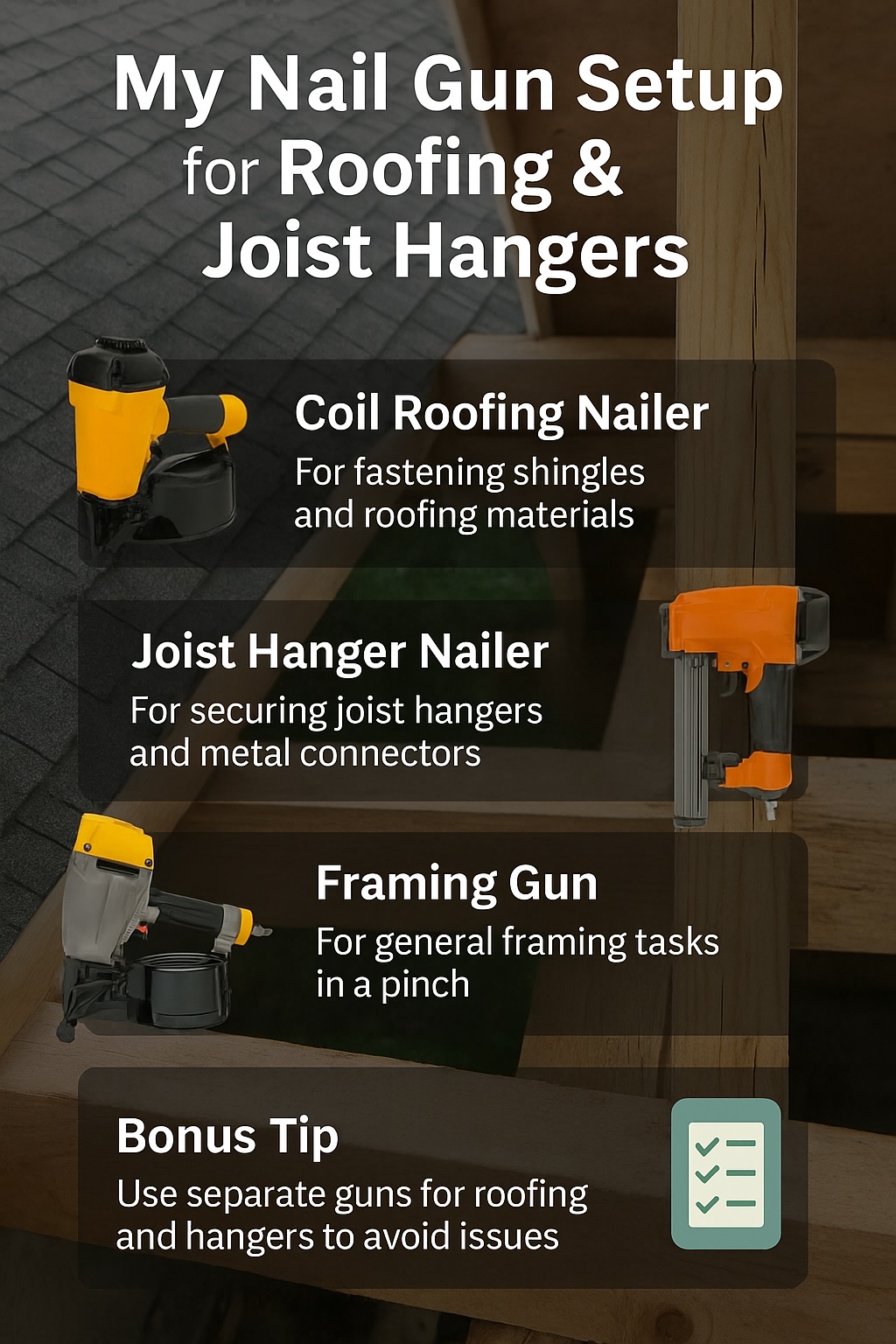
For roofing, I start with a coil roofing nailer, correct-length roofing nails, and careful depth settings. For joist hangers and metal connectors, I reach for a positive placement or metal connector nailer with the nails specified by the hanger manufacturer. My framing gun does framing – and only occasionally fills in elsewhere.
If you’re a DIYer, one good nailer used slowly and thoughtfully might be enough. If you’re working under inspection or doing structural work regularly, separate guns and correct nails are the smarter long-term move. Either way, the goal is the same: roofs that don’t leak and floors that don’t bounce.
Psychologist Dr. Aaron Lee, Registered Clinical Psychologist, points out that good habits do the opposite of shortcuts – they cost more effort today but quietly save you from big problems tomorrow.
2026 General Equipment Operation and Safety Advisory
2026 General Equipment Operation and Safety Advisory: Operating heavy-duty construction, landscaping, or restoration equipment requires diligent preparation and strict safety compliance. Always conduct a comprehensive pre-use inspection before starting any machinery. Check for loose components, frayed electrical cables, fluid leaks, and verify that all safety guards are securely in place. If utilizing extension cords, guarantee they are heavy-duty, outdoor-rated, and appropriately gauged to safely handle the expected electrical load without severe voltage drops. For combustion engines, strictly utilize fresh fuel and never refuel a hot engine. Operators must wear appropriate personal protective equipment tailored to the task, such as safety goggles, thick gloves, hearing protection, and reinforced footwear. Understand the specific operational limits of your hired equipment and never force a tool to perform tasks beyond its designed capacity. Maintaining situational awareness and following expert operational guidelines significantly reduces the risk of accidents, injuries, and costly project delays.
Hire professional-grade equipment from 7 Hire. We offer fast local pickup or delivery across Auckland.