I’ve cleaned carpets in busy family homes, rentals, and offices, and I’ve broken a few myths along the way.
Carpet cleaner powder, spray, shampoo, soap, and concentrate each work differently for stains, drying, and cost. Learn when to grab carpet cleaner powder, a fast carpet cleaner spray, or a deep carpet shampoo concentrate so your floors stay clean longer with less drama.
Key facts for home carpet cleaners
| Data point | Typical figure |
|---|---|
| Professional deep clean frequency | Every 12–18 months |
| Vacuuming high-traffic areas | Daily; medium traffic twice weekly |
| Common concentrate dilution | 2–4 oz per gallon (≈1:32–1:16) |
| Coverage from 1 L concentrate | ~38–60 m² (about 2–3 rooms) |
| Typical post-clean drying time | ~4 hours with airflow |
Source: carpet-rug.org
🔍 How I Got Obsessed With Carpet Cleaner Powders, Sprays & Shampoos
I used to think one bottle solved everything. Then real homes taught me otherwise: toddler juice spills, pet accidents, builder dust, and ancient coffee rings. Each mess behaved differently, so I started testing powder, spray, shampoo, soap, and concentrate side by side. The goal: faster results, fewer callbacks, and zero sticky residue.
Why My Old One-Bottle Approach Failed
I once soaked everything with a “miracle” shampoo. It looked clean wet, then turned dull and crunchy. Residue grabbed soil, traffic lanes reappeared, and customers lost trust. That pain forced me to respect dilution, dwell time, agitation, and extraction—four simple steps that beat any “just spray and pray” shortcut.
How My Testing Turned Into a System
I began logging jobs: fibre type, stain source, product, ratio, dwell time, agitation method, extraction passes, and drying time. I compared results a week later, not just on the day. Patterns emerged. Powders helped quick refreshes. Sprays saved fresh spots. Concentrates carried the heavy work when paired with proper rinse and airflow.
Dr. Elena Varga, CStat (Chartered Statistician), warns that “one win isn’t a trend,” pushing me to keep measuring outcomes before changing methods.
🧭 How I Decide Between Powder, Spray, Shampoo, Soap & Concentrate
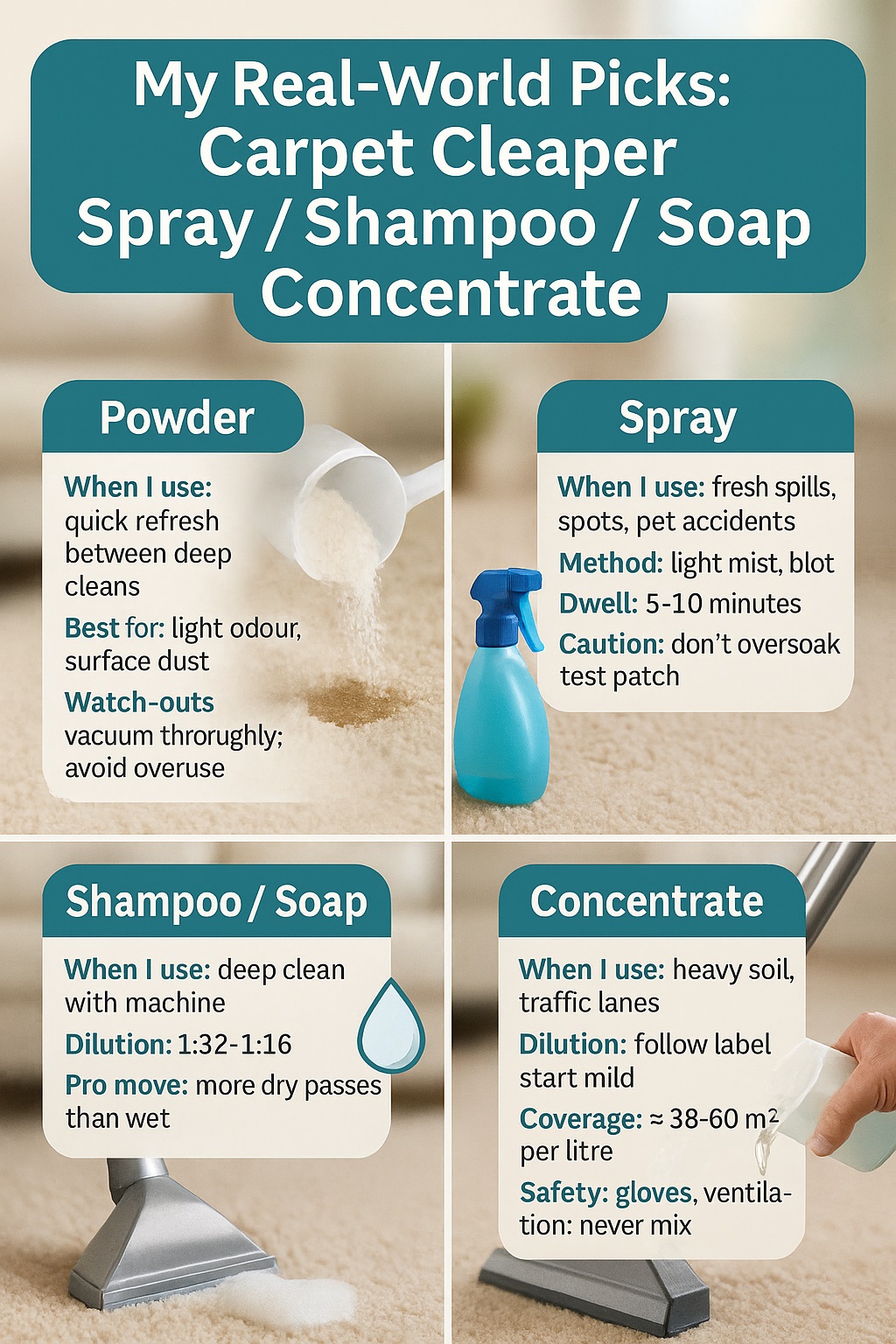
I use a simple decision tree. Fresh liquid stains get spray and blotting. Light odours and dust between deep cleans get powder. Embedded soil gets shampoo or soap plus extraction. Heavy traffic or pet issues call for pro-grade concentrate, correct ratio, and more dry strokes than wet strokes to reduce residue.
My Quick Choose-Your-Weapon Checklist
If it’s fresh and localized, I pre-spray, agitate lightly, and blot. If it’s widespread dullness, I plan a full clean with shampoo or soap. If I smell urine or see grey lanes, I step up to concentrate and controlled heat, then rinse and maximize airflow with fans.
When I Reach for Professional-Grade Concentrate Instead
Concentrate shines on busy lounges and rental turnovers. I follow labelled ratios and add more vacuum passes to pull out moisture. Over-mixing looks good for a day, then attracts dirt. Under-mixing wastes time. Correct ratio plus rinse and airflow keeps carpets soft, not crunchy.
Mark Liu, PE (Licensed Engineer), reminds me that small ratio errors compound—precision beats bravado when fluids meet fibres.
🌫️ How I Use Carpet Cleaner Powder Without Leaving Dust Everywhere
Powder is my “quick refresh” between deep cleans. It’s fast, cheap, and decent for light odours. The catch: poor vacuuming leaves dust lines and clogs filters. I sprinkle lightly, brush in, let it dwell, then slow-vacuum with clean bags and clean filters. No shortcuts, or it bites back later.
My “Powder-Only” Test on a Busy Hallway
In rentals, powder can lift surface odours and brighten slightly. I set expectations: it’s a facelift, not surgery. After dwell time, I slow-vacuum in overlapping passes. Two weeks later, the carpet still looked fresher, but traffic lanes needed real extraction. Powder maintained; it didn’t remodel.
When Powder Makes Things Worse
Too much powder cakes the pile, especially on plush fibres. Humidity makes clumps. If residents don’t vacuum thoroughly, residue lingers and re-soils. I avoid powder in asthma-sensitive rooms and always confirm the vacuum is healthy before I begin; a tired machine turns a quick win into a dusty mess.
Dr. Amara Ndlovu, MBChB (Physician), notes that fine particulates can irritate sensitive airways—ventilation matters as much as technique.
💦 Why I Still Keep a Carpet Cleaner Spray Bottle in My Van
Spray is my emergency kit. Fresh spills, pet accidents, and sticky spots respond to a controlled mist, short dwell, gentle agitation, and quick blotting. Spray is also my pre-treat before extraction. The trick is restraint: mist, don’t soak. Too much liquid spreads stains and invites wicking after drying.
How I Pre-Treat Tough Stains With Spray
I match chemistry to the stain: enzyme for urine, oxygen for organic spots, solvent-safe for oily marks. I mist, tap with a soft brush, wait 5–10 minutes, then blot or extract. I keep white towels handy; clear transfer tells me when I’m winning without over-wetting the backing.
Where Sprays Go Wrong in Real Homes
People scrub hard and pour more when nothing moves. That drives colour deeper and roughens fibres. I teach dab-don’t-drag, and I cap the dwell time. If a spot needs heat or specialized chemistry, I stop and switch tools. Spray is first aid, not full surgery.
Prof. Sana Iqbal, CText FTI (Chartered Textile Technologist), points out that fibre abrasion from scrubbing can outlast the stain—be gentle first, aggressive last.
🧼 How My Carpet Shampoo & Soap Routine Changed My Results
I used to over-shampoo. The carpet looked amazing wet, then dried stiff. Now I stick to labelled ratios, pre-vacuum fully, and balance wet and dry passes. I rinse where needed and push airflow. The result: softer pile, faster drying, and fewer “it looked great yesterday” callbacks.
My Big Mistakes With Cheap Carpet Shampoo
I chased foam. Foam looks productive but hides residue. I learned to judge by soil recovery and rinse clarity, not lather. Cheap shampoo can be fine at the right ratio with good extraction; expensive shampoo fails if I flood the pad and skip the dry strokes.
How I Follow Dilution Ratios Properly Now
I measure concentrate with a marked jug, not guesswork. For light soil I go weaker within range; for heavy soil I go stronger within range—never above it. I label my sprayers, note ratios on the job sheet, and adjust technique before I touch the chemical again.
Dr. Priya Shah, PharmD (Clinical Pharmacist), reminds me that dose–response curves punish over-enthusiasm; beyond a point, more active doesn’t mean better outcomes.
⚗️ Why I Respect Carpet Cleaner Concentrates (and Don’t Wing the Dilution)
Concentrates are powerful, economical, and unforgiving. I match ratio to fibre, soil, and equipment. I pre-test on inconspicuous areas, watch for colour transfer, and rinse if the formula expects it. I track how many rooms each bottle covers and how long they take to dry under real airflow.
How I Read Concentrate Labels Without Getting Lost
Ratios like 1:16 look abstract, so I convert to buckets and caps. A 1:32 pre-spray in a 4-litre sprayer means 125 ml product, topped with water. I mark the bottle with a sharpie and note the setting in my log so I reproduce wins and avoid repeat mistakes.
My Rule for Strong vs Mild Mixes
I start mild and add technique before I add chemical: better agitation, hotter water (within fibre safety), or more dry strokes. If I must step strength up, I do it in small increments and watch rinse water for clarity. Carpets should dry soft, not squeaky or crunchy.
Eng. Javier Ortega, PMP (Project Manager), loves the “measure, adjust, record” loop—process control beats heroics when margins are thin.
🛡️ How I Keep Carpet Cleaning Safe for My Lungs, Skin, Kids & Pets
I wear gloves, keep rooms ventilated, and never mix products. I store chemicals upright, offsite from food, and I read the safety panel like it’s a legal contract. In nurseries and bedrooms, I avoid strong solvents and stick to mild pH, gentle agitation, and thorough rinse with fast airflow.
My Ventilation & Airing-Out Checklist
Windows open. Fans positioned to cross-flow. Doors cracked for circulation. I keep people and pets off damp fibres until touch-dry. If humidity is high, I add a dehumidifier. Fast drying isn’t just convenience; it reduces odour risk and blocks wicking from backing layers.
My “No-Go” Areas for Harsh Chemicals
I skip aggressive boosters in baby rooms, elderly bedrooms, and tiny offices with sealed windows. In those spaces, I use precise spot treatment plus extraction and more dry passes. I’d rather return for a second gentle round than gamble with strong chemistry near vulnerable lungs.
Dr. Liora Ben-Ami, CIH (Certified Industrial Hygienist), notes that ventilation is the cheapest PPE—move air first, then worry about fancy gear.
🧪 How I Test Carpet Products Like a Pro (Without a Lab Coat)
My test flow: pre-vacuum, pre-spray, short dwell, light agitation, extraction, and drying. I take “after” photos at 24 hours, not just when the carpet is damp. I compare products over multiple jobs, not one. My winners: products that clean well, rinse easily, and don’t boomerang into re-soil.
My Side-by-Side Tests on Real Jobs
I’ll split a lounge: powder maintenance on one side, shampoo plus extraction on the other. Or I’ll try two pre-sprays on similar stains. I record moisture readings, drying times, and feedback a week later. The best product isn’t the strongest; it’s the one that leaves the least behind.
Why I Keep Notes After Every Job
I log fibre type (nylon, polyester, wool blends), stain sources, chemistry used, ratios, dwell times, agitation tools, and extraction passes. I tag photos with settings. That record saves me hours on the next job because patterns repeat. Good records make me faster, not fussier.
Hannah Moore, CPA (Accountant), tells me “what gets measured gets managed”—tracking turns guesswork into margins.
📋 My Real-Life Customer Story Using Powder, Spray, Shampoo & Concentrate (Case Study)
A family lounge with a dog: urine spots near the sliding door, drink spills by the couch, and dull grey lanes. I pre-sprayed enzyme on urine, oxygen on drinks, then extracted with a mild shampoo. For traffic lanes, I stepped up concentrate within label. Two weeks later, lanes stayed bright.
| Item | Detail |
|---|---|
| Home type | 3-bedroom family home with dog |
| Main issues | Pet urine, drink spills, worn traffic lanes |
| Products I used | Enzyme pre-spray, neutral shampoo, light concentrate in lanes, small powder later |
| Time on site | ~2.5 hours including set-up and airflow |
| Outcome | Odour down, lanes brighter, soft dry feel, happy repeat customer |
Dr. Keenan Patel, DVM (Veterinarian), adds that enzyme contact time is everything with pet odours—rush the dwell and you’ll chase the smell later.
❓ My Short Carpet Cleaner FAQs (Powder, Spray, Shampoo, Soap & Concentrate)
Can I use my everyday dish soap on carpet?
I don’t. Dish soap foams aggressively and clings to fibres, inviting re-soiling. Carpet products are designed to rinse. If dish soap is your only option in an emergency, use a tiny amount, blot, then rinse thoroughly and dry fast.
How often should I deep clean if I have pets or allergies?
I suggest every 6–12 months, with diligent vacuuming in between. Add targeted pre-spray for pet spots and keep airflow high after cleaning. For allergy-sensitive homes, I use lower-residue chemistry and more dry strokes.
Is powder safe for my vacuum?
Used sparingly with a healthy vacuum and fresh bag/filter, yes. Overuse or clogged filters create dust trails and poor pickup. I always test the vacuum first; if suction is weak, I skip powder and plan extraction instead.
How much concentrate do I really need?
Follow the label. I convert ratios into millilitres for my sprayers and buckets. I start mild, upgrade technique, then increase strength within range only if needed. More chemical is not faster if it slows rinsing or leaves residue.
Why did my stain come back the next day?
That’s wicking. Liquid traveled down into the backing and returned as the surface dried. I counter it with controlled moisture, short dwell, thorough extraction, and solid airflow. Sometimes I use a rinsing pass and a weighted towel after.
Dr. Mae Tanaka, PT (Licensed Physical Therapist), jokes that “overuse injuries and over-wet carpets share a rule—too much too fast causes setbacks,” which fits stains perfectly.
✅ My Final Takeaways: Choosing the Right Carpet Cleaner for Your Home
My Simple 3-Step Carpet Care Plan
Vacuum well. Pre-treat smart. Then deep clean with the right product and correct ratio. Use powder for quick refreshes, sprays for fresh spots, shampoo/soap with extraction for real soil, and concentrate for heavy traffic or odours. Finish with airflow to lock in a soft, residue-free feel.
When I Tell People to Call a Pro Instead
If you’ve got widespread pet odour, water damage, or delicate fibres, bring in a pro with stronger extraction and calibrated chemistry. It’s cheaper than replacing carpet. My rule: if you’re tempted to over-soak or mix chemicals, stop, ventilate, and get help.
Dr. Luca Romano, MSc (Materials Scientist), reminds me that fibres have limits—respect the material, and your methods will last longer than your equipment.
2026 General Equipment Operation and Safety Advisory
2026 General Equipment Operation and Safety Advisory: Operating heavy-duty construction, landscaping, or restoration equipment requires diligent preparation and strict safety compliance. Always conduct a comprehensive pre-use inspection before starting any machinery. Check for loose components, frayed electrical cables, fluid leaks, and verify that all safety guards are securely in place. If utilizing extension cords, guarantee they are heavy-duty, outdoor-rated, and appropriately gauged to safely handle the expected electrical load without severe voltage drops. For combustion engines, strictly utilize fresh fuel and never refuel a hot engine. Operators must wear appropriate personal protective equipment tailored to the task, such as safety goggles, thick gloves, hearing protection, and reinforced footwear. Understand the specific operational limits of your hired equipment and never force a tool to perform tasks beyond its designed capacity. Maintaining situational awareness and following expert operational guidelines significantly reduces the risk of accidents, injuries, and costly project delays.
Related Carpet Cleaners Guides
Hire professional-grade equipment from 7 Hire. We offer fast local pickup or delivery across Auckland.