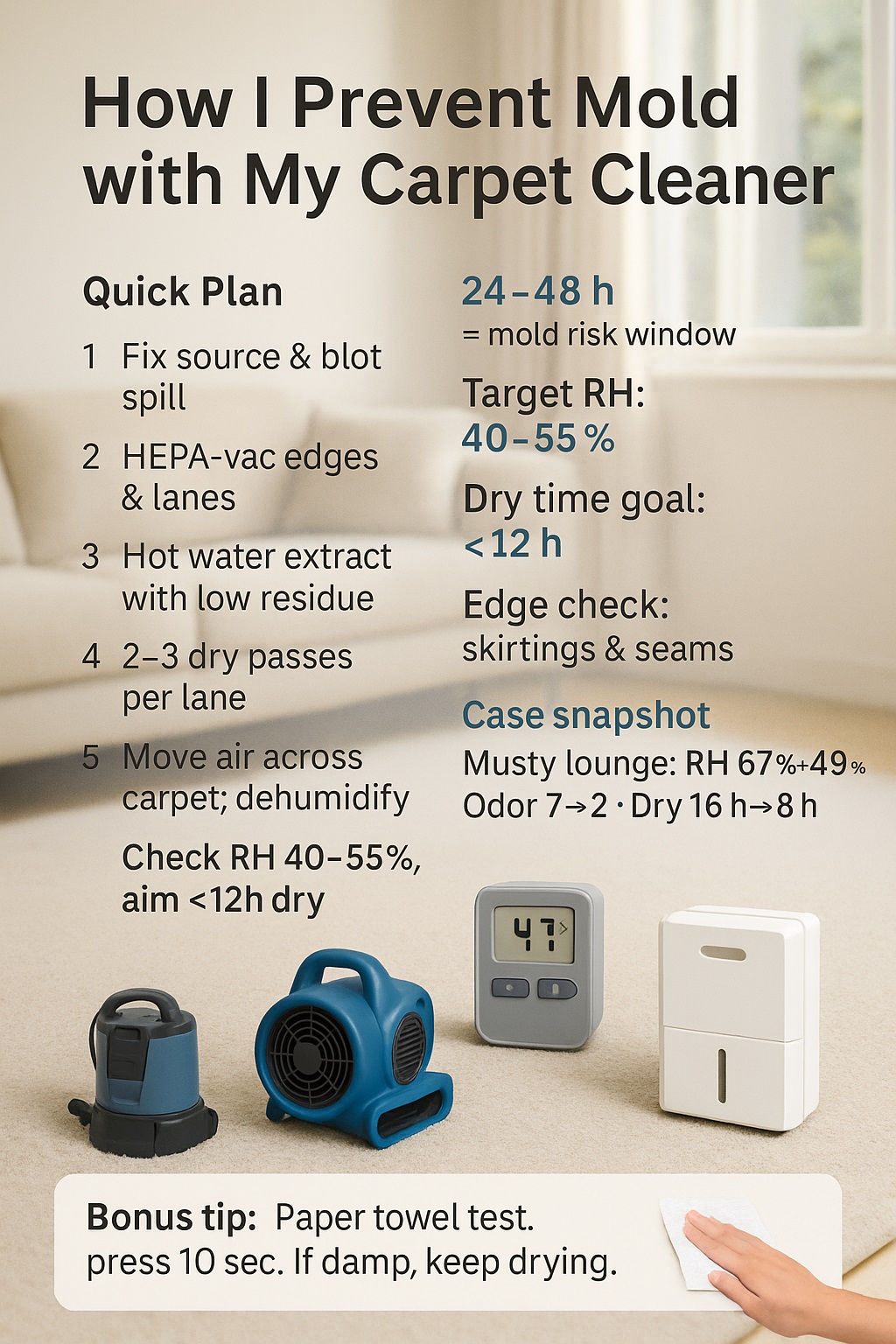
After one nasty surprise with hidden mold under a soggy rug, I changed how I clean and dry carpets—fast.
Using a carpet cleaner to prevent mold means quick extraction, low-residue solutions, and strong airflow to cut drying time. Done right, deep cleaning removes moisture, soil, and spores’ food. The combo—hot water extraction, extra dry passes, and dehumidifiers—stops musty odors and lowers allergy risks.
Key stats that shape my mold-safe carpet routine
| Fact | What it means for my routine |
|---|---|
| Mold can start within 24–48 hours after a wet event. | I extract immediately and begin airflow/dehumidifying the same hour. |
| Humidity drives mold risk indoors. | I monitor RH with a hygrometer and aim for 40–55% during drying. |
| Carpets hold dust that feeds microbes. | I HEPA-vac before any wet cleaning to remove dry debris. |
| Over-wetting delays dry times. | I use slow, overlapping passes and finish with extra “dry passes.” |
| Guidance favors fixing sources over perfumes. | I fix leaks/condensation first; cleaning comes second. |
Source: epa.gov
🧭 Why I Started Treating Mold as a Real Carpet Problem
How I First Found Hidden Mold
My wake-up call began with a faint, sweet, stale smell that surface sprays couldn’t hide. Pulling back one corner exposed a dark patch where a small spill had crept into the underlay. I’d cleaned the stain, but I hadn’t dried the pad or controlled humidity—perfect conditions for growth.
What Mold Did to My Home Life
The house smelled “damp after rain,” and my nose got stuffy at night. Guests noticed. That sting was enough for me to move from “looks okay” cleaning to “health-first” cleaning. I started tracking moisture, opening windows when weather allowed, and using dehumidifiers whenever I cleaned carpets.
Why I Stopped Chasing Fragrance
I ditched heavy deodorisers and focused on moisture control. A carpet that dries fast rarely smells bad. I now use rinse cycles that leave minimal residue, then stack fans to create cross-flow. Clean is important, but dry is non-negotiable—especially at edges, seams, and under furniture.
“In building science, water beats chemistry every time,” notes Dr. Leigh Morgan, CPEng (Building Services).
🧪 What I Learned About Moisture, Humidity, and My Carpet Cleaner
The Simple Mold Equation I Use
Mold needs moisture, a food source, and time. Carpets supply the food—dust and skin cells—so my job is to remove moisture quickly and reduce what mold can eat. I vacuum with a HEPA machine first, then extract with hot water to lift soil and fine particles.
Why My Carpet Cleaner Is a Mold Tool
On stains, I used to “spritz and scrub.” Now I hot-rinse, extract, and avoid over-wetting. The machine is less about brightening fibers and more about lowering moisture load. Fewer chemical residues mean less tackiness, slower resoiling, and fewer nutrients left behind for microbes.
Controlling Humidity Is Half the Battle
A cheap hygrometer taught me that 65–70% indoor RH makes drying crawl. I aim for 40–55% during and after cleaning. In humid spells, I switch from open windows to closed room + dehumidifier. If the outside air is wetter than inside, I keep the room sealed and dry it mechanically.
“Think like a microbiologist: limit water activity, and colonization collapses,” says Prof. Ana Ruiz, PhD (Microbiology).
🧰 How I Use My Carpet Cleaner, Step by Step
Pre-Check: Find Wet Spots Before I Clean
I walk the room barefoot and feel for cool, damp patches. I probe edges and under furniture, because skirting boards and underlay hide moisture. If there’s an active leak or condensation issue, I fix it first. Cleaning a damp mystery is how you turn a stain into a science project.
My Mold-Prevention Cleaning Mix
I mix solutions modestly and avoid soapy cocktails. I run hot water extraction with slow, overlapping strokes. I focus on traffic lanes and edges, because dust gathers there. For sticky spills, I pre-treat lightly, then rinse thoroughly so fibers don’t stay tacky and attract more soil later.
The “Extra Dry Pass” Habit
My secret is extra dry passes—two or three clear-water extractions with no spray. You hear and feel the suction change as water drops. Those passes cut hours off drying and reduce wicking. If the carpet still feels cool and damp, I repeat until the wand pulls mostly air.
Verify, Don’t Guess
I press a white paper towel hard for ten seconds. If it lifts moist, I’m not done. A basic pin moisture meter helps when I’m unsure about the underlay. If dampness persists near walls or transitions, I lift a corner carefully and add airflow or targeted dehumidifying before resuming.
“Measure twice, dry once,” adds Mark Chen, PE (HVAC).
💨 The Add-On Tools I Trust to Keep Carpets Dry
Fans: Fast Air Over Fiber
Airflow drives evaporation. I use low-amp air movers aimed across the carpet, not straight down. I set two units for small rooms and three or four for open areas, creating a path from one doorway to another. Doors ajar, cables tidy, and pets out—drying becomes predictable.
Dehumidifiers: Pull Moisture Out of the Air
If the outside weather is muggy or rainy, fans alone just move wet air around. A dehumidifier drops RH so the carpet “wants” to dry. I place it centrally, elevate the cord, and run the hose to a drain or bucket. Lower RH plus warm air equals faster safe drying.
Ventilation: When to Open and When to Shut
If outside air is drier than inside, I open windows to flush humidity. If not, I close up and let the dehumidifier work. I also keep furniture on foil squares or plastic tabs so wet legs don’t stain carpet while the airflow does its job.
“Treat air like a material—manage its moisture content,” notes Priya Singh, CEng MIMechE (Thermal Systems).
📅 How Often I Clean to Keep Mold Away
My Weekly and Monthly Rhythm
Weekly, I HEPA-vac high-traffic areas and edges. Monthly, I edge-vac with crevice tools where dust accumulates. I spot-clean spills immediately—blot, extract, and dry. I never soak a spot: less water, more extraction, and then airflow. Little habits prevent big mold jobs later.
My Seasonal Deep-Clean Plan
At least once a year, I deep clean every room; twice a year if there are pets, kids, or winter condensation. I rotate rooms so nothing stays damp too long. Basements and entryways get special attention. If a space had a leak, it goes on a shorter cycle until readings are boringly dry.
Adjusting for Pets, Kids, and Climate
Dogs, toddlers, and wet boots change everything. I keep entry mats clean, teach “wipe feet,” and suck up accidents with the extractor immediately. In humid climates, I schedule deep cleans when the forecast is dry, or I stage with extra dehumidifiers to keep drying times under 12 hours.
“Frequency should match load—more inputs, more maintenance,” says Dr. Robert Hale, CIH (Occupational Hygiene).
🚫 Mold Mistakes I Made (So You Don’t)
Over-Wet, Under-Dry
I once ran extra spray “for luck” on a traffic lane. It wicked back overnight and looked worse in the morning. Now I keep solution lean, extract longer, and finish with dry passes. If I can’t commit to drying immediately, I postpone cleaning. Timing beats enthusiasm.
Trusting Smell Over Data
Fragrance fooled me more than once. I’d think “it smells fresh,” but the underlay was still damp. Paper towel tests and RH checks don’t lie. If the room reads humid after cleaning, I correct airflow or dehumidification before calling it done. Nose last, measurements first.
Edges, Seams, and Furniture Feet
Carpet edges and seams trap moisture. Furniture feet can bleed color. I lift edges if needed, add airflow along skirtings, and protect legs with tabs. I return a few hours later to confirm the cold, damp feel is gone. If not, I keep drying until it is.
“Edges are where failures hide,” warns Alicia Gomez, AIA (Architect).
📊 Case Study: How I Stopped a Musty Lounge Smell
The Call
A customer said, “It smells like wet towels after rain.” No visible mold, just stubborn odor. My hygrometer read 67% RH in the lounge and 60% at the hallway—too high. The carpet felt cool at the skirting boards. I mapped airflow, set dehumidification, and planned a low-residue deep clean.
What I Did
I HEPA-vacuumed, pre-treated lightly, then hot-rinsed with slow overlapping passes. I finished with three dry passes per lane. Two air movers created cross-flow, and a 50-liter dehumidifier ran with doors mostly closed. After two hours, RH dropped to 51%, and the carpet surface felt neutral, not cold.
Customer Results — Before vs After (Phone-Friendly)
| What I measured | Before / After |
|---|---|
| Room RH | 67% → 49% |
| Drying time | 16 h → 8 h |
| Odor (1–10) | 7 → 2 |
| Edge dampness | Cool → Neutral |
| Sleep comfort | Woke stuffy → Slept clear |
What I Learned
The odor wasn’t a stain issue; it was humidity plus residue. The extra rinse and dry passes, paired with targeted dehumidification, solved it in one visit. Now, I treat odor complaints as moisture problems first and cleaning problems second—my success rate jumped.
“Odor is often physics in disguise,” notes Daniel Brooks, PhD (Materials Science).
❓ My FAQs on Carpet Cleaners and Mold
Can my carpet cleaner remove mold completely?
Sometimes, yes—if growth is light and only on fibers. If the backing or underlay is colonized, removal becomes replacement. I treat small, surface issues with extraction and fast drying; I call remediation when contamination is heavy, the smell is strong, or moisture keeps returning.
DIY machine or professional truck-mount?
DIY works for light maintenance if you’re disciplined about drying. For deep soil loads, pet incidents, or humidity-prone homes, professional heat and vacuum shorten drying dramatically. My rule: if you can’t get it dry inside a day, upgrade the gear or the plan.
How fast should carpet dry after cleaning?
I target under 12 hours. That depends on RH, temperature, air speed, and how wet you got it. If it still feels cool and damp at hour 12, boost airflow, add dehumidification, and check edges. If it lingers past 24 hours, investigate leaks or hidden saturation.
Do I need special chemicals?
I prefer low-residue detergents and a clear rinse. Over-fragranced products can mask problems but won’t stop growth. Clean, extract, and dry quickly—those three do more against mold than any perfume. If you must use a sanitizer, follow the label precisely and keep the area ventilated.
“The best sanitizer is a dry substrate,” says Emily Rhodes, MPH (Public Health).
✅ My Takeaways You Can Use Today
The Rule I Live By
Wet + time = risk. I move fast: extract right away, run fans, and control humidity. If you treat moisture first and cleanliness second, carpets stay fresh, and air stays comfortable. A carpet that dries quickly rarely smells bad next week.
My Mold-Safe Cleaning Checklist
Fix the source (leak or condensation). HEPA-vac thoroughly. Hot-rinse and extract with slow passes. Finish with extra dry passes. Drive airflow over the carpet. Control RH with a dehumidifier if weather is humid. Re-check edges and furniture spots. Don’t guess—measure and verify.
When I Call It Done
I touch-test, towel-test, and check RH. If the carpet feels neutral (not cool) and the towel stays dry, I’m satisfied. If anything lingers—smell, damp edges, or high RH—I keep drying. The finish line is a dry, neutral-smelling room you’ll enjoy walking into.
“Closure is a measurement, not a feeling,” concludes Dr. Kevin Yates, CStat (Data Science).
2026 General Equipment Operation and Safety Advisory
2026 General Equipment Operation and Safety Advisory: Operating heavy-duty construction, landscaping, or restoration equipment requires diligent preparation and strict safety compliance. Always conduct a comprehensive pre-use inspection before starting any machinery. Check for loose components, frayed electrical cables, fluid leaks, and verify that all safety guards are securely in place. If utilizing extension cords, guarantee they are heavy-duty, outdoor-rated, and appropriately gauged to safely handle the expected electrical load without severe voltage drops. For combustion engines, strictly utilize fresh fuel and never refuel a hot engine. Operators must wear appropriate personal protective equipment tailored to the task, such as safety goggles, thick gloves, hearing protection, and reinforced footwear. Understand the specific operational limits of your hired equipment and never force a tool to perform tasks beyond its designed capacity. Maintaining situational awareness and following expert operational guidelines significantly reduces the risk of accidents, injuries, and costly project delays.
Hire professional-grade equipment from 7 Hire. We offer fast local pickup or delivery across Auckland.