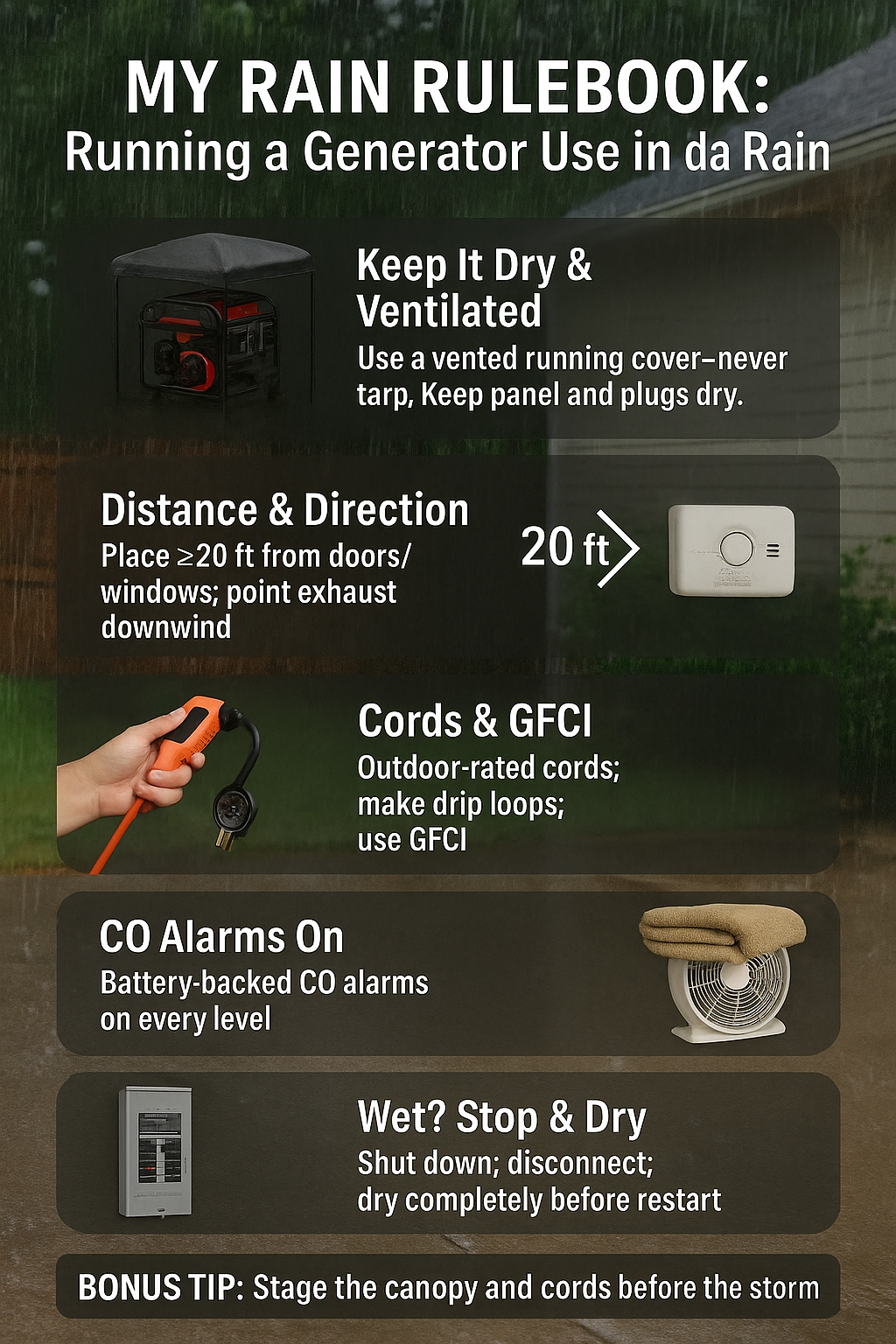
My Rain Rulebook: How I Run a Generator Safely in Wet Weather
I learned fast that storms don’t forgive electrical mistakes—so I built a simple rain-safe plan that I actually use.
Keep portable generators dry, outside, and far from the home. Are generators waterproof? No. Can generator run in rain? Only if kept dry and ventilated under a purpose-built cover. Know when to use a generator cover and keep at least 20 feet from doors, windows, and vents.
Storm-Use Generator Facts (Phone-Friendly)
| Safety/Spec | Guideline |
|---|---|
| Minimum distance from openings | ≥ 20 ft |
| Indoors/garage use | Never |
| Wet operation | Only if kept dry (running cover) |
| CO alarms in home | Yes, battery-backed |
| Typical alternator protection | IP23 (spray, not soak) |
Source: cdc.gov
☔ My Wet-Weather Reality Check: What I Learned First
The first time I tried to run a generator in drizzle, I felt invincible—until I saw water tracing the cord into the outlet panel. That near-miss taught me two truths: water always finds a path, and electricity never negotiates. Now I treat rain like a hostile guest: manage it, or don’t run at all.
I also learned that “almost dry” isn’t dry. Mist in high winds can blow sideways, puddles creep under frames, and cords wick water by capillary action. A deck overhang looks safe until the breeze flips the script and blows exhaust toward the door. My new default: dry, ventilated, downwind, with a real running cover—or I wait.
“If you can’t clearly control moisture and airflow, you haven’t controlled risk,” notes Ava Chen, PE (Licensed Electrical Engineer).
🧭 My Rain Rule: When I Will—and Won’t—Run a Generator
Here’s my plain rule: I never operate a portable generator uncovered in active rain. I run only outside, on high ground, with a vented “running” canopy that keeps water off the outlets and alternator while letting hot exhaust out. If I can’t keep it dry and ventilated, I shut it down. No heroics.
People ask, “Are generators waterproof?” No—portables aren’t. “Will generator run in the rain?” Maybe, but that’s not the safety question. The real question is “generator can it be in the rain safely?” Only if water can’t intrude, exhaust can breathe, and cords are managed with drip loops and GFCI.
I also decide by risk layers: active precipitation, wind direction, splash potential, puddles, and human traffic. Kids, pets, and midnight grogginess multiply risk. If any layer stacks against me—like sideways rain or standing water—I pause the plan and move to dry heat packs, fridge timing, or battery backups until it clears.
“In emergencies, good decisions are mostly ‘rules you made yesterday,’” says Lena Brooks, CSP (Certified Safety Professional).
🧰 My Setup: How I Keep Water Away from Electricity
Placement first: I pick high, level ground with no pooling, downwind from doors and windows. I angle the running canopy so rain sheds away from outlets and the muffler. I keep five clear feet around the unit so airflow cools the engine and exhaust doesn’t roll back at me or toward the house.
Cords matter more than most folks think. I use outdoor-rated, heavy-gauge cords sized to the load, and I build drip loops (cord dips below the outlet) so water falls off before the plug. I keep connections off the ground on a dry block, and I avoid “just this once” shortcuts across wet grass.
Finally, I run GFCI where practical and keep quick-dry towels plus silica packs in a sealed bin. If anything gets wet—panel, cord end, or plug—I power down, disconnect, and dry fully before a restart. No towel-and-pray restarts. The time I “rushed it,” I tripped protection and got lucky; lesson learned.
“Moisture plus current plus haste equals incident,” reminds Darius Patel, CIH (Certified Industrial Hygienist).
🫁 My CO Safety Checklist (The Real Storm Killer)
Carbon monoxide is the danger you won’t smell or see. I keep the generator at least 20 feet from openings, point the exhaust away from the house, and run battery-backed CO alarms on every sleeping level. Garages and carports are out—attached spaces trap CO even if doors are cracked.
Overnight, I audit the wind shift: if the breeze swings toward the house, I adjust placement or shut down. After heavy rain, I check gutters and splash zones that can bounce airflow in weird directions. Keeping the power on isn’t worth waking up to alarms—or not waking up at all.
“Treat CO like floodwater: you can’t see the current, but it moves through any gap,” says Renee Watkins, MD (Emergency Physician).
🛠️ My Gear Choices for Wet Weather: What I Buy (and Skip)
My storm kit favors features that fight mistakes. I like inverter generators with covered outlets, built-in CO shutoff sensors, and fuel gauges. A quality transfer switch gives me safe, legal power to circuits without back-feeding the grid. For cords, I buy once, cry once: proper gauge, outdoor jacket, and locking ends when possible.
What I skip: garage-door “venting hacks,” plastic tote lids over hot mufflers, and tarps draped on the unit (they trap heat and fumes). I also skip bargain cords that feel warm under load. If a component makes me say, “It’ll probably be fine,” I replace it before a storm proves me wrong.
“The cheapest gear is the kit that fails when conditions change,” warns Hector Alvarez, NFPA Member (Fire & Life Safety).
⛺ My Cover Options Compared (When I Use a Running Cover)
A true “running cover” or canopy is designed to shed rain while venting heat and exhaust. Mine has a rigid frame, side skirts that don’t block the muffler, and an open top baffle so heat rises out. I assemble it before the storm—because fumbling poles in a downpour is how mistakes multiply.
Pop-up tents and patio umbrellas? I only use them as secondary rain shields with lots of space and airflow, never touching the hot surfaces, and only if a real running cover is in place. DIY tarp burritos are off my list. Water finds the panel, heat climbs, fumes swirl—three strikes, outage continues.
“Any cover must solve for water, heat, and fumes at once,” notes Mira Schultz, MSME (Mechanical Engineer).
🧾 My Labels Decoded: NEMA & IP Ratings in Plain English
Labels help, but they don’t rewrite physics. “NEMA 3R” shows a weather-resistant enclosure—for things like outdoor panels and transfer switch housings—not a pass for open-frame portables in a storm. “Weather-resistant” isn’t “rain-proof while operating.” Know the difference, and don’t let a badge talk you into a bad setup.
Many alternators are around IP23—meaning protected against water spray up to 60 degrees from vertical. That’s not sideways gusts, not puddle splash, and not days of mist. If you see higher ratings, still remember the rest of the machine: outlets, breakers, and cords aren’t magically upgraded by one number.
“Ratings guide buying; procedures guide survival,” adds Pauline Greer, IEng (Institution of Engineering & Technology).
🔎 My Quick Answers to Rainy-Day Questions
Are generators waterproof?
No. Portables aren’t built as waterproof devices. They may tolerate occasional spray, but that’s not safe operation in rain. Keep them dry and ventilated outside, or wait out the weather. If someone says “It runs fine in rain,” ask how they manage water and fumes—then do it better.
Can generator run in rain?
Yes—if it’s kept dry under a purpose-built running cover with clear exhaust and solid airflow. Keep 20 feet from openings, elevate cords, and use drip loops. If you can’t ensure dry, ventilated, downwind conditions, the right answer is “not right now.”
Will generator run in the rain?
It will run, but “it runs” is not the goal—“it runs safely” is. Rain invites shock risk and hidden CO pathways. My standard is simple: a real running canopy, dry panel and plugs, stable placement, and trained habits. Otherwise I sequence loads to stretch fridge time and wait.
Can generator get wet / generator can get wet?
Avoid it. If the panel or plugs get wet, shut down, disconnect, and dry completely before use. Moisture inside outlets and breakers lingers longer than you think. I keep a small fan and desiccant packs in my storm bin for safe, patient drying.
When to use a generator cover?
Any time precipitation, mist, or blow-back threatens the unit. A running cover is part of my baseline—not an exception—during storms. If wind shifts, I re-position the canopy and unit together, keeping the exhaust path clear and the panel dry.
“Short answers are for sunny days; checklists are for storms,” quips Owen Patel, CHMM (Certified Hazardous Materials Manager).
⚡ My Bigger Safety Picture: Powering Homes Without Back-Feeding
Back-feeding a home panel with a “suicide cord” is a hard no. I use a transfer switch or interlock kit installed by a pro. It isolates my house from the grid, protects line workers, and keeps motors safer from nasty voltage swings. It also stops me from “just plugging one more thing” in the rain.
Load discipline keeps me honest. I prioritize the fridge, a few lights, chargers, and maybe the gas furnace blower. By planning what stays on, I avoid sketchy extension-cord daisy chains. Less chaos outside means fewer mistakes when the sky opens up and I’m soaked, tired, and tempted to cut corners.
“Most electrical injuries arrive disguised as ‘one quick workaround,’” says Tracy Long, Master Electrician (Licensed).
👥 My Real-World Rainy Outage Case Study
A summer thunderstorm cut power at a neighbor’s home just as rain picked up. We staged the generator 25 feet downwind on high ground, set the running canopy, and routed two heavy-gauge cords with drip loops. CO alarms were armed inside. The fridge cycled fine, phone chargers hummed, and nobody stood near the panel.
We also practiced a wet-shutdown drill: unload, switch off, close the fuel valve, then power down. That way, when a gust drove mist under the canopy, we paused, wiped, and waited until everything was dry again—no panic, no guessing. Seven hours later, the lights came back without a single trip.
Case Data (Phone-Friendly)
| Item | What I Did / Outcome |
|---|---|
| Weather | Light rain, gusty wind |
| Placement | 25 ft from doors/windows, downwind |
| Cover | Vented running canopy; exhaust clear |
| Cords | Heavy-gauge, drip loops, off ground |
| Result | 7 hours runtime; no faults |
“Real drills beat YouTube marathons when the rain starts,” says Elena Ross, EMT-P (Paramedic).
❓ My FAQs (The Stuff Neighbors Ask Me)
How far from the house should I put it?
I use 20 feet as my minimum from doors, windows, and vents—and farther if the wind pushes exhaust toward the home. Distance buys safety time when conditions shift and people forget a window is cracked upstairs.
Can I put the generator in the garage with the door open?
No. Attached spaces turn into CO traps, especially with swirling wind or long runtimes. If it’s not fully outside, it’s wrong. I keep it outdoors with a running cover and treat the garage like a no-go zone for anything with exhaust.
What if the generator gets wet?
Shut down, disconnect, and dry completely before use. Water hides in outlets, breaker gaps, and cord ends. I use a small fan, dry towels, and patience. Once everything is bone-dry, I inspect for damage before restarting.
Do IP or NEMA ratings change the rain rules?
They guide equipment choice but don’t green-light rainy operation without protection. A portable’s mixed components (panel, breakers, cords) set the limit, not one rating on one part. My rule stays: dry, ventilated, downwind, covered—or don’t run.
Are “are generators waterproof” and “generator can it be in the rain” the same question?
They overlap, but the answer I use is about safe operation, not just “will it run.” Waterproof? No. In rain? Only if kept dry and ventilated with correct placement and practices.
“Good FAQs reduce panic decisions when the storm app pings,” says Marta Nguyen, PMP (Project Management Professional).
✅ My Takeaways: Rain-Safe Generator Rules I Live By
I keep this list printed in my storm bin. Outdoors only. Keep it dry with a real running cover. Stay 20 feet from openings and set up downwind. Use GFCI and drip loops. Never back-feed. Arm CO alarms. If conditions change, I pause and reset—power isn’t worth permanent mistakes.
When friends ask, “can generator run in rain?” I say, “Yes—safely—if you master water, heat, and fumes.” If not, I wait, protect the fridge with timing, and keep phones charged with batteries. That way the storm is just a story, not a headline.
“Prepared routines turn bad weather into manageable work,” concludes Noah Price, CEM (Certified Energy Manager).
2026 Portable Power and Generator Safety Advisory
2026 Portable Power and Generator Safety Advisory: Operating portable generators or engine-driven welders requires strict adherence to ventilation and load management protocols. Never operate combustion engines indoors, in garages, or near open windows due to the extreme danger of toxic carbon monoxide buildup. Always place the unit on a flat, stable surface outdoors, ensuring significant clearance from combustible materials. Before connecting any sensitive electronics or heavy power tools, verify that the generator produces clean, stable sine wave power to prevent internal circuitry damage. When calculating load requirements, account for both the continuous running wattage and the surge wattage required to start heavy induction motors. Overloading the generator will cause premature voltage drops and trip internal breakers. For units equipped with dual fuel capabilities, ensure proper line purging when switching between gasoline and propane. Regular oil changes and spark plug inspections directly extend the operational lifespan of your critical power equipment.
Hire professional-grade equipment from 7 Hire. We offer fast local pickup or delivery across Auckland.