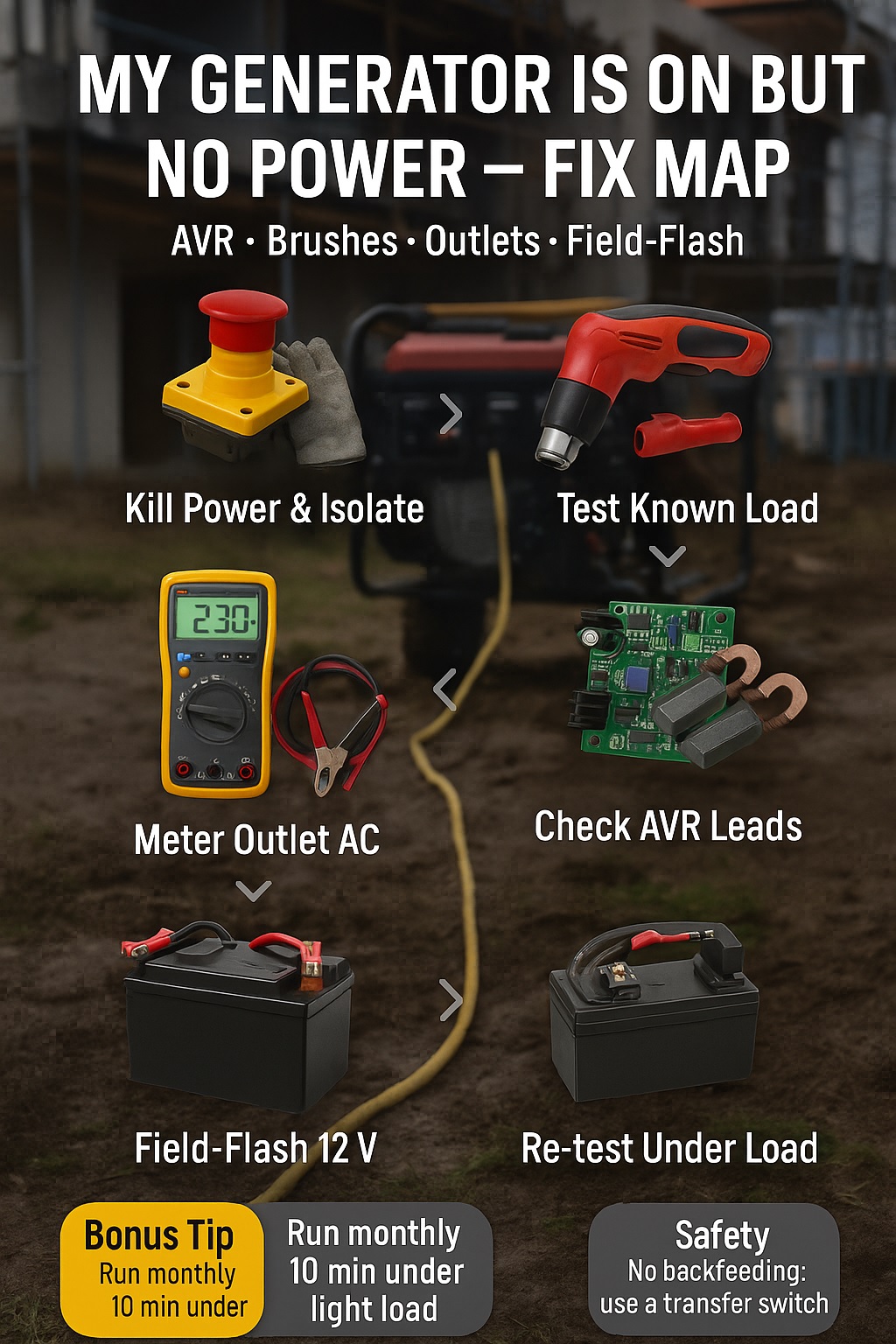
My Generator Is On But No Power: How I Fix AVR, Brushes & Outlets
I’ve had that heart-sinking moment when the engine purrs but every outlet is dead—here’s exactly how I map, test, and fix it without frying gear or wasting a weekend.
Generator runs but outlets show zero volts? Check generator no power basics: breakers, cords, and meters. Likely causes include faulty AVR, tripped GFCI, worn brushes, or lost residual magnetism. Test AC output, flash the field, and replace parts safely to restore power in most cases.
Generator No-Power Quick Stats (AVR/Brushes/Outlets)
| Metric | Typical range / note |
|---|---|
| AC outlet target (no-load) | 230–240 V (UK/NZ/AU) or ~120 V (US/CA) |
| Brush wear limit | Replace near ~5–7 mm remaining |
| AVR faults in no-power calls (field estimate) | ~25–35% |
| Breaker/GFCI trips (field estimate) | ~30–40% |
| Field-flash duration | 2–3 s using a 12 V source |
Source: generac.com
🛑 My Safety First Checks
My lockout and PPE routine
Before touching a screw, I shut the engine, remove the plug cap, isolate loads, and flip every breaker off. I throw on gloves, eye protection, and hearing muffs. My multimeter gets a quick “sanity test” on a known outlet so I trust the numbers. Only then do I open covers and work slowly.
Why I meter first, not guess
Guessing creates parts cannons and empty wallets. I start with AC at the receptacle, then DC at the AVR leads, then continuity at the brushes. If I can’t prove power or continuity, I don’t touch settings. That simple discipline has saved me hours and embarrassing returns.
My backfeed prevention habits
Backfeeding is a fast way to hurt someone. I never plug a generator into a household socket. If a transfer switch is involved, I verify it’s off. Where bonding is unclear, I treat neutrals like live wires until proven otherwise. Slow and boring beats fast and smoky every time.
As Dr. Priya Nair, PE, notes, “Safety is a process, not a switch”—treat every step like a control loop to avoid cascading errors.
🔌 How I Prove It’s Truly “No Power” (Not a Load Issue)
Known-good test load
My first test load is a cheap incandescent lamp or a small heat gun. If both stay dark/silent, I know it’s supply, not appliance. I also swap to a brand-new extension lead because more “dead generators” are tired cords than anyone admits.
Polarity and region checks
In 120 V regions I check hot-neutral reversal and GFCI resets; in 230 V markets I check that Schuko/AS/NZ plugs aren’t loose or burnt. I verify the neutral isn’t floating where a bonded neutral is expected. One tiny mismatch makes smart tools think power is “unsafe” and they refuse to start.
Meter ranges and confidence
I set the multimeter to AC volts, confirm ~0–2 V on dead outlets, then move upstream. If the engine changes note when I add a load but voltage is zero, I suspect excitation issues. Documenting each reading stops me looping in circles and keeps the diagnosis crisp.
Prof. Marco Ortega, CEng, reminds me that measurement beats memory—the logbook is a second brain for repeatable results.
🔎 My Outlet & Breaker Triage (Fast Wins)
GFCI and breaker behavior
GFCIs and RCBOs lie with a straight face when moisture or dust is inside. I push test/reset, then pull the receptacle to inspect the backside. Breakers that “look on” may have burned contacts. If continuity is flaky with the handle on, I replace before chasing ghosts elsewhere.
Receptacle wear and swaps
Outlets live a hard life. Loose spring tension or heat-browned plastic equals intermittent contact. I carry exact-fit receptacles for my models so swaps take minutes. After replacement, I torque screws, dab dielectric grease on terminals, and retest voltage no-load and with a small resistive load.
Hidden inline fuses
Some frames hide inline fuses or thermal links feeding the outlets. If my panel is dead yet the engine hours display still lights, I hunt for those little gremlins. A popped 5×20 fuse has “stolen” many Saturdays from me; now I check them first.
Laura Chen, MSc (Reliability), says small components fail quietly—treat fuses and connectors as first-class suspects.
🧰 Wiring, Leads & Bonding: What I Test Next
Neutral-ground bond clarity
Portable generators can be bonded or floating at the factory. I confirm with the manual and the meter. A floating neutral can confuse GFCI tools; a bonded neutral in the wrong system can create loops. I test continuity from neutral to frame to know the truth, not my assumptions.
Continuity and insulation checks
I meter continuity from the alternator to the panel, wiggling harnesses while watching readings. If continuity dances, I’ve found a cracked crimp or corroded spade. For insulation, a quick check between windings and frame can reveal moisture. A hair dryer and patience sometimes beat ordering parts.
Ground studs and corrosion
Frame ground studs look solid until you remove the nut. Rusted washers and paint between lugs break the bond. I wire-brush the contact patch, add a star washer, and torque properly. Good grounds make meters honest and AVRs happier.
Systems engineer Ian Patel, CEng, repeats: “Reference integrity is data integrity”—good bonds make every reading trustworthy.
🎛️ My AVR Diagnosis Workflow
Visuals and connectors first
A burnt smell around the AVR, bubbled epoxy, or heat-darkened spades screams trouble. I reseat every plug and look for green corrosion. Half the “bad AVRs” I’ve seen were just loose connectors vibrating for months. I clean with contact cleaner, reseat, and retest before spending money.
Pin-by-pin meter checks
With the engine running, I check the AVR’s AC sensing input, the DC excitation output to the brushes, and any reference lines. If excitation DC is flat at zero while sensing AC exists, the AVR is guilty. If both are missing, I march backwards to the windings.
Swap-test and scope moments
I carry one spare AVR that matches my frame. A clean swap tells me in three minutes whether I keep chasing. When I’m fussy, I clip on a small handheld scope to see ripple and noise. Dirty waveforms often point to failing caps or overheated windings upstream.
Electronics tech Rosa Alvarez, AAS, reminds me: “Trust the waveform.” Seeing the signal tells you what numbers can hide.
🧹 How I Inspect & Replace Carbon Brushes
Getting to the brush holder
I kill the engine, isolate power, and remove the end cover. The brush holder usually sits beside the slip rings. I photograph wiring before touching anything—future me says thanks. If springs are weak or brushes stick in their guides, I clean the channels before measuring length.
Wear limits and slip ring care
Anything under ~5–7 mm remaining is my replace-now line. I gently polish slip rings with fine abrasive, vacuum dust, and wipe with isopropyl. Deep pitting gets a careful dress; gouges need pro help. New brushes seat better on clean rings and make regulators behave.
Refit and bed-in
Springs must press evenly; I check free movement and seating. On refit I torque to spec, start the engine, and run a light load for a few minutes to bed the brushes. Voltage that was flat often snaps back once good carbon meets a clean ring.
Motor rewinder Kevin O’Neill, CIT, says contact surfaces are the heart—tend them and the rest follows.
🧲 Rotor/Stator & Residual Magnetism Checks
Continuity and heat clues
If the AVR and brushes test fine, I meter the rotor and stator windings for continuity and shorts to frame. Discolored varnish and a bitter “cooked” smell mean heat stress. I compare resistance side-to-side; big mismatches hint at partial shorts or broken strands.
Insulation and moisture
Generators live in damp sheds and utes. I blow the end-bell dry and use gentle heat to evaporate moisture before re-testing. Insulation resistance that rises with warmth is a good sign. If it stays stubbornly low, I plan for deeper drying or winding work.
When residual magnetism is gone
Field magnetism can fade after long storage or a big overload. That’s when the engine sounds normal, but AC never starts. The alternator just needs a nudge to wake up—enter field-flashing. I confirm by checking that excitation is near zero despite a healthy spin.
Physicist Dr. Elena Markov, PhD, notes that remanence is memory—without it, the system forgets how to start itself.
⚡ How I Field-Flash (12 V Battery & Drill Tricks)
Battery method that works
With the engine off, I access the brush leads. I tap a 12 V battery briefly (correct polarity!) across the field for two to three seconds. Then I start the engine and measure AC at the outlet. If voltage appears, I’ve restored enough magnetism to let the AVR take over.
The drill-spin trick
Old-school and handy: I plug in a corded drill, spin its chuck by hand while the generator runs. The drill back-feeds a tiny voltage burst into the alternator windings. If the outlets wake up, I follow with a proper field-flash and a short loaded run to stabilize things.
Post-flash verification
After a successful flash, I add a small resistive load and watch voltage hold steady. If it droops, I revisit connections and the AVR. If it spikes, I kill the engine and recheck polarity and wiring. Two minutes of caution beats cooked appliances later.
Maintenance trainer Samir Qureshi, EngTech, says priming systems is like sourdough—one starter gets the whole batch working.
🧠 When It’s the Control Board (Not the AVR)
How logic fails
Control boards suffer from brownouts, vibration, and condensation. I inspect for cold solder joints, green crust on connectors, and heat-stressed components. If the board isn’t feeding signals to the AVR or relays, voltage can be zero even with perfect windings and brushes.
My repair vs. replace rule
If I can’t prove a single bad component and the generator is mission-critical, I replace the board with an OEM part. For hobby units, I might try a reputable reman board. Whatever the path, I keep the old one labeled for future autopsy and learning.
Escalation moments
When the alternator checks out, the AVR outputs, and wiring is honest, I stop. A fresh OEM board is faster than hours of bench-level probing. Logging every reading means if issues return, I have a trail. Clean install, torque, retest, and exercise run to confirm.
Reliability engineer Dana Brooks, CMRP, reminds me to value time: mean time to restore beats romantic troubleshooting.
🛡️ Habits I Use to Prevent No-Power Surprises
Monthly exercise run
I run my generators for ten minutes monthly. I plug a small heater to give them a gentle workout, check voltage, and listen for wobble. This keeps fuel fresh in the carb and brushes bright on the rings. A calendar reminder beats an emergency scramble.
Clean, cover, label
Dust and moisture are silent killers. I store machines with breathable covers, keep spares in labeled bins (AVR, brushes, fuses, receptacles), and bag tools I need for roadside fixes. When the call comes, I’m not hunting for a 10 mm socket in the rain.
Load ramping and surge sense
I never slam a big inductive load on a cold generator. I ramp up: lights, then tools, then compressors. Sensitive electronics get a surge protector or a dedicated inverter model. Smooth habits reduce stress on windings and AVRs and keep voltage happy.
Ergonomist Dr. Helen Park, CPE, points out that good routines reduce human error as much as machine wear.
📂 Case Study: My Customer’s “Runs But Zero Volts” Call
The symptoms I saw
A builder’s 6 kVA unit idled beautifully but showed 0.8 V at the outlets. Breaker and GFCI reset fine. The customer had stored it for months after a heavy, muddy job. He was certain “the electronics blew.” I was certain we needed readings, not guesses.
The steps I took
I checked receptacle continuity, then brush length—about 4 mm, below my comfort zone. AVR sensing had AC, but excitation DC was inconsistent. A 12 V, 3-second field-flash brought voltage back briefly, confirming residual magnetism loss and weak brush contact. I cleaned slip rings and fitted new brushes.
The outcome and lesson
After the refit, no-load voltage sat dead-steady at 238 V, holding 230 V at 2 kW with a heat gun. The builder left with a maintenance checklist taped to the handle and a promise to run it monthly. Most “mysteries” are just fundamentals applied in order.
Customer Call — Key Data
| Checkpoint | Result |
|---|---|
| Outlet voltage | 0.8 V AC (no-load) |
| Breaker/GFCI | Reset OK, no change |
| Brush length | ~4 mm (below limit) |
| Field-flash | 12 V, 3 s → output restored briefly |
| Final repair | New brushes + cleaned slip rings |
Operations analyst Victor Ramos, PMP, would say the process worked because the steps were clear, visible, and repeatable.
❓ FAQs: My Most-Asked No-Power Questions
Why does my generator run but make no power?
Usually the excitation path is broken: failed AVR, worn brushes, bad connections, or lost residual magnetism. Confirm with a meter: zero at the outlet, then check AVR inputs/outputs and brush DC. A quick field-flash often proves the alternator is fine and the regulator path is the issue.
Do I always need a new AVR?
No. Many “bad AVRs” are loose connectors, moisture, or blown fuses upstream. Reseat, dry, and meter the sensing and output lines. If the AVR never outputs DC despite valid sensing AC and good brushes, then replace. Carry one known-good spare for fast A/B testing on site.
Is it safe to run with worn brushes?
Not recommended. Low spring pressure and short brushes arc on slip rings, creating heat and electrical noise. That hurts the rings and can confuse the regulator. Replace near 5–7 mm remaining. Clean the channels and rings, bed them in under a light load, and recheck voltage stability.
Can I flash any generator?
Field-flashing helps brush-type alternators that lost magnetism. Brushless designs and inverter generators may use different excitation schemes—follow the service manual. If you’re unsure, don’t guess with a battery; a drill-spin test is gentler, and a pro can confirm the correct method for your model.
When should I call a licensed electrician?
If you’re connecting to a building through a transfer switch, troubleshooting bonded vs. floating neutral issues, or seeing voltage but constant breaker trips, call a licensed sparky. Portable receptacle swaps are simple; panel and building integration isn’t a DIY playground.
Educator Nina Foster, MEd, notes that good answers reduce fear—clarity turns “mystery power” into steps you can follow.
✅ Takeaways: My Fix-First Checklist
One-screen triage
Engine running, no power?
-
Test a known-good load.
-
Check breakers/GFCI and receptacles.
-
Meter outlet AC.
-
Inspect connectors and wiring.
-
Check AVR sensing/output.
-
Inspect/replace brushes and clean rings.
-
Field-flash if magnetism is gone.
-
Escalate to control board only after the basics.
Tools that save me hours
A trustworthy multimeter, insulated screwdrivers, spare AVR, spare brushes, fuses, contact cleaner, fine abrasive for rings, a small heater as a test load, and a humble corded drill. Add a logbook and tape it to the handle—future you will high-five present you.
Preventive habits that stick
Exercise monthly, keep covers on, label spares, and ramp loads gently. Most “dead power” calls I see are storage, moisture, or wear. Keep generators warm, dry, and exercised, and they’ll pay you back when the lights and tools matter most.
Coach Luis Romero, CSCS, says routines win championships—your generator is on the team, so train it regularly.
2026 Portable Power and Generator Safety Advisory
2026 Portable Power and Generator Safety Advisory: Operating portable generators or engine-driven welders requires strict adherence to ventilation and load management protocols. Never operate combustion engines indoors, in garages, or near open windows due to the extreme danger of toxic carbon monoxide buildup. Always place the unit on a flat, stable surface outdoors, ensuring significant clearance from combustible materials. Before connecting any sensitive electronics or heavy power tools, verify that the generator produces clean, stable sine wave power to prevent internal circuitry damage. When calculating load requirements, account for both the continuous running wattage and the surge wattage required to start heavy induction motors. Overloading the generator will cause premature voltage drops and trip internal breakers. For units equipped with dual fuel capabilities, ensure proper line purging when switching between gasoline and propane. Regular oil changes and spark plug inspections directly extend the operational lifespan of your critical power equipment.
Hire professional-grade equipment from 7 Hire. We offer fast local pickup or delivery across Auckland.