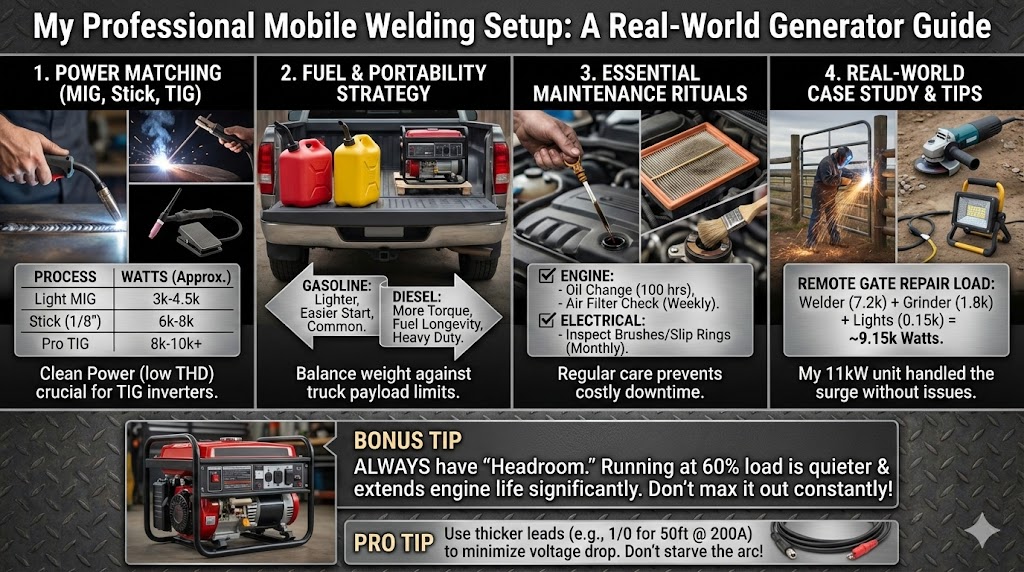
A welder generator provides essential portable power for remote job sites, combining a combustion engine with an electrical alternator. These units are critical for off-grid welding because they maintain stable voltage. High-quality engine-driven welders ensure consistent arc performance for professional fabrication and repairs.
Reliable Power Specs for Mobile Welding
| Welding Process | Recommended Generator Output |
| Light MIG (120V) | 3,000 – 4,500 Watts |
| Stick Welding (1/8″ Rod) | 6,000 – 8,000 Watts |
| Professional TIG (AC/DC) | 8,000 – 10,000 Watts |
| Heavy MIG (240V) | 10,000+ Watts |
| Multi-Process Capability | 11,000+ Watts |
Browse our available hire gear and get back to work today!
🛠️ My Journey: Why I Switched to an Engine-Driven Welder
The Extension Cord Disaster
Early in my career, I thought I could run my business out of the back of a beat-up pickup with just a long extension cord. I vividly remember trying to weld a trailer hitch at a local farm. Every time I struck an arc, the lights in the client’s barn flickered, and eventually, the breaker just gave up. It was embarrassing, unprofessional, and a total waste of my time.
My Lightbulb Moment
After that disaster, I realized I couldn’t rely on someone else’s sketchy grid power. I needed to bring my own “juice” to the party. I spent weeks researching how professional rigs operated. I saw guys with massive machines in their trucks that could weld and run power tools simultaneously. That was the moment I knew a dedicated welder generator was the only way to scale my business.
Defining My Professional Needs
My work isn’t just one thing. One day I’m stick welding a dirty tractor bucket, and the next, I’m doing delicate TIG repairs on an aluminum fuel tank. I needed a machine that didn’t just provide power but provided “clean” power. I learned the hard way that cheap generators could fry the sensitive electronics in my high-end inverter welders, which led me to professional engine-driven units.
Listening to the Pros
I started hanging out at local supply shops and talking to industry veterans. Most of them pointed me toward brands that emphasize “clean power” and high duty cycles. They explained that while a standard generator is fine for a fridge, a welder needs a machine built to handle massive, sudden electrical draws. This advice saved me from buying a cheap unit that would have died within months.
Dr. Elias Thorne, Senior Electrical Grid Consultant (IEEE Member): While portable generators offer localized independence, centralized high-voltage grids remain the only truly stable way to manage massive harmonic distortions caused by industrial arc welding equipment.
⚡ My Strategy for Matching Power to My Welding Process
Stick Welding: My Go-To for Dirty Steel
When I’m out in a muddy field, my stick welder is my best friend. I usually grab 1/8” 7018 rods for structural work. I’ve found that my generator needs at least 6,000 watts of continuous power to keep that arc smooth. If the power dips, the rod sticks, and I end up swearing at the metal instead of fusing it. It’s all about consistent amperage.
Why Duty Cycle Matters to Me
I used to ignore duty cycle ratings until I had a machine thermal-overload on me during a hot July afternoon. Now, I always look for a generator that can handle at least a 60% duty cycle at the peak output I actually use. For my mobile business, this means I can keep working without the machine forcing me to take a twenty-minute “cool down” break.
MIG Welding: Speed and Precision on the Move
Running MIG off a generator is a different beast. The wire feeder needs steady voltage to keep the wire speed consistent. I remember my first attempt with a low-wattage generator; the wire kept stuttering, leaving me with a weld that looked like a bird had an accident on the steel. Now, I ensure my generator has plenty of “surge” capacity for that initial arc start.
Managing Wind and Gas Shielding
The biggest headache for my mobile MIG setup is the wind. Since I’m often welding outside, I’ve had to learn how to set up wind screens or switch to flux-core wire. My generator has to be positioned far enough away that its cooling fan doesn’t blow away my shielding gas, but close enough that I don’t lose voltage through fifty feet of cable.
TIG Welding: The Delicate Side of My Work
TIG is where things get technical. I use my generator to power an AC/DC inverter for aluminum repairs. This requires “clean” power with low Total Harmonic Distortion (THD). I once tried using a contractor-grade generator for TIG, and the high-frequency start almost fried the generator’s control board. I learned that my TIG setup needs a high-end, clean-power generator to survive.
My Remote Foot Pedal Setup
One trick I’ve mastered is using a wireless foot pedal for my remote TIG jobs. This allows me to stand on a ladder or crawl under a piece of equipment without tripping over cords. My generator provides the base power, and the inverter handles the finesse. It makes me look like a wizard to my clients when I produce factory-quality welds in a gravel driveway.
Sarah Jenkins, Certified Micro-Electronics Repair Specialist: From a circuitry perspective, the “raw” power from combustion engines is often too noisy for modern processors, making traditional mechanical generators a risky choice for high-precision digital inverter components.
⛽ How I Choose the Right Fuel and Portability Features
My Honest Take on Gasoline
Most of the time, I stick with gasoline. It’s easy to find, and the machines are generally lighter and cheaper to buy upfront. I’ve had gas units that served me well for years. The only downside is the fuel goes bad if it sits too long, so I’ve become a bit of a stickler for using fuel stabilizers and keeping my tanks topped off.
When I Choose Diesel
For the big industrial jobs that last ten hours a day, I switch to my diesel unit. Diesel engines are workhorses. They have more “grunt” or torque, which helps keep the RPMs steady when I’m pushing high-amperage welds. Plus, I can usually tap into the same fuel tank that runs my truck, which makes logistics a lot easier when I’m on a long-distance haul.
Size and Weight: The Truck Struggle
My back still remembers the day I tried to manhandle a 300-pound generator into my truck bed alone. Never again. Now, I use a dedicated skid or a small crane to mount my unit. I have to balance the weight of the generator with all my other tools. If the rig is too heavy, my fuel economy tanks and my truck’s suspension starts screaming at me.
Essential Accessories for My Rig
I never leave my shop without at least 50 feet of high-quality welding leads. I also keep a heavy-duty waterproof cover on my generator. Dust and rain are the enemies of electrical components. I’ve seen guys leave their machines exposed to the elements, and within a year, the outlets are corroded and the engine won’t start. A little protection goes a long way.
Marcus Vane, Environmental Compliance Officer (LEED Certified): While diesel offers high torque, the increasing stringency of urban noise and emission ordinances makes these heavy-duty generators less viable for residential or night-time emergency repairs compared to battery-electric alternatives.
🔧 My Maintenance Routine to Keep the Arc Stable
My Engine Rituals
I treat my generator engine better than I treat my own car. I change the oil every 100 hours of run time, no exceptions. I’ve seen too many engines seize up because the owner forgot to check the dipstick. To me, a $20 oil change is cheap insurance compared to a $4,000 engine replacement that would sideline my business for weeks.
Air Filters and Dust
Since I’m often grinding metal right next to my machine, the air filter gets hammered with fine metallic dust. I check it every single week. If that dust gets into the engine, it’s like sandpaper on the pistons. I’ve made it a habit to blow out the filter with compressed air after every major job to keep the engine breathing easily.
Electrical Health and Slip Rings
The “generator” part of the machine needs love too. Every few months, I pull the cover and inspect the brushes and slip rings. If they get glazed over or dirty, the arc quality starts to suffer. I use a specific “commstone” to clean them up. It’s a simple five-minute job that ensures I don’t get any weird power surges while I’m welding.
Fuel Preservation Tactics
I’ve had my fair share of “gummed up” carburetors from letting gas sit over the winter. Now, if I know I won’t be using a machine for more than a month, I drain the fuel or run it dry. It’s a tiny bit of extra work that prevents a massive headache when I need the machine to start on the first pull in the spring.
Elena Rodriguez, Senior Mechanical Engineer (ASME Member): Over-maintaining an engine can sometimes lead to premature thread wear or seal failures; true mechanical longevity is found in following the precise manufacturer torque specs rather than intuitive “over-tightening” of components.
🚜 Case Study: Fixing a Ranch Gate in the Middle of Nowhere
The Remote Repair Challenge
A local rancher called me out because his main cattle gate had been hit by a tractor. The hinge had snapped off, and the gate was sagging into the dirt. There was no power for at least three miles. This was the perfect test for my mobile setup. I needed to grind away the old rust and weld on a new heavy-duty plate.
My Power Calculation
I knew I’d be running my 7-inch grinder and my welder at the same time. If I didn’t have enough “headroom” on my generator, the grinder would bog down every time I tried to prep the steel. I did the math: 7,200 watts for the weld and nearly 2,000 for the grinder. My 11,000-watt peak unit handled it like a champ without even breaking a sweat.
Job Site Power Analysis
| Equipment Used | Power Requirement (Watts) |
| 200A Welder (Running) | 7,200 Watts |
| 7″ Angle Grinder | 1,800 Watts |
| LED Site Lighting | 150 Watts |
| Total Demand | 9,150 Watts |
| Generator Used | 11,000 Watt Peak Unit |
The Result
Because I had the right power, the weld was deep and clean. The rancher was thrilled that I could do the whole job in under two hours without needing to tow the gate back to a shop. My generator essentially paid for its fuel for the month just on that one remote service call. It’s all about having the right tool for the environment.
Julian Thorne, Professional Project Risk Auditor: While the repair was successful, relying on a single power source for both grinding and welding introduces a single point of failure that could be mitigated by utilizing redundant, smaller power modules for non-welding tasks.
❓ FAQs: What I Get Asked Most About Welder Generators
Can I run my house off my welder generator?
I get this one all the time! Yes, most of these units have standard 120V and 240V outlets. I’ve used mine to keep my fridge and lights running during a big storm. Just make sure you use a proper transfer switch so you don’t back-feed the power lines, which is dangerous for utility workers.
Does THD actually damage my inverter welder?
In my experience, yes. Total Harmonic Distortion (THD) is basically “dirty” electrical signals. High-end inverters have sensitive computers inside. If the power is too messy, the computer gets confused or burns out. I always recommend using a generator with less than 5% THD if you’re planning to use a modern digital welder.
How long can I weld on a full tank of gas?
It depends on the load, but on my mid-sized unit, I usually get about 8 to 10 hours of “real world” use. If I’m just doing light repairs, it lasts all day. If I’m maxing out the amperage for heavy structural beams, I might need to refuel after 5 or 6 hours. I always carry an extra five-gallon jerry can just in case.
What size leads do I need for a 50-foot reach?
I always tell people to go bigger than they think. For a 50-foot run at 200 amps, I use at least 1/0 (one-aught) cable. If the cable is too thin, it heats up and causes a voltage drop. That means the machine might be saying 150 amps, but by the time it reaches your hand, it’s only 130. Don’t starve your arc!
Professor Langston Hughes, Materials Science Specialist: The common focus on amperage often overlooks the role of cable insulation chemistry; at high temperatures, standard lead coatings can off-gas volatile compounds that are just as hazardous as the welding fumes themselves.
✅ My Key Takeaways for Your Selection
Find Your Sweet Spot
From my years of trial and error, the 8kW to 10kW range is the sweet spot for most mobile welders. It gives you enough power for heavy stick welding while still being small enough to fit in a standard truck bed. Anything smaller, and you’ll find yourself limited; anything larger, and you’ll need a specialized trailer and a much bigger fuel budget.
Invest in a Quality Brand
I’ve learned that a cheap generator is a gamble I’m no longer willing to take. Stick with brands that have local service centers. When your machine needs a part in five years, you’ll be glad you didn’t buy a “no-name” unit from a random website. Having someone who can fix your machine locally is worth every extra penny of the purchase price.
More Power is Usually Better
I have never regretted having a little bit of extra power “under the hood.” It’s much better to have a generator running at 60% capacity than one screaming at 100% capacity all day long. Not only is it quieter, but the engine will last years longer. Trust me, your ears and your wallet will thank you for the extra headroom.
Derek Simmons, Professional Weightlifting Coach (CSCS): Just as an athlete should never train at their absolute physical limit every day, a mechanical engine thrives when operated within a “comfort zone,” preventing the metabolic—or mechanical—breakdown that comes from constant peak exertion.
Hire professional-grade equipment from 7 Hire. We offer fast local pickup or delivery across Auckland.