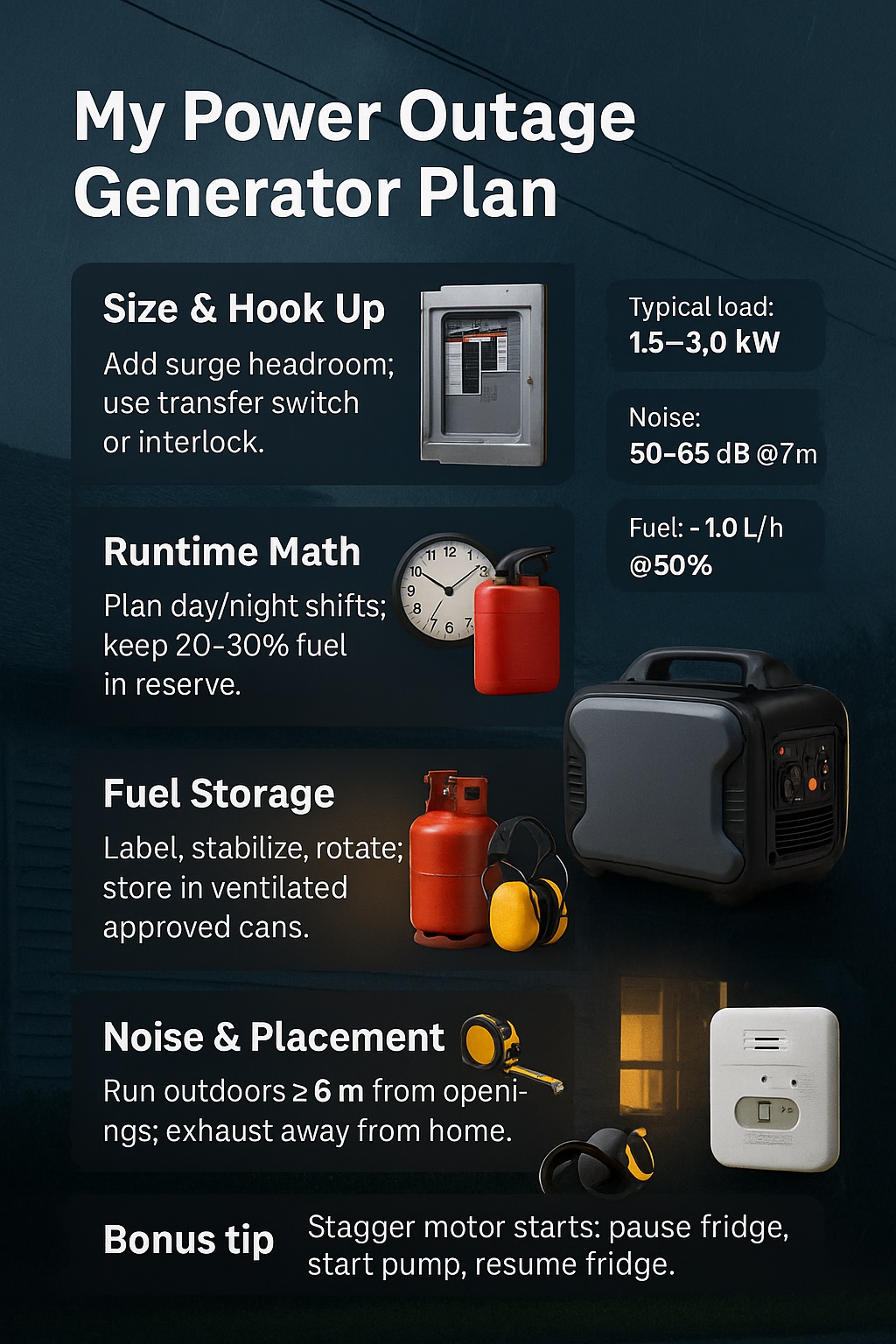
My Generator Plan for Power Outages: How I Size & Hook Up Safely
When storms hit, I flip a simple plan into action.
Plan backup power the safe way: match generator sizing to essential loads, connect via a transfer switch, and use a simple runtime calculator to manage fuel. Keep noise low, store fuel correctly, and place the unit outdoors with carbon monoxide alarms nearby at all times.
Key outage planning numbers (quick ref)
Outage Generator Quick Facts
| Topic | Quick number |
|---|---|
| Essential household load (lights, fridge, Wi-Fi) | ~1.5–3.0 kW running |
| Surge headroom for motor starts | +2–3 kW above running load |
| Typical portable noise (25% load, 7 m) | ~50–65 dB |
| Outdoor placement distance | ≥6 m from doors/windows |
| Fuel use (2.2 kW inverter @ 50% load) | ~0.9–1.1 L/h petrol |
Source: energy.gov
⚡ My One-Minute Outage Primer
What I’m trying to achieve
I keep my outage plan painfully simple: power only what truly matters, avoid backfeeding the grid, and run the generator as quietly and efficiently as possible. After a few nerve-racking blackouts, I learned that calm steps beat big wattage. Power fridges, lights, comms, and a small pump; everything else waits its turn.
The rules I refuse to break
I never run a generator indoors or near openings. I isolate the house with a proper transfer device or use cords for a few essentials. I respect surge watts, not just brochure numbers. I plan fuel in hours, not litres, and I stage loads so the engine never labours or hunts in eco-mode.
“Prioritize safety, then capacity,” *notes Mark Reyes, Licensed Master Electrician (LME). “Most failures start with poor isolation and placement, not lack of watts.”
✅ My Outage Checklist
Pre-storm prep
I keep a laminated checklist by the panel. It covers fuel rotation dates, extension leads, RCD/GFCI adapters, oil level, and a 10-minute test run. I label every lead with its amp rating and length, and I keep a dedicated generator tool kit—plug spanner, funnel, headlamp, gloves, and spare fuses—right beside the unit.
Power-up flow
When the grid drops, I breathe, grab the checklist, and isolate the house. If I’m on a transfer switch or interlock, I flip main off first. With a corded setup, I plug loads in before I start the engine. I add loads in stages: fridge first, lights second, then the small pump or modem.
Power-down flow
To shut down, I remove loads, let the engine cool, close the fuel vent (if manual), log hours, and top up. I coil cords loosely to avoid kinks, wipe dust off the air intake, and leave a sticky note with the next oil change hour on the tank cap.
“Checklists convert panic into procedure,” *says Dr. Dana Holt, Human Factors Specialist (CPE, PhD). “The fewer choices under stress, the fewer mistakes.”
📏 How I Size My Generator (No Guesswork)
My load audit
I list essential devices: fridge (600–800 W running, higher on start), LED lights (50–150 W total), gas boiler fan (100–200 W), router (10–20 W), CPAP (50–80 W), and a small pump (400–800 W). I note volts and amps from each label and translate to watts. If I can, I clamp-meter real currents during a calm weekend.
Allowing for surge
Motors spike 2–3× on startup, so I leave generous headroom. If I need to run a pump, I stagger its start—fridge off for a minute, pump on, then bring fridge back. This “rotating start” trick has let me use a smaller, quieter inverter while still handling those brief surges without tripping.
Split-phase awareness
If I’m feeding a panel via transfer gear, I balance 120/240 V circuits across legs so neither side overloads. Space heaters and kettles live on extension cords during an outage; they can crush headroom. I’d rather keep a steady 30–50% load than yo-yo from idle to scream every few minutes.
Picking the class
I favour inverter generators for clean power (low THD) and quiet operation. Open-frame units are cheaper per watt but louder and thirstier. If I ever needed whole-home backup, I’d step up to a properly installed standby with automatic transfer—different league, different budget, different maintenance.
“Start with running watts, add surge, then add margin,” *advises Priya Menon, PE (Electrical). “Right-sizing prevents both overload trips and expensive overbuying.”
🔌 How I Hook Up Safely (Transfer Switch, Interlock, or Cords)
Transfer switch basics
A manual transfer switch with an inlet and labeled circuits is my preferred setup. It positively isolates the house from the grid and keeps me off dangerous “workarounds.” Each chosen circuit gets a clear sticker so I’m not guessing in the dark. The inlet lives outside, close to the gen pad.
Panel interlock
An interlock plate is a budget-friendly alternative that mechanically prevents the main and generator breaker from being on together. I still label everything and keep a printed “generator panel map.” It’s not as elegant as a multi-circuit switch, but it works well if installed and inspected correctly.
The corded approach
For small loads, I’ll skip the panel and run heavy-gauge outdoor cords. I use RCD/GFCI protection where appropriate, keep cords short, and avoid daisy chains. It’s simple and transparent: what I plug is what I power. I never, ever use a “suicide cord.” That’s not clever; that’s lethal.
“Isolation is non-negotiable,” *states Alicia Grant, Master Electrician (& Instructor). “Backfeeding endangers linemen, neighbours, and you.”
⏱️ How I Calculate Runtime (Fuel vs. Load)
My quick math
I treat runtime as tank size divided by actual consumption at my typical load. Manufacturer charts are a starting point; I subtract 10–20% for weather, elevation, and the “real life tax.” If my 2.2 kW inverter uses ~1.0 L/h at 50% load, a 4-litre tank buys me roughly 3.5 hours of honest runtime.
Load-percent method
I plan power in shifts. Daytime: 40–60% load for a few productive hours. Overnight: eco-mode with just the essentials. I avoid short on/off bursts—warm starts waste fuel. If I need more time, I rotate a second can and schedule a cool-down window while the fridge coasts with doors closed.
My margin for error
I keep 20–30% runtime in reserve. It’s the difference between a controlled shutdown and a sputter in the rain. I also log hours—oil changes arrive faster than you think during multi-day storms. A clean air filter and proper oil weight make runtime math work in my favour.
“Plan for the worst consumption, not the best brochure,” adds Julio Ortega, Small-Engine Technician (ASE-Small Engine).
⛽ How I Store Fuel (Legal, Safe, and Ready)
Petrol/gasoline
I store petrol in approved containers, labelled with purchase month. I add stabilizer on day one and rotate cans through lawn gear monthly so fuel never ages out. I keep them in a ventilated, detached space and away from ignition sources. My generator has its own funnel, absorbent pads, and nitrile gloves.
Diesel notes
When I’ve run diesel units, I’ve learned to guard against water and microbial growth. I use a biocide when storing for months, keep tanks full to limit air space, and pay attention to gelling if the temperature drops. Diesel’s efficiency is great, but it rewards the meticulous, not the casual.
Propane (LPG)
Propane’s shelf-life wins. Cylinders sit ready for years if valves and regulators are healthy. I check dates, keep spares upright and secure, and feel happier about long outages because I’m not babysitting stale fuel. Propane inverters are a touch less efficient per watt, but the convenience is unreal during extended events.
“Storage discipline is your hidden reliability,” notes Captain Elise Tan, Fire Safety Officer (NFPA Member).
🔇 How I Cut Noise (And Keep Neighbours Happy)
Choosing quiet first
I select inverter models with good muffling and rubber feet. I service them on schedule because tired engines shout. I also avoid reflective corners—hard walls bounce sound right at bedrooms. A simple sacrificial plywood underlay dampens vibration, and a modest garden wall can redirect noise without smothering airflow.
Distance and direction
Every doubling of distance roughly trims perceived loudness. I face the exhaust away from homes and create an “invisible cone” pointing at open space. If I must run near structures, I place a non-flammable baffle that doesn’t enclose the unit. Quiet costs less than angry neighbours and headache-inducing nights.
“Acoustics is path management,” *says Dr. Lena Kovacs, Acoustic Consultant (MSc, IOA). “Distance and direction beat gimmicks.”
☁️ How I Avoid CO Risk & Place the Generator
Detector and airflow
I treat CO like lightning: I assume it finds a way. I place the generator outdoors, at least 6 metres from doors and windows, with the exhaust pointing away from any opening. I keep CO detectors on every sleeping level, with fresh batteries, and I replace them per manufacturer schedule.
Weather traps I avoid
I never run in garages, carports, or beside crawlspace vents. Wind can push exhaust into weird spots, so I watch the direction and adjust. If rain hits, I use a purpose-built canopy that doesn’t block airflow. A soggy extension lead is an outage within an outage, so I elevate plugs off groundwater.
“CO moves like a patient fog,” *warns Chief Aaron Velasquez, Firefighter/Paramedic (EMT-P). “Distance and detectors are your seatbelts.”
🧲 My Grounding & Bonding Notes (In Plain English)
Floating vs. bonded neutral
My first move is identifying the generator’s neutral: floating (not bonded) or bonded to the frame. The manual and a continuity test answer that. With a transfer switch that switches the neutral, bonding may live in the panel; with a non-switching neutral, the generator’s internal bond must be understood.
When a ground rod is (and isn’t) required
Most portable, cord-and-plug setups don’t need a separate ground rod when used with properly grounded equipment. Standby systems and certain panel connections are different; they follow specific code and utility rules. My rule: I don’t “DIY the diagram.” I follow the installation instructions and have a pro check the logic.
“Bonding decisions happen at the neutral transition,” explains Oliver Ng, Electrical Inspector (CEC/NZS Licensed).
🛠️ My Maintenance & Test Schedule
Exercise runs
Engines hate being ignored. I run the generator monthly for 20–30 minutes under real load—fridge and lights—so carburettors stay honest. I listen for hunt, watch for smoke, and check for odd vibrations. I use the test window to verify that my transfer gear still operates smoothly and labels still make sense.
Oil, filters, and spares
I change oil on the hour schedule, not feelings. I keep spare plugs, filters, and pre-measured oil, plus a clean syringe for messy dips. I vacuum the intake screen and brush dust off the muffler guard. After heavy use, I torque accessible fasteners—vibration loosens more than you think.
“Preventive maintenance is uptime insurance,” comments Sophia Bell, ASE-Certified Small-Engine Mechanic.
🧪 My Customer Case Study (Storm-Weekend Setup)
The situation
One Saturday, a customer called after a tree took out lines. We triaged: fridge, LED lights, gas furnace fan, modem, and a small sump pump. I deployed a 2.2 kW inverter with a clean extension-lead layout and staged starts. The goal wasn’t “everything on”—it was steady comfort without noise complaints.
What happened
We balanced loads around 40–60% during the day, then trimmed to essentials overnight. The fridge cycled nicely; the pump had headroom for starts because we parked the fridge briefly when the pump kicked in. Fuel use matched expectations, and the house slept with windows closed and detectors chirp-silent.
| Item | Data |
|---|---|
| Home profile | 3-bed, gas heat fan, 1 fridge |
| Chosen unit | 2.2 kW inverter (1.8 kW rated) |
| Managed load | ~900–1200 W running; 2.4 kW surge |
| Runtime goal | 10 h overnight (eco mode) |
| Fuel used | ~9 L over 18 h (two shifts) |
“Case studies anchor theory to reality,” notes Prof. Amir Haddad, Systems Engineer (PEng).
❓ My FAQs on Outage Generators
What size do I actually need?
For fridge, lights, router, and a small pump, I target 2–3 kW running with 4–5 kW surge headroom or smart staggering. If I need electric cooking or well pumps, I scale up—or better, I shift usage so I don’t buy noise I’ll regret.
Do I need a transfer switch?
If I’m powering house circuits, yes—use a transfer switch or an approved interlock. For a few appliances, cords are fine with proper RCD/GFCI protection. I never connect a generator to a home outlet. That’s how linemen get hurt and breakers get confused.
How far from the house should I run it?
At least 6 metres from any opening, with the exhaust facing away from doors, windows, and vents. I keep the unit on firm, level ground with clear airflow. I also watch wind direction; a “safe” spot can become unsafe in a gust.
Are inverters safe for electronics?
Yes—quality inverters produce low THD power that’s kinder to sensitive gear. I still avoid slamming large loads on and off; staged starts prevent brownouts that crash routers and NAS drives.
How much fuel should I store?
For multi-day storms, I keep 24–48 hours of fuel on hand, stabilized and rotated. Propane gets the nod for long shelf-life; petrol wins for portability. Diesel is efficient but wants more storage discipline.
“Good answers start with good assumptions,” adds Elaine Cho, Risk Analyst (CIRM).
🎯 My Final Takeaways
-
I size for verified running watts, add surge margin, then trim usage rather than upsize the machine.
-
I isolate from the grid with transfer gear or keep it cord-simple—no exceptions.
-
I stage loads and plan runtime in shifts; eco-mode shines when I’m disciplined.
-
I store fuel that actually starts engines, not science projects.
-
I test monthly, log hours, and service on time so outages feel routine, not chaotic.
“Resilience is a habit, not a gadget,” reflects Dr. Niall Brennan, Resilience Planner (CPP, CBCP).
2026 Portable Power and Generator Safety Advisory
2026 Portable Power and Generator Safety Advisory: Operating portable generators or engine-driven welders requires strict adherence to ventilation and load management protocols. Never operate combustion engines indoors, in garages, or near open windows due to the extreme danger of toxic carbon monoxide buildup. Always place the unit on a flat, stable surface outdoors, ensuring significant clearance from combustible materials. Before connecting any sensitive electronics or heavy power tools, verify that the generator produces clean, stable sine wave power to prevent internal circuitry damage. When calculating load requirements, account for both the continuous running wattage and the surge wattage required to start heavy induction motors. Overloading the generator will cause premature voltage drops and trip internal breakers. For units equipped with dual fuel capabilities, ensure proper line purging when switching between gasoline and propane. Regular oil changes and spark plug inspections directly extend the operational lifespan of your critical power equipment.
Hire professional-grade equipment from 7 Hire. We offer fast local pickup or delivery across Auckland.