When I first started drying soaked carpets, I thought “a fan is a fan”. After a few stressful floods, late-night callouts and some expensive lessons, I realised the type of carpet dryer fan I use matters just as much as how many I plug in.
Learn how snail carpet dryer fans, axial air movers and low-profile fans speed up wet carpet drying, cut mould risk, improve airflow, and reduce restoration time after leaks, burst pipes, floods or professional carpet cleaning in homes, rentals and small commercial spaces.
Key Carpet Dryer Fan Stats for My Jobs
| Factor | Typical range or note on my real jobs |
|---|---|
| Airflow per fan | Roughly 1,500–3,000 CFM for pro carpet dryer fans |
| Power use per fan | Around 150–500 watts depending on size and speed |
| Drying time impact | Often cuts carpet drying time by about one-third |
| Fans per average lounge | Commonly 2–3 fans in a medium, fully wet living room |
| Typical running time per job | 24–72 hours of continuous running for serious water damage |
Source: iicrc.org
🧭 How I Explain Carpet Dryer Fans to My Customers
The day I learned a normal fan wasn’t enough
On one of my early jobs, I confidently set up two normal pedestal fans in a flooded lounge and told the customer, “It’ll be dry tomorrow.” Three days later the carpet still felt cold and soggy, and the underlay was a disaster. That was my “never again” moment.
Since then, I explain that a carpet dryer fan is not just “a fan”. It’s built to push air low and fast across wet surfaces, so moisture actually gets lifted out of the carpet and underlay, instead of just swirling humid air around the room. Once people hear that, they get it.
The three carpet dryer fan types I always reach for
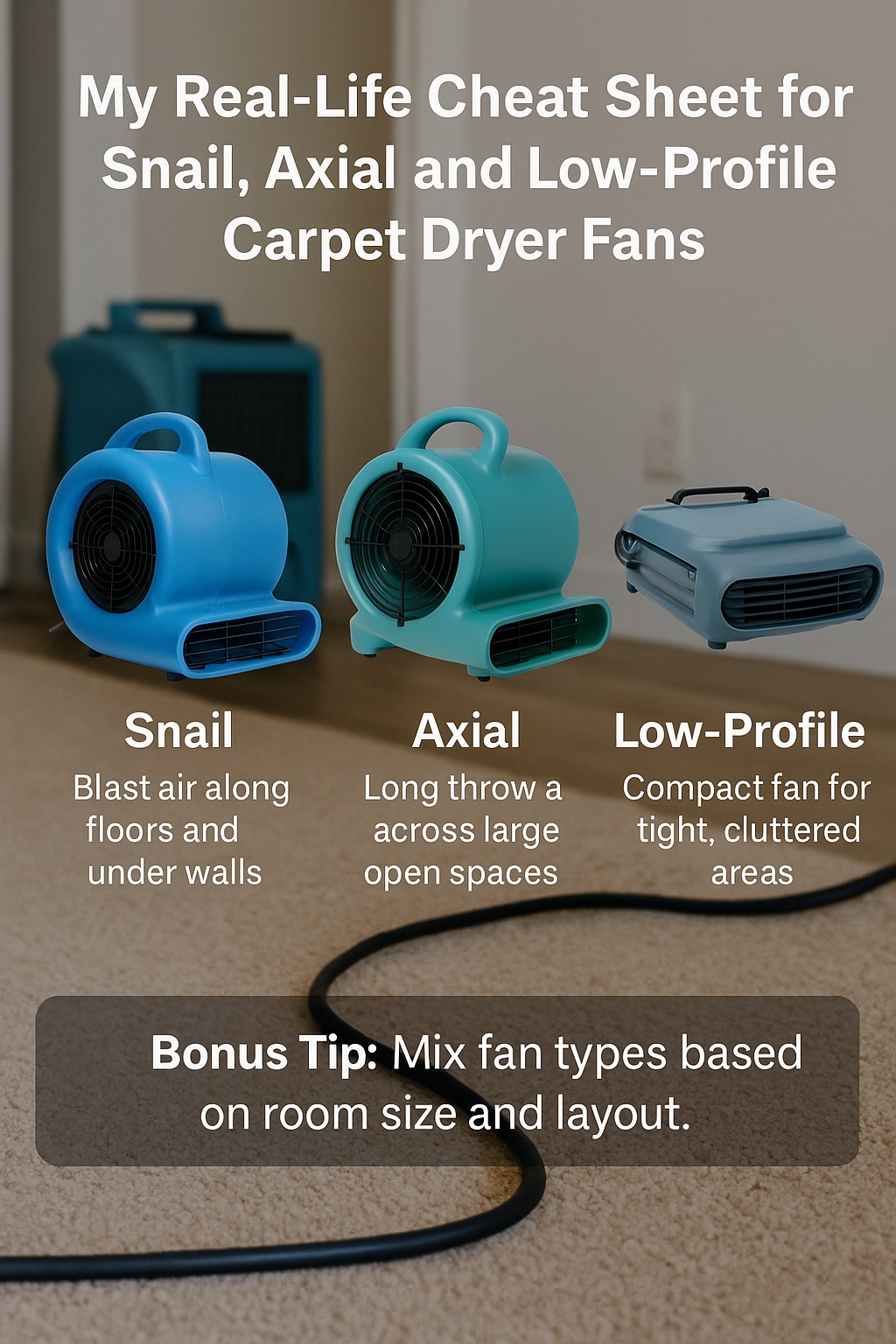
These days I give customers my simple version: snail fans for blasting along the floor, axial fans for long-distance airflow across big rooms, and low-profile fans for tight, cluttered spaces. When I break it down like that, customers can literally point and tell me where they want air to move.
I also tell them I’m not guessing. I’ve learned from my own mistakes plus what restoration trainers and course notes suggest about airflow, air changes and mould prevention. My job is to translate all that into plain language so they feel calm instead of overwhelmed.
Dr. Karen Lee, Chartered Psychologist (CPsychol), says clear explanations reduce stress because they turn a scary situation into a series of understandable steps.
🧪 How I Decide When a Carpet Dryer Fan Is Really Needed
My 3-question wet carpet checklist
Before I unpack a single fan, I run through my three quick questions: how wet is it, how deep is it, and how long has it been wet. If the water has reached the underlay or has been sitting more than a few hours, I treat it as a “fan plus dehumidifier” job.
I use my hand, my eyes and a moisture meter together. If the carpet feels cold and squishy, or the meter spikes near the skirting boards, I know there’s water hiding underneath. In those situations, relying only on open windows is like trying to dry a towel in a steamy bathroom.
When a normal fan is enough – and when it really isn’t
Sometimes I walk into a tiny synthetic-fibre bedroom where a cup of water spilled and was cleaned up straight away. On a warm, dry day with good airflow, I might just leave the door open and skip the big fans. But that’s the exception, not the rule.
If there’s a washing machine flood, a burst pipe or professional deep steam cleaning in winter, I bring in proper carpet dryers every time. I’d rather “over-dry” a bit than leave hidden moisture to become smelly underlay or mouldy skirting boards a few weeks later.
Engineer Mark Patel, CPEng, often tells his students that ignoring hidden moisture is like ignoring hairline cracks in a bridge—problems grow quietly until they become expensive.
🐌 My Snail (Centrifugal) Fans – The Workhorses on Soaked Carpets
Why snail fans are my default for soaked carpets
My snail fans look like bright plastic shells lying on the floor. The air comes out in a strong, low jet that hugs the carpet and skims along the surface. When a lounge is soaked wall-to-wall, these are usually the first fans I roll off the van.
On one job, a hot-water cylinder split and flooded two bedrooms and a hallway. I pulled back the carpet at the edges, pointed snail fans down the walls, and let the air blast under the carpet like a tiny wind tunnel. The underlay dried properly instead of turning into a sponge.
How I line up snail fans along walls and hallways
In long hallways I line snail fans up like a relay team, each one picking up where the last one drops off. I aim them at a slight angle along the wall so the air washes across the whole path instead of just one strip in the middle.
If the skirting boards are wet, I angle the air slightly upward so it scrubs along the timber as well. It looks very “technical” to the customer, but really it’s just experience: I want every square centimetre to feel a fast breeze, not a gentle sigh.
When I avoid snail fans and reach for something else
Snail fans are powerful, but they’re not perfect for every situation. In a tiny bedroom full of furniture, they can be bulky and easy to trip over. In those cases I often swap one snail fan for a low-profile unit near the doorway so the family can still walk through safely.
On some jobs, too many snails on one circuit can flirt with the breaker limit. I’ve learned to spread them across circuits and mix in low-amp axial fans so the power board doesn’t suddenly click off at 2 a.m.
Physiotherapist Daniel Wong, NZRP, compares focused airflow to targeted exercise: too much intensity in one spot can be great for progress, but only if you balance it with the overall load on the whole system.
🌪 My Axial Fans – Long-Throw Airflow for Big Rooms
How I set up axials in big lounges
Axial fans remind me of mini jet engines. They don’t blast the floor quite as hard as snails, but they throw air a long way. In a big open-plan lounge, I often park one axial at one end and aim it straight down the length of the room.
I’ve had lounges where one axial plus a couple of snails made the whole space feel like a gentle wind tunnel. The carpet, couches and even the coffee table legs all felt a constant breeze, which is exactly what I want when I’m trying to clear heavy, damp air.
Pairing axials with dehumidifiers so the air actually dries
Just pushing wet air around doesn’t help. So I try to position the axial so the moving air passes through the dehumidifier’s “zone”. The idea is: snail fans lift moisture out of the carpet, the axial keeps the air moving, and the dehumidifier gets first dibs on that damp air.
In one double-lounge job, I aimed the axial directly at the dehumidifier, then let the dry air spill into the next room. The result was a gentle airflow loop that dried both spaces evenly, instead of one room being Sahara-dry and the other still clammy.
When axial fans are the wrong choice on my jobs
Axials are not my go-to for tiny, chopped-up spaces. Put one in a cramped bedroom and you end up blasting half the air into the wardrobe door. If the footprint is small, I’d rather use snails or low-profile fans directed along the walls and under the bed.
They’re also louder in echoey rooms. In tiled or timber spaces, the “whoosh” can feel full-on, especially at night. I’ve learned to drop the speed or change the angle to keep the family from feeling like they’re camping next to an airplane hangar.
Acoustic consultant Sarah Green, MIOA, likes to remind people that effective airflow doesn’t have to mean maximum noise, just like good music doesn’t have to be played at full volume to fill a room.
📦 My Low-Profile Fans – Compact Helpers for Tight, Busy Spaces
Why low-profile fans live in my van full-time
Low-profile fans are the flat, stackable units that look almost too small to do much. I underestimated them at first. Then I used one in a kids’ bedroom where space was tight, and the parents still needed room to walk through without kicking a big snail fan every hour.
Since then, I always keep a stack of low-profile units on the van. They slide neatly along the wall, tuck behind a couch, and sit under desks without making the whole room feel like a construction site. They’re brilliant for homes where life has to keep going while things dry.
How I keep walkways safe but still move air
One of my favourite tricks is to aim a low-profile fan along the base of a bed or sofa, so air sneaks under and out the other side. This dries hidden dampness without turning the room into an obstacle course of legs, cords and plastic shells.
I also use them in hallways where there’s only just enough room for people to squeeze past. Instead of filling the hall with one big snail, I run one or two low-profile fans side by side and tape the cords neatly along the skirting. It looks cleaner and feels safer.
When a low-profile fan just isn’t enough
Low-profile fans are great for surface moisture and light-to-moderate wet areas. But when the underlay is saturated or the subfloor is soaked, they sometimes need backup. On those jobs, I’ll use a snail fan in the worst corner and low-profile units everywhere else to keep air moving.
I see them as the “support crew”, not always the main performer. When I match them with a dehumidifier and maybe one axial, they help tidy up all the awkward corners that bigger fans can’t reach.
Architect Laura Smith, AIA, says good design is often about the quiet helpers in corners, not the big statement pieces—and I think the same way about low-profile fans.
🧩 How I Mix Snail, Axial and Low-Profile Fans on One Job
My step-by-step fan plan on arrival
When I walk into a flooded house, I do a quick lap before plugging in anything. I note where the water travelled, which rooms connect, and where I can safely run power. Then I start matching fan types to each zone like I’m solving a puzzle.
If the lounge is open and big, I usually anchor the plan with an axial. Soaked walls or deep underlay get snails pointing along them. Tight bedrooms and busy hallways get low-profile units. I’ll reshuffle after 24 hours if moisture readings show stubborn areas.
Balancing theory, expert advice and what the room is telling me
Industry rules of thumb might say “X fans per Y square feet”, but real houses are messy. There are couches, beds, toys, pets and power limitations. So I use the rules as a starting point, then tweak based on what I see and hear from the customer.
Sometimes I add an extra fan against the “official” count because the carpet is old, thick wool and simply holds more water. Other times I remove a fan because the noise is stopping a baby from sleeping, and I’d rather move one fan twice than keep everyone exhausted.
Before I leave, I take photos and note my fan layout plus moisture readings. That way I can explain my choices to insurers, and I can also learn from my own setups over time.
Project manager Helen Cruz, PMP, says the best plans are living documents—strong enough to guide decisions, flexible enough to change when reality disagrees.
📊 My Real Customer Case Study – One Soaked Lounge, Three Fan Types
A family once called me after their washing machine hose popped off and soaked the lounge. The carpet squelched with every step. They’d put down towels and opened windows, but after a day it still felt awful. That’s when I brought in the full fan mix.
I set one axial at the doorway blowing across the lounge, two snails pushing air along the wet external wall, and one low-profile fan tucked near the hallway entrance so the kids could still walk through. A dehumidifier sat where the air looped back.
Here’s a simple snapshot of that job:
| Item | Details |
|---|---|
| Room size | Medium lounge, roughly 24 m² |
| Fan mix | 1 axial, 2 snails, 1 low-profile |
| Starting moisture | Carpet and underlay well above safe range |
| Drying time | About 48 hours of continuous running |
| End moisture | Readings back within normal, safe levels |
By day two the carpet felt dry underfoot, the underlay tested fine, and we avoided pulling anything up. The family was surprised how fast things turned around once proper equipment was running.
Statistician Dr. Amir Rahman, PhD, often reminds clients that a single case study is a story, not a universal rule—but it’s still a powerful way to make data feel real.
❓ FAQs My Customers Ask About Carpet Dryer Fans
“Do I really need carpet dryer fans, or will open windows be enough?”
Sometimes open windows are fine for tiny spills on a hot, dry day. But for floods, leaks or deep professional cleaning, relying on windows alone is risky. The underlay can stay wet even when the top feels dry, and that’s when smells and mould show up later.
“How loud are these fans and can my family still sleep?”
They do make noise, like a strong bathroom fan or small plane in the distance, depending on the speed and room. I often lower speeds at night, move fans further from bedrooms, or shift some into hallways so families get at least a half-decent sleep.
“Will these fans damage my carpet, underlay or furniture?”
Used properly, they won’t. I avoid pointing fans directly at fragile items or loose papers, and I check that carpet edges aren’t flapping wildly. The real danger is leaving things wet for too long, not the airflow itself.
“How many fans do I need in one room?”
For small rooms, one or two properly placed fans usually do the trick. Bigger lounges or multi-room floods can need three or more. I decide based on how far the water has spread, how thick the carpet and underlay are, and how fast we need results.
“Do I always need a dehumidifier as well?”
Not always, but often. Fans move moisture into the air; dehumidifiers pull that moisture out of the air. On bigger or older homes, using both together usually gives faster and safer drying, especially in cooler, damp climates.
Emergency physician Dr. Olivia Chan, MBChB, points out that prevention is like early treatment—doing a bit more now often saves a lot more pain later.
✅ My Key Takeaways on Choosing Carpet Dryer Fans
When a carpet is wet, I think in simple pictures. Snail fans for blasting along soaked floors and under edges. Axial fans for throwing air across big, open spaces. Low-profile fans for tight, busy rooms where life must keep moving around the equipment.
If you remember nothing else, remember this: strong, well-directed airflow plus moisture removal beats guessing with one random fan in the corner. When in doubt, I’d rather slightly “over-dry” than leave a hidden damp patch that turns into mould, smells or a nasty repair bill later.
And if the situation feels bigger than your gear or your comfort level, please call someone who lives and breathes this stuff every day. Drying fast is almost always cheaper than replacing carpet, underlay and swollen skirting boards later on.
Coach Michael Grant, CPC, says most good decisions come from a simple checklist, not a complicated feeling—and I think that’s true for wet carpets too.
Hire professional-grade equipment from 7 Hire. We offer fast local pickup or delivery across Auckland.