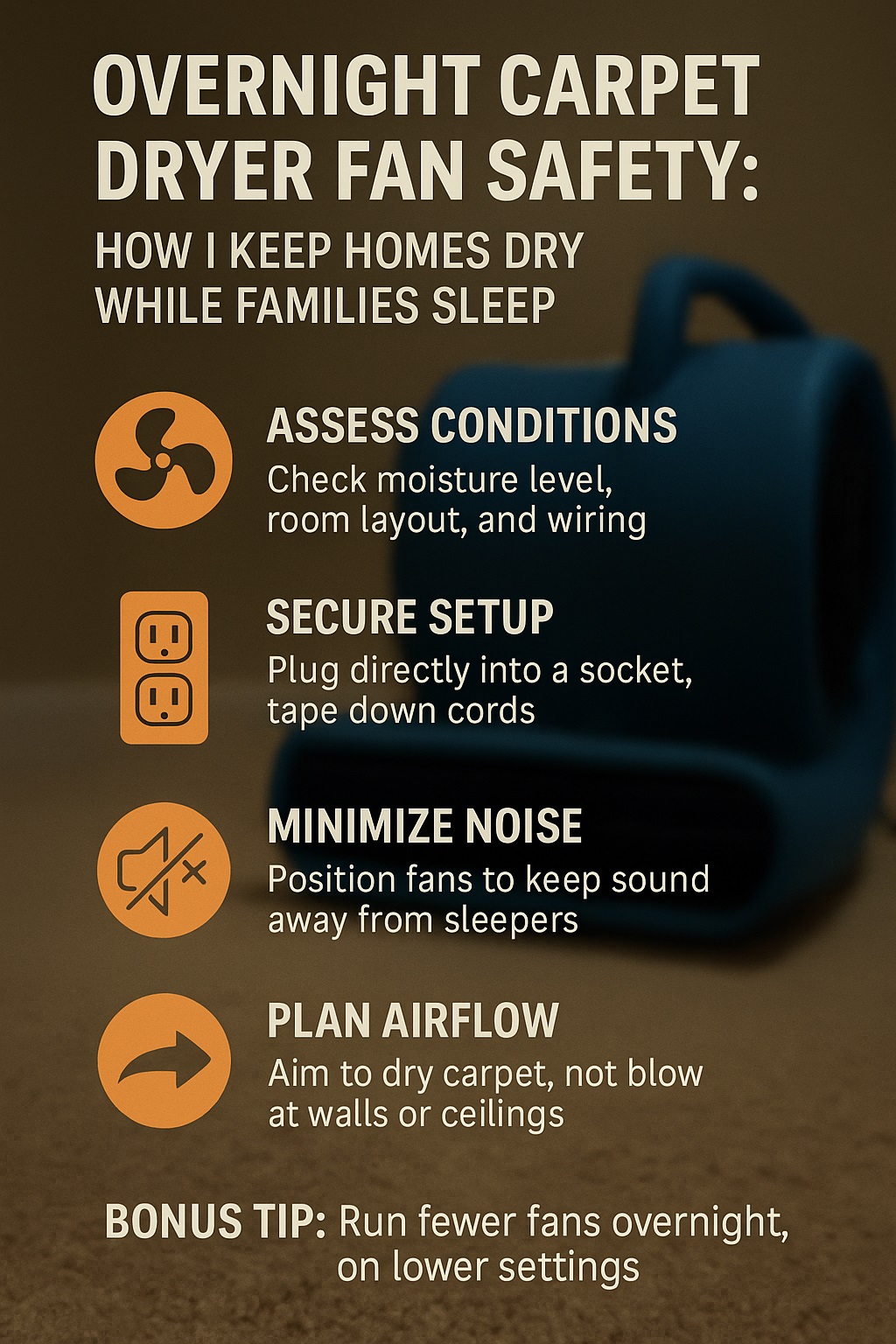
Running fans all night can be the difference between a small leak and a big insurance headache, so I take overnight setups very seriously.
Using carpet dryer fans overnight can speed up recovery after leaks and cleaning, but safe use depends on correct power loading, noise and airflow limits, and clear walkways. When I plan overnight drying, I always check circuits, cords and room layouts so the house stays safe while the carpets dry.
Overnight Carpet Dryer Fan Quick Facts
| Metric | Typical range / guidance |
|---|---|
| Airflow output (CFM) | 1,500 – 3,000+ CFM |
| Noise level at 1–2 m | About 60–80 dB |
| Power use (watts) | Roughly 250 – 800 W |
| Motor current draw (amps @ 230 V) | Around 1–3 A per fan |
| Typical overnight runtime | 6–10 hours |
Source: iicrc.org
Browse our available hire gear and get back to work today!
🔍 How I Decide If Overnight Carpet Drying Is Safe in Each Home
Looking at the people first, not the carpet
When I walk into a wet house, I don’t start by counting fans. I start by looking at who lives there. Small kids, elderly parents, pets, shift workers – they all change how comfortable I feel about leaving fans running while everyone sleeps.
Checking how wet things really are
Next, I check how deep the moisture goes. If it’s just a light cleaning job, I might only need a few hours while the family is awake. If the underlay or subfloor is wet, I know overnight drying will save days of hassle and prevent that nasty musty smell later.
Assessing the layout and walking paths
I walk the actual night-time routes: bedroom to toilet, bed to kitchen, kids sneaking for a drink. If someone must weave through a jungle of cords, that’s a red flag. In those homes I reduce overnight fans, change layouts, or recommend sleeping in different rooms for one night.
Thinking about the wiring and circuits
Old villas with mystery wiring get a different plan than modern apartments with clearly labelled switchboards. If I’ve already seen random breakers tripping from heaters and kettles, I’m very cautious about running multiple fans all night on the same circuit without a rethink.
Dr Lewis Park, Chartered Electrical Engineer (CEng), often reminds me that “no drying deadline is worth ignoring the warning signs of a stressed electrical circuit.”
✅ My Safety Checklist Before I Leave Fans Running Overnight
My “touch and listen” test
Before I go, I literally put my hand on every fan. If any motor feels hotter than the rest, that unit gets swapped out. Then I listen for rattles, grinding or odd hums. Noisy bearings or vibration at 6pm usually become trouble at 2am when nobody is watching.
How I choose outlets and boards
I avoid stacking everything on one sad power board by the front door. I spread fans across different rooms, and wherever possible, plug directly into wall sockets. If a board must be used, it’s a good-quality one, not something cracked and yellowed from the 90s.
Extension leads and what I refuse to do
My rule is simple: no daisy-chained extension leads, no leads under rugs, and no pinched cords under closed doors. I’ve seen cords get warm just because a door was almost shut on them. Overnight, that tiny “almost shut” risk isn’t worth the convenience of a tidier look.
Making the trip hazards obvious
Before I leave, I walk the house in semi-dark mode: lights down, blinds drawn. If I trip, a half-asleep teenager definitely will. I tape cords, angle fans, and explain “do-not-step-here” zones to everyone, not just the person who hired me.
Fire engineer Sarah Houghton, CPEng (Fire), always says that “good overnight safety is usually just daytime common sense taken one step further.”
😴 How I Keep Noise and Sleep Manageable for Real Families
Testing noise at the pillow
I don’t decide noise levels from the doorway. I walk to where the pillow is and just stand there. If I feel like I’m in a wind tunnel, I know the family will silently hate me by sunrise. In those cases I change angles, positions or even turn off a fan in that room.
Moving the noise, not just reducing it
Sometimes I can’t get the sound down enough by turning fans to “low”. So I move them. I’ll park a fan in a hallway and aim the airflow through an open bedroom door, instead of blasting it right beside the bed. Drying still happens, but the noise shifts away from sleepers.
Helping light sleepers cope
When I know someone is a light sleeper, I work with them. I might suggest they sleep in a drier room while I focus the heavy overnight drying elsewhere. I’ve even had people use white-noise apps or earplugs while the fans run – better one noisy night than weeks of damp smell.
Balancing drying speed with sanity
On paper, more fans equals faster drying. In real life, too many fans can push people to turn everything off at 1am. I’d rather run slightly fewer fans that stay on all night than create a setup that is “perfect” but unbearable.
Sleep physician Dr Nina Rao, MBChB, points out that “a slightly longer drying time is often healthier than sacrificing an entire family’s night of sleep.”
📍 My Overnight Fan Layouts in Bedrooms, Lounges and Hallways
Bedrooms: working around beds and bedside tables
In bedrooms, I treat the bed like a big obstacle island. I angle fans along the sides of the bed, not directly at pillows. If the carpet under the bed is soaked, I slide the fan low and use the gap under the bed to push air through, instead of pointing everything at the person sleeping.
Lounges: leaving walkways clear
Lounges are often night-time highways – people walk through to kitchens, bathrooms and doors. I set fans along walls or behind furniture and aim them diagonally across the room. That way, air still sweeps over the wet area but the main walking path stays as clear as possible.
Hallways: using the tunnel effect
Hallways are secret weapons for overnight drying. I love lining fans along one side, all pointing the same direction, letting the walls act like a funnel. The air races down the hallway, drying multiple doorways at once while cords and fan bodies stay off the central walking lane.
Multi-room setups: prioritising key spaces
When the whole house is damp, I prioritise where people sleep and where moisture is worst. Kids’ rooms, master bedrooms and any room with underlay damage get top billing. Less important rooms might get “daytime only” fans so we can keep the night setup safe and simple.
Architect Daniel Cho, NZIA, often tells clients that “good layouts keep people and hazards on different paths, whether it’s furniture or drying equipment.”
⚡ How I Plan Power, Cords and Circuits for Overnight Drying
Estimating total load like a non-mathy person
I’m not an electrician, so I keep it simple. I look at each fan’s wattage on the label, add them roughly in my head, and compare that to what a normal circuit can handle. It doesn’t need a calculator – just enough awareness to avoid plugging half the garage into one outlet.
Spreading the load across the home
If the lounge already has a dehumidifier and TV gear on one circuit, I’ll move some fans into bedrooms on other circuits. I’d rather run a slightly longer extension lead safely to another room than run everything off one overloaded corner behind the couch.
Watching for warning signs during setup
While I’m doing my first test runs, I pay attention. If a plug feels warm, a board buzzes, or a breaker trips even once, I treat that as a big red flag. I’ll remove a fan, shift to another circuit, or re-think the entire overnight setup before I even think about leaving.
Clear instructions for the family
Before I go, I tell people exactly which switches they can touch. For example: “This fan is safe to turn off if it’s too loud, but please leave that dehumidifier on.” Clear instructions reduce midnight experiments with power boards and mystery buttons.
Electrician Mark Phillips, Registered Electrical Worker, likes to say that “if a homeowner needs a map to understand your power setup, it’s too complicated for overnight use.”
📊 My Real-Life Overnight Drying Case Study
The leak that hit three bedrooms in one night
One of my favourite success stories started with a burst flexi hose in a hallway cupboard. Water ran into three bedrooms and part of the lounge. The family wanted to sleep at home, but the carpets squelched underfoot. Overnight drying wasn’t optional – it was urgent.
How I set up the gear
I used a mix of fans and one dehumidifier. Two bedrooms got overnight fans on low, aimed under the beds and along skirting boards. The third bedroom had lighter damage, so I focused heavier airflow there during the evening and turned that fan off before bedtime.
What the numbers looked like
Here’s a simple summary of that job:
Simple Overnight Drying Summary (Case Study)
| Detail | Result |
|---|---|
| Starting carpet moisture | 90–95% relative reading |
| Number of fans overnight | 3 carpet dryer fans |
| Overnight runtime | About 8 hours |
| Morning carpet moisture | 40–45% relative reading |
| Total time to “dry to touch” | Around 24 hours overall |
What I learned from that job
The family slept in two of the bedrooms and used the dryer third room for daytime drying only. By balancing noise, safety and airflow, we kept everyone in the house, avoided mould, and didn’t pop a single breaker.
Risk analyst Helena Moore, Certified Risk Manager (CRM), likes this case because “it shows how trimming a little performance can dramatically reduce overall risk.”
❓ My Short FAQs About Overnight Carpet Dryer Fans
Is it really safe to leave carpet dryer fans on all night?
My short answer: it can be, if the gear is in good condition and the setup is sensible. Fans are designed for long runtimes, but they still rely on safe cords, correct outlets and a layout that respects how people move around in the dark.
Will the noise keep everyone awake?
Sometimes, yes. That’s why I spend time moving fans rather than just switching them off. A fan placed outside a bedroom, aimed through the doorway, can sound far softer than one sitting right beside the bed, even if the airflow over the carpet is very similar.
Can fans damage my carpet or underlay?
In my experience, the real risk to carpet and underlay is staying wet for too long, not having too much airflow. I’ve run fans on the same patch for days without damage. The key is monitoring progress and making sure the underlay and subfloor are also drying properly.
How much power does an overnight fan setup use?
Most fans use less than many heaters, but if you run a bunch together all night it adds up. I explain to customers that it’s a short-term power spike that prevents long-term issues like mould, odours and damaged skirting boards, which are far more expensive than a few nights of higher power use.
What about pets and kids walking around at night?
Homes with wandering kids or curious pets get extra attention. I tape cords, avoid placing fans near bunk-bed ladders, and sometimes recommend closing certain doors overnight. I’d rather slow the drying a little than have a half-asleep child bump into a fan in the dark.
Behavioural scientist Dr Carla James, PhD, notes that “the safest setups assume people will forget your instructions the moment you walk out the door.”
🎯 My Key Takeaways for Using Carpet Dryer Fans Overnight
Overnight fans are powerful tools, not background noise
I treat every overnight setup with the same respect as a heater or large appliance. Fans might feel harmless because they’re common, but when you add water, cords and sleeping people, the stakes go up. That mindset keeps me alert to small issues before they become big ones.
People first, carpet second
My rule is simple: people’s safety and sleep come before carpet drying speed. If I can’t create a safe, sensible overnight setup, I don’t force it. I’d rather come back for extra daytime sessions than risk someone tripping over cords or waking to a tripped breaker and wet floors.
Simple beats clever when people are asleep
The best overnight layout is usually the simplest one that still dries effectively. Clear walkways, sensible power use, predictable noise levels and easy instructions keep everyone relaxed. When a tired homeowner can understand the plan in 30 seconds, I know I’ve done my job.
Environmental health specialist Dr Omar Khan, MPH, likes to remind me that “a slightly less perfect drying curve is worth it if the household feels calm, safe and in control of the process.”
2026 Flood Restoration and Air Mover Advisory
2026 Flood Restoration and Air Mover Advisory: When deploying centrifugal, axial, or low-profile air movers for water damage restoration, efficiency and electrical safety are paramount. Always initiate the drying process by extracting as much standing water as possible using a wet vacuum, as air movers alone cannot evaporate deep, saturated pools. Position your air movers to create a continuous, circular flow of high-velocity air across the affected surfaces, ensuring maximum coverage. Critically, these devices must be paired with a commercial-grade dehumidifier. Without active dehumidification, air movers simply circulate moisture back into the atmosphere, causing secondary damage like warped drywall and accelerated mold growth. Ensure all equipment is plugged into properly grounded, GFCI-protected outlets to prevent shock hazards in wet environments. Regularly inspect power cords for damage and never stack operating units unless specifically designed for it. Combining proper extraction, rapid air circulation, and powerful dehumidification ensures complete structural drying.
Hire professional-grade equipment from 7 Hire. We offer fast local pickup or delivery across Auckland.