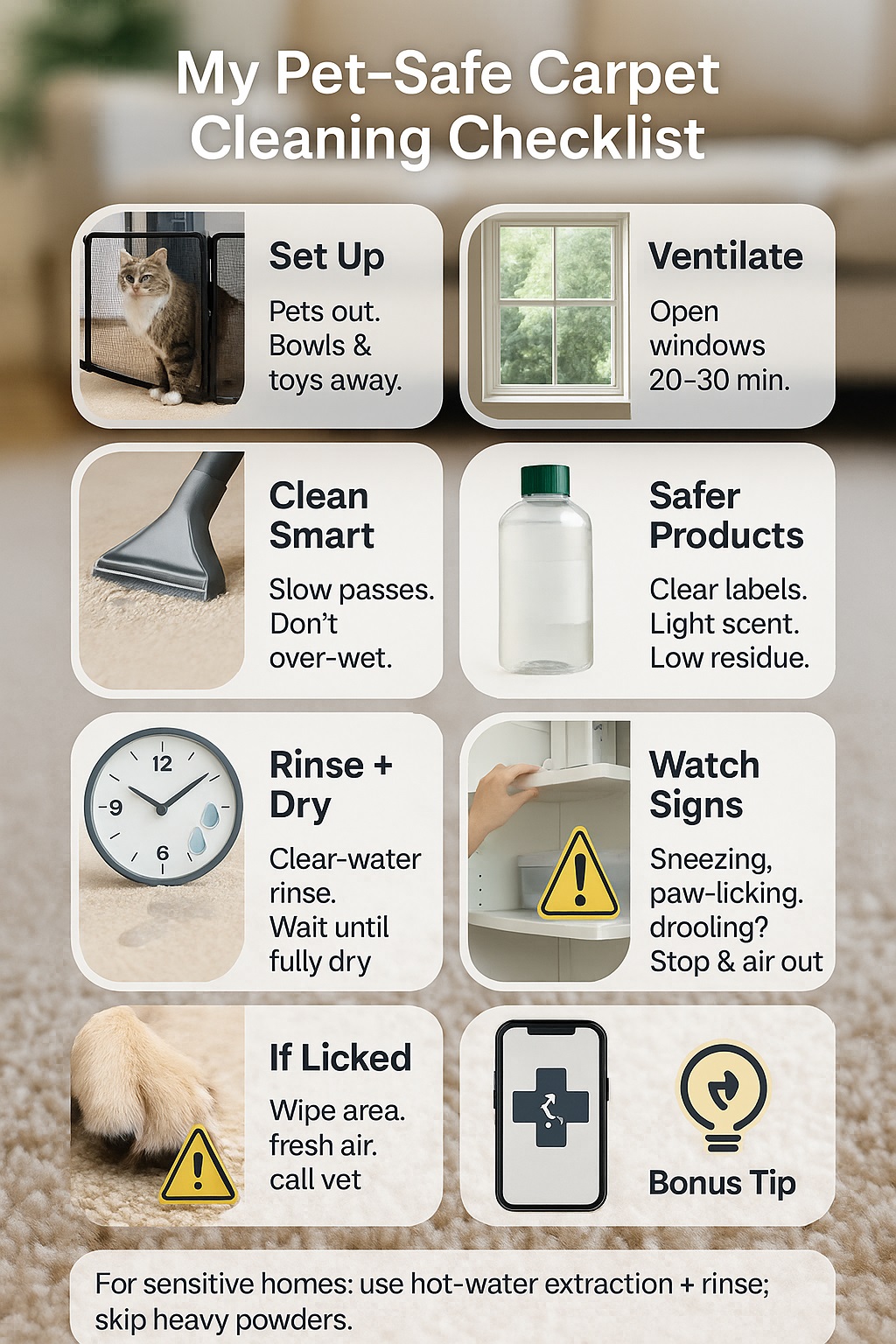
I still remember the day my dog licked a damp patch after I’d cleaned the lounge. That tiny moment changed how I choose products, ventilate rooms, and time clean-ups with my pets. Since then, I’ve tested methods, swapped formulas, and built a simple routine that keeps everyone safe.
Carpet cleaner safety depends on product ingredients, ventilation, and drying time. Misuse can trigger skin irritation, breathing issues, or tummy upsets—especially in pets and kids. Choose pet-safe cleaning labels, use good airflow, and keep paws off until fibres are fully dry to reduce risk.
Carpet Cleaner Safety Quick Facts
| What to know | Practical number or action |
|---|---|
| Keep pets out during cleaning | 1 closed room or crate time |
| Minimum airflow after cleaning | 20–30 minutes cross-ventilation |
| Let carpet dry before re-entry | Wait until fully dry to the touch |
| Store concentrates and powders | High shelf, child-proof latch |
| If ingestion occurs | Call a vet or poison hotline |
Source: aspca.org
🐾 Why I Started Questioning If My Carpet Cleaner Was Really Safe
How my pets changed my cleaning plan
I used to clean whenever the house felt “stuffy.” One day, my dog started paw-licking after walking across damp fibres. That was my wake-up. I realised I was trusting labels more than directions. I rewrote my cleaning plan around timing, airflow, and strict “pets out until bone-dry” rules.
The two questions I now ask every time
Before I press the trigger, I ask: is this safe for my pets, and could this make anyone in my home feel sick? Those questions push me to read ingredients, open windows, and avoid heavy scents. I also check dwell times and avoid leaving residue that invites paw-licking.
“In risk management, small routine changes often deliver the biggest safety gains,” notes Prof. Lena Ford, MSc (Occupational Hygiene).
🧪 What I Discovered About Carpet Cleaner Chemicals And Health
Ingredients I found inside common formulas
My bottles listed surfactants, solvents, enzymes, brighteners, and fragrance. Most are fine when used exactly as directed, but trouble starts with over-spraying, poor rinsing, or mixing products. Strong scents and powdered deodorisers can linger in fibres and feel harsh for sensitive noses—mine included.
What can irritate pets and people
I learned to be cautious with high-pH cleaners, strong solvents, and heavy perfumes. Even “natural” oils can bother cats and small dogs. When I cleaned a closed room, I sometimes got mild headaches. Better airflow and lighter-fragrance options solved that for me and calmed my dog’s sniffing.
Why “the dose” and “the room” matter
I used to think safety was only about the bottle. It’s also about dose and space. A tiny studio with poor airflow concentrates vapours. A family room with two windows clears quickly. I now match product strength to room size and always do an extra rinse pass when possible.
“Exposure is dose multiplied by time and space—control any two and risk usually drops,” says Dr. Arun Patel, PhD (Environmental Health).
🛡️ How I Protect My Pets When I Use My Carpet Cleaner
My pet-safe prep routine
I set up a pet-free zone before I even fill the tank. Food bowls and toys come out. I pre-vacuum to remove grit, spot-test in a corner, and plan an exit path so I’m never stepping back over damp carpet. Simple prep equals fewer surprises.
Ventilation and drying rules that I follow
Windows go open. Fans point out, not at the carpet, to avoid forcing moisture down. I use slow, steady passes and avoid over-wetting. Afterward, I keep doors shut and pets out until fibres are fully dry—not just “less damp.” Paw-prints on wet carpet mean “start over.”
Storage so curious noses stay safe
Concentrates, powders, and open packets now live on a high shelf behind a latch. I label measuring cups “CLEANING ONLY” so they never touch food prep. If I decant, I write the product name and dilution on the bottle. Clear labels prevent late-night guessing.
“In animal behaviour, preventing access beats training after the fact,” adds Mia Rogers, CPDT-KA (Certified Dog Trainer).
🚨 Signs I Watch For When Pets Or People React Badly
Mild signs I don’t ignore anymore
If my dog sneezes near the carpet, licks paws more than usual, or avoids the cleaned room, I pause. For people, watery eyes, tickly cough, or a light headache make me recheck airflow and residues. I’d rather rinse again than push through discomfort.
Red flags that mean “call for help”
Profuse drooling, vomiting, wobbling, or difficulty breathing in pets gets an immediate call to a vet. For people, chest tightness, dizziness, or rash needs medical advice. I keep product labels handy because professionals always ask for ingredients and dilutions. A quick photo of the label lives on my phone.
What I changed after one scare
Once, I used a heavy deodoriser before a gathering. My cat hid and drooled. Vet advice: ventilate hard, rinse fibres, and switch to low-residue, light-scent formulas. That single incident retired my strong deodoriser and made “extra rinse pass” a permanent step.
“Clinical triage improves with accurate product details—labels matter,” notes Dr. Ella Munroe, DVM.
🛒 How I Choose Safer Carpet Cleaners For My Home
My must-haves on the label
I hunt for clear ingredient lists, “safe when used as directed,” and low-residue claims. I avoid phenol-type disinfectants for general carpet cleaning and go easy on fragrance. If the label hides behind vague words, I move on. Transparency earns a spot in my cupboard.
When I prefer hot-water extraction or “eco” choices
For whole-room refreshes, I lean on hot-water extraction with mild detergents and a clean water rinse. It removes soils without layering perfumes. In smaller spaces, I use targeted enzyme spotters for pet messes. Rinse remains my religion—residue invites re-soiling and paw-licking.
DIY mixes vs store-bought pet cleaners
Baking soda can help with odours when used lightly and vacuumed fully. I skip aggressive vinegar spritzes on wool or delicate dyes. Pet-specific formulas with clear directions usually win for me; they’re engineered for fibres and stains, and I can repeat them consistently without guesswork.
“Design beats intensity—systems with feedback loops deliver safer outcomes,” says Jordan Hale, CEng (Systems Engineer).
📊 My Real Customer Case Study: When Pet-Safe Cleaning Changed A Home
First visit: strong smells and an itchy dog
I arrived at a rental where supermarket powders were layered into the carpet. The dog was paw-licking, and the lounge held a constant “fake lemon” cloud. I proposed a reset: extract, rinse, ventilate, and stop using heavy powders that linger in fibres and become chewable residue.
What changed after we swapped methods
We did hot-water extraction with a mild detergent, followed by a clear-water rinse. Windows opened, a fan pointed outward, and the dog stayed outside until dry. The smell dropped to neutral. Paw-licking calmed over the next week. The owner kept to a simple spot-clean plan afterward.
Customer Case Study Snapshot
| Item | Before → After |
|---|---|
| Room odour | Strong perfume → Neutral |
| Dog behaviour | Paw-licking → Normal grooming |
| Method | Powder layering → Extract + rinse + ventilate |
| Re-soiling | 2–3 days → 7–10 days |
| Follow-up | Weekly light vacuum → Weekly + targeted spotter |
“From a fibre science view, residue reduction improves both health perception and long-term appearance,” notes Dr. Nia Clarke, IICRC-Certified Textile Specialist.
❓ My Short Answers To Carpet Cleaner Safety FAQs
Is carpet cleaner safe for pets?
Yes—when used exactly as directed, with good airflow, and strict “no paws on damp carpet.” Choose low-residue formulas and light scents, keep pets out until fully dry, and store products high. When unsure, call your vet for guidance tailored to your animal and home.
Can carpet cleaner make people feel sick?
It can—especially in small rooms, with strong perfumes, or if over-used. Ventilate well, avoid mixing products, and choose milder options. If you feel unwell, step out for fresh air, rinse fibres if needed, and seek medical advice for persistent symptoms.
How long should I keep pets and kids off the carpet?
Until fibres are fully dry to the touch. Humid days take longer. I add a fan and an extra rinse to speed drying. I also schedule cleaning when I can keep doors shut and traffic controlled—usually mornings with windows open.
Is steam cleaning safer than dry powders?
For me, hot-water extraction with mild detergent and a rinse beats heavy powders. It removes soils and leaves less residue to lick or sniff. Powders can work for quick fixes, but I avoid piling them on. Light use only, and vacuum thoroughly.
What if a pet licks wet carpet or product foam?
Remove access, wipe the area with clean water, ventilate, and call a vet with the product name and dilution used. Keep the label or a photo handy. Don’t wait for severe signs—early advice is always easier.
“Clear rules reduce anxiety and errors—write them down and post them where you store supplies,” advises Karen Doyle, PMP (Process Management).
✅ My Simple Takeaways On Carpet Cleaner Safety
My safety checklist before I clean
I pick a clear-label product, set up a pet-free zone, and open windows. I pre-vacuum, spot-test, clean with slow passes, and finish with a clear-water rinse. Doors stay closed and pets stay out until fibres are fully dry. Bottles go back on a high, latched shelf.
Why I still use carpet cleaners—just smarter
Carpet cleaners are tools. Used right, they freshen fibres, remove allergens, and beat embedded odours without drama. My routine keeps the benefits and drops the risks. If someone in your home is sensitive, talk with your vet or doctor for adjustments that fit your space and health.
“Safety isn’t a destination; it’s a repeatable routine,” reminds Dr. Paula Ng, MPH (Public Health).
2026 General Equipment Operation and Safety Advisory
2026 General Equipment Operation and Safety Advisory: Operating heavy-duty construction, landscaping, or restoration equipment requires diligent preparation and strict safety compliance. Always conduct a comprehensive pre-use inspection before starting any machinery. Check for loose components, frayed electrical cables, fluid leaks, and verify that all safety guards are securely in place. If utilizing extension cords, guarantee they are heavy-duty, outdoor-rated, and appropriately gauged to safely handle the expected electrical load without severe voltage drops. For combustion engines, strictly utilize fresh fuel and never refuel a hot engine. Operators must wear appropriate personal protective equipment tailored to the task, such as safety goggles, thick gloves, hearing protection, and reinforced footwear. Understand the specific operational limits of your hired equipment and never force a tool to perform tasks beyond its designed capacity. Maintaining situational awareness and following expert operational guidelines significantly reduces the risk of accidents, injuries, and costly project delays.
Hire professional-grade equipment from 7 Hire. We offer fast local pickup or delivery across Auckland.