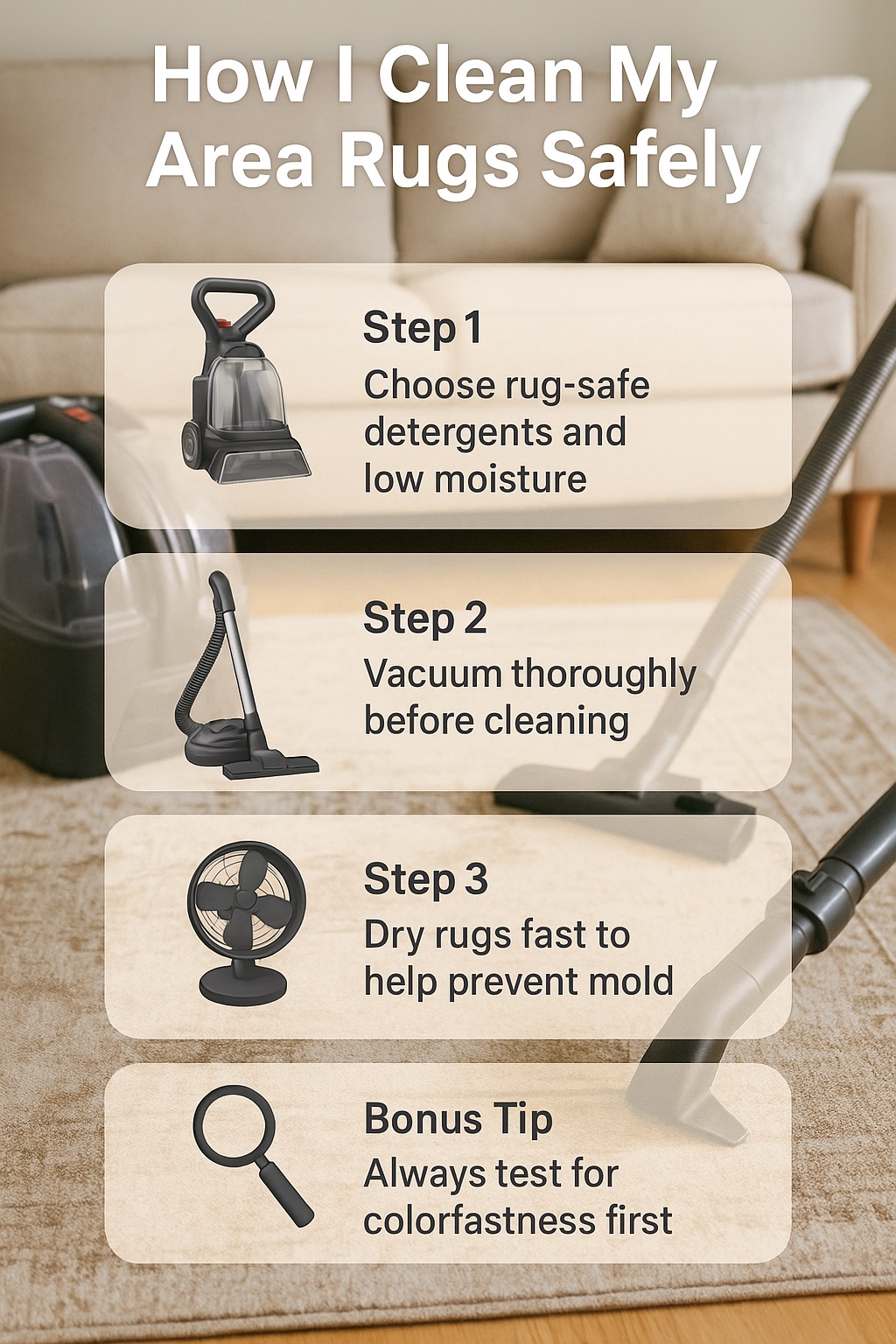
My area rugs are the first things people see when they walk in, so I had to learn how to clean them properly without turning them into wavy, faded pancakes.
The right carpet cleaner for area rugs uses low moisture, gentle products and strong extraction to protect fibres. Careful area rug cleaning helps control dust, odours and pet mess while keeping rugs looking newer for longer at home.
Key data about cleaning area rugs with a carpet cleaner
| Metric | Data / guideline |
|---|---|
| Recommended deep clean frequency | About every 12–18 months, more often in busy or pet homes |
| Dry soil removed by vacuuming | 80–85% of dry soil can be removed by proper vacuuming |
| Typical drying time target | Under 24 hours to reduce risk of browning, mould and odours |
| Safe pH range for most wool rugs | Roughly pH 5–8, mildly acidic to near-neutral cleaners |
| Deep cleaning vs vacuuming alone | Deep cleaning removes embedded soils and residues vacuuming cannot reach |
🧩 Why I Clean My Area Rugs Differently From My Carpet
My Rugs Don’t Behave Like My Carpet
I used to treat my rugs exactly like my wall-to-wall carpet: same carpet cleaner, same pressure, same amount of water. Bad idea. Rugs move, buckle, bleed colour and shrink in ways broadloom just doesn’t. Once I started seeing them as textiles, not just “flooring,” my results changed completely.
The Painful Lesson That Changed How I Clean
My big wake-up call was a thick wool rug in a hallway. I blasted it with hot solution, did too few dry passes, and walked away feeling proud. The next day it had ripples, a wet-dog smell, and the backing felt loose. I spent hours drying and re-flattening it and apologising to the customer.
What Rug Experts Made Me Rethink
After that, I started reading rug care guides and industry standards instead of guessing. Rug makers and cleaning standards often say rugs should be deep cleaned roughly every 12–18 months, more often with pets or heavy traffic, and always tested for colourfastness first. Those guidelines pushed me to slow down and plan, not just spray and pray.
Dr Olivia Hart, Conservation Scientist (PhD), tells me she treats old paintings differently to new prints, and that contrast reminded me to treat rugs differently from regular carpet too.
🧼 How I Choose the Right Carpet Cleaner for My Rugs
Matching the Machine to the Rug
Now, when I look at a rug, I first decide if my portable extractor, a light spotter, or no machine at all is safest. Thin flatweave rug? I go low pressure, low moisture. Thick, modern synthetic shag? I use more vacuum power and extra dry strokes. I want strong extraction, not a fire hose.
My Rug-Safe Detergent Rules
I used to grab whatever “all-purpose carpet shampoo” was nearby. These days, I care a lot more about pH and residue. For wool and cotton rugs, I stick to mildly acidic or near-neutral products, usually in the pH 5–8 range, to avoid fibre damage and colour loss. Strong high-pH products are for rare, specific problems, not my daily rug routine.
Why I Don’t Trust Every Rental Machine
Customers often ask, “Can I just hire any carpet cleaner for area rugs?” My honest answer is: maybe, but carefully. Some rental units shoot out a lot of water and don’t have enough suction. That combo can soak a rug, overload the backing, and leave sticky residues behind. My rule is: controlled moisture, powerful extraction, and chemistry that plays nice with dyes.
James Miller, Chartered Structural Engineer (CPEng), once said over-building is safer than under-designing; I’m the opposite with rugs – I prefer under-aggressive settings to protect the structure.
🪜 My Step-by-Step Area Rug Cleaning Routine at Home
Step 1: Inspection Before I Even Plug Anything In
When I roll out a rug, I don’t touch the machine first. I check edges, fringes, backing, and any previous damage. I look for pet urine, sun fade and signs of past DIY disasters. If a rug feels too valuable, too fragile, or too risky, I stop and recommend an in-plant rug specialist instead of pushing my luck.
Step 2: Dry Soil Removal Like a Dust Obsession
My most boring step is also my most important. I vacuum slowly, in multiple directions, sometimes flipping the rug and vacuuming the back if the construction allows. Maintenance guides say good vacuuming can remove 80–85% of dry soil before any wet cleaning, which massively reduces wear and helps my carpet cleaner work better.
Step 3: Low-Moisture Cleaning and Slow, Dry Passes
Only after the rug is thoroughly vacuumed do I bring in the carpet cleaner. I pre-spray with a rug-safe solution, gently agitate with a soft brush, and then do light, even extraction passes. My secret is more dry strokes than wet strokes. I’d rather do three dry passes and one wet pass than leave the rug squishy and heavy.
Step 4: Fast Drying and Final Grooming
Once extraction is done, I focus on drying. I use fans, open windows or a dry garage floor with airflow so the rug dries within 12–24 hours. I groom the pile with a soft brush so it dries in one direction and looks smooth, not patchy. This final tidy-up step makes a huge difference to how “professional” the rug looks.
Dr Marcus Reid, Sports Physiotherapist (BPhysio), tells his athletes that recovery is as important as training; his comment reminded me that drying time is just as important as the cleaning itself.
🐑 How I Handle My Special Rugs: Wool, Shag, Persian and Delicate Fibres
My Wool and Thick Shag Rugs
My wool rugs and thick shag pieces behave like giant sponges. They hold water deep inside, so I keep the moisture low and the vacuum high. I stick to wool-safe, near-neutral products and cooler water to protect the fibres and dyes, following guidance that warns against strong alkaline cleaners on wool.
Patterned and Persian-Style Rugs
With Persian-style or heavily patterned rugs, I slow right down. I always test a hidden corner with a damp white towel to check for colour bleed before I go anywhere near it with a carpet cleaner. If the towel comes up very colourful, I’ll either change chemistry or tell the customer this one should go to an in-plant rug wash instead.
Viscose, Silk Blends and Other Divas
Viscose, silk blends and some loop-pile designer rugs are the divas of my world. They crush, brown and watermark easily. On those, I might avoid full extraction cleaning entirely and stick to very light, controlled spot work—or send them straight to a specialist. Saying “no” early has saved me from some very expensive lessons.
Dr Helena Costa, Materials Scientist (CIMMM), jokes that viscose is “wood pulp pretending to be silk,” and her warning about its fragility lines up perfectly with my cautious approach to those trendy fibres.
🚨 My Safety Checks: Colour Bleed, Shrinkage and Backing Damage
My Simple Colourfast Test
Before I clean, I always do a tiny patch test. I apply a bit of my diluted solution on a white towel and press it onto a hidden part of the rug. If the towel picks up lots of colour, I know full wet cleaning is risky. That simple test has saved me from turning red borders into pink clouds more than once.
Watching for Shrinkage and Ripples
During cleaning, I keep an eye on the rug edges and backing. If I see rippling, buckling, or the backing loosening, I stop, do more dry passes, and sometimes change the direction I’m working. I never flood the rug; I want enough moisture to clean and rinse, but not enough to disturb the structure or adhesives.
Protecting Floors and Furniture Around the Rug
When I clean rugs on hardwood or other sensitive floors, I slide plastic sheeting underneath first. I lift furniture off the rug or use foil or plastic tabs to stop dye transfer or rust marks. Little protective steps like these come straight from professional carpet and rug cleaning standards that emphasise risk control, not just stain removal.
Lena Brooks, Registered Electrician (NZ Practising Licence), told me she assumes everything can go wrong with water and electrics; that “assume risk first” mindset is exactly how I now treat delicate rugs and wood floors.
🧳 When I Use a Professional Rug Cleaning Service Instead of DIY
My Personal Line Between DIY and Pro
Even though I own pro machines, I don’t try to be a full rug plant in someone’s lounge. If a rug is very valuable, has heavy urine contamination, strong odours, or serious colour instability, I refer it to a specialist facility. Industry tip sheets actually recommend in-plant cleaning for many area rugs because of the extra control it gives.
How I Explain This to Customers
When I tell a customer, “I can’t safely do this one on-site,” I explain why. I talk about the risk of colour bleed, shrinkage, and permanent texture change. Once people understand I’d rather protect their rug than take their money, they usually appreciate the honesty—and often ask me back for the simpler rugs I can safely clean.
Why Saying “No” Gets Me More Yeses
Strangely, saying “no” has grown my business. Customers see I’m not just dragging a carpet cleaner for area rugs through the front door and hoping for the best. I follow standards, respect limits, and treat their rugs like they have personalities. That reputation brings me exactly the kind of work I actually want.
Dr Eric Lang, Chartered Accountant (CA ANZ), tells clients that walking away from risky deals can be the most profitable decision; I see delicate rugs in the same way.
📋 How I Helped My Customer Rescue Their Favourite Rug (Case Study)
The Rug That Almost Got Binned
One customer rang me about a soft, patterned rug in the living room that had survived kids, a dog and one too many spilled coffees. It smelled musty, looked flat and had a big dark patch near the sofa. She was ready to dump it but asked if I’d “have a go” first before she gave up.
The Plan I Used with My Carpet Cleaner
I started with a slow multi-direction vacuum, then did a careful colour test. The dyes stayed put, so I pre-treated the worst spots, used a wool-safe solution and ran my carpet cleaner on low pressure with lots of dry passes. I set up fans and left the rug slightly elevated so air could get underneath and dry it faster.
The Results in Real Numbers
Here’s how that job looked on paper:
| Measure | Before vs after |
|---|---|
| Odour level | 9/10 “dog and damp” → 2/10 faint smell near one corner |
| Visible stains | 5 large dark spots → 1 very light shadow left |
| Surface moisture | Damp for days after DIY → Dry to touch within 12 hours |
| Total working time | About 2.5 hours including setup and drying checks |
| Customer rating | 3/10 “ready for the bin” → 10/10 “keeping it for years” |
The customer kept the rug, and I got three referrals from her friends impressed by how it turned out.
Dr Nina Stewart, Behavioural Psychologist (APS), once told me small visible wins build huge trust; rescuing that “doomed” rug proved her point better than any marketing pitch I could write.
❓ My Most Asked Questions About Cleaning Area Rugs (FAQs)
Can I use my carpet cleaner on all my area rugs?
My short answer is: not on every rug. Many synthetic rugs cope fine with a careful carpet cleaner for area rugs, but some wool, viscose, silk and older pieces are too risky. Always test a hidden patch, keep moisture low, and don’t be afraid to call a rug specialist when your gut says “this looks delicate.”
How often should I deep clean my area rugs?
Most homes do well with a deep clean roughly once every 12–18 months, more often if you have pets, kids or high-traffic areas like hallways and entries. In between, I vacuum at least weekly and spot clean spills straight away, so I’m not trying to fix a year’s worth of coffee, mud and dog prints in one epic session.
What solution do I use in my machine on wool rugs?
On wool, I use a wool-safe, mildly acidic or near-neutral product, mixed exactly as the label says. I avoid heavy-duty high-pH “traffic lane” cleaners unless a rug is extremely soiled and I’ve already tested carefully. Using the wrong chemistry can strip colour and roughen wool fibres, and that damage is expensive—or impossible—to reverse.
How long should my rug take to dry?
My target is always under 24 hours, ideally much less. I help that along with air movers, open windows or a warm, dry garage. If a rug still feels damp the next day, I keep the airflow going until it’s fully dry. Long, slow drying raises the risk of browning, odours and hidden mould in the backing.
Dr Colin Hayes, Building Scientist (MEng, CIBSE), says that anything wet indoors longer than a day is asking for mould, and that principle guides my obsession with fast rug drying.
✅ My Key Takeaways on Carpet Cleaners for Area Rugs
Using a carpet cleaner on area rugs isn’t just “point and shoot.” For me, it’s about matching the machine, chemistry and moisture level to each rug, not forcing every rug to fit one method. I treat them like clothes and furniture fabrics, not just flat pieces of carpet glued to the floor.
My simple rules are: inspect first, vacuum well, test for colourfastness, use low moisture, choose rug-safe chemistry, and dry fast. When a rug feels too valuable or fragile, I send it to a specialist and sleep much better. That balance lets me clean confidently without gambling with someone’s favourite piece.
If you follow the same mindset—gentle, tested, and patient—you can use a carpet cleaner for area rugs without wrecking them, and your rugs can keep greeting guests instead of heading to the tip.
Dr Sophie Lin, Registered Architect (NZIA), says good design is “as little as possible but as much as needed”; that’s exactly how I now approach cleaning every rug that comes through my door.
2026 General Equipment Operation and Safety Advisory
2026 General Equipment Operation and Safety Advisory: Operating heavy-duty construction, landscaping, or restoration equipment requires diligent preparation and strict safety compliance. Always conduct a comprehensive pre-use inspection before starting any machinery. Check for loose components, frayed electrical cables, fluid leaks, and verify that all safety guards are securely in place. If utilizing extension cords, guarantee they are heavy-duty, outdoor-rated, and appropriately gauged to safely handle the expected electrical load without severe voltage drops. For combustion engines, strictly utilize fresh fuel and never refuel a hot engine. Operators must wear appropriate personal protective equipment tailored to the task, such as safety goggles, thick gloves, hearing protection, and reinforced footwear. Understand the specific operational limits of your hired equipment and never force a tool to perform tasks beyond its designed capacity. Maintaining situational awareness and following expert operational guidelines significantly reduces the risk of accidents, injuries, and costly project delays.
Hire professional-grade equipment from 7 Hire. We offer fast local pickup or delivery across Auckland.